Effect of concentrated impulse loading (impact) on massive, glulam, and cross-laminated timber beams
DOI:
https://doi.org/10.15587/1729-4061.2026.353019Keywords:
timber beams, natural vibrations, damping decrement, impact, dynamic loadingAbstract
In this study, massive, glulam, and cross-laminated timber beams of rectangular cross-section were examined under a concentrated impulse loading (impact).
The task addressed was to determine and compare the deformation and dynamic characteristics of beams made of different types of timber under short-term impact.
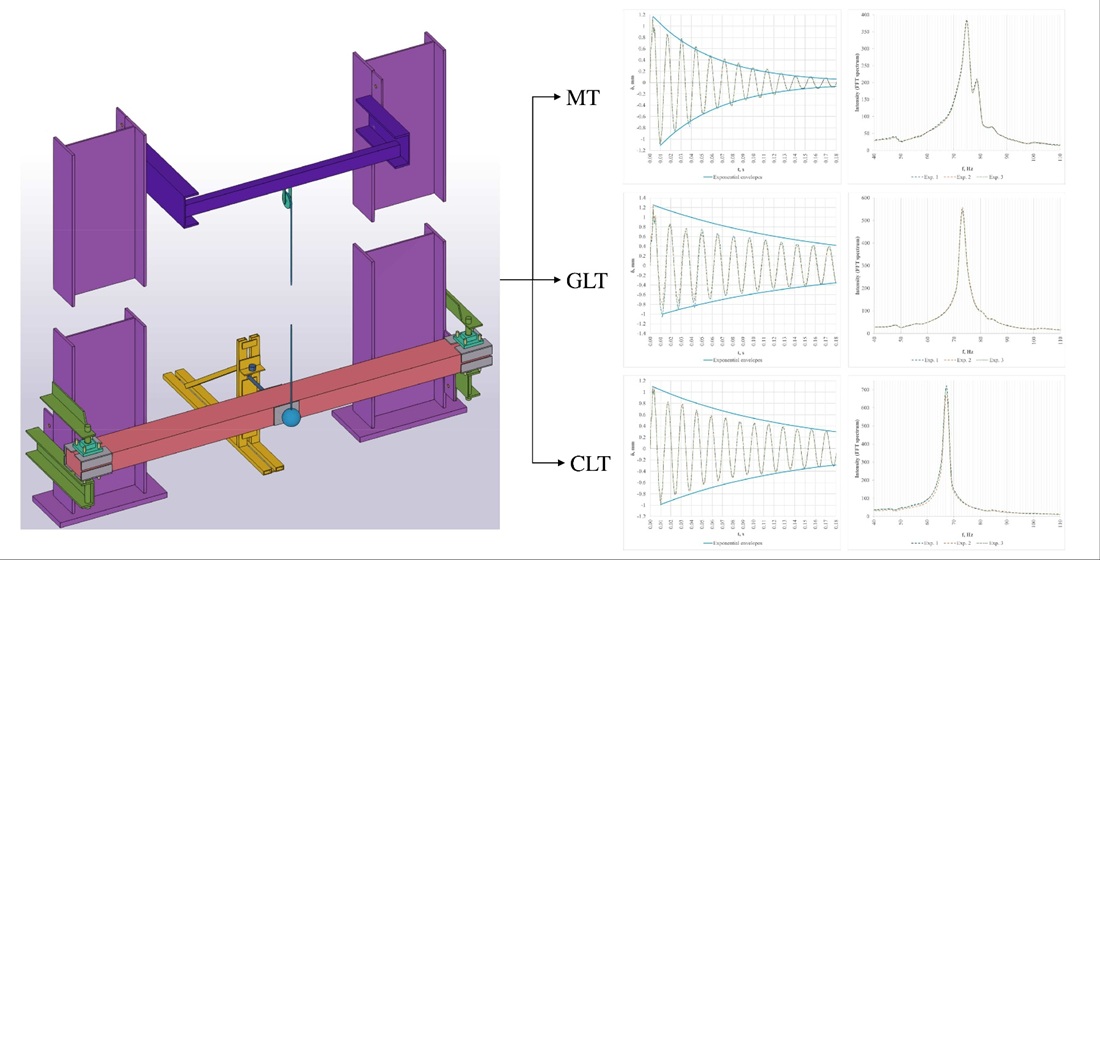
During experimental studies, dependences of displacements over time were established; oscillation oscillograms were constructed; spectral analysis was performed, and the frequencies of free oscillations (fMT,exp = 75 Hz, fGLT,exp = 73 Hz, fCLT,exp = 67 Hz) and logarithmic damping decrements (βMT,mean = 0.222, βGLT,mean = 0.100, βCLT,mean = 0.092) were determined for each type of beam. It was found that a cross-laminated timber beam is characterized by the lowest deformation resistance and the lowest oscillation damping rate. Glue-laminated timber (glulam), in comparison with solid timber, demonstrates a smaller maximum displacement and a lower oscillation damping rate.
The results are attributed to the peculiarities of internal structure of the materials, the orientation of the fibers, the presence of adhesive layers, and the nature of the interlayer interaction, which significantly affect the stiffness, damping properties, and distribution of impact energy.
A distinctive feature of the findings is the experimentally confirmed comparison of the dynamic response of beams made of different wooden based materials under the same loading conditions, which made it possible to reasonably assess their effectiveness under the action of impulse influences and solve the research problem.
This study's results could be used in the design of timber load-bearing elements of buildings and structures subjected to dynamic or impact loads, as well as to refine calculation models, determine dynamic coefficients, and assess the effectiveness of using solid, glued, and cross-glued wood
References
- Mykhailovskyi, D., Komar, O., Komar, M. (2022). Engineering method of calculating laminated timber elements reinforced with composite tapes. Strength of Materials and Theory of Structures, 109, 239–262. https://doi.org/10.32347/2410-2547.2022.109.239-262
- Komar, M., Mykhailovskyi, D. (2024). Definition of the stress-strain state of a glued laminated timber beam reinforced with composite strips using experimental method. Strength of Materials and Theory of Structures, 112, 43–51. https://doi.org/10.32347/2410-2547.2024.112.43-51
- Polishchuk, M. V. (2023). Napruzheno-deformovanyi stan zghynalnykh elementiv z kleienoi derevyny z kombinovanym armuvanniam. Rivne, 168. Available at: http://ep3.nuwm.edu.ua/id/eprint/25048
- Gomon, S. S., Gomon, P. S., Homon, S. S., Puhaсh, Y. V. (2024). Concerning the need to use the deformation model in the calculation of wooden structures. Resource-saving materials, structures, buildings and structures, 46, 185–191. https://doi.org/10.31713/budres.v0i46.21
- Mykhaylovskyi, D., Komar, M. (2022). Analysis of the stress-strain state of laminated timber beams reinforced with composite tapes. Academic Journal Industrial Machine Building Civil Engineering, 2 (57), 90–97. https://doi.org/10.26906/znp.2021.57.2590
- Mykhaylovsky, D., Komar, M. (2020). Engineering method of calculation of elements made of glued timber reinforced with composite reinforcement. Building Constructions. Theory and Practice, 7, 93–100. https://doi.org/10.32347/2522-4182.7.2020.93-100
- Mykhailovskyi, D. (2021). Method of calculation of panel buildings from cross-laminated timber. Strength of Materials and Theory of Structures, 107, 75–88. https://doi.org/10.32347/2410-2547.2021.107.75-88
- Mykhailovskyi, D. (2023). Modeling and calculation of panel buildings made of cross-laminated timber. Strength of Materials and Theory of Structures, 110, 164–177. https://doi.org/10.32347/2410-2547.2023.110.164-177
- Karagöz İşleyen, Ü., Ghoroubi, R., Mercimek, Ö., Anıl, Ö., Tuğrul Erdem, R. (2023). Investigation of impact behavior of glulam beam strengthened with CFRP. Structures, 51, 196–214. https://doi.org/10.1016/j.istruc.2023.03.038
- Böhm, N., Vogelsberg, A., Kühn, B. (2024). Bending and Vibration Behaviour of CLT-Steel Composite Beams. Journal of Sustainable Architecture and Civil Engineering, 34 (1), 75–88. https://doi.org/10.5755/j01.sace.34.1.35467
- Kara Alaşalvar, M. A. (2025). Effects of Loading Type and Loading Rate on Glulam Sipo Timber Beams for Flexural Loading. Black Sea Journal of Engineering and Science, 8 (1), 1–10. https://doi.org/10.34248/bsengineering.1557319
- Chapman, J., Reynolds, T., Harris, R. (2012). A 30 level cross laminated timber building system and analysis of the eurocode dynamic wind loads. 12th World Conference on Timber Engineering. Available at: https://www.google.com/url?sa=t&source=web&rct=j&opi=89978449&url=https://reynoldstom.wordpress.com/wp-content/uploads/2013/08/30-level-clt-building.pdf&ved=2ahUKEwjlju_xw7CSAxWfORAIHdUZIRYQFnoECBsQAQ&usg=AOvVaw3BLn3vQUmkQi7-GlcfVTOB
- Nuzhnyj, V., Bilyk, S. (2024). Revealing the influence of wind vortex shedding on the stressed-strained state of steel tower structures with solid cross-section. Eastern-European Journal of Enterprise Technologies, 3 (1 (129)), 69–79. https://doi.org/10.15587/1729-4061.2024.306181
- Ternoviy, M., Bilyk, A. (2025). Selection of the rational height of the steel roof trusses taking into account the effect of the impulse load. Strength of Materials and Theory of Structures, 114, 231–240. https://doi.org/10.32347/2410-2547.2025.114.231-240
- DSTU-N B EN 1991-1-4:2010 Yevrokod 1. Diyi na konstruktsiyi. Chastyna 1-4. Zahalni diyi. Vitrovi navantazhennia (EN 1991-1-4:2005, IDT). Available at: https://online.budstandart.com/ua/catalog/doc-page.html?id_doc=26648
- Bitiukov, D., Bilyk, S. (2025). Determination and analysis of physical and mechanical properties of solid, glued laminated and cross-laminated timber beams. Spatial Development, 11, 265–281. Available at: https://spd.knuba.edu.ua/article/view/348696
- Bilyk, S., Bitiukov, D. (2025). Comparison of experimentally obtained and theoretically determined in the Dlubal RFEM 5 software physical and mechanical properties of massive, glued laminated and cross-laminated timber beams. Strength of Materials and Theory of Structures, 114, 101–110. https://doi.org/10.32347/2410-2547.2025.114.101-110
- Bitiukov, D. (2025). Comparison of theoretical calculated deflections according to the Euler-Bernoulli and Еymoshenko beam models with experimentally obtained. Building Constructions. Theory and Practice, 16, 100–109. https://doi.org/10.32347/2522-4182.16.2025.100-109
- Tolasa, D. G. (2025). Theoretical Analysis of a Simple Pendulum Experiment. International Journal of Current Research in Science, Engineering & Technology, 8 (1), 214–218. https://doi.org/10.30967/ijcrset/diriba-gonfa-tolasa/168
- Artomov, V. (2025). Yak vyznachyty chastotu i period vlasnykh kolyvan balky. Dystlab. Available at: https://dystlab.store/uk/blog/engineering/203-20230403
- Timoshenko, S. (1937). Vibration Problems in Engineering. New York: D. Van Nostrand Company, Inc. Available at: https://archive.org/details/vibrationproblem031611mbp/page/n3/mode/2up
- Ozymok, Y., Pavlyuk, R., Kapral, Y. (2022). Calculation of optimal parameters of the foundation for woodworking machines with large dynamic loads. Strength of Materials and Theory of Structures, 109, 473–484. https://doi.org/10.32347/2410-2547.2022.109.473-484
- Biselli, A., Coleman, M. P. (2020). The Exact Frequency Equations for the Euler-Bernoulli Beam Subject to Boundary Damping. The International Journal of Acoustics and Vibration, 25 (2), 183–189. https://doi.org/10.20855/ijav.2020.25.21574
Downloads
Published
How to Cite
Issue
Section
License
Copyright (c) 2026 Dmytro Bitiukov, Serhiy Bilyk

This work is licensed under a Creative Commons Attribution 4.0 International License.
The consolidation and conditions for the transfer of copyright (identification of authorship) is carried out in the License Agreement. In particular, the authors reserve the right to the authorship of their manuscript and transfer the first publication of this work to the journal under the terms of the Creative Commons CC BY license. At the same time, they have the right to conclude on their own additional agreements concerning the non-exclusive distribution of the work in the form in which it was published by this journal, but provided that the link to the first publication of the article in this journal is preserved.
A license agreement is a document in which the author warrants that he/she owns all copyright for the work (manuscript, article, etc.).
The authors, signing the License Agreement with TECHNOLOGY CENTER PC, have all rights to the further use of their work, provided that they link to our edition in which the work was published.
According to the terms of the License Agreement, the Publisher TECHNOLOGY CENTER PC does not take away your copyrights and receives permission from the authors to use and dissemination of the publication through the world's scientific resources (own electronic resources, scientometric databases, repositories, libraries, etc.).
In the absence of a signed License Agreement or in the absence of this agreement of identifiers allowing to identify the identity of the author, the editors have no right to work with the manuscript.
It is important to remember that there is another type of agreement between authors and publishers – when copyright is transferred from the authors to the publisher. In this case, the authors lose ownership of their work and may not use it in any way.








