Definition of reliability parameters of the spacer plate of a jaw crusher depending on the characteristics of the working environment and the material of manufacture
DOI:
https://doi.org/10.15587/1729-4061.2026.353102Keywords:
jaw crusher, spacer plate, model, Weibull distribution, parameters, failure, reliabilityAbstract
The object of the study is the spacer plate of a Jaw crusher. The Jaw crusher is the main machine in the crushing and sorting scheme. An unexpected failure of one of the crusher parts leads to a stoppage of the entire scheme. One of the important parts of the crusher is the spacer plate, which is in a complex, alternating stress state.
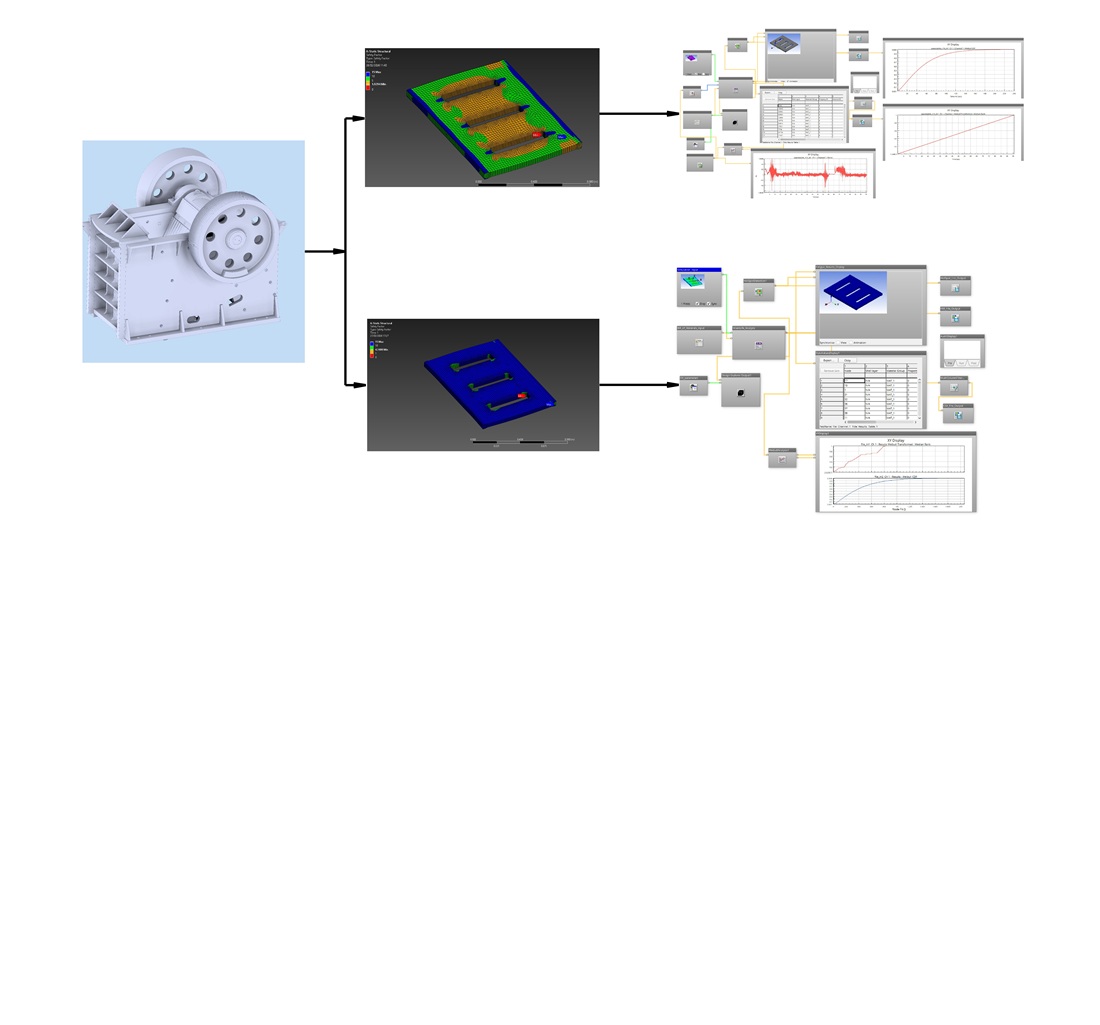
The paper investigates the reliability parameters of the spacer plate of a jaw crusher in the processes of crushing crushed stone, which is an aggregate in the manufacture of concrete. The calculation of the strength of the spacer plate in existing methods is carried out using empirical formulas. A number of functional methods are also used. However, most functional methods have inherent shortcomings that are built on statistical approaches, which can lead to inaccurate reproduction of the picture of the failure of machine elements. In the work, the problem is solved by using a combined model, namely the linear damage accumulation algorithm in combination with a finite element model to which the Weibull distribution is added, which is the most universal method of functional distribution for determining the limit states of parts and machine assemblies. Such a solution allows to determine the reliability parameters and establish a real picture of the process. A solid-state model of a jaw crusher has been developed and the loads applied to the spacer plate have been calculated.
Using the nCode EN Constant and nCode EN TimeSeries presets, which are built into the ncode DesignLife product of Hottinger Baldwin Messtechnik GmbH (Germany), the parameters of the failure life and fatigue strength of the crusher spacer plate were determined. In the nCode EN TimeSeries preset, the WeibullAnalysis glyph was used for data analysis. The results of the study can be used in studies of a wide range of machines to determine the limit states of machine parts and assemblies
References
- Fang, K.-T., Lin, Y.-X., Deng, Y.-H. (2025). A Review: Construction of Statistical Distributions. Entropy, 27 (12), 1188. https://doi.org/10.3390/e27121188
- Li, Z., Fu, H., Guo, J. (2025). Reliability Assessment of a Series System with Weibull-Distributed Components Based on Zero-Failure Data. Applied Sciences, 15 (5), 2869. https://doi.org/10.3390/app15052869
- Li, H. L. (2015). A Reliability Analysis of NC Machine Tools Based on the Weibull Distribution. Applied Mechanics and Materials, 741, 763–767. https://doi.org/10.4028/www.scientific.net/amm.741.763
- Yu, N. H., Zhang, Z. X., Wang, Z., Zhang, X. P. (2011). Weibull-Distribution-Based Method of Bayesian Reliability Evaluation for Machining Center. Advanced Materials Research, 317-319, 1949–1953. https://doi.org/10.4028/www.scientific.net/amr.317-319.1949
- Wang, Z. M., Yang, J. G. (2011). Reliability Assessment of Numerical Control Machine Tools Using Weibull Mixture Models. Advanced Materials Research, 181-182, 161–165. https://doi.org/10.4028/www.scientific.net/amr.181-182.161
- Chen, C. H., Yang, Z. J., Chen, F., Hao, Q. B., Xu, B. B., Kan, Y. N., Li, G. F. (2013). The Study of Reliability Modeling of Machining Center Based on Blocksim and Weibull++. Applied Mechanics and Materials, 274, 49–52. https://doi.org/10.4028/www.scientific.net/amm.274.49
- Barraza-Contreras, J. M., Piña-Monarrez, M. R., Torres-Villaseñor, R. C. (2023). Reliability by Using Weibull Distribution Based on Vibration Fatigue Damage. Applied Sciences, 13 (18), 10291. https://doi.org/10.3390/app131810291
- Zhang, C. W. (2021). Weibull parameter estimation and reliability analysis with zero-failure data from high-quality products. Reliability Engineering & System Safety, 207, 107321. https://doi.org/10.1016/j.ress.2020.107321
- Pasanisi, A., Roero, C., Remy, E., Bousquet, N. (2015). On the Practical Interest of Discrete Inverse Pólya and Weibull‐1 Models in Industrial Reliability Studies. Quality and Reliability Engineering International, 31 (7), 1161–1175. https://doi.org/10.1002/qre.1845
- Zhang, Q., Hua, C., Xu, G. (2014). A mixture Weibull proportional hazard model for mechanical system failure prediction utilising lifetime and monitoring data. Mechanical Systems and Signal Processing, 43 (1-2), 103–112. https://doi.org/10.1016/j.ymssp.2013.10.013
- Biały, W., Prostański, D., Korbiel, T., Kuric, I. (2024). Weibull distribution as a criterion of emergency levels. Acta Montanistica Slovaca, 29 (1), 216–226. https://doi.org/10.46544/ams.v29i1.19
- Nazarenko, I., Dedov, O., Mishchuk, Y., Slipetskyi, V., Delembovskyi, M., Zalisko, I., Nesterenko, M. (2021). Research of stress-strain state of elements of technological technical constructions. Dynamic Processes In Technological Technical Systems, 140–179. https://doi.org/10.15587/978-617-7319-49-7.ch8
- Nazarenko, I., Dedov, O., Bernyk, I., Zapryvoda, A., Ruchynskyi, M., Bondarenko, A. (2025). Determining the rational energy level for processing environments of different structures. Eastern-European Journal of Enterprise Technologies, 5 (1 (137)), 55–65. https://doi.org/10.15587/1729-4061.2025.341458
- Gómez, Y. M., Gallardo, D. I., Marchant, C., Sánchez, L., Bourguignon, M. (2023). An In-Depth Review of the Weibull Model with a Focus on Various Parameterizations. Mathematics, 12 (1), 56. https://doi.org/10.3390/math12010056
- Mu, F. S., Li, H., Li, X. X., Xiong, H. Z. (2013). Jaw Crusher Based on Discrete Element Method. Applied Mechanics and Materials, 312, 101–105. https://doi.org/10.4028/www.scientific.net/amm.312.101
- Oloyede, O., Cochrane, R. F., Mullis, A. M. (2017). Effect of rapid solidification on the microstructure and microhardness of BS1452 grade 250 hypoeutectic grey cast iron. Journal of Alloys and Compounds, 707, 347–350. https://doi.org/10.1016/j.jallcom.2016.08.214
- Boardman, B. E. (1982). Crack Initiation Fatigue – Data, Analysis, Trends and Estimation. SAE Technical Paper Series, 1. https://doi.org/10.4271/820682
Downloads
Published
How to Cite
Issue
Section
License
Copyright (c) 2026 Ivan Nazarenko, Yevhen Mishchuk, Viktor Nechiporuk, Dmytro Albeshchenko, Ivan Perehinets

This work is licensed under a Creative Commons Attribution 4.0 International License.
The consolidation and conditions for the transfer of copyright (identification of authorship) is carried out in the License Agreement. In particular, the authors reserve the right to the authorship of their manuscript and transfer the first publication of this work to the journal under the terms of the Creative Commons CC BY license. At the same time, they have the right to conclude on their own additional agreements concerning the non-exclusive distribution of the work in the form in which it was published by this journal, but provided that the link to the first publication of the article in this journal is preserved.
A license agreement is a document in which the author warrants that he/she owns all copyright for the work (manuscript, article, etc.).
The authors, signing the License Agreement with TECHNOLOGY CENTER PC, have all rights to the further use of their work, provided that they link to our edition in which the work was published.
According to the terms of the License Agreement, the Publisher TECHNOLOGY CENTER PC does not take away your copyrights and receives permission from the authors to use and dissemination of the publication through the world's scientific resources (own electronic resources, scientometric databases, repositories, libraries, etc.).
In the absence of a signed License Agreement or in the absence of this agreement of identifiers allowing to identify the identity of the author, the editors have no right to work with the manuscript.
It is important to remember that there is another type of agreement between authors and publishers – when copyright is transferred from the authors to the publisher. In this case, the authors lose ownership of their work and may not use it in any way.








