Identification of the performance mechanical secondary safety brake under hydraulic failure conditions: experimental assessment under fluid leakage
DOI:
https://doi.org/10.15587/1729-4061.2026.354678Keywords:
secondary safety brake, leakage, stopping time, pressure threshold, failure zoneAbstract
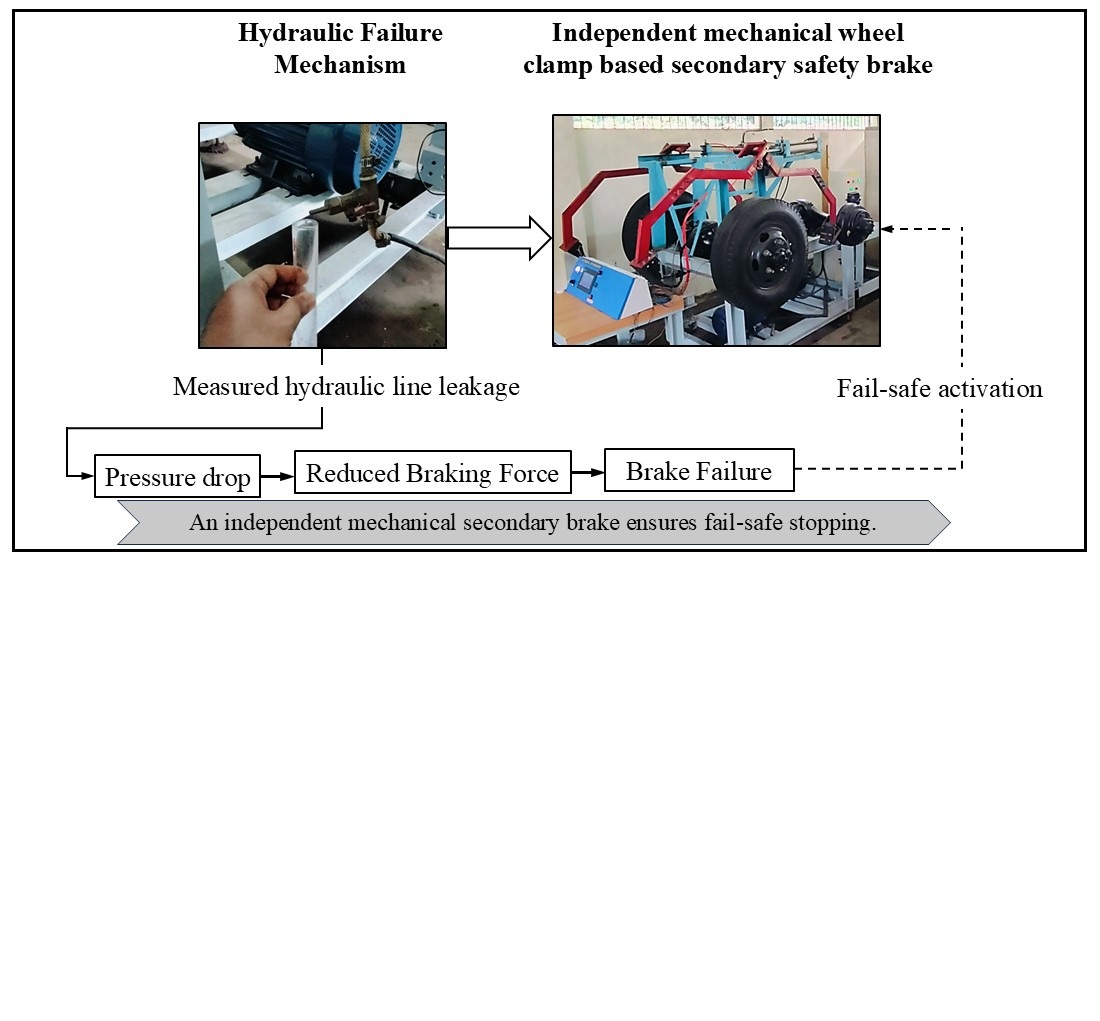
The object of the study is the hydraulic braking system of heavy vehicles under conditions of progressive brake fluid leakage, with particular emphasis on its effect on braking performance and failure behavior. The problem addressed is the loss of braking performance due to hydraulic brake failure caused by fluid leakage, which reduces hydraulic pressure and may lead to total brake failure.
This study presents the design and experimental analysis of an independent mechanical wheel-clamp-based secondary safety brake for heavy vehicle braking systems. Experimental evaluation was conducted using a rotational test rig under varying load conditions. The results show that brake failure is strongly dependent on load. Under low load (5 Hz), total failure occurs at approximately 70 mL leakage and 5 bars, whereas under high load (50 Hz), failure occurs at only 25 mL and 9.3 bar, indicating increased sensitivity to leakage. This behavior is explained by the loss of hydraulic fluid and the compressibility of trapped air in the braking circuit, which prevents pressure from reaching its maximum level and reduces effective force transmission. Under total hydraulic failure, the secondary safety brake is capable of stopping wheel rotation across all tested conditions; however, the stopping time is longer, reaching up to 6.5 s compared to 1.4–2.9 s for the primary brake. These results demonstrate that the proposed system provides a fully independent fail-safe braking mechanism capable of maintaining braking functionality when the primary system fails, thereby addressing the problem of brake performance loss under hydraulic failure conditions. The system can be applied in heavy vehicle braking systems as a risk mitigation solution under failure scenarios, particularly in high-load operating conditions, with potential for further development, experimental refinement, and real vehicle implementation, including integration with activation strategies
References
- Wang, Z., Yu, Q., Han, F., Shi, P. (2016). Research on a Brake Temperature Model of Heavy-Duty Trucks Braking on Long Downhill. Journal of Highway and Transportation Research and Development (English Edition), 10 (3), 90–96. https://doi.org/10.1061/jhtrcq.0000524
- Gang, W., Tian, C., ZhiPeng, L. (2023). Study on the influence of running parameters on the temperature field of disc brake on long downhill road. Proceedings of the Institution of Mechanical Engineers, Part D: Journal of Automobile Engineering, 238 (10-11), 3386–3398. https://doi.org/10.1177/09544070231177176
- Budhi, W. S., Utanaka, A., Wiryasuta, I. K. H., Widyastuti, H. (2024). Identifying Traffic Accident Trends and Black Spot Locations on National Road (A Case Study: Rogojampi-Kabat, Banyuwangi). Advances in Civil Engineering Materials, 683–695. https://doi.org/10.1007/978-981-97-0751-5_60
- Lu, Y., Wang, F., Zhang, G. (2020). Research on Brake Failure Control of Heavy Commercial Vehicles Based on Turning Conditions. 2020 4th CAA International Conference on Vehicular Control and Intelligence (CVCI), 395–400. https://doi.org/10.1109/cvci51460.2020.9338601
- Haq, M. T., Ampadu, V.-M. K., Ksaibati, K. (2023). An investigation of brake failure related crashes and injury severity on mountainous roadways in Wyoming. Journal of Safety Research, 84, 7–17. https://doi.org/10.1016/j.jsr.2022.10.003
- Wang, F., Lu, Y., Li, H. (2022). Heavy-Duty Vehicle Braking Stability Control and HIL Verification for Improving Traffic Safety. Journal of Advanced Transportation, 2022, 1–27. https://doi.org/10.1155/2022/5680599
- Umaras, E., Barari, A., Tsuzuki, M. S. G. (2021). Heavy Vehicles Brake Drums – An Accurate Evaluation on Thermal Loads in Severe Service Conditions. International Journal of Automotive Technology, 22 (2), 371–382. https://doi.org/10.1007/s12239-021-0035-1
- Kosbe, P., Patil, P., Kulkarni, R. (2020). Fade and recovery characteristics of commercial disc brake friction materials: a case study. International Journal of Ambient Energy, 43 (1), 2446–2452. https://doi.org/10.1080/01430750.2020.1730959
- Hilden, M., Dietl, H. (2024). Improvements in brake fluid standardization to avoid noise & wear. 14th International Munich Chassis Symposium 2023, 425–437. https://doi.org/10.1007/978-3-662-70348-9_26
- Kawakami, A., Shikada, A., Miyao, K. (2000). Control method for brake vapor lock in automobiles. JSAE Review, 21 (1), 73–78. https://doi.org/10.1016/s0389-4304(99)00066-1
- Hui, Y., Liu, G., Zhang, Q., Zhang, Y., Zang, Y., Wang, S., Shi, R. (2023). Fading behavior and wear mechanisms of C/C–SiC brake disc during cyclic braking. Wear, 526-527, 204930. https://doi.org/10.1016/j.wear.2023.204930
- Zhang, P., Zhang, L., Fu, K., Wu, P., Cao, J., Shijia, C., Qu, X. (2019). Fade behaviour of copper-based brake pad during cyclic emergency braking at high speed and overload condition. Wear, 428-429, 10–23. https://doi.org/10.1016/j.wear.2019.01.126
- Zhang, Q., Liu, H., He, Z., Mo, J., Jin, W., Shen, M., Zhao, C. (2025). Impact of initial braking temperature on thermal-induced brake fade during long-downhill operations. Engineering Failure Analysis, 167, 109077. https://doi.org/10.1016/j.engfailanal.2024.109077
- Vdovin, A., Gustafsson, M., Sebben, S. (2018). A coupled approach for vehicle brake cooling performance simulations. International Journal of Thermal Sciences, 132, 257–266. https://doi.org/10.1016/j.ijthermalsci.2018.05.016
- Peng, D., Tan, G., Tang, J., Guo, X. (2021). Design and Optimization of Forced-Air Cooling System for Commercial Vehicle Brake System. SAE International Journal of Commercial Vehicles, 15 (1), 15–25. https://doi.org/10.4271/02-14-04-0031
- Adamowicz, A., Grzes, P. (2011). Influence of convective cooling on a disc brake temperature distribution during repetitive braking. Applied Thermal Engineering, 31 (14-15), 2177–2185. https://doi.org/10.1016/j.applthermaleng.2011.05.016
- de Freitas, L. H., Roux, G. A. C. L. (2009). Exploiting R&D Databases for Efficient Product Design: Application to Brake Fluid Formulations. 10th International Symposium on Process Systems Engineering: Part A, 1161–1166. https://doi.org/10.1016/s1570-7946(09)70414-6
- Khamidullin, R. F., Bashkirtseva, N. Yu., Abdullin, A. I., Akhmetov, I. I. (2006). Polyethylene glycol monomethyl ethers as the main component of brake fluid. Russian Journal of Applied Chemistry, 79 (11), 1853–1856. https://doi.org/10.1134/s107042720611022x
- Zulhilmi, I. M., Peeie, M. H., Asyraf, S. M., Sollehudin, I. M., Ishak, I. M. (2020). Experimental Study on the Effect of Emergency Braking without Anti-Lock Braking System to Vehicle Dynamics Behaviour. International Journal of Automotive and Mechanical Engineering, 17 (2), 7832–7841. https://doi.org/10.15282/ijame.17.2.2020.02.0583
- Lai, F., Liu, J., Hu, Y. (2024). An Automatic Emergency Braking Control Method for Improving Ride Comfort. World Electric Vehicle Journal, 15 (6), 259. https://doi.org/10.3390/wevj15060259
- Kurhade, A. S., Tiwari, A. P., Wadkar, R. M., Kumar, S. (2017). Development of Secondary Braking System in Order Reduce Accidents Happening Due to Brake Failure. IJSRD - International Journal for Scientific Research & Development, 5 (10), 584–586. Available at: https://www.ijsrd.com/articles/IJSRDV5I100332.pdf
- Rancourt, D., Khazoom, C., Blanchette, C., Giraud, L., Lemire, J., St-Amant, Y. (2018). Wheel Chock Key Design Elements and Geometrical Profile for Truck Vehicle Restraint. SAE International Journal of Transportation Safety, 06 (1), 69–84. https://doi.org/10.4271/09-06-01-0006
- Adhitya, M., Siregar, R., Sumarsono, D. A., Nazaruddin, N., Heryana, G., Prasetyo, S., Zainuri, F. (2020). Experimental analysis in the test rig to detect temperature at the surface disc brake rotor using rubbing thermocouple. Eastern-European Journal of Enterprise Technologies, 2 (5 (104)), 6–11. https://doi.org/10.15587/1729-4061.2020.191949
- Limpert, R. (2011). Brake Design and Safety, Third Edition R-398. SAE International. https://doi.org/10.4271/r-398
- Siregar, R., Adhitya, M., Sumarsono, D. A., Nazaruddin, N., Heryana, G., Prasetya, S., Zainuri, F. (2021). Optimization of temperature measurement on the bus drum brake as a basis for developing brake fault signals. Eastern-European Journal of Enterprise Technologies, 1 (1 (109)), 13–19. https://doi.org/10.15587/1729-4061.2021.224907
- Bogomolov, V., Klimenko, V., Leontiev, D., Kuripka, O., Frolov, A., Don, Y. (2021). Features of adaptive brake control of the secondary brake system of a multi-axle vehicle. Automobile Transport, 48, 27–37. https://doi.org/10.30977/at.2219-8342.2021.48.0.27
Downloads
Published
How to Cite
Issue
Section
License
Copyright (c) 2026 Rolan Siregar, Asyari Asyari, Suzuki Syofian

This work is licensed under a Creative Commons Attribution 4.0 International License.
The consolidation and conditions for the transfer of copyright (identification of authorship) is carried out in the License Agreement. In particular, the authors reserve the right to the authorship of their manuscript and transfer the first publication of this work to the journal under the terms of the Creative Commons CC BY license. At the same time, they have the right to conclude on their own additional agreements concerning the non-exclusive distribution of the work in the form in which it was published by this journal, but provided that the link to the first publication of the article in this journal is preserved.
A license agreement is a document in which the author warrants that he/she owns all copyright for the work (manuscript, article, etc.).
The authors, signing the License Agreement with TECHNOLOGY CENTER PC, have all rights to the further use of their work, provided that they link to our edition in which the work was published.
According to the terms of the License Agreement, the Publisher TECHNOLOGY CENTER PC does not take away your copyrights and receives permission from the authors to use and dissemination of the publication through the world's scientific resources (own electronic resources, scientometric databases, repositories, libraries, etc.).
In the absence of a signed License Agreement or in the absence of this agreement of identifiers allowing to identify the identity of the author, the editors have no right to work with the manuscript.
It is important to remember that there is another type of agreement between authors and publishers – when copyright is transferred from the authors to the publisher. In this case, the authors lose ownership of their work and may not use it in any way.








