Assessment of the bearing capacity of rigid secondary support systems for gob-side retained entries based on strain energy analysis
DOI:
https://doi.org/10.15587/1729-4061.2026.354698Keywords:
entry support, dynamic bearing capacity, secondary support, deformation energy density, occupational safetyAbstract
This study investigates deformation processes occurring in secondary support systems for gob-side retained entries in coal mine extraction panels mining thin seams. The task addressed is to stabilize gob-side retained entries by improving the bearing capacity of secondary support systems to prevent roof collapses and provide safe working conditions. The comparative assessment was conducted based on an analysis of strain energy-related indicators. Underlying the study are physical models simulating filling walls, concrete blocks, and combined structures consisting of blocks with wooden interlayers.
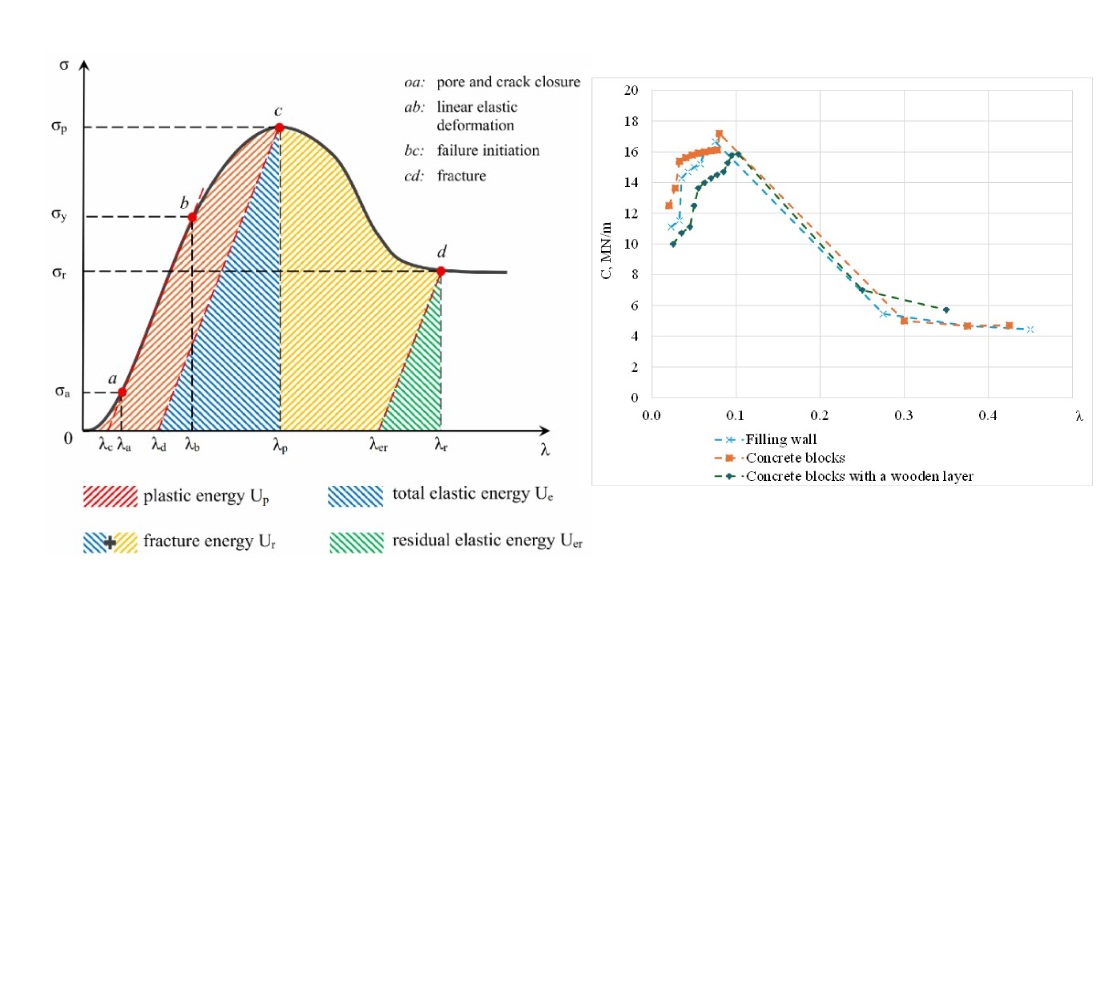
During uniaxial compression tests, the deformation capacity of each type of support system was determined; critical values of relative deformation at which the structures lose their functional performance were identified. The application of an energy-based approach has made it possible to quantify the stability limit and to predict the onset of structural failure. Experimental results showed that, under uniaxial compression, rigid secondary support systems operate under an increasing resistance mode before the initiation of failure processes. At the same time, the range of linear elastic deformation of the combined support structure is 33% greater than that of the homogeneous structure (damage initiation occurs at λb = 0.103 and λb = 0.075–0.08, respectively), which results in a delayed transition to loss of bearing capacity. The incorporation of limited yielding elements into rigid structures facilitates stress redistribution and enhances their deformation capacity.
An energy-based approach to analyzing the interaction between secondary support systems and the surrounding rock mass has been proposed, based on the use of strain energy density and its components, which characterize the processes of energy accumulation and dissipation. The practical significance of this study is associated with the application of the results to substantiate the design parameters for rigid secondary support systems for gob-side retained entries in coal extraction panels mining thin seams up to 1.2 m thick
References
- Sheka, I. V. (2024). Obgruntuvannia ratsionalnykh parametriv kriplennia iz kompozytnykh materialiv dlia hirnychykh vyrobok vuhilnykh shakht, shcho roztashovani na hlybynakh ponad 1000 metriv. Dnipro: Natsionalnyi tekhnichnyi universytet «Dniprovska Politekhnika», 158. https://doi.org/10.13140/RG.2.2.18898.77765
- Kyrychenko, V. Ya., Usachenko, B. M. (2008). Driftic metal timbers, answering to economic requirements and geomechanical problems of the big depths. Heotekhnycheskaia Mekhanyka, 78, 178–189. Available at: http://www.geotm.dp.ua/index.php/en/collection/474-geo-technical-mechanics-2008/geo-technical-mechanics-2008-78/7562-2024-06-04-19-42-58
- Bondarenko, V. I., Buzylo, V. I., Tabachenko, M. M., Medianyk, V. Yu. (2010). Heomekhanichni osnovy pidvyshchennia stiykosti pidhotovchykh vyrobok. Dnipropetrovsk: Natsionalnyi hirnychyi universytet, 408. Available at: http://ir.nmu.org.ua/handle/123456789/156064
- Pro zatverdzhennia Instruktsiyi z zabezpechennia stiykosti dilnychnykh vyrobok dlia povtornoho vykorystannia na vuhilnykh shakhtakh. Ministerstvo Enerhetyky Ukrainy nakaz 10.11.2022 No. 378. Available at: https://zakon.rada.gov.ua/laws/show/z1665-22
- Yalanskiy, A. O., Slashchov, І. M., Slashchova, O. A., Seleznov, A. M., Arestov, V. V. (2018). Development of new auxiliary measures for protecting preparatory roadways by the cast strips. Geo-Technical Mechanics, 141, 3–17. https://doi.org/10.15407/geotm2018.141.003
- Li, H., Zu, H., Zhang, K., Qian, J. (2022). Study on Filling Support Design and Ground Pressure Monitoring Scheme for Gob-Side Entry Retention by Roof Cutting and Pressure Relief in High-Gas Thin Coal Seam. International Journal of Environmental Research and Public Health, 19 (7), 3913. https://doi.org/10.3390/ijerph19073913
- Kanin, V. O., Antsyferov, A. V. (2004). Okhorona hirnychykh vyrobok hazobetonnym kriplenniam. Donetsk: TOV «Alan», 396.
- Qin, T., Wang, Y., Hou, X., Duan, Y. (2023). A characterization method for equivalent elastic modulus of rock based on elastic strain energy. Frontiers in Earth Science, 11. https://doi.org/10.3389/feart.2023.1120344
- Gong, F., Wang, Y. (2022). A New Rock Brittleness Index Based on the Peak Elastic Strain Energy Consumption Ratio. Rock Mechanics and Rock Engineering, 55 (3), 1571–1582. https://doi.org/10.1007/s00603-021-02738-y
- Rahimzadeh Kivi, I., Ameri, M., Molladavoodi, H. (2018). Shale brittleness evaluation based on energy balance analysis of stress-strain curves. Journal of Petroleum Science and Engineering, 167, 1–19. https://doi.org/10.1016/j.petrol.2018.03.061
- Liu, Z., Fan, T., Wang, Z., Yang, R., Fan, H., Wang, H., Hu, N. (2025). A rock brittleness evaluation method in interbedded reservoirs based on statistical damage constitutive. Journal of Petroleum Exploration and Production Technology, 15 (7). https://doi.org/10.1007/s13202-025-02008-5
- Qiao, L., Hao, J., Liu, Z., Li, Q., Deng, N. (2022). Influence of temperature on the transformation and self-control of energy during sandstone damage: Experimental and theoretical research. International Journal of Mining Science and Technology, 32 (4), 761–777. https://doi.org/10.1016/j.ijmst.2022.02.008
- Krasnikova, O., Kuzmenkо, P., Vyzhva, S. (2024). Analysis of the methods of determining the brittleness index and their application for terrigenous reservoir rocks of the Dnipro-Donetsk Basin. Visnyk of Taras Shevchenko National University of Kyiv. Geology, 1 (104), 22–29. https://doi.org/10.17721/1728-2713.104.03
- Li, L., Li, G., Gong, W., Wang, J., Deng, H. (2019). Energy Evolution Pattern and Roof Control Strategy in Non-Pillar Mining Method of Goaf-Side Entry Retaining by Roof Cutting – A Case Study. Sustainability, 11 (24), 7029. https://doi.org/10.3390/su11247029
- Hui, Z.-L., Zhao, Z.-Q., Wei, X.-X., Yao-Li. (2025). The energy and stress evolution law of surrounding rock in gob side entry driving of adjacent mining faces. Scientific Reports, 15 (1). https://doi.org/10.1038/s41598-025-10977-0
- Xin, X., Meng, Q., Pu, H., Wu, J. (2024). Theoretical analysis and numerical simulation analysis of energy distribution characteristics of surrounding rocks of roadways. Tunnelling and Underground Space Technology, 147, 105747. https://doi.org/10.1016/j.tust.2024.105747
- Wang, C., Liu, L., Elmo, D., Shi, F., Gao, A., Ni, P., Zhang, B. (2018). Improved energy balance theory applied to roadway support design in deep mining. Journal of Geophysics and Engineering, 15 (4), 1588–1601. https://doi.org/10.1088/1742-2140/aab3a0
- Huang, S., Li, Z. (2023). Optimization and Application of Coal Pillar in Fully Mechanized Mining Face based on Energy Analysis. International Journal of Energy, 3 (3), 47–51. https://doi.org/10.54097/ije.v3i3.011
- Wang, W., Qiu, W. (2023). Energy-Dissipation Support Technology for Large Deformation Tunnels Based on the Post-Peak Behavior of Steel Plate Buckling: A Case Study. Applied Sciences, 13 (21), 11972. https://doi.org/10.3390/app132111972
- Liu, X., Zhang, Y., Fan, D., Zhao, Y., Gao, Y., Pei, H., Shi, Z. (2025). Energy driven mechanism of surrounding rock deformation and failure of mining roadway and classified control technology. Scientific Reports, 15 (1). https://doi.org/10.1038/s41598-025-98452-8
- Chepiga, D., Bessarab, I., Hnatiuk, V., Tkachuk, O., Kipko, O., Podkopaiev, S. (2023). Deformation as a process to transform shape and volume of protective structures of the development mine workings during coal-rock mass off-loading. Mining of Mineral Deposits, 17 (4), 1–11. https://doi.org/10.33271/mining17.04.001
- Bachurin, L. L., Iordanov, I. V., Bessarab, I. М., Korol, A. V., Kaіun, O. Р., Podkopaіev, Y. S. et al. (2021). Comprehensive research of the stability of haulage drifts on steep coal seams in different protection methods. Visnyk Natsionalnoho universytetu vodnoho hospodarstva ta pryrodokorystuvannia, 1 (93), 217–236. Available at: https://ep3.nuwm.edu.ua/22666/
- Chepiga, D., Podkopaiev, S., Kayun, O., Bielikov, A., Podkopayev, Y., Kipko, O., Pidhurna, O. (2024). Assessing the stability of protective structures in preparatory mining workings under conditions of static load. Eastern-European Journal of Enterprise Technologies, 3 (1 (129)), 57–68. https://doi.org/10.15587/1729-4061.2024.304721
- Sadd, M. H. (2009). Elasticity. Academic Press, 536. https://doi.org/10.1016/b978-0-12-374446-3.x0001-6
- Lu, G., Yu, T. (2003). Energy absorption of structures and materials. Woodhead Publishings, 403. https://doi.org/10.1533/9781855738584
- Baron, L. I., Kurbatov, V. M. (1959). O diagramme szhatiya krepkih gornyh porod. Nauchnye Soobsheniya IGD AN SSSR, 22.
- Hucka, V., Das, B. (1974). Brittleness determination of rocks by different methods. International Journal of Rock Mechanics and Mining Sciences & Geomechanics Abstracts, 11 (10), 389–392. https://doi.org/10.1016/0148-9062(74)91109-7
Downloads
Published
How to Cite
Issue
Section
License
Copyright (c) 2026 Daria Chepiga, Leonid Bachurin, Serhii Podkopaiev, Danylo Polii, Olena Visyn, Yevgen Podkopayev, Halyna Herasymchuk, Yaroslava Bachurina

This work is licensed under a Creative Commons Attribution 4.0 International License.
The consolidation and conditions for the transfer of copyright (identification of authorship) is carried out in the License Agreement. In particular, the authors reserve the right to the authorship of their manuscript and transfer the first publication of this work to the journal under the terms of the Creative Commons CC BY license. At the same time, they have the right to conclude on their own additional agreements concerning the non-exclusive distribution of the work in the form in which it was published by this journal, but provided that the link to the first publication of the article in this journal is preserved.
A license agreement is a document in which the author warrants that he/she owns all copyright for the work (manuscript, article, etc.).
The authors, signing the License Agreement with TECHNOLOGY CENTER PC, have all rights to the further use of their work, provided that they link to our edition in which the work was published.
According to the terms of the License Agreement, the Publisher TECHNOLOGY CENTER PC does not take away your copyrights and receives permission from the authors to use and dissemination of the publication through the world's scientific resources (own electronic resources, scientometric databases, repositories, libraries, etc.).
In the absence of a signed License Agreement or in the absence of this agreement of identifiers allowing to identify the identity of the author, the editors have no right to work with the manuscript.
It is important to remember that there is another type of agreement between authors and publishers – when copyright is transferred from the authors to the publisher. In this case, the authors lose ownership of their work and may not use it in any way.








