Determining weight coefficients in the control system for a symmetry-compensating device using a fuzzy logic apparatus
DOI:
https://doi.org/10.15587/1729-4061.2026.354701Keywords:
symmetry-compensating device, fuzzy logic, multi-criteria optimization, automatic control systemAbstract
This study investigates processes of automatic control over parameters of the distribution network mode at a voltage of 6–10 kV with a sharply changing asymmetric load.
The task addressed relates to the compromised efficiency of existing systems for automatic control over symmetry-compensating devices, which are based on multi-criteria optimization methods with unchanged weight coefficients. Such systems continue to give maximum priority to reducing the steady-state voltage deviation even if it meets regulatory requirements. This leads to incomplete utilization of regulating reserve of the symmetry-compensating device.
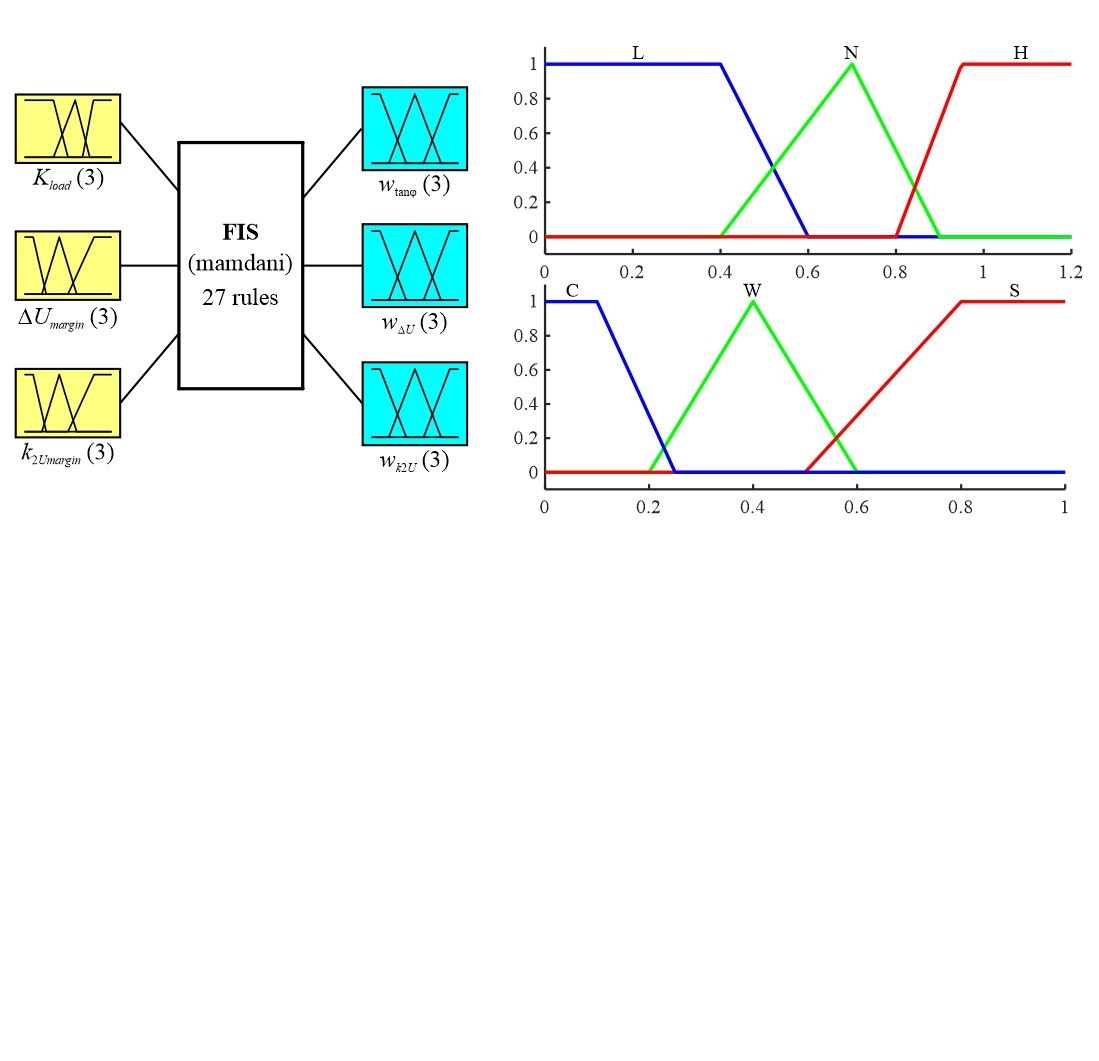
The system of automatic control over the symmetry-compensating device has been improved by integrating a fuzzy controller into its structure. This controller changes the values of weight coefficients in the objective function depending on the current values of the network mode parameters. The computer simulation has confirmed the effectiveness of the designed system, which provided a reduction in the mathematical expectations of the reactive power factor M[tanφ] by 13.9% and the voltage unbalance factor M[k2U] by 8.5% compared to the baseline.
The increase in the efficiency of the control system is explained by its ability to adaptively change the weight coefficients. Thus, if there is a margin for the steady-state voltage deviation, the fuzzy controller reduces the weight coefficient that meets this criterion, directing the regulating resource of the symmetrical-compensating device to increase the level of reactive power compensation and reduce the level of asymmetry.
A feature of the designed control system is the use of the levels of approximation of the current values of the steady-state deviation and voltage asymmetry to their regulatory permissible limits as input variables in the fuzzy controller.
The designed automatic control system could be used in distribution electrical networks with a voltage of 6–10 kV at a sharply changing asymmetrical load
References
- Hamza, A., Hamza, M., Awais, M., Ahmad, F., Rehman, Z. (2023). Development and Deployment of Programmable Logic Controller-Based Switched Capacitor Banks to Enhance Power Factor of Three-Phase Induction Motors. 2023 International Conference on Emerging Power Technologies (ICEPT), 1–7. https://doi.org/10.1109/icept58859.2023.10152354
- Patil, S. D., Kachare, R. A., Mulla, A. M., Patil, D. R. (2021). Performance up gradation of static VAR compensator with thyristor binary switched capacitor and reactor using model reference adaptive controller. Automatika, 63 (1), 26–48. https://doi.org/10.1080/00051144.2021.1999704
- Widjonarko, W., Avian, C., Setiawan, A., Rusli, Moch., Iskandar, E. (2020). Capacitor bank controller using artificial neural network with closed-loop system. Bulletin of Electrical Engineering and Informatics, 9 (4), 1379–1386. https://doi.org/10.11591/eei.v9i4.2411
- Rocha, P. H. A., Coelho, F. (2022). Fuzzy control for automatic operation of bank capacitors installed in a substation. Electrical Engineering, 104 (6), 4357–4366. https://doi.org/10.1007/s00202-022-01624-2
- Reddy, N. V. U. (2023). Improved Performance Analysis and Reactive Power Compensation of FACTS Devices Utilizing Fuzzy Logic. 2023 4th International Conference on Smart Electronics and Communication (ICOSEC), 240–245. https://doi.org/10.1109/icosec58147.2023.10276046
- Ibrahim, W. Kh., Alkhayyat, M. T., Suliman, M. Y. (2025). Unbalanced Voltage Enhancement based on STATCOM for Distribution Network Integrated with Renewable Energy. International Journal of Electrical and Electronics Research, 13 (3), 572–579. https://doi.org/10.37391/ijeer.130322
- Maataoui, Y., Chekenbah, H., Boutfarjoute, O., Lasri, R. (2022). Voltage control using fuzzy logic for radial distribution network with high penetration of photovoltaic generators. E3S Web of Conferences, 351, 01030. https://doi.org/10.1051/e3sconf/202235101030
- Zeng, X. J., Zhai, H. F., Wang, M. X., Yang, M., Wang, M. Q. (2019). A system optimization method for mitigating three-phase imbalance in distribution network. International Journal of Electrical Power & Energy Systems, 113, 618–633. https://doi.org/10.1016/j.ijepes.2019.05.038
- Taranukha, M. S., Teluyta, R. V., Zinzura, V. V. (2015). Optimal control of reactive load modes in conditions of asymmetry of voltage electricity distribution networks. Bulletin of NTU "KhPI". Series: Problems of Electrical Machines and Apparatus Perfection. The Theory and Practice, 42 (1151), 62–66. Available at: https://pema.khpi.edu.ua/index.php/2079-3944/article/view/55966
- Plieshkov, P. H., Zinzura, V. V., Plieshkov, S. P. (2019). Automatic control of electrical distribution network mode with the voltage unbalance. Naukovyi Visnyk Natsionalnoho Hirnychoho Universytetu, 3. https://doi.org/10.29202/nvngu/2019-3/10
- Plieshkov, P., Soldatenko, V., Zinzura, V., Plieshkov, S. (2020). Determining weight coefficients for an optimal system of control over electric energy generation in a combined electric power system. Eastern-European Journal of Enterprise Technologies, 1 (2 (103)), 77–82. https://doi.org/10.15587/1729-4061.2020.193362
Downloads
Published
How to Cite
Issue
Section
License
Copyright (c) 2026 Petro Plieshkov, Vasyl Zinzura, Kateryna Petrova, Valentyn Soldatenko, Andrii Nekrasov

This work is licensed under a Creative Commons Attribution 4.0 International License.
The consolidation and conditions for the transfer of copyright (identification of authorship) is carried out in the License Agreement. In particular, the authors reserve the right to the authorship of their manuscript and transfer the first publication of this work to the journal under the terms of the Creative Commons CC BY license. At the same time, they have the right to conclude on their own additional agreements concerning the non-exclusive distribution of the work in the form in which it was published by this journal, but provided that the link to the first publication of the article in this journal is preserved.
A license agreement is a document in which the author warrants that he/she owns all copyright for the work (manuscript, article, etc.).
The authors, signing the License Agreement with TECHNOLOGY CENTER PC, have all rights to the further use of their work, provided that they link to our edition in which the work was published.
According to the terms of the License Agreement, the Publisher TECHNOLOGY CENTER PC does not take away your copyrights and receives permission from the authors to use and dissemination of the publication through the world's scientific resources (own electronic resources, scientometric databases, repositories, libraries, etc.).
In the absence of a signed License Agreement or in the absence of this agreement of identifiers allowing to identify the identity of the author, the editors have no right to work with the manuscript.
It is important to remember that there is another type of agreement between authors and publishers – when copyright is transferred from the authors to the publisher. In this case, the authors lose ownership of their work and may not use it in any way.








