Identifying regularities in the strength indicators of a passenger railroad car body depending on the use of a C-shaped profile with perforation in the girdle beam
DOI:
https://doi.org/10.15587/1729-4061.2026.354921Keywords:
railroad transport, passenger car, body improvement, girdle beam, body strengthAbstract
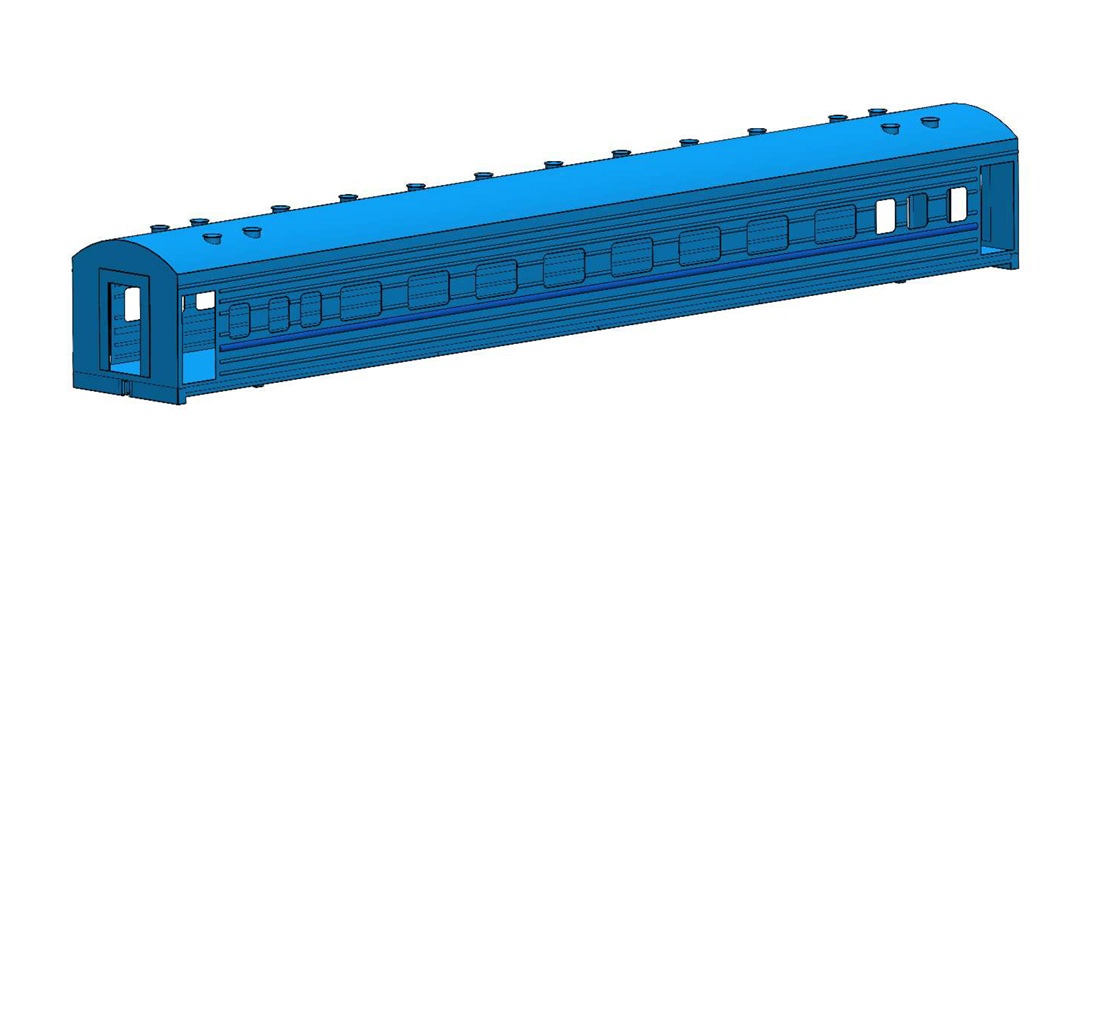
This study considers processes resulting in the occurrence and acceptance of loads by the body of a passenger railroad car with a girdle beam under operational conditions. The task addressed is to improve the strength indicators of the girdle beam in a passenger car.
To improve the strength of the frame of a passenger car, it is proposed to introduce a C-shaped profile with perforation as a profile for the girdle beam. The mass of the girdle beam using the proposed profile will decrease by more than 20%. At the same time, the moment of resistance of the cross-section of the girdle beam will increase by almost 14%.
To substantiate such an implementation, a calculation was performed for the strength of the body of a passenger car under the main modes of its loading during operation. It was established that the maximum stresses arising in the girdle beam under the most unfavorable loading scheme are lower than the permissible ones by 20.5%. Under other design loading conditions of the body, the strength of its structure is also maintained. As part of the study, a modal analysis of the passenger car body was conducted. The calculations showed that traffic safety from the point of view of modal analysis is observed.
A feature of the proposed improvement of the passenger car body is that it does not complicate the maintenance and repair of the car using the existing base.
The scope of practical use of the results is railroad transport.
The condition for using the research results is compliance with periodic maintenance of the passenger car body during operation.
The study reported here will contribute to compiling recommendations for the design of new passenger car structures with improved technical and economic indicators
References
- Tokarev, D., Tvoronovych, V. (2023). World practices for the development of passenger traffic by railway transport. Economy and Society, 52. https://doi.org/10.32782/2524-0072/2023-52-23
- Li, H., Jiang, Z., Li, C., Gu, J., Wang, B. (2025). Formulation and Evaluation of Rail Transit Passenger Influx Control Schemes Based on Train-Passenger-Station Interactive Simulation. Urban Rail Transit, 11 (4), 351–370. https://doi.org/10.1007/s40864-025-00248-6
- Fischer, S., Harangozó, D., Németh, D., Kocsis, B., Sysyn, M., Kurhan, D., Brautigam, A. (2024). Investigation of heat-affected zones of thermite rail weldings. Facta Universitatis, Series: Mechanical Engineering, 689. https://doi.org/10.22190/fume221217008f
- Baykasoglu, C., Sunbuloglu, E., Bozdag, S. E., Aruk, F., Toprak, T., Mugan, A. (2012). Numerical static and dynamic stress analysis on railway passenger and freight car models. International Iron & Steel Symposium. Karabük, 579–586. Available at: https://d1wqtxts1xzle7.cloudfront.net/85453299/cengizbaykasoglu_hititedutr110920130Y7K9T0V-libre.pdf?1651643639=&response-content-disposition=inline%3B+filename%3DNumerical_Static_and_Dynamic_Stress_Anal.pdf&Expires=1774004664&Signature=eMoHIIr6PknKOJ8PIBLb2Smb2bM118UpW5tqC6YaWLHU2AjpSsth8Jd4tpVN8KLMQX2FZfcXLbJd4D4MsvDK9RvcX3A0DPAtfilfKTzdYdnauhYwOO-2hSpVz~eXKp3SDKYqfAmQDkqoJr66KpuGoRykuD3WShkuMD-bTScj2msmcQ-ZK7VuqG3eSiCZNRGLPruP6Ylv41eJnds-FOBxTilyOuaJZ1AGJHTUVUkLhw~as11PI-Nr1brxsT8TprsBrbFigLLnHx~2Vuj13le6fZXTdNIBCb03S~A03v9sgCBZjv62VP1MVzfzyJaSBYCynnYOiQUu3Nuwb-IHk~ETSA__&Key-Pair-Id=APKAJLOHF5GGSLRBV4ZA
- Lovska, A., Gerlici, J., Dižo, J. (2025). Research of the possibility of using beams with corrugated walls in a passenger rail car frame. Scientific Reports, 15 (1). https://doi.org/10.1038/s41598-025-12783-0
- Tyrell, D., Jacobsen, K., Martinez, E., Perlman, A. B. (2006). Train-to-Train Impact Test of Crash Energy Management Passenger Rail Equipment: Structural Results. Rail Transportation, 35–44. https://doi.org/10.1115/imece2006-13597
- Kirkpatrick, S. W., MacNeill, R. A. (2002). Development of a computer model for prediction of collision response of a railroad passenger car. ASME/IEEE Joint Railroad Conference, 9–16. https://doi.org/10.1109/rrcon.2002.1000085
- Kuczek, T. (2015). Application of manufacturing constraints to structural optimization of thin-walled structures. Engineering Optimization, 48 (2), 351–360. https://doi.org/10.1080/0305215x.2015.1017350
- Zairova, D., Kadirov, M. A., Khojiev, N., Khikmatov, F., Shokuchkorov, K. (2021). Running quality assessment of a passenger car produced in the Republic of Uzbekistan. E3S Web of Conferences, 264, 05058. https://doi.org/10.1051/e3sconf/202126405058
- Lovska, A., Stanovska, I., Nerubatskyi, V., Hordiienko, D., Zinchenko, O., Karpenko, N., Semenenko, Y. (2022). Determining features of the stressed state of a passenger car frame with an energy-absorbing material in the girder beam. Eastern-European Journal of Enterprise Technologies, 5 (7 (119)), 44–53. https://doi.org/10.15587/1729-4061.2022.265043
- Radkevich, N. (2022). The influence of the environment on the bearing structures of passenger cars. Collection of Scientific Works of the State University of Infrastructure and Technologies Series “Transport Systems and Technologies,” 1 (40), 131–138. https://doi.org/10.32703/2617-9040-2022-40-11
- Dizo, J., Blatnicky, M., Harusinec, J., Falendysh, A. (2018). Modification and analyses of structural properties of a goods wagon bogie frame. Diagnostyka, 20 (1), 41–48. https://doi.org/10.29354/diag/99853
- Dižo, J., Harušinec, J., Blatnický, M. (2015). Multibody System of a Rail Vehicle Bogie with a Flexible Body. Manufacturing Technology, 15 (5), 781–788. https://doi.org/10.21062/ujep/x.2015/a/1213-2489/mt/15/5/781
- Kondratiev, A., Píštěk, V., Gajdachuk, V., Kharchenko, M., Nabokina, T., Kučera, P., Kučera, O. (2023). Effect of Ply Orientation on the Mechanical Performance of Carbon Fibre Honeycomb Cores. Polymers, 15 (11), 2503. https://doi.org/10.3390/polym15112503
- Kowalski, S., Cieślikowski, B., Barta, D., Dižo, J., Dittrich, A. (2023). Analysis of the Operational Wear of the Combustion Engine Piston Pin. Lubricants, 11 (3), 100. https://doi.org/10.3390/lubricants11030100
- Šťastniak, P., Rakár, M., Tížek, J. (2023). Design of a Height-Adjustable Boarding System for a New Double-Deck Railway Vehicle. Acta Mechanica et Automatica, 17 (1), 44–51. https://doi.org/10.2478/ama-2023-0005
- Smetanka, L., Šťastniak, P. (2017). Analysis of Contact Stresses of Theoretical and Worn Profile by Using Computer Simulation. Manufacturing Technology, 1 7(4), 580–585. https://doi.org/10.21062/ujep/x.2017/a/1213-2489/mt/17/4/580
- Dižo, J., Blatnický, M., Melnik, R., Karľa, M. (2022). Improvement of Steerability and Driving Safety of an Electric Three-Wheeled Vehicle by a Design Modification of its Steering Mechanism. LOGI – Scientific Journal on Transport and Logistics, 13 (1), 49–60. https://doi.org/10.2478/logi-2022-0005
- Ďungel, J., Zvolenský, P., Grenčík, J., Leštinský, L., Krivda, J. (2021). Localization of Increased Noise at Operating Speed of a Passenger Wagon. Sustainability, 13 (2), 453. https://doi.org/10.3390/su13020453
- Dižo, J., Steišunas, S., Blatnický, M. (2017). Vibration Analysis of a Coach with the Wheel-flat Due to Suspension Parameters Changes. Procedia Engineering, 192, 107–112. https://doi.org/10.1016/j.proeng.2017.06.019
- Alizhan, A., Apshikur, B., Alimkulov, M., Goltsev, A., Chernavin, V., Almas, K. (2025). Dynamic Behavior of a Modernized Passenger Coach for Multimodal Transport: Effect of Wheel Wear and Clearance Optimization. Future Transportation, 5 (4), 168. https://doi.org/10.3390/futuretransp5040168
- Fischer, S. (2024). Investigation of the Settlement Behavior of Ballasted Railway Tracks Due to Dynamic Loading. Spectrum of Mechanical Engineering and Operational Research, 2 (1), 24–46. https://doi.org/10.31181/smeor21202528
Downloads
Published
How to Cite
Issue
Section
License
Copyright (c) 2026 Sergii Panchenko, Alyona Lovska, Iraida Stanovska, Arsen Muradian, Ihor Voloshyn

This work is licensed under a Creative Commons Attribution 4.0 International License.
The consolidation and conditions for the transfer of copyright (identification of authorship) is carried out in the License Agreement. In particular, the authors reserve the right to the authorship of their manuscript and transfer the first publication of this work to the journal under the terms of the Creative Commons CC BY license. At the same time, they have the right to conclude on their own additional agreements concerning the non-exclusive distribution of the work in the form in which it was published by this journal, but provided that the link to the first publication of the article in this journal is preserved.
A license agreement is a document in which the author warrants that he/she owns all copyright for the work (manuscript, article, etc.).
The authors, signing the License Agreement with TECHNOLOGY CENTER PC, have all rights to the further use of their work, provided that they link to our edition in which the work was published.
According to the terms of the License Agreement, the Publisher TECHNOLOGY CENTER PC does not take away your copyrights and receives permission from the authors to use and dissemination of the publication through the world's scientific resources (own electronic resources, scientometric databases, repositories, libraries, etc.).
In the absence of a signed License Agreement or in the absence of this agreement of identifiers allowing to identify the identity of the author, the editors have no right to work with the manuscript.
It is important to remember that there is another type of agreement between authors and publishers – when copyright is transferred from the authors to the publisher. In this case, the authors lose ownership of their work and may not use it in any way.








