Wear prediction and material selection of contact inserts for electric transport based on energy model using the finite element method
DOI:
https://doi.org/10.15587/1729-4061.2026.354922Keywords:
frictional interaction, fullerene soot, contact insert, wear prediction, energy modelAbstract
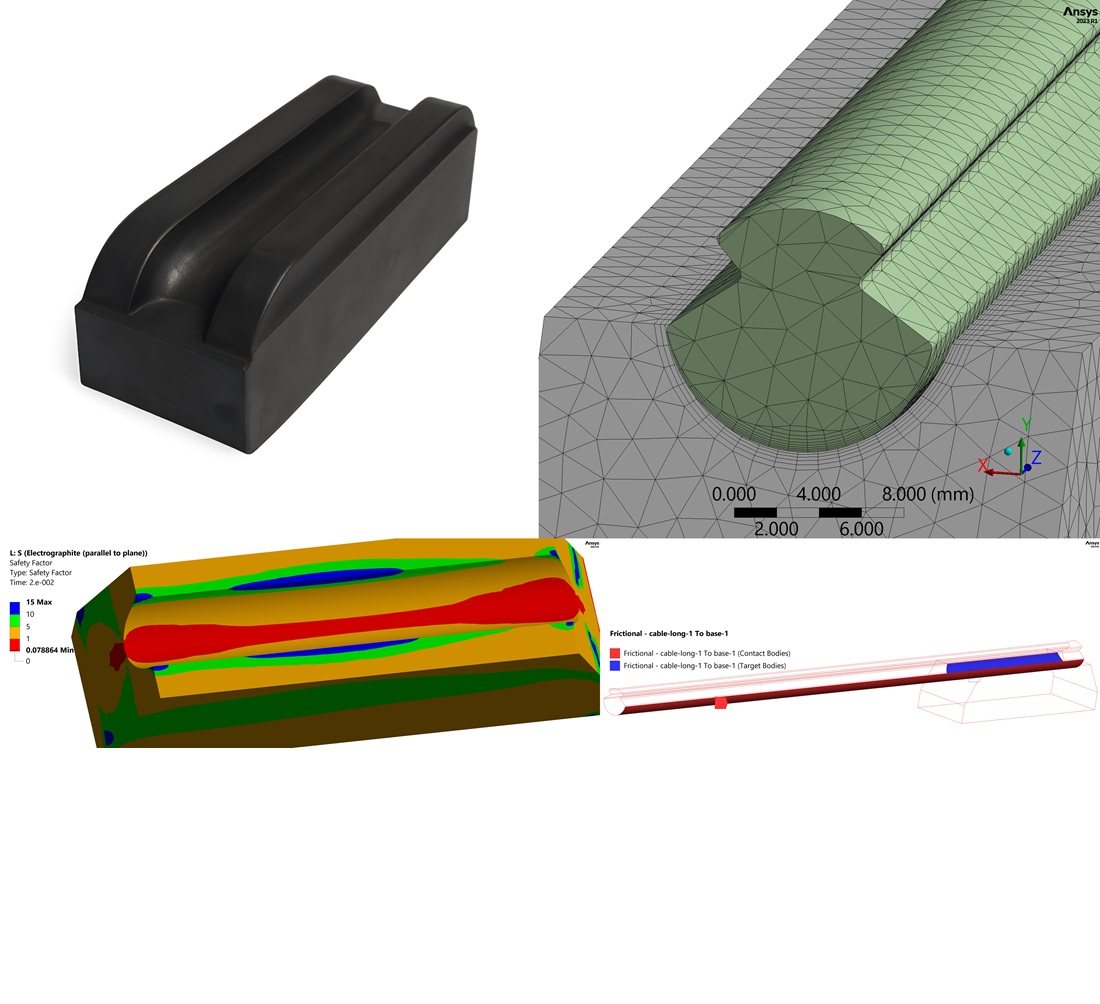
This study explores the contact pair «trolleybus contact insert «TCI-power wire». The task addressed relates to the lack of consideration of thermal effects, phase changes, and thermal softening of the material in the classical Archard and Karman models, which complicates wear prediction.
To solve this problem, an energy-temperature wear model (ETW) has been constructed, which integrates mechanical, thermal, and energy processes in the contact zone. Unlike existing approaches, the model considers the temperature-dependent hardness H(T) and local fields of contact pressure and frictional stresses, determined by the finite element method (FEM) in the Ansys environment.
The research features involve a hybrid approach to wear prediction – the integration of mathematical modeling and FEM simulation. The results include von Mises stresses σmax = 16.24 MPa (amorphous carbon), 18.99 MPa (electrographite – EG), and 30.53 MPa (copper-graphite composite Cu-40%C(f) 0.90 – CU). Under sliding conditions of Stotal = 0.2 m at contact pressure p = 0.5 MPa, the wear depth for EG is 1.99·10⁻5 mm, which is extrapolated to 47.8 mm at 450 km and exceeds the permissible 10 mm, while for CU the wear decreases to 2.2 mm. The wear reduction is associated with the greater hardness of CU (120–135 HV) and a uniform distribution of contact stresses, which confirms the ETW effectiveness.
Practical significance of the results is the possibility of a reasonable choice of TCI materials, in particular copper-fullerene composites (Cu-0.5% FS), to increase wear resistance and stability of current collection with priority insert wear over the contact wire. The scope of practical implementation of the results includes the design of materials for current collection systems of electric transport
References
- Wilk, A., Bartłomiejczyk, M., Skibicki, J., Jarzębowicz, L., Karkosinski, D. R., Hupka, Ł. et al. (2025). Processing and analysis of trolleybus traction data using LINQ technology. Bulletin of the Polish Academy of Sciences Technical Sciences, 73 (4), 154144–154144. https://doi.org/10.24425/bpasts.2025.154144
- Jakubowski, A., Jarzebowicz, L., Bartłomiejczyk, M., Skibicki, J., Judek, S., Wilk, A., Płonka, M. (2021). Modeling of Electrified Transportation Systems Featuring Multiple Vehicles and Complex Power Supply Layout. Energies, 14 (24), 8196. https://doi.org/10.3390/en14248196
- Apostolidou, N., Papanikolaou, N. (2018). Energy Saving Estimation of Athens Trolleybuses Considering Regenerative Braking and Improved Control Scheme. Resources, 7 (3), 43. https://doi.org/10.3390/resources7030043
- Barbone, R., Mandrioli, R., Ricco, M., Paternost, R. F. P., Franco, F. L., Grandi, G. (2022). Flexible and Modular Model for Smart Trolleybus Grids. 2022 IEEE 16th International Conference on Compatibility, Power Electronics, and Power Engineering (CPE-POWERENG), 1–6. https://doi.org/10.1109/cpe-powereng54966.2022.9880904
- Paternost, R. F., Mandrioli, R., Barbone, R., Ricco, M., Cirimele, V., Grandi, G. (2022). Catenary-Powered Electric Traction Network Modeling: A Data-Driven Analysis for Trolleybus System Simulation. World Electric Vehicle Journal, 13 (9), 169. https://doi.org/10.3390/wevj13090169
- Skurikhin, V. (2014). Determination of wearproofness of contact wire by the method of complete factor experiment. Technology Audit and Production Reserves, 1 (2 (15)), 26–30. https://doi.org/10.15587/2312-8372.2014.21251
- Bolshakov, Yu. L., Antonov, A. V. (2015). Investigation of properties of current collector elements and their effect on the performance of tribosystem «contact wire - current collector element». Science and Transport Progress, 6 (60), 35–44. https://doi.org/10.15802/stp2015/57006
- Chen, M., Allen, T. (2021). Trolleybus Catenary-Pantograph Self-generation Contact Force Under Preload. World Journal of Applied Physics, 6 (4), 60. https://doi.org/10.11648/j.wjap.20210604.12
- Dykha, A., Aulin, V., Makovkin, O., Posonskiy, S. (2017). Determining the characteristics of viscous friction in the sliding supports using the method of pendulum. Eastern-European Journal of Enterprise Technologies, 3 (7 (87)), 4–10. https://doi.org/10.15587/1729-4061.2017.99823
- Pan, L., Yang, C., Xing, T., Yu, Q. (2025). An Experimental Investigation of the Electrical Tribological Characteristics of a Copper–Silver Alloy Contact Wire/Novel Pure Carbon Slider. Lubricants, 13 (2), 87. https://doi.org/10.3390/lubricants13020087
- Chen, T., Song, C., Liu, Z., Wang, L., Hou, X., Lu, H., Zhang, Y. (2023). Current-carrying tribological properties of an elastic roll ring under different currents. Wear, 514-515, 204590. https://doi.org/10.1016/j.wear.2022.204590
- Holenko, K., Dykha, O., Koda, E., Kernytskyy, I., Horbay, O. et al. (2025). Peculiarities of Assessing Body Strength When Converting a Bus from Diesel to Electric Traction Following the UNECE R100 Regulation. Applied Sciences, 15 (14), 8115. https://doi.org/10.3390/app15148115
- Cao, Z., Li, R., Shou, M., Luo, R., Wei, B., Wang, T. (2024). Mechanical properties and tribological behaviors of Ag/graphene composite coating under sliding friction and current-carrying fretting. Tribology International, 197, 109811. https://doi.org/10.1016/j.triboint.2024.109811
- Li, S., Yang, X., Kang, Y., Li, Z., Li, H. (2022). Progress on Current-Carry Friction and Wear: An Overview from Measurements to Mechanism. Coatings, 12 (9), 1345. https://doi.org/10.3390/coatings12091345
- Ogasawara, T., Ishida, Y., Kasai, T. (2009). Mechanical properties of carbon fiber/fullerene-dispersed epoxy composites. Composites Science and Technology, 69 (11-12), 2002–2007. https://doi.org/10.1016/j.compscitech.2009.05.003
- Kubo, S., Tsuchiya, H. (2005). Wear Properties of Metal-Impregnated Carbon Fiber-Reinforced Carbon Composite Sliding Against a Copper Plate Under an Electric Current. World Tribology Congress III, Volume 1, 85–86. https://doi.org/10.1115/wtc2005-63457
- Zhu, W., Miser, D. E., Geoffrey Chan, W., Hajaligol, M. R. (2004). Characterization of combustion fullerene soot, C60, and mixed fullerene. Carbon, 42 (8-9), 1463–1471. https://doi.org/10.1016/j.carbon.2004.01.076
- Bucca, G., Collina, A. (2009). A procedure for the wear prediction of collector strip and contact wire in pantograph–catenary system. Wear, 266 (1-2), 46–59. https://doi.org/10.1016/j.wear.2008.05.006
- P., A. K., V., V. N., Joshi, G., Mehta, K. P. (2021). Fabrication and applications of fullerene-based metal nanocomposites: A review. Journal of Materials Research, 36 (1), 114–128. https://doi.org/10.1557/s43578-020-00094-1
- Zhao, H., Barber, G. C., Liu, J. (2001). Friction and wear in high speed sliding with and without electrical current. Wear, 249 (5-6), 409–414. https://doi.org/10.1016/s0043-1648(01)00545-2
- Fals, A. E., Hadjiev, V. G., Robles Hernández, F. C. (2012). Multi-functional fullerene soot/alumina composites with improved toughness and electrical conductivity. Materials Science and Engineering: A, 558, 13–20. https://doi.org/10.1016/j.msea.2012.07.027
- Dub, S. N., Haftaoglu, C., Kindrachuk, V. M. (2021). Estimate of theoretical shear strength of C60 single crystal by nanoindentation. Journal of Materials Science, 56 (18), 10905–10914. https://doi.org/10.1007/s10853-021-05991-2
- Holenko, K., Dykha, A., Dytyniuk, V., Dykha, M., Horbay, O. (2025). Simulation of the Shaft Surface Strengthening as a Result of Discrete Electro-Mechanical Processing. Advanced Manufacturing Processes VI, 525–534. https://doi.org/10.1007/978-3-031-82746-4_46
- Dykha, A. V., Zaspa, Yu. P., Slashchuk, V. O. (2018). Triboacoustic Control of Fretting. Journal of Friction and Wear, 39 (2), 169–172. https://doi.org/10.3103/s1068366618020046
Downloads
Published
How to Cite
Issue
Section
License
Copyright (c) 2026 Kostiantyn Holenko, Oleksandr Dykha, Orest Horbay, Oleksii Kovtun, Volodymyr Dytyniuk

This work is licensed under a Creative Commons Attribution 4.0 International License.
The consolidation and conditions for the transfer of copyright (identification of authorship) is carried out in the License Agreement. In particular, the authors reserve the right to the authorship of their manuscript and transfer the first publication of this work to the journal under the terms of the Creative Commons CC BY license. At the same time, they have the right to conclude on their own additional agreements concerning the non-exclusive distribution of the work in the form in which it was published by this journal, but provided that the link to the first publication of the article in this journal is preserved.
A license agreement is a document in which the author warrants that he/she owns all copyright for the work (manuscript, article, etc.).
The authors, signing the License Agreement with TECHNOLOGY CENTER PC, have all rights to the further use of their work, provided that they link to our edition in which the work was published.
According to the terms of the License Agreement, the Publisher TECHNOLOGY CENTER PC does not take away your copyrights and receives permission from the authors to use and dissemination of the publication through the world's scientific resources (own electronic resources, scientometric databases, repositories, libraries, etc.).
In the absence of a signed License Agreement or in the absence of this agreement of identifiers allowing to identify the identity of the author, the editors have no right to work with the manuscript.
It is important to remember that there is another type of agreement between authors and publishers – when copyright is transferred from the authors to the publisher. In this case, the authors lose ownership of their work and may not use it in any way.








