Determining patterns that induce the stressed-strained state of a printing plate during intaglio printing
DOI:
https://doi.org/10.15587/1729-4061.2026.355567Keywords:
intaglio printing plates, direct laser engraving, wear resistance, stressed-strained state, intaglio printing modellingAbstract
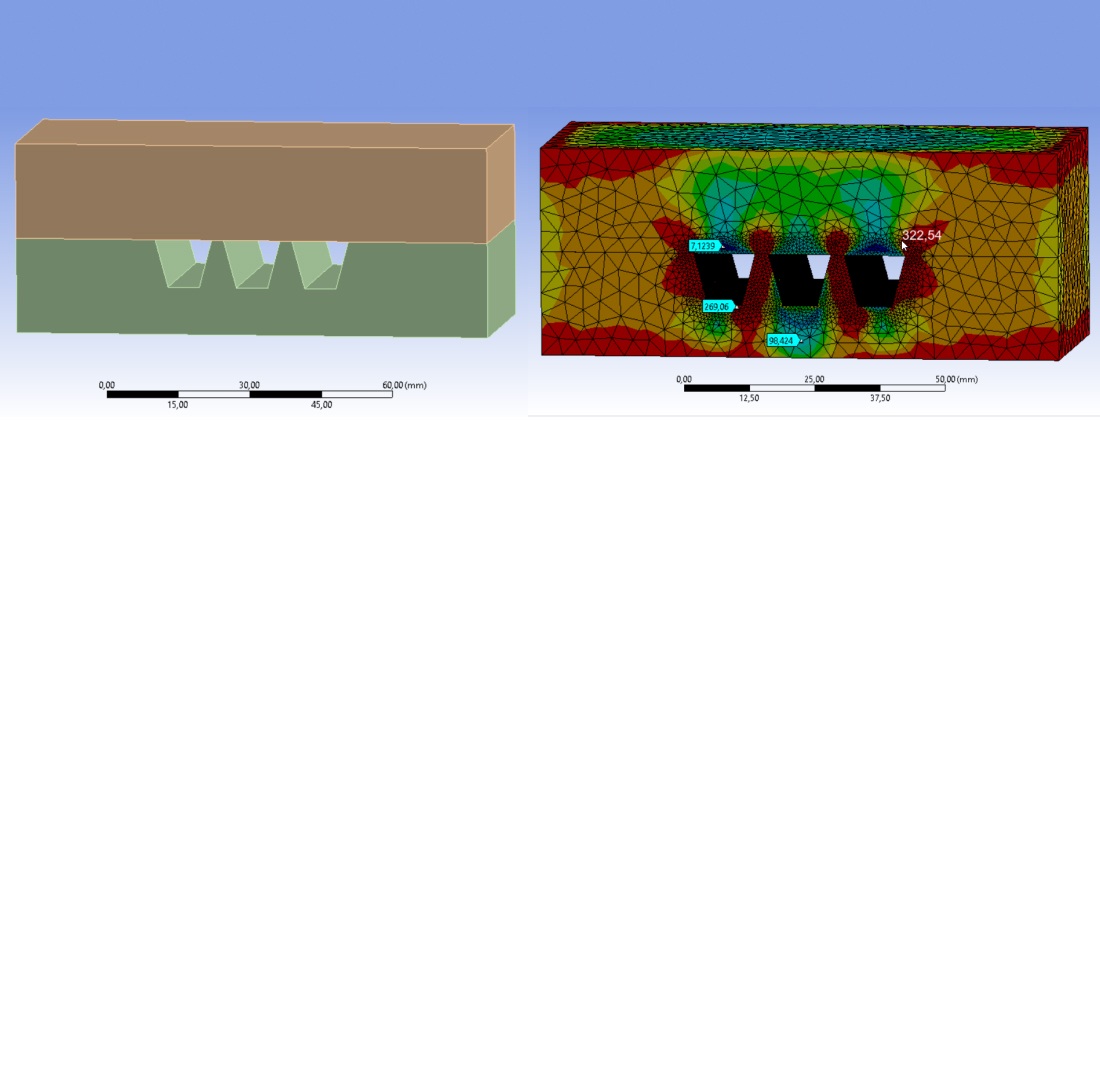
One of the main methods for protecting paper banknotes is intaglio printing, whose key quality factor is the durability of the printing plate. This study investigates the process that induces the stressed-strained state of an engraved printing plate obtained by direct laser engraving with different geometric parameters of printing and non-printing elements of printing plate. The task addressed relates to the lack of understanding of the mechanism behind the influence of geometric engraving parameters on the stress concentration and deformation of engraved elements of intaglio printing plates. This causes their premature wear and a decrease in the stability of the printing process.
Based on modelling the contact interaction of the plate and printing cylinders, the results of the study have established quantitative dependences between the geometric parameters of engraving and the values of equivalent stresses and deformations of engraved strokes. It was found that the stress values vary within the range of 15–550 MPa, and the deformations range from 0.01 to 0.06 mm, depending on the characteristic zone of the engraved elements and their geometric parameters. The optimal geometric parameters of engraving have been determined based on the analysis of simulation results.
A notable feature of the results is that the model accounted for the actual printing conditions during intaglio printing, as well as the presence or absence of paint within the stroke. Compiled recommendations for the selection of geometric parameters of engraved strokes could be taken into consideration when designing the engraving of intaglio printing plates. The results of this study are valuable for the industrial production of banknote products and securities
References
- Banknote Printing Machine Market. Available at: https://www.emergenresearch.com/industry-report/banknote-printing-machine-market
- Watermarks and intaglio printing remain top security features (2020). Central Banking Staff. Available at: https://www.centralbanking.com/central-banks/currency/7701186/watermarks-and-intaglio-printing-remain-top-security-features
- Funk, M., Gillich, E., Hofmann, J., Lohweg, V. (2016). Intaglio quality measurement. Conference: Optical Document Security - The Conference on Optical Security and Counterfeit Detection. Available at: https://www.researchgate.net/publication/282327575
- van der Horst, F., Miedema, J., Snell, J., Theeuwes, J. (2020). Banknote Verification Relies on Vision, Feel and a Single Second. SSRN Electronic Journal. https://doi.org/10.2139/ssrn.3581541
- Kyrychok, T., Kyrychok, P., Havenko, S., Kibirkštis, Е., Miliūnas, V. (2014). The influence of pressure during intaglio printing on banknotes durability. Mechanics, 20 (3). https://doi.org/10.5755/j01.mech.20.3.7393
- Jura and OEBS: Stainless Steel Intaglio Plate Making Process (2024). International Association of Currency Affairs. Available at: https://currencyaffairs.org/document/stainless-steel-intaglio-plate-making-process/
- Deinhammer, H., Loos, F., Schwarzbach, D., Fajmann, P. (2004). Direct laser engraving of intaglio printing plates. Optical Security and Counterfeit Deterrence Techniques V, 5310, 184. https://doi.org/10.1117/12.526899
- Hennig, G., Selbmann, K.-H., Brockelt, A. (2005). Laser engraving in gravure industry. Workshop on Laser Applications in Europe, 6157, 61570C. https://doi.org/10.1117/12.660938
- Kyrychok, T., Bahlai, V., Bezpalyi, A., Rehida, P. (2019). Method of Automated Quality Assessment for Technological Operation of Direct Laser Engraving of Intaglio Printing Plates. Technology and Technique of Typography (Tekhnolohiia I Tekhnika Drukarstva), 4 (66), 31–41. https://doi.org/10.20535/2077-7264.4(66).2019.208868
- Kyrychok, T., Bahlai, V., Bezpalyi, A. (2020). Influence of Technological Parameters on the Properties of Printing Elements of Intaglio Printing Forms Obtained by Direct Laser Engraving. Technology and Technique of Typography (Tekhnolohiia I Tekhnika Drukarstva), 3 (69), 4–15. https://doi.org/10.20535/2077-7264.3(69).2020.226568
- Kyrychok, T., Korotenko, O., Bahlai, V. (2021). The Influence of Printing Elements Parameters of Intaglio Printing Plates Obtained by Direct Laser Engraving on Graphic and Gradation Accuracy of Imprints. Technology and Technique of Typography (Tekhnolohiia I Tekhnika Drukarstva), 4 (74), 4–15. https://doi.org/10.20535/2077-7264.4(74).2021.258285
- Al Aboud, A., Dörsam, E., Spiehl, D. (2020). Investigation of printing pad geometry by using FEM simulation. Journal of Print and Media Technology Research, 9 (2), 81–93. Available at: https://jpmtr.net/index.php/journal/article/view/14
- Rydefalk, C., Hagman, A., Kulachenko, A., Thorman, S. (2025). Simulations of lateral stress variations in a flexographic print nip. Nordic Pulp & Paper Research Journal. https://doi.org/10.1515/npprj-2025-0019
- Kyrychok, T., Bahlai, V. (2022). Determination of Means of Ensuring the Quality of Intaglio Printing Plates. Technology and Technique of Typography (Tekhnolohiia I Tekhnika Drukarstva), 1 (75), 4–14. https://doi.org/10.20535/2077-7264.1(75).2022.263575
- Developer documentation. Ansys. Available at: https://developer.ansys.com/docs
- Zienkiewicz, O. C., Taylor, R., Zhu, J. (2005). The Finite Element Method: Its Basis and Fundamentals. Elsevier. Available at: https://api.pageplace.de/preview/DT0400.9780080531670_A23527211/preview-9780080531670_A23527211.pdf
- Bathe, K.-J. (1996). Finite Element Procedures. Upper Saddle River. Available at: https://soaneemrana.org/onewebmedia/Finite%20Element%20Procedures%20in%20Engineering%20Analysis%20Bathe%20K.J.pdf
- Cook, R. D., Malkus, D. S., Plesha, M. E., Witt, R. J. (2002). Concepts and Applications of Finite Element Analysis. John Wiley & Sons. Available at: https://cybertycoons.wordpress.com/wp-content/uploads/2014/04/robert_d-_cook_david_s-_malkus_michael_e-_pleshbookos-org-fem.pdf
- HSFLD242. 3D Hydrostatic Fluid. Available at: https://ansyshelp.ansys.com/public/account/secured?returnurl=/Views/Secured/corp/v242/en/ans_elem/Hlp_E_HSFLD242.html
Downloads
Published
How to Cite
Issue
Section
License
Copyright (c) 2026 Tetiana Kyrychok, Olena Korotenko, Vladyslav Korotenko, Vladyslav Doroshchuk

This work is licensed under a Creative Commons Attribution 4.0 International License.
The consolidation and conditions for the transfer of copyright (identification of authorship) is carried out in the License Agreement. In particular, the authors reserve the right to the authorship of their manuscript and transfer the first publication of this work to the journal under the terms of the Creative Commons CC BY license. At the same time, they have the right to conclude on their own additional agreements concerning the non-exclusive distribution of the work in the form in which it was published by this journal, but provided that the link to the first publication of the article in this journal is preserved.
A license agreement is a document in which the author warrants that he/she owns all copyright for the work (manuscript, article, etc.).
The authors, signing the License Agreement with TECHNOLOGY CENTER PC, have all rights to the further use of their work, provided that they link to our edition in which the work was published.
According to the terms of the License Agreement, the Publisher TECHNOLOGY CENTER PC does not take away your copyrights and receives permission from the authors to use and dissemination of the publication through the world's scientific resources (own electronic resources, scientometric databases, repositories, libraries, etc.).
In the absence of a signed License Agreement or in the absence of this agreement of identifiers allowing to identify the identity of the author, the editors have no right to work with the manuscript.
It is important to remember that there is another type of agreement between authors and publishers – when copyright is transferred from the authors to the publisher. In this case, the authors lose ownership of their work and may not use it in any way.








