Devising a method for dynamic stabilization of PoS consensus using adaptive weight mixing and a time factor
DOI:
https://doi.org/10.15587/1729-4061.2026.355853Keywords:
Proof-of-Stake, Sybil resistance, adaptive consensus, committee selection, Gini coefficient, Proof-of-PersistenceAbstract
This study investigates the process of validator committee selection in permissionless blockchain networks operating on the Proof-of-Stake algorithm. The task addressed relates to the vulnerability of conventional static selection schemes to identity-forging (Sybil) attacks.
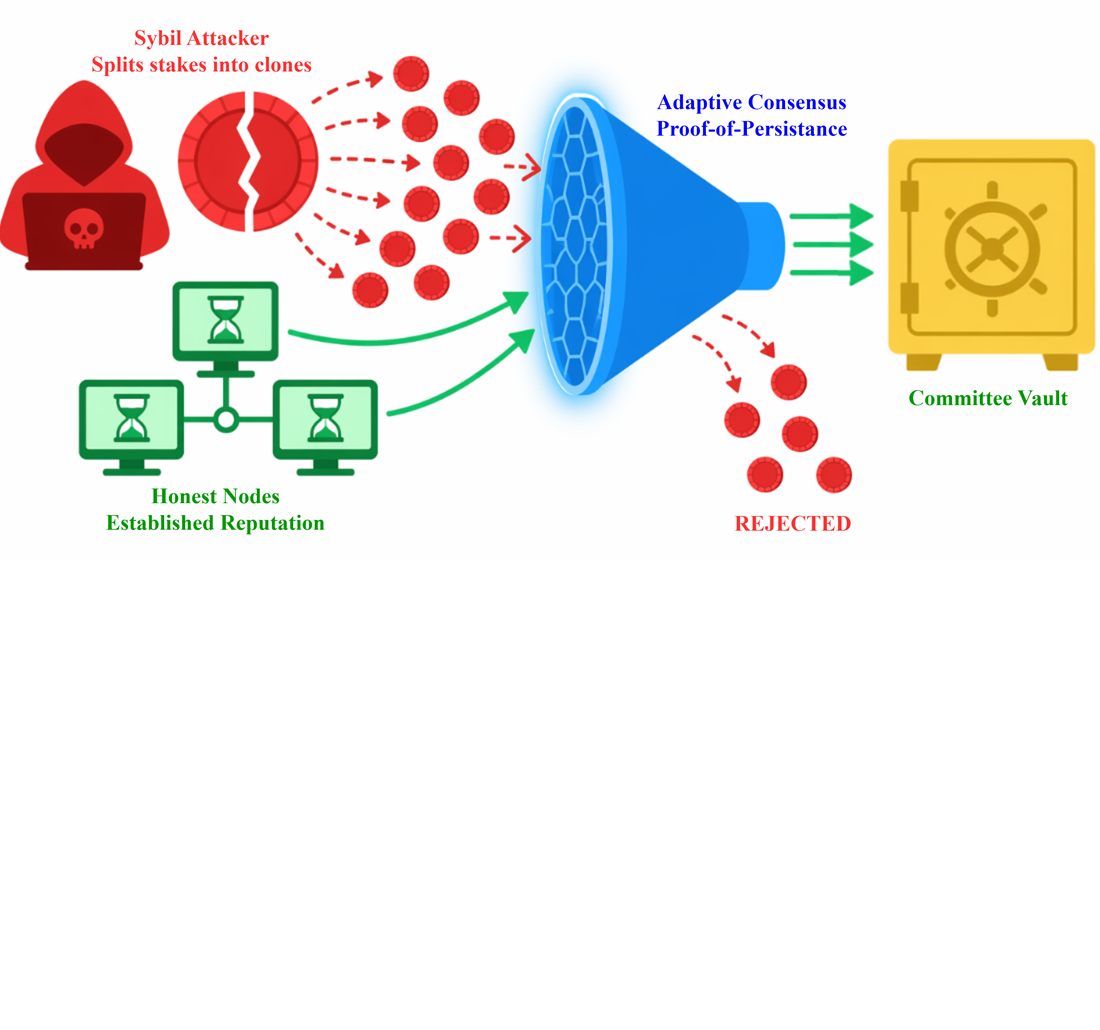
A fixed baseline weight facilitates stake splitting among numerous fictitious entities, allowing attackers to gain control over the network. In response to these challenges, a method for the dynamic stabilization of consensus based on an adaptive control law has been devised. This method automatically regulates the weight mixing intensity using the smoothed Gini coefficient.
The concept of Proof-of-Persistence has been proposed, which replaces the uniform baseline distribution with a time-weighted reputation of the participants. The analytical and experimental analyses of data from 10 real-world networks were conducted, demonstrating that the proposed mechanism reliably reduces the aggregate weight of a potential attacker. The result is attributed to the fact that when new entities are created, their prior participation experience is not considered, and the loss of reputational weight outweighs the benefits of acquiring new baseline shares. This makes the stake-splitting strategy economically unviable.
An important distinct feature is that the system's adaptation is carried out exclusively on the basis of deterministic on-chain data, without the need for external identification. The proposed system functions autonomously: under a normal mode, intervention is minimized, while under the risk of an oligopoly, protection is strengthened. The results could be practically applied to the architecture of permissionless blockchain networks as the method might be integrated both at the network protocol core level and in the form of smart contracts to enhance the security of distributed ledgers without additional manual adjustments.
References
- Xu, J., Wang, C., Jia, X. (2023). A Survey of Blockchain Consensus Protocols. ACM Computing Surveys, 55 (13s), 1–35. https://doi.org/10.1145/3579845
- Motepalli, S., Jacobsen, H.-A. (2024). How Does Stake Distribution Influence Consensus? Analyzing Blockchain Decentralization. 2024 IEEE International Conference on Blockchain and Cryptocurrency (ICBC), 343–352. https://doi.org/10.1109/icbc59979.2024.10634400
- Saleh, F. (2020). Blockchain without Waste: Proof-of-Stake. The Review of Financial Studies, 34 (3), 1156–1190. https://doi.org/10.1093/rfs/hhaa075
- Roşu, I., Saleh, F. (2021). Evolution of Shares in a Proof-of-Stake Cryptocurrency. Management Science, 67 (2), 661–672. https://doi.org/10.1287/mnsc.2020.3791
- Motepalli, S., Jacobsen, H.-A. (2025). Decentralization in PoS Blockchain Consensus: Quantification and Advancement. IEEE Transactions on Network and Service Management, 22 (4), 2930–2943. https://doi.org/10.1109/tnsm.2025.3561098
- Cevallos, A., Stewart, A. (2021). A verifiably secure and proportional committee election rule. Proceedings of the 3rd ACM Conference on Advances in Financial Technologies, 29–42. https://doi.org/10.1145/3479722.3480988
- Leporati, A., Rovida, L. (2024). Looking for stability in proof-of-stake based consensus mechanisms. Blockchain: Research and Applications, 5 (4), 100222. https://doi.org/10.1016/j.bcra.2024.100222
- Huang, H., Peng, X., Lin, Y., Xu, M., Ye, G., Zheng, Z., Guo, S. (2023). Scheduling Most Valuable Committees for the Sharded Blockchain. IEEE/ACM Transactions on Networking, 31 (6), 3284–3299. https://doi.org/10.1109/tnet.2023.3278456
- Windiatmaja, J. H., Hanggoro, D., Salman, M., Sari, R. F. (2023). PoIR: A Node Selection Mechanism in Reputation-Based Blockchain Consensus Using Bidirectional LSTM Regression Model. Computers, Materials & Continua, 77 (2), 2309–2339. https://doi.org/10.32604/cmc.2023.041152
- Zhang, M., Liu, M., Ding, X., Wang, Y., Li, G. (2025). GPE-PoS: A Fair and Sybil-Resistant Proof of Stake Consensus. Journal of Internet Technology, 26 (4), 463–470. https://doi.org/10.70003/160792642025072604005
- Castañeda, A., Hurault, A., Quéinnec, P., Roy, M. (2019). Tasks in Modular Proofs of Concurrent Algorithms. Stabilization, Safety, and Security of Distributed Systems, 69–83. https://doi.org/10.1007/978-3-030-34992-9_6
- Iqbal, M., Matulevicius, R. (2021). Exploring Sybil and Double-Spending Risks in Blockchain Systems. IEEE Access, 9, 76153–76177. https://doi.org/10.1109/access.2021.3081998
- Solomka, I. R., Liubinskyi, B. B., Peniak, B. O. (2025). Mixed-Weight Committee Selection in Proof-of-Stake: Tunable Stake-Baseline Mixing with Exponential Tail Guarantees and Incentive Compatibility. Mathematical Modeling and Computing, 12 (4), 1320–1332. https://doi.org/10.23939/mmc2025.04.1320
- Ihoso. Mixweight-committee-consensus. Self-Stabilizing Consensus. Available at: https://github.com/ihosol/mixweight-committee-consensus/tree/feature/self-stabilized-consensus/self-stabilizing-consensus
Downloads
Published
How to Cite
Issue
Section
License
Copyright (c) 2026 Ihor Solomka, Bohdan Liubinskyi

This work is licensed under a Creative Commons Attribution 4.0 International License.
The consolidation and conditions for the transfer of copyright (identification of authorship) is carried out in the License Agreement. In particular, the authors reserve the right to the authorship of their manuscript and transfer the first publication of this work to the journal under the terms of the Creative Commons CC BY license. At the same time, they have the right to conclude on their own additional agreements concerning the non-exclusive distribution of the work in the form in which it was published by this journal, but provided that the link to the first publication of the article in this journal is preserved.
A license agreement is a document in which the author warrants that he/she owns all copyright for the work (manuscript, article, etc.).
The authors, signing the License Agreement with TECHNOLOGY CENTER PC, have all rights to the further use of their work, provided that they link to our edition in which the work was published.
According to the terms of the License Agreement, the Publisher TECHNOLOGY CENTER PC does not take away your copyrights and receives permission from the authors to use and dissemination of the publication through the world's scientific resources (own electronic resources, scientometric databases, repositories, libraries, etc.).
In the absence of a signed License Agreement or in the absence of this agreement of identifiers allowing to identify the identity of the author, the editors have no right to work with the manuscript.
It is important to remember that there is another type of agreement between authors and publishers – when copyright is transferred from the authors to the publisher. In this case, the authors lose ownership of their work and may not use it in any way.








