Development of an automated question generation system from multimedia content using text-to-text transfer transformer with Bloom taxonomy classification
DOI:
https://doi.org/10.15587/1729-4061.2026.355867Keywords:
automated question generation, multimedia, T5 transformer, bloom taxonomy, BLEU, ROUGEAbstract
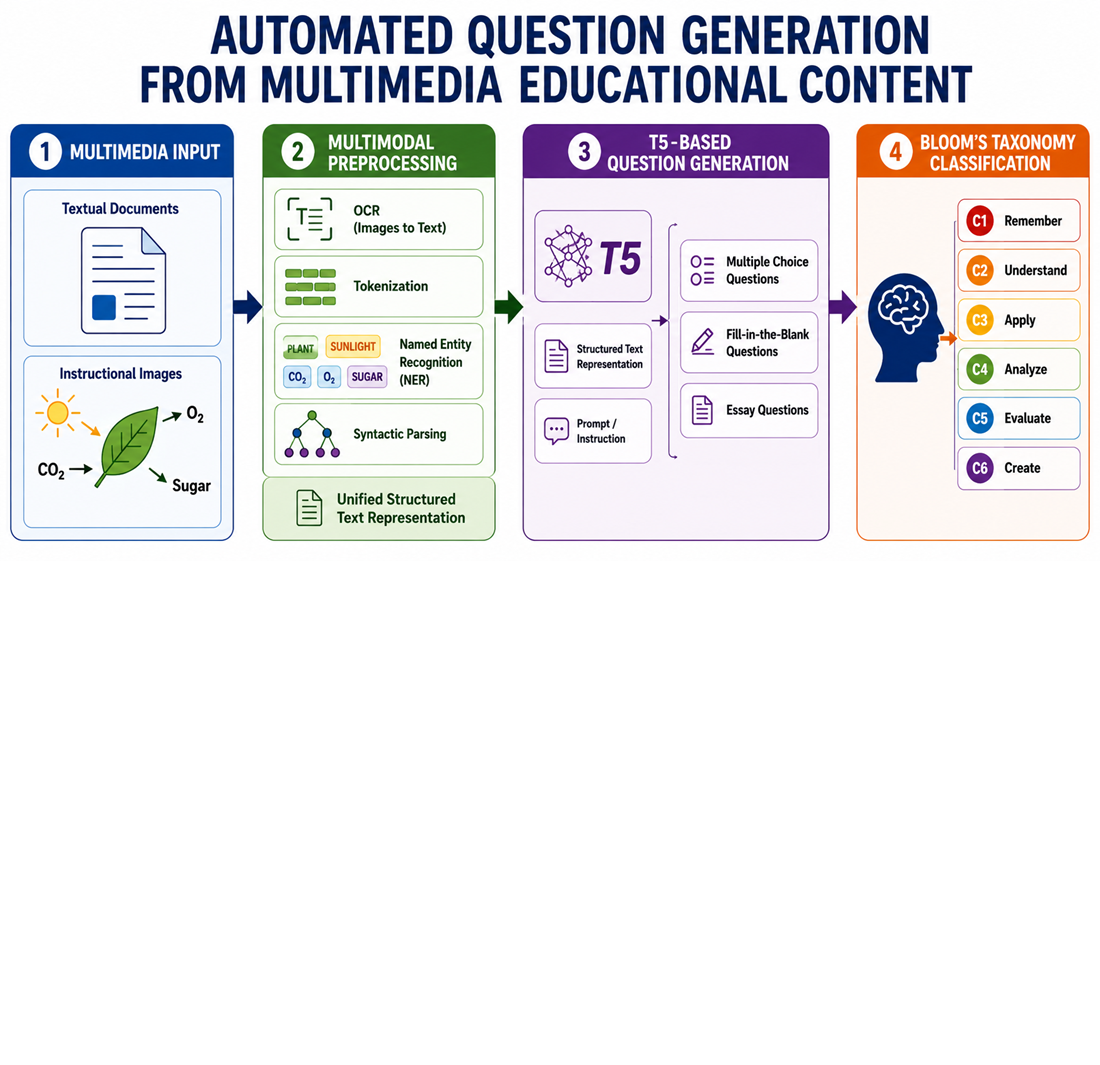
The object of this study is the assessment process in digital learning environments, where multimedia educational materials such as textual documents and instructional images and require efficient methods for automatic question generation. The main problem investigated is the difficulty in generating high-quality, relevant questions from various multimedia learning materials (text and images). A multimedia question-generation system is proposed that integrates the text-to-text transfer transformer (T5) model with classification based on Bloom's taxonomy. A preprocessing workflow has been created that extracts and combines textual representations from text and images using optical character recognition (OCR) for data tokenization and performs named entity recognition (NER). The question generator application can generate various question types, including multiple-choice, short-answer, and essay questions. These questions are classified according to Bloom's taxonomy. The generated questions were evaluated using bilingual evaluation understudy (BLEU) and recall-oriented understudy for gisting evaluation (ROUGE). Experimental results demonstrated strong performance, with average scores of BLEU-1 = 0.86, BLEU-2 = 0.79, ROUGE-1 = 0.88, and ROUGE-2 = 0.81. Evaluation scores indicate that the multimodal quiz generator application produces high-quality and contextually relevant questions. Evaluation scores show similarities between reference questions and generated questions, with structured questions receiving higher scores than essay questions. The system allows its use in education and intelligent tutoring systems to produce measurable, efficient assessments. The method proposed in this study is limited to multimedia input consisting of text and images
References
- Kurdi, G., Leo, J., Parsia, B., Sattler, U., Al-Emari, S. (2019). A Systematic Review of Automatic Question Generation for Educational Purposes. International Journal of Artificial Intelligence in Education, 30 (1), 121–204. https://doi.org/10.1007/s40593-019-00186-y
- Raffel, C., Shazeer, N., Roberts, A., Lee, K., Narang, S., Matena, M. et al. (2020). Exploring the limits of transfer learning with a unified text-to-text transformer. Journal of Machine Learning Research, 21. https://doi.org/10.48550/arXiv.1910.10683
- Zhou, L., Hu, J., Zhang, S., Du, X., Song, M., Zhang, X., Feng, Z. (2024). DenseSAM: Semantic Enhance SAM for Efficient Dense Object Segmentation. Proceedings of the Thirty-ThirdInternational Joint Conference on Artificial Intelligence, 7994–8002. https://doi.org/10.24963/ijcai.2024/889
- Adhikari, Y. (2024). A Review of Revised Bloom’s Taxonomy of Educational Objectives. Education Review Journal, 1, 115–126. https://doi.org/10.3126/erj.v1i1.82852
- Du, X., Shao, J., Cardie, C. (2017). Learning to Ask: Neural Question Generation for Reading Comprehension. Proceedings of the 55th Annual Meeting of the Association for Computational Linguistics (Volume 1: Long Papers), 1342–1352. https://doi.org/10.18653/v1/p17-1123
- Rus, V., Wyse, B., Piwek, P., Lintean, M., Stoyanchev, S., Moldovan, C. (2010). The first question generation shared task evaluation challenge. in Proceedings of the 6th International Natural Language Generation Conference, 251–257. Available at: https://aclanthology.org/W10-4234/
- Sun, X., Liu, J., Lyu, Y., He, W., Ma, Y., Wang, S. (2018). Answer-focused and Position-aware Neural Question Generation. Proceedings of the 2018 Conference on Empirical Methods in Natural Language Processing, 3930–3939. https://doi.org/10.18653/v1/d18-1427
- Zhao, Y., Ni, X., Ding, Y., Ke, Q. (2018). Paragraph-level Neural Question Generation with Maxout Pointer and Gated Self-attention Networks. Proceedings of the 2018 Conference on Empirical Methods in Natural Language Processing, 3901–3910. https://doi.org/10.18653/v1/d18-1424
- Devlin, J., Chang, M.-W., Lee, K., Toutanova, K. (2019). BERT: Pre-training of Deep Bidirectional Transformers for Language Understanding. Proceedings of the 2019 Conference of the North. https://doi.org/10.18653/v1/n19-1423
- Wijaya, M. C. (2021). Automatic Short Answer Grading System in Indonesian Language Using BERT Machine Learning. Revue d’Intelligence Artificielle, 35 (6), 503–509. https://doi.org/10.18280/ria.350609
- Alzubi, J. A., Jain, R., Singh, A., Parwekar, P., Gupta, M. (2021). COBERT: COVID-19 Question Answering System Using BERT. Arabian Journal for Science and Engineering, 48 (8), 11003–11013. https://doi.org/10.1007/s13369-021-05810-5
- Wijaya, M. C. (2025). Development of adaptive congestion control mechanism for real-time multimedia streaming in variable network condition. Eastern-European Journal of Enterprise Technologies, 5 (9 (137)), 54–63. https://doi.org/10.15587/1729-4061.2025.339985
- Oliinyk, V., Biziuk, A., Deineko, Z., Chelombitko, V. (2025). Formalization of text prompts to artificial intelligence systems. Eastern-European Journal of Enterprise Technologies, 5 (2 (137)), 84–97. https://doi.org/10.15587/1729-4061.2025.335473
- Omarkhanova, D., Oralbekova, Z. (2024). Interpretation of georadar data based on machine learning technologies. EUREKA: Physics and Engineering, 4, 193–204. https://doi.org/10.21303/2461-4262.2024.003289
- Baek, J., Kim, G., Lee, J., Park, S., Han, D., Yun, S. et al. (2019). What Is Wrong With Scene Text Recognition Model Comparisons? Dataset and Model Analysis. 2019 IEEE/CVF International Conference on Computer Vision (ICCV), 4714–4722. https://doi.org/10.1109/iccv.2019.00481
- Antol, S., Agrawal, A., Lu, J., Mitchell, M., Batra, D., Zitnick, C. L., Parikh, D. (2015). VQA: Visual Question Answering. 2015 IEEE International Conference on Computer Vision (ICCV), 2425–2433. https://doi.org/10.1109/iccv.2015.279
- Gummineni, M. (2020). Implementing Bloom’s Taxonomy Tool for Better Learning Outcomes of PLC and Robotics Course. International Journal of Emerging Technologies in Learning (iJET), 15 (05), 184. https://doi.org/10.3991/ijet.v15i05.12173
- Voloshchuk, Y., Mitsa, O. (2025). Determining the effectiveness of GPT-4.1-mini for multiclass text categorization. Eastern-European Journal of Enterprise Technologies, 5 (2 (137)), 98–106. https://doi.org/10.15587/1729-4061.2025.340492
- Gani, M. O., Ayyasamy, R. K., Sangodiah, A., Fui, Y. T. (2023). Bloom’s Taxonomy-based exam question classification: The outcome of CNN and optimal pre-trained word embedding technique. Education and Information Technologies, 28 (12), 15893–15914. https://doi.org/10.1007/s10639-023-11842-1
- Chatoui, H., Ata, O. (2021). Automated Evaluation of the Virtual Assistant in Bleu and Rouge Scores. 2021 3rd International Congress on Human-Computer Interaction, Optimization and Robotic Applications (HORA), 1–6. https://doi.org/10.1109/hora52670.2021.9461351
Downloads
Published
How to Cite
Issue
Section
License
Copyright (c) 2026 Marvin Chandra Wijaya, Markus Tanubrata

This work is licensed under a Creative Commons Attribution 4.0 International License.
The consolidation and conditions for the transfer of copyright (identification of authorship) is carried out in the License Agreement. In particular, the authors reserve the right to the authorship of their manuscript and transfer the first publication of this work to the journal under the terms of the Creative Commons CC BY license. At the same time, they have the right to conclude on their own additional agreements concerning the non-exclusive distribution of the work in the form in which it was published by this journal, but provided that the link to the first publication of the article in this journal is preserved.
A license agreement is a document in which the author warrants that he/she owns all copyright for the work (manuscript, article, etc.).
The authors, signing the License Agreement with TECHNOLOGY CENTER PC, have all rights to the further use of their work, provided that they link to our edition in which the work was published.
According to the terms of the License Agreement, the Publisher TECHNOLOGY CENTER PC does not take away your copyrights and receives permission from the authors to use and dissemination of the publication through the world's scientific resources (own electronic resources, scientometric databases, repositories, libraries, etc.).
In the absence of a signed License Agreement or in the absence of this agreement of identifiers allowing to identify the identity of the author, the editors have no right to work with the manuscript.
It is important to remember that there is another type of agreement between authors and publishers – when copyright is transferred from the authors to the publisher. In this case, the authors lose ownership of their work and may not use it in any way.








