Detection of the impact of technology maturity on investment activity in the industry using the example of fintech
DOI:
https://doi.org/10.15587/1729-4061.2026.356116Keywords:
FinTech, technology maturity, Gartner Hype Cycle, drivers of investment activity, investment attractivenessAbstract
The financial technology industry and its individual segments have been investigated in this study. The task addressed relates to the insufficient development of methodological tools for quantitatively determining the role of maturity of key technologies as a factor of investment attractiveness, as well as the fragmentation of the analysis of technological drivers of investment activity in FinTech segments.
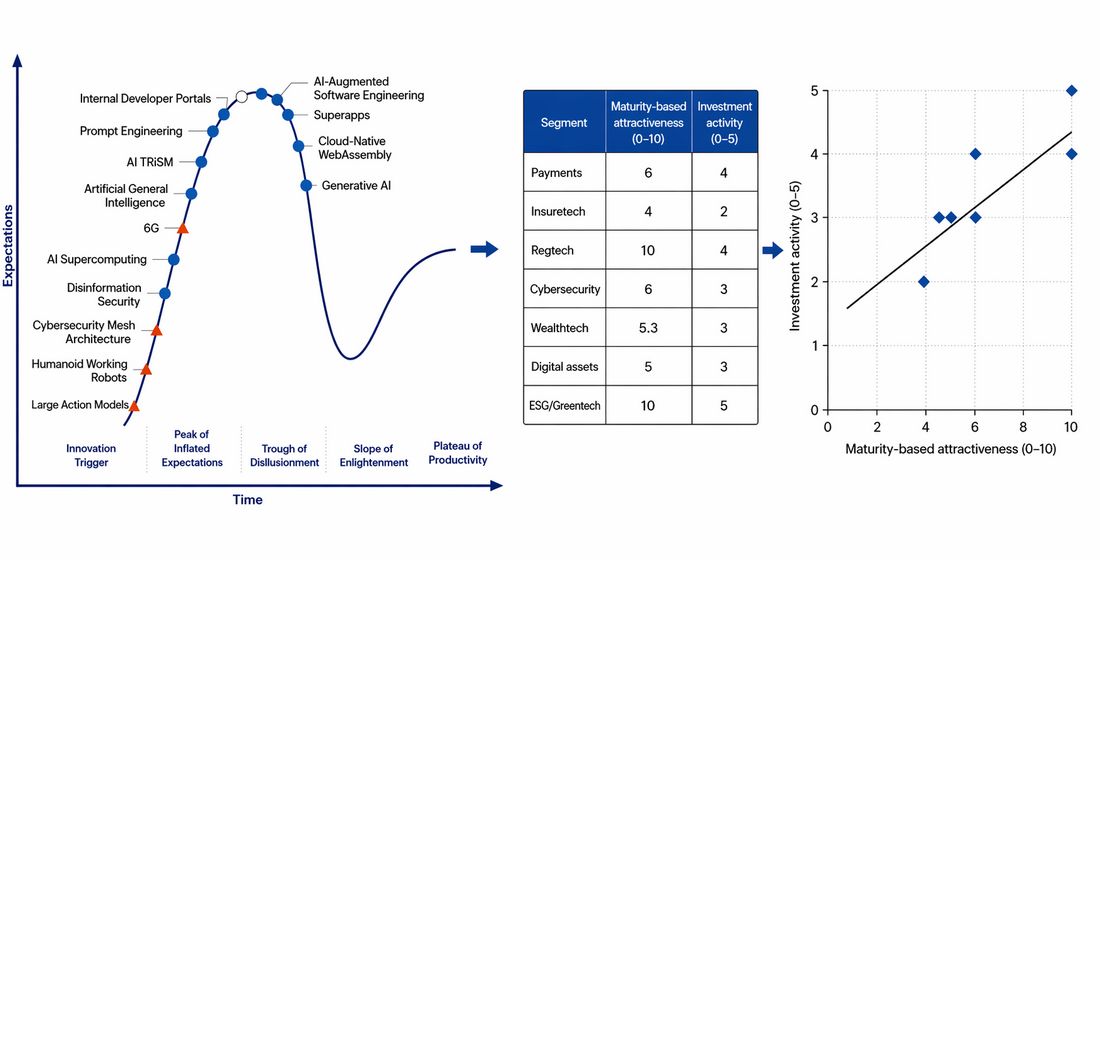
The methodological basis of this study is the Gartner Hype Cycle model. The information basis is data from global rating and research agencies. The global investment dynamics for 2018–2024 were analyzed, as well as their parameters in the context of individual sectors, which made it possible to identify the main patterns of investment activity.
Based on the rule-based approach, methods for determining score estimates for investment activity and for the technology maturity factor have been proposed. They make it possible to eliminate the nonlinearity critical for the use of correlation analysis, which is inherent in the Gartner model. The results of the analysis of investment activity and maturity factors of key technologies confirmed a high positive correlation (r = 0.8615) between the indicated indicators.
It was determined that the main driver for increasing investment activity is the implementation of key technologies that are near the “peak of inflated expectations” in the Gartner model. It was established that at present such technologies are often associated with artificial intelligence. Thus, taking into account the stages of technology maturity allows one to better explain investor behavior and predict changes in investment activity in FinTech segments.
The results also extend to other sectors of the digital economy with a high share of intangible assets, fast cycles of updating and scaling, network effects, and a global sales model
References
- Cloft, H. J. (2008). What is All of the Hype About? American Journal of Neuroradiology, 29 (9), 1604–1604. https://doi.org/10.3174/ajnr.a1228
- Alt, R., Beck, R., Smits, M. T. (2018). FinTech and the transformation of the financial industry. Electronic Markets, 28 (3), 235–243. https://doi.org/10.1007/s12525-018-0310-9
- Pulse of Fintech H1 2025: Global analysis of fintech funding (2025). KPMG. Available at: https://assets.kpmg.com/content/dam/kpmgsites/xx/pdf/2025/08/pulse-of-fintech-h1-2025.pdf
- Mints, A., Kolodiziev, O., Krupka, M., Vyshyvana, B., Yastrubetska, L. (2022). A cross-impact analysis of the bank payment card market parameters and non-financial sectors’ indicators in the Ukrainian economy. Banks and Bank Systems, 17 (2), 163–177. https://doi.org/10.21511/bbs.17(2).2022.14
- Ogawa, E., Luo, P. (2022). Macroeconomic effects of global policy and financial risks. International Journal of Finance & Economics, 29 (1), 177–205. https://doi.org/10.1002/ijfe.2681
- Zeng, T., Wei, L., Reniers, G., Chen, G. (2024). A comprehensive study for probability prediction of domino effects considering synergistic effects. Reliability Engineering & System Safety, 251, 110318. https://doi.org/10.1016/j.ress.2024.110318
- Benkenstein, M., Bloch, B. (1993). Models of Technological Evolution: Their Impact on Technology Management. Marketing Intelligence & Planning, 11 (1), 20–27. https://doi.org/10.1108/02634509310024146
- Levchenko, Y. (2018). Assessing and ensuring enterprise investment attractiveness in the context of regional development. Mykolo Romerio Universitetas. Available at: https://gs.elaba.lt/object/elaba:29698767
- Dedehayir, O., Steinert, M. (2016). The hype cycle model: A review and future directions. Technological Forecasting and Social Change, 108, 28–41. https://doi.org/10.1016/j.techfore.2016.04.005
- Gavrysh, O., Kukharuk, A., Gavrysh, I. (2022). Innovative Determinants of the Investment Attractiveness of a Country: The Case of Ukraine. Marketing of Scientific and Research Organizations, 44 (2), 21–40. https://doi.org/10.2478/minib-2022-0007
- Amosha, O., Velychko, V., Troian, V. (2023). Strategies for managing the company’s potential to increase the enterprise’s investment attractiveness. Baltic Journal of Economic Studies, 9 (2), 34–39. https://doi.org/10.30525/2256-0742/2023-9-2-34-39
- Lin, C., Huang, Y. A., Cheng, M. S., Lin, W. C. (2007). Effects of information technology maturity on the adoption of investment evaluation methodologies: A survey of large Australian organizations. International Journal of management, 24 (4), 697. Available at: https://www.semanticscholar.org/paper/Effects-of-Information-Technology-Maturity-on-the-A-Lin-Huang/5051dfcaf161e266dd2b3a36cd687a124d437323
- Shpak, N., Vytvytska, O., Martynyuk, O., Kylaec, M., Sroka, W. (2022). Formation of management and technological maturity levels of enterprises for their dynamic development. Engineering Management in Production and Services, 14 (3), 1–12. https://doi.org/10.2478/emj-2022-0022
- Akhtar, Q., Nosheen, S. (2022). The impact of fintech and banks M&A on Acquirer’s performance: A strategic win or loss? Borsa Istanbul Review, 22 (6), 1195–1208. https://doi.org/10.1016/j.bir.2022.08.007
- Baranovskyi, O., Kuzheliev, M., Zherlitsyn, D., Serdyukov, K., Sokyrko, O. (2021). Cryptocurrency market trends and fundamental economic indicators: correlation and regression analysis. Financial and Credit Activity Problems of Theory and Practice, 3 (38), 249–261. https://doi.org/10.18371/fcaptp.v3i38.237454
- Grodal, S., Krabbe, A. D., Chang-Zunino, M. (2023). The Evolution of Technology. Academy of Management Annals, 17 (1), 141–180. https://doi.org/10.5465/annals.2021.0086
- Experiences and future perspectives in digital banking. Architecht. Available at: https://architecht.com/en/corporate/blog/technology/experiences-and-future-perspectives-in-digital-banking/
- Gartner. Available at: https://www.gartner.com/
- Griffiths, P. D. R. (2021). Fintech and Its Historical Perspective. The Palgrave Handbook of FinTech and Blockchain, 19–50. https://doi.org/10.1007/978-3-030-66433-6_2
- Li, G., Au, C. H. A., Chou, C.-Y. (2025). Exploring the trend of the cryptocurrency market – an extended hype cycle perspective. SAIS 2025 Proceedings. Available at: https://aisel.aisnet.org/sais2025/28/
- Lee, K.-F. (2018). The four waves of A.I. FORTUNE. Available at: https://fortune.com/2018/10/22/artificial-intelligence-ai-deep-learning-kai-fu-lee/
- Kolodiziev, O., Chmutova, I., Biliaieva, V. (2016). Selecting a kind of financial innovation according to the level of a bank’s financial soundness and its life cycle stage. Banks and Bank Systems, 11 (4), 40–49. https://doi.org/10.21511/bbs.11(4).2016.04
- Ellul, J. (2021). Blockchain is dead! Long live Blockchain! The Journal of The British Blockchain Association, 4 (1), 1–11. https://doi.org/10.31585/jbba-4-1-(8)2021
- Akwue, I. A. (2024). Financing futures: How hype shapes the funding and progression of quantum computing and AI. University of Twente. Available at: https://purl.utwente.nl/essays/100360
- Cnattingius, S., Johansson, S., Razaz, N. (2020). Apgar Score and Risk of Neonatal Death among Preterm Infants. New England Journal of Medicine, 383 (1), 49–57. https://doi.org/10.1056/nejmoa1915075
- Asif, M., Saxena, A., Bhardwaj Padmaja, S., Tiwari, S., Chaturvedi, S. (2024). A study of altman z-score bankruptcy model for assessing bankruptcy risk of national stock exchange-listed companies. Proceedings on Engineering Sciences, 6 (2), 789–806. https://doi.org/10.24874/pes06.02a.006
- Kim, K. O., Zuo, M. J. (2018). General model for the risk priority number in failure mode and effects analysis. Reliability Engineering & System Safety, 169, 321–329. https://doi.org/10.1016/j.ress.2017.09.010
- Salazar, G., Russi-Vigoya, M. N. (2021). Technology Readiness Level as the Foundation of Human Readiness Level. Ergonomics in Design: The Quarterly of Human Factors Applications, 29 (4), 25–29. https://doi.org/10.1177/10648046211020527
- Keeney, R. L., Raiffa, H. (1993). Decisions with multiple objectives: preferences and value trade-offs. Cambridge University Press, 569.
- Brans, J. P., Vincke, Ph. (1985). Note—A Preference Ranking Organisation Method. Management Science, 31 (6), 647–656. https://doi.org/10.1287/mnsc.31.6.647
- Bond, T. G., Fox, C. M. (2013). Applying the Rasch Model. Psychology Press. https://doi.org/10.4324/9781410614575
- Saaty, T. L. (2008). Decision making with the analytic hierarchy process. International Journal of Services Sciences, 1 (1), 83. https://doi.org/10.1504/ijssci.2008.017590
- Get Grounded With the 2025 Gartner Hype Cycle™ for Emerging Technologies. Gartner. Available at: https://www.gartner.com/en/articles/hype-cycle-for-emerging-technologies
- Bujang, M. A., Baharum, N. (2016). Sample Size Guideline for Correlation Analysis. World Journal of Social Science Research, 3 (1), 37. https://doi.org/10.22158/wjssr.v3n1p37
- Chaddock, R. E. (1925). Principles and methods of statistics. Houghton Mifflin, 471. Available at: https://openlibrary.org/books/OL6680442M/Principles_and_methods_of_statistics
- Mints, O., Yankovets, A. (2025). The Investment Attractiveness of FinTech Businesses in the Context of Global Technological Trends. Economic Herald of the Donbas, 1 (79), 141–147. https://doi.org/10.12958/1817-3772-2025-1(79)-141-147
- Artificial intelligence (AI) startup funding worldwide from 2011 to 2023 (in billion U.S. dollars), by Quarter (2025). Review Report. Available at: https://reviewreport.co/artificial-intelligence-ai-startup-funding-worldwide-from-2011-to-2023-in-billion-u-s-dollars-by-quarter
- State of European FinTech 2024 (2024). FinchCapital. Available at: https://finchcapital.com/archive/state-of-european-fintech-2024
Downloads
Published
How to Cite
Issue
Section
License
Copyright (c) 2026 Oleksiy Mints, Oleh Kolodiziev, Olena Khadzhynova, Mykhailo Krupka, Nazar Demchyshak, Oleksandr Shchepka, Pavlo Sidelov, Markiian Zaplatynskyi

This work is licensed under a Creative Commons Attribution 4.0 International License.
The consolidation and conditions for the transfer of copyright (identification of authorship) is carried out in the License Agreement. In particular, the authors reserve the right to the authorship of their manuscript and transfer the first publication of this work to the journal under the terms of the Creative Commons CC BY license. At the same time, they have the right to conclude on their own additional agreements concerning the non-exclusive distribution of the work in the form in which it was published by this journal, but provided that the link to the first publication of the article in this journal is preserved.
A license agreement is a document in which the author warrants that he/she owns all copyright for the work (manuscript, article, etc.).
The authors, signing the License Agreement with TECHNOLOGY CENTER PC, have all rights to the further use of their work, provided that they link to our edition in which the work was published.
According to the terms of the License Agreement, the Publisher TECHNOLOGY CENTER PC does not take away your copyrights and receives permission from the authors to use and dissemination of the publication through the world's scientific resources (own electronic resources, scientometric databases, repositories, libraries, etc.).
In the absence of a signed License Agreement or in the absence of this agreement of identifiers allowing to identify the identity of the author, the editors have no right to work with the manuscript.
It is important to remember that there is another type of agreement between authors and publishers – when copyright is transferred from the authors to the publisher. In this case, the authors lose ownership of their work and may not use it in any way.








