Determining the optimal composition of stabilization systems in structured low-calorie dairy desserts with protein and carbohydrogen components
DOI:
https://doi.org/10.15587/1729-4061.2026.356499Keywords:
dairy desserts, low-calories, stabilization systems, pudding, cream, composition design, viscosityAbstract
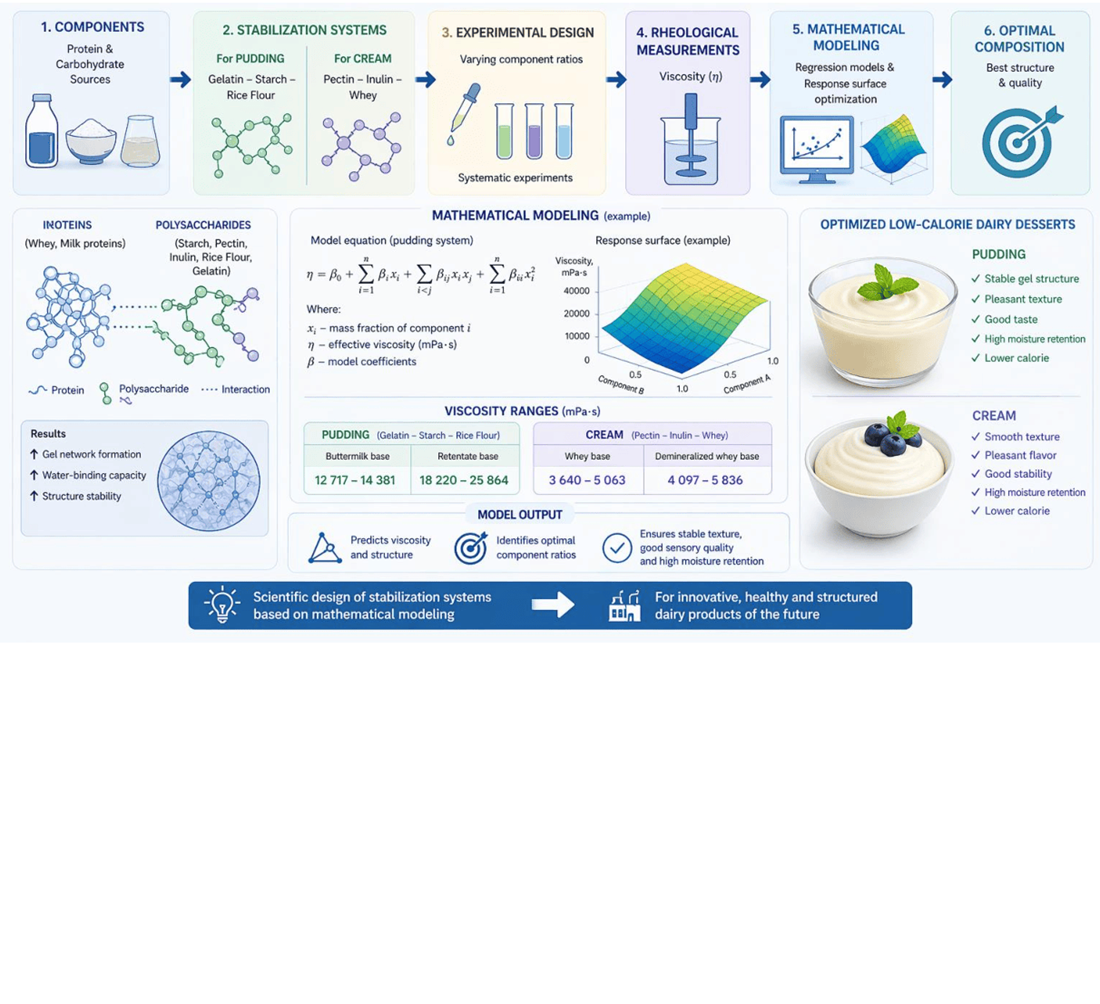
This study investigates structured low-calorie dairy desserts with multicomponent stabilization systems, including protein and carbohydrate components.
The issue of the ratio of stabilization systems' components and their influence on the structural-mechanical and organoleptic characteristics of the product remains insufficiently studied. The lack of substantiated mathematical models complicates the targeted design of recipes with predefined properties.
Mathematical models of the dependence of viscosity on the ratio of components in the stabilization system have been constructed. For puddings with the "gelatin-starch-rice flour" system, the effective viscosity based on buttermilk was 12717–14381 mPa·s, based on retentate – 18220–25864 mPa·s. For creams with the "pectin-inulin-whey" system – 3640–5063 mPa·s and 4097–5836 mPa·s, respectively.
Organoleptic and physicochemical indicators confirmed that the optimized stabilization systems provide a stable structure of desserts with proper organoleptic characteristics and high moisture retention capacity.
It was established that the interaction of protein molecules with polysaccharide chains during thermomechanical processing leads to the formation of a stable gel structure and an increase in water-binding capacity. Taking these interactions into account in mathematical models has made it possible to determine the optimal composition of stabilization systems.
The effectiveness of combining rice flour, starch, and gelatin for structuring pudding; inulin, pectin, and demineralized whey for cream was confirmed by mathematical modeling.
The results could be used by dairy processing enterprises when devising low-calorie products with a predefined structure.
References
- Peshuk, L., Gorbach, A., Bakhmach, V. (2017). Prospects for the use of plant and animal proteins in the technology of meat products. Scientific Messenger LNUVMB, 19 (80), 68–73. Available at: https://doi.org/10.15421/nvlvet8014
- Perraud, E., Wang, J., Salomé, M., Huneau, J.-F., Lapidus, N., Mariotti, F. (2022). Plant and Animal Protein Intakes Largely Explain the Nutritional Quality and Health Value of Diets Higher in Plants: A Path Analysis in French Adults. Frontiers in Nutrition, 9. https://doi.org/10.3389/fnut.2022.924526
- Yak kharchuvatysia zbalansovano. Ministerstvo okhorony zdorovia Ukrainy. Available at: https://moz.gov.ua/article/health/jak-harchuvatisja-zbalansovano
- Higher ratio of plant protein to animal protein may improve heart health. Harvard T.H. Chan. Available at: https://hsph.harvard.edu/news/higher-ratio-of-plant-protein-to-animal-protein-may-improve-heart-health
- Krutovyi, G., Zaparenko, G., Zakharenko, V., Burliubayeva, T. (2014). Three principles of projecting recipes of floury products for nutrition systems. Prohresyvni tekhnika ta tekhnolohiyi kharchovykh vyrobnytstv restorannoho hospodarstva i torhivli, 2, 222–230. Available at: https://repo.btu.kharkiv.ua/server/api/core/bitstreams/27c8d582-93ed-43f4-aa7c-6bf94e157165/content
- Tkachenko, N. A., Nekrasov, P. O., Kopiyko, A. V. (2016). Mathematical modelling of the component composition of combined yoghurt drinks. Zernovi produkty i kombikormy, 61 (1), 20–25. Available at: https://repository.kpi.kharkov.ua/handle/KhPI-Press/40198
- Yukalo, V., Datsyshyn, K., Storozh, L. (2024). The effect of low heating temperatures on casein whey proteins. Food Science and Technology, 18 (1). https://doi.org/10.15673/fst.v18i1.2847
- Minorova, A., Rudakova, T., Krushelnytska, N., Narizhnyi, S. (2020). Biological value of dry milk multicomponent mixtures. FOOD RESOURCES, 8 (14), 125–136. https://doi.org/10.31073/foodresources2020-14-13
- Minorova, A., Romanchuk, I., Zhukova, Ya., Krushelnytska, N., Vezhlivtseva, S. (2017). Protein composition and technological properties of milk whey concentrates. Agricultural Science and Practice, 4 (2), 52–58. https://doi.org/10.15407/agrisp4.02.052
- Sakkas, L., Evageliou, V., Igoumenidis, P. E., Moatsou, G. (2022). Properties of Sweet Buttermilk Released from the Churning of Cream Separated from Sheep or Cow Milk or Sheep Cheese Whey: Effect of Heat Treatment and Storage of Cream. Foods, 11 (3), 465. https://doi.org/10.3390/foods11030465
- Bellés, A., Abad, I., Sánchez, L., Grasa, L. (2023). Whey and Buttermilk‐Based Formulas Modulate Gut Microbiota in Mice with Antibiotic‐Induced Dysbiosis. Molecular Nutrition & Food Research, 67 (20). https://doi.org/10.1002/mnfr.202300248
- Guiné, R. P. F., De Lemos, E. T. (2018). Development of New Dairy Products with Functional Ingredients. Journal of Culinary Science & Technology, 18 (3), 159–176. https://doi.org/10.1080/15428052.2018.1552901
- Meyer, D., Bayarri, S., Tárrega, A., Costell, E. (2011). Inulin as texture modifier in dairy products. Food Hydrocolloids, 25 (8), 1881–1890. https://doi.org/10.1016/j.foodhyd.2011.04.012
- Rudakova, T., Romanchuk, I., Minorova, A., Moiseeva, L., Krushelnytska, N., Narizhnyy, S. (2022). Rationale for stabilization systems for dairy desserts with combined raw material composition. FOOD RESOURCES, 10 (18), 131–141. https://doi.org/10.31073/foodresources2022-18-13
- Rezvani, F., Abbasi, H., Nourani, M. (2020). Effects of protein-polysaccharide interactions on the physical and textural characteristics of low‐fat whipped cream. Journal of Food Processing and Preservation, 44 (10). https://doi.org/10.1111/jfpp.14743
- Sahin, S., Hamamci, H., Garayev, S. (2016). Rheological properties of lactose-free dairy desserts. Food Science and Technology International, 22 (7), 609–620. https://doi.org/10.1177/1082013216636262
- Chen, C., Pan, Z. (2023). An overview of progress, challenges, needs and trends in mathematical modeling approaches in food drying. Drying Technology, 41 (16), 2586–2605. https://doi.org/10.1080/07373937.2023.2207636
- Alam, T., Jha, A., Saraswat, N., Dhasmana, J. (2012). Optimization of ingredients for the manufacture of fruit cream using response surface methodology. Asian Journal of Dairy and Food Research, 4, 244–251. Available at: https://arccjournals.com/journal/asian-journal-of-dairy-and-food-research/ARCC726
- Díaz-Bustamante, M. L., Fernández-Niño, M., Reyes, L. H., Alvarez Solano, O. A. (2022). Multiscale Approach to Dairy Products Design. Frontiers in Chemical Engineering, 4. https://doi.org/10.3389/fceng.2022.830314
- Jha, A., Tripathi, A. D., Alam, T., Yadav, R. (2011). Process optimization for manufacture of pearl millet-based dairy dessert by using response surface methodology (RSM). Journal of Food Science and Technology, 50 (2), 367–373. https://doi.org/10.1007/s13197-011-0347-7
- Ho, Q. T., Carmeliet, J., Datta, A. K., Defraeye, T., Delele, M. A., Herremans, E. et al. (2013). Multiscale modeling in food engineering. Journal of Food Engineering, 114 (3), 279–291. https://doi.org/10.1016/j.jfoodeng.2012.08.019
- Gladkyi, F., Tymchenko, V., Nekrasov, P., Fediakina, Z., Kunitsa, E., Molchenko, S. (2018). Sensory analysis of food products. Kharkiv: TECHNOLOGY CENTER PC. https://doi.org/10.15587/978-617-7319-16-9
- Critical values for Student’s t-distribution. Available at: https://www.stat.purdue.edu/~lfindsen/stat503/t-Dist.pdf
- Metodychni vkazivky do laboratornykh ta samostiynykh robit iz dystsypliny "Matematychna statystyka" (2014). Kyiv: Vydavnycho-polihrafichnyi tsentr “Kyivskyi universytet”, 84. Available at: https://mechmat.knu.ua/wp-content/uploads/2023/08/met_stu.pdf
- Lin, H.-T. V., Tsai, J.-S., Liao, H.-H., Sung, W.-C. (2025). Effect of Hydrocolloids on Penetration Tests, Sensory Evaluation, and Syneresis of Milk Pudding. Polymers, 17 (3), 300. https://doi.org/10.3390/polym17030300
- Chen, L., Opara, U. L. (2013). Texture measurement approaches in fresh and processed foods – A review. Food Research International, 51 (2), 823–835. https://doi.org/10.1016/j.foodres.2013.01.046
- Saint-Eve, A., Lévy, C., Le Moigne, M., Ducruet, V., Souchon, I. (2008). Quality changes in yogurt during storage in different packaging materials. Food Chemistry, 110 (2), 285–293. https://doi.org/10.1016/j.foodchem.2008.01.070
- Cheng, J., Ma, Y., Li, X., Yan, T., Cui, J. (2015). Effects of milk protein-polysaccharide interactions on the stability of ice cream mix model systems. Food Hydrocolloids, 45, 327–336. https://doi.org/10.1016/j.foodhyd.2014.11.027
- Zahn, S., Hoppert, K., Ullrich, F., Rohm, H. (2013). Dairy-Based Emulsions: Viscosity Affects Fat Difference Thresholds and Sweetness Perception. Foods, 2 (4), 521–533. https://doi.org/10.3390/foods2040521
Downloads
Published
How to Cite
Issue
Section
License
Copyright (c) 2026 Iryna Romanchuk, Tetіana Rudakova, Antonina Minorova, Viktor Voroshchuk, Sergiy Narizhnyy, Lesia Korol-Bezpala, Liudmyla Zahorui

This work is licensed under a Creative Commons Attribution 4.0 International License.
The consolidation and conditions for the transfer of copyright (identification of authorship) is carried out in the License Agreement. In particular, the authors reserve the right to the authorship of their manuscript and transfer the first publication of this work to the journal under the terms of the Creative Commons CC BY license. At the same time, they have the right to conclude on their own additional agreements concerning the non-exclusive distribution of the work in the form in which it was published by this journal, but provided that the link to the first publication of the article in this journal is preserved.
A license agreement is a document in which the author warrants that he/she owns all copyright for the work (manuscript, article, etc.).
The authors, signing the License Agreement with TECHNOLOGY CENTER PC, have all rights to the further use of their work, provided that they link to our edition in which the work was published.
According to the terms of the License Agreement, the Publisher TECHNOLOGY CENTER PC does not take away your copyrights and receives permission from the authors to use and dissemination of the publication through the world's scientific resources (own electronic resources, scientometric databases, repositories, libraries, etc.).
In the absence of a signed License Agreement or in the absence of this agreement of identifiers allowing to identify the identity of the author, the editors have no right to work with the manuscript.
It is important to remember that there is another type of agreement between authors and publishers – when copyright is transferred from the authors to the publisher. In this case, the authors lose ownership of their work and may not use it in any way.








