Construction of a theoretical model of oscillations of a tillage (seeding) implement with independent mounting and two support rollers
DOI:
https://doi.org/10.15587/1729-4061.2026.356828Keywords:
tillage (seeding) implement, aggregation, support rollers, parallelogram oscillatory system, soil surface following, tillage (seeding) depth accuracyAbstract
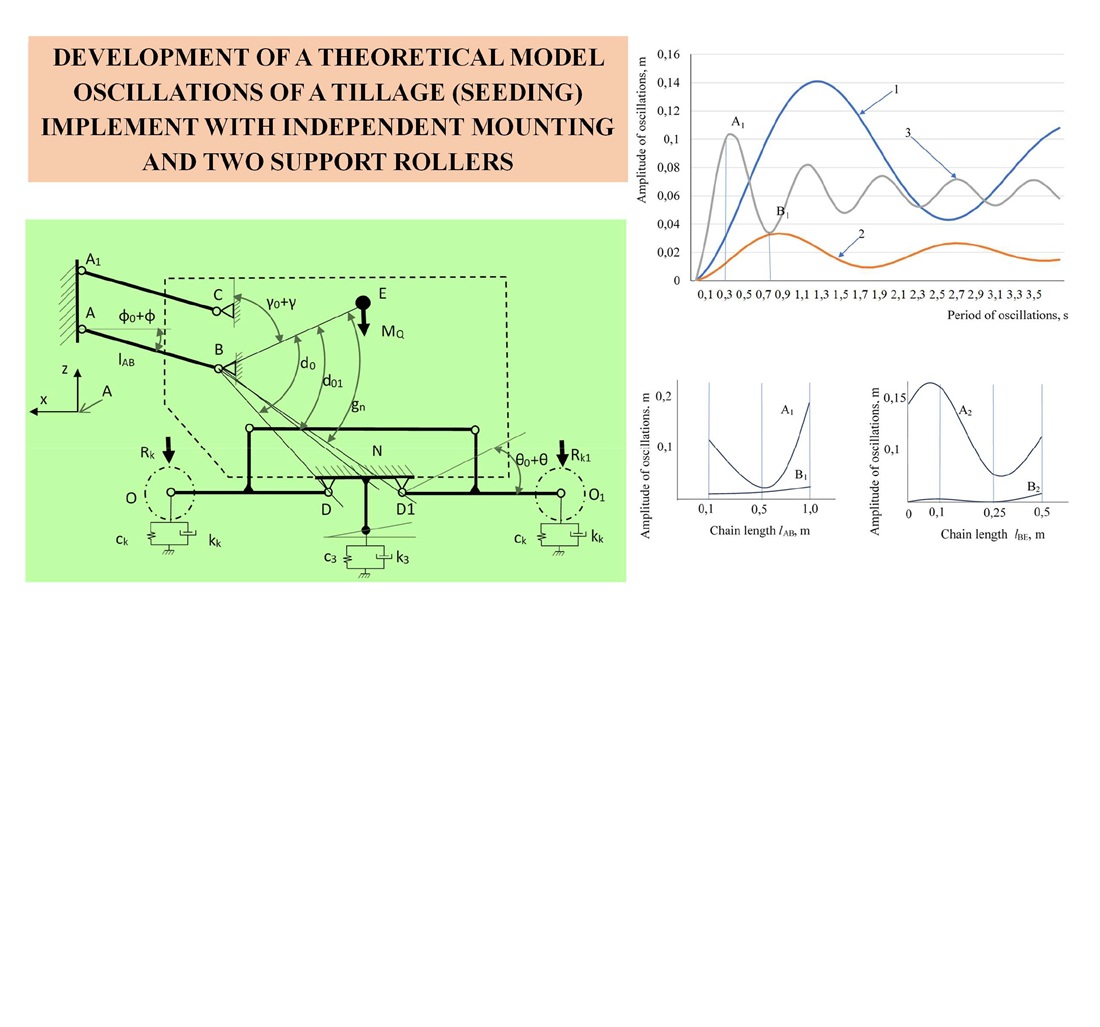
This study investigates natural harmonic vibrations of a working implement equipped with a lever-type hitching system to the traction mechanisms and two support points on the surface. The task addressed relates to the absence of a generalized theoretical model for quantitative prediction of amplitude-frequency characteristics of such systems. This complicates the substantiation of rational structural and geometric parameters to enable technologically acceptable vertical deviations of working bodies under field irregularities and variable soil properties.
A calculation scheme of a two-support lever mechanism has been devised, separating the implement’s intrinsic dynamics from the power unit motion and considering roller-soil contact as an excitation source. An energy-based mathematical model using Lagrange equations of the second kind has been constructed; parametric modeling revealed the decisive influence of attachment geometry and made it possible to determine rational parameter values. The length of the hitch lever to the power unit is 0.5 m, and the distance from the oscillatory system’s center of mass to the hitch point is 0.25 m.
The advantage of the results involves the analytical relationship between the mechanism geometry, contact parameters, and vibration characteristics, which enables structural minimization of vertical deviations without mandatory use of active control. The identified regularities are explained by changes in the reduced inertial-elastic characteristics of the system when varying the lever arms and the position of the hitch point relative to the center of mass.
The results could be practically applied at the stages of designing and adjusting implements provided that equivalent elastic-damping parameters of the “roller-soil” contact are identified for specific field and soil conditions and operating speeds
References
- Kim, Y.-S., Lee, S.-D., Baek, S.-M., Baek, S.-Y., Jeon, H.-H., Lee, J.-H. et al. (2022). Analysis of the Effect of Tillage Depth on the Working Performance of Tractor-Moldboard Plow System under Various Field Environments. Sensors, 22 (7), 2750. https://doi.org/10.3390/s22072750
- Rud, A. (2025). Analysis of deformation characteristics of spring elements of tillage tools under dynamic loads. Naukovij Žurnal «Tehnìka Ta Energetika», 16 (1), 43–53. https://doi.org/10.31548/machinery/1.2025.43
- Bauer, F., Porteš, P., Slimařík, D., Čupera, J., Fajman, M. (2017). Observation of load transfer from fully mounted plough to tractor wheels by analysis of three point hitch forces during ploughing. Soil and Tillage Research, 172, 69–78. https://doi.org/10.1016/j.still.2017.05.007
- Martelli, M., Chiarabelli, D., Gessi, S., Marani, P., Mucchi, E., Polastri, M. (2023). Comprehensive lumped parameter and multibody approach for the dynamic simulation of agricultural tractors with tyre–soil interaction. IET Cyber-Systems and Robotics, 5 (3). https://doi.org/10.1049/csy2.12092
- Kim, Y.-S., Kim, T.-J., Kim, Y.-J., Lee, S.-D., Park, S.-U., Kim, W.-S. (2020). Development of a Real-Time Tillage Depth Measurement System for Agricultural Tractors: Application to the Effect Analysis of Tillage Depth on Draft Force during Plow Tillage. Sensors, 20 (3), 912. https://doi.org/10.3390/s20030912
- Zhu, Y., Cui, B., Yu, Z., Gao, Y., Wei, X. (2024). Tillage Depth Detection and Control Based on Attitude Estimation and Online Calibration of Model Parameters. Agriculture, 14 (12), 2130. https://doi.org/10.3390/agriculture14122130
- Xiao, M., Ma, Y., Wang, C., Chen, J., Zhu, Y., Bartos, P., Geng, G. (2023). Design and experiment of fuzzy-PID based tillage depth control system for a self-propelled electric tiller. International Journal of Agricultural and Biological Engineering, 16 (4), 116–125. https://doi.org/10.25165/j.ijabe.20231604.8116
- Wang, A., Ji, X., Zhu, Y., Wang, Q., Wei, X., Zhang, S. (2023). Tillage depth regulation system via depth measurement feedback and composite sliding mode control: A field comparison validation study. Measurement and Control, 57 (6), 685–702. https://doi.org/10.1177/00202940231216139
- Shang, J., Liu, D., Song, X., Han, Y., He, S., Zhang, Y. et al. (2024). Sowing depth stability analysis and test verification of no-tillage planter parallel 4-bar row unit. Heliyon, 10 (19), e36721. https://doi.org/10.1016/j.heliyon.2024.e36721
- Sharipov, G. M., Paraforos, D. S., Griepentrog, H. W. (2018). Implementation of a magnetorheological damper on a no-till seeding assembly for optimising seeding depth. Computers and Electronics in Agriculture, 150, 465–475. https://doi.org/10.1016/j.compag.2018.05.024
- Xu, T., Zhang, R., Wang, Y., Jiang, X., Feng, W., Wang, J. (2022). Simulation and Analysis of the Working Process of Soil Covering and Compacting of Precision Seeding Units Based on the Coupling Model of DEM with MBD. Processes, 10 (6), 1103. https://doi.org/10.3390/pr10061103
- Zhang, C., Wang, X., Guo, M., Zhao, J., Li, M. (2024). A compacting device of rice dry direct-seeding planter based on DEM-MFBD coupling simulation significantly improves the seedbed uniformity and seedling emergence rate. Biosystems Engineering, 246, 26–40. https://doi.org/10.1016/j.biosystemseng.2024.07.018
- Horabik, J., Molenda, M. (2016). Parameters and contact models for DEM simulations of agricultural granular materials: A review. Biosystems Engineering, 147, 206–225. https://doi.org/10.1016/j.biosystemseng.2016.02.017
- Bulgakov, V., Pascuzzi, S., Nadykto, V., Ivanovs, S. (2018). A Mathematical Model of the Plane-Parallel Movement of an Asymmetric Machine-and-Tractor Aggregate. Agriculture, 8 (10), 151. https://doi.org/10.3390/agriculture8100151
- Bulgakov, V., Pascuzzi, S., Ivanovs, S., Kaletnik, G., Yanovich, V. (2018). Angular oscillation model to predict the performance of a vibratory ball mill for the fine grinding of grain. Biosystems Engineering, 171, 155–164. https://doi.org/10.1016/j.biosystemseng.2018.04.021
- Bulgakov, V., Pascuzzi, S., Nadykto, V., Ivanovs, S., Adamchuk, V. (2021). Experimental study of the implement-and-tractor aggregate used for laying tracks of permanent traffic lanes inside controlled traffic farming systems. Soil and Tillage Research, 208, 104895. https://doi.org/10.1016/j.still.2020.104895
- Padalka, V., Liashenko, S., Kalinichenko, A., Burlaka, O., Sakalo, V., Padalka, Y. (2021). Modeling of Resonance Phenomena in Self-Oscillating System of Agricultural Machines. 2021 IEEE International Conference on Modern Electrical and Energy Systems (MEES), 1–6. https://doi.org/10.1109/mees52427.2021.9598763
Downloads
Published
How to Cite
Issue
Section
License
Copyright (c) 2026 Viacheslav Padalka, Oleksandr Gorbenko, Dmytro Khvostenko, Andrii Lazorenko, Vladyslav Alpidovskyi

This work is licensed under a Creative Commons Attribution 4.0 International License.
The consolidation and conditions for the transfer of copyright (identification of authorship) is carried out in the License Agreement. In particular, the authors reserve the right to the authorship of their manuscript and transfer the first publication of this work to the journal under the terms of the Creative Commons CC BY license. At the same time, they have the right to conclude on their own additional agreements concerning the non-exclusive distribution of the work in the form in which it was published by this journal, but provided that the link to the first publication of the article in this journal is preserved.
A license agreement is a document in which the author warrants that he/she owns all copyright for the work (manuscript, article, etc.).
The authors, signing the License Agreement with TECHNOLOGY CENTER PC, have all rights to the further use of their work, provided that they link to our edition in which the work was published.
According to the terms of the License Agreement, the Publisher TECHNOLOGY CENTER PC does not take away your copyrights and receives permission from the authors to use and dissemination of the publication through the world's scientific resources (own electronic resources, scientometric databases, repositories, libraries, etc.).
In the absence of a signed License Agreement or in the absence of this agreement of identifiers allowing to identify the identity of the author, the editors have no right to work with the manuscript.
It is important to remember that there is another type of agreement between authors and publishers – when copyright is transferred from the authors to the publisher. In this case, the authors lose ownership of their work and may not use it in any way.








