Study of the regularities of centerline porosity formation in continuously cast billets depending on casting parameters
DOI:
https://doi.org/10.15587/1729-4061.2026.356920Keywords:
continuous billet, centerline porosity, physical modeling, similarity numbers, temperature-speed regime, stearinAbstract
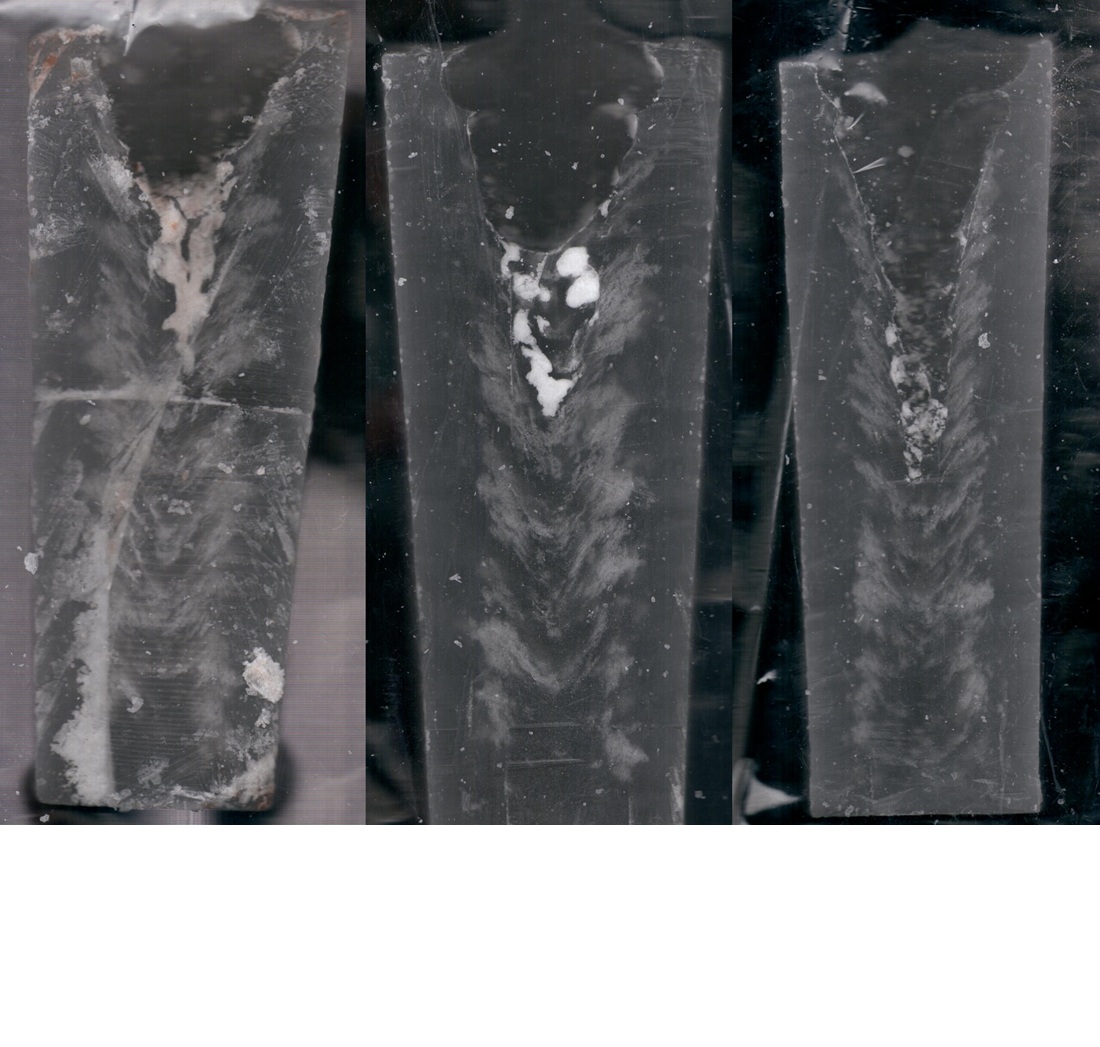
This study investigates the process that forms centerline porosity in the axial zone of a continuously cast steel billet during its hardening. The task addressed relates to the need to establish rational parameters for the temperature-speed mode of casting to minimize axial porosity, which is critical for increasing the density of the metal and the quality of rolled products.
A comprehensive methodology for physical modeling of the hardening process using stearin as a model substance has been devised. Based on the analysis of similarity numbers (Biot, Fourier, Kosovych), the exact scales of modeling were established: by time – 1.854, by linear dimensions – 0.1778, by heat transfer coefficient – 0.04639. It was determined that for an adequate simulation of the formation of the bloom blank, the closing angle of the liquid core varies within 2.3–6°. Quantitative parameters of the experiment on the model were established: overheating of the melt in the range of 1.8–4.2°C, which corresponds to 15–35°C for steel.
The resulting data are explained by the laws of convection heat transfer and phase transition. The angle of inclination of the crystallization front and the intensity of heat removal determine the moment of formation of "bridges" and interceptions in the thermal center, which directly defines the morphology and volume of shrinkage pores.
Unlike conventional mathematical modeling, the proposed approach provides high visual reliability of defect formation due to the use of the π-theorem for the selection of physical parameters. This makes it possible to investigate critical system states without the risk of emergencies in industrial settings.
The research results could be used for implementation at metallurgical enterprises in the design and optimization of billet cooling modes on a continuous billet casting machine (CCM), which will ensure an increase in the yield of suitable metal
References
- Sigarev, E. N., Chernyatevich, A. G., Chubin, K. I., Zarandiya, S. A. (2011). Desulfurization of hot metal by the injection of disperse magnesium through a submerged rotating tuyere. Steel in Translation, 41 (6), 487–491. https://doi.org/10.3103/s0967091211060155
- Wang, X., Guo, Y., Xiao, P., Liu, Z., Zhu, L. (2023). Numerical simulation of shrinkage porosity defect in billet continuous casting. High Temperature Materials and Processes, 42 (1). https://doi.org/10.1515/htmp-2022-0246
- Yao, C., Wang, M., Cheng, M., Xing, L., Wang, Y., Gao, Y., Bao, Y. (2022). Effect of Dynamic Soft Reduction Range and Amount on Central Segregation in Bloom and the Resulting Microstructure in the Rod of GCr15‐Bearing Steel. Steel Research International, 93 (11). https://doi.org/10.1002/srin.202200495
- Gao, Y., Bao, Y., Wang, Y., Wang, M., Zhang, M. (2023). Development of a Novel Strand Reduction Technology for the Continuous Casting of Homogeneous High‐Carbon Steel Billet. Steel Research International, 94 (5). https://doi.org/10.1002/srin.202200740
- Han, Y., Yan, W., Zhang, J., Chen, W., Chen, J., Liu, Q. (2020). Optimization of Thermal Soft Reduction on Continuous-Casting Billet. ISIJ International, 60 (1), 106–113. https://doi.org/10.2355/isijinternational.isijint-2019-409
- Liu, Y., Liu, J., He, Y. (2022). Evolution Behavior and Closure Mechanism of Porosity in Large Billet during the Reduction Pretreatment. Metals, 12 (4), 599. https://doi.org/10.3390/met12040599
- Gao, Y., Bao, Y., Wang, M., Zhang, H., Wang, Y. (2024). Investigation on the effect of reduction process on internal quality of high carbon steel billet and its evolution in as-rolled wire rod. Metallurgical Research & Technology, 121 (5), 506. https://doi.org/10.1051/metal/2024058
- Shen, C., Liping, W., Qiang, L., Biao, S., Zheng, Y., Chunlin, H. (2019). Research on improving central defects of billet by external vibration strike. Ironmaking & Steelmaking, 47 (9), 986–990. https://doi.org/10.1080/03019233.2019.1652446
- Shakhov, S. I., Sivak, B. A., Vdovin, K. N., Shakhov, D. S., Kerimov, R. I., Bairamov, А. Т. (2020). Perfection of the equipment of electromagnetic stirring in moulds of billet and bloom CCM. Ferrous Metallurgy. Bulletin of Scientific , Technical and Economic Information, 76 (10), 1014–1020. https://doi.org/10.32339/0135-5910-2020-10-1014-1020
- Yamanaka, A., Ota, K., Terunuma, M., Tsujita, S., Abe, T. (1998). Reduction of Center Porosity of Round Billet by Electromagnetic Stirring in Horizontal Continuous Casting. Tetsu-to-Hagane, 84 (9), 609–616. https://doi.org/10.2355/tetsutohagane1955.84.9_609
- Kanaev, A. T., Bykov, P. O., Bogomolov, A. V., Reshotkina, E. N. (2012). Reducing the central porosity of continuous-cast billet by modification of the solidification process. Steel in Translation, 42 (8), 643–645. https://doi.org/10.3103/s0967091212080037
- Salina, V. A. (2022). Modeling of a continuously cast billet central porosity reducing processes. Science and Technology of Kazakhstan, 4, 59–67. https://doi.org/10.48081/qfdl7381
- Ruban, V., Stoianov, O., Niziaiev, K., Synehin, Y. (2021). Determining changes in the temperature field of a graphitized hollow electrode during metal processing periods in ladle-furnace. Eastern-European Journal of Enterprise Technologies, 2 (1 (110)), 109–115. https://doi.org/10.15587/1729-4061.2021.230002
- Myrav’yova, I. G., Ivancha, N. G., Shcherbachov, V. R., Vishnyakov, V. I., Ermolina, E. P. (2023). Improvement of the Burden Column Structure by Controlling the Multicomponent Burden Loading Mode into the Blast Furnace. Problems of the Regional Energetics, 2 (58), 138–149. https://doi.org/10.52254/1857-0070.2023.2-58-12
- DSTU 7620:2014. Palm Kernel Stearin. Technical specifications suppliment. Kyiv. Available at: https://online.budstandart.com/ua/catalog/doc-page.html?id_doc=92687
- Mamuzić, I., Longauerova, M., Strkalj, A. (2005). The analysis of defects on continuous cast billets. Metalurgija, 44 (3), 201–207. Available at: https://bucketvirtualpro-private.s3.amazonaws.com/files-bv/20050728/49395.pdf
- Yu, H., Zhu, M. (2009). Effect of electromagnetic stirring in mold on the macroscopic quality of high carbon steel billet. Acta Metallurgica Sinica (English Letters), 22 (6), 461–467. https://doi.org/10.1016/s1006-7191(08)60124-6
- Hress, O. V., Ohurtsov, A. P., Nedopokin, F. V. (2010). Doslidzhennia, modeliuvannia ta optymizatsiya lyvarnykh system. Dniprodzerzhynsk: DDTU, 282. Available at: https://nmetau.edu.ua/file/gress_o_v___ogurtsov_a_p___nedopokin_f_v_doslidzhennya__modelyuvannya.pdf
- Lantukh, O. S., Molchanov, L. S., Synehin, Ye. V. (2018). Metodyka fizychnoho modeliuvannia splyvannia ansambliu nemetalevykh vkliuchen u stalerozlyvnomu kovshi. Matematychne modeliuvannia, 1 (38), 95–99. Available at: https://nmetau.edu.ua/file/kmetsteel_16495.pdf
- Smirnov, O. M., Kuberskyi, S. V., Shtepan, Ye. V. (2011). Bezperervne rozlyvannia stali. Alchevsk: DonDTU, 518. Available at: https://drive.google.com/file/d/1fqRdAAfnynPV47ZFsc9m9y9_9JU8S9eS/view
Downloads
Published
How to Cite
Issue
Section
License
Copyright (c) 2026 Yevhen Synehin, Volodymyr Ruban, Kostiantyn Niziaiev, Oleksandr Stoianov, Svitlana Zhuravlova

This work is licensed under a Creative Commons Attribution 4.0 International License.
The consolidation and conditions for the transfer of copyright (identification of authorship) is carried out in the License Agreement. In particular, the authors reserve the right to the authorship of their manuscript and transfer the first publication of this work to the journal under the terms of the Creative Commons CC BY license. At the same time, they have the right to conclude on their own additional agreements concerning the non-exclusive distribution of the work in the form in which it was published by this journal, but provided that the link to the first publication of the article in this journal is preserved.
A license agreement is a document in which the author warrants that he/she owns all copyright for the work (manuscript, article, etc.).
The authors, signing the License Agreement with TECHNOLOGY CENTER PC, have all rights to the further use of their work, provided that they link to our edition in which the work was published.
According to the terms of the License Agreement, the Publisher TECHNOLOGY CENTER PC does not take away your copyrights and receives permission from the authors to use and dissemination of the publication through the world's scientific resources (own electronic resources, scientometric databases, repositories, libraries, etc.).
In the absence of a signed License Agreement or in the absence of this agreement of identifiers allowing to identify the identity of the author, the editors have no right to work with the manuscript.
It is important to remember that there is another type of agreement between authors and publishers – when copyright is transferred from the authors to the publisher. In this case, the authors lose ownership of their work and may not use it in any way.








