Effect of modifying the surface of cardboard with aluminum hydroxyl chloride solution on the indicators of the contact angle and surface energy
DOI:
https://doi.org/10.15587/1729-4061.2026.357229Keywords:
laminated cardboard, raw material modification, contact angle, cationic chargeAbstract
This study investigates the process of cardboard surface modification with an aqueous solution of Al2(OH)nCl6–n and its effect on the indicators of contact angle and surface charge of dissolved substances in cardboard for the manufacture of packaging and disposable tableware.
The task addressed relates to the lack of a technological approach to modifying the surface of cardboard, which would simultaneously enable high adhesion between cardboard and polymer by controlled change in wettability and surface energy without loss of its barrier properties. A solution option is to improve the technology of modifying cardboard for the production of disposable tableware with an aqueous solution of Al2(OH)nCl6–n
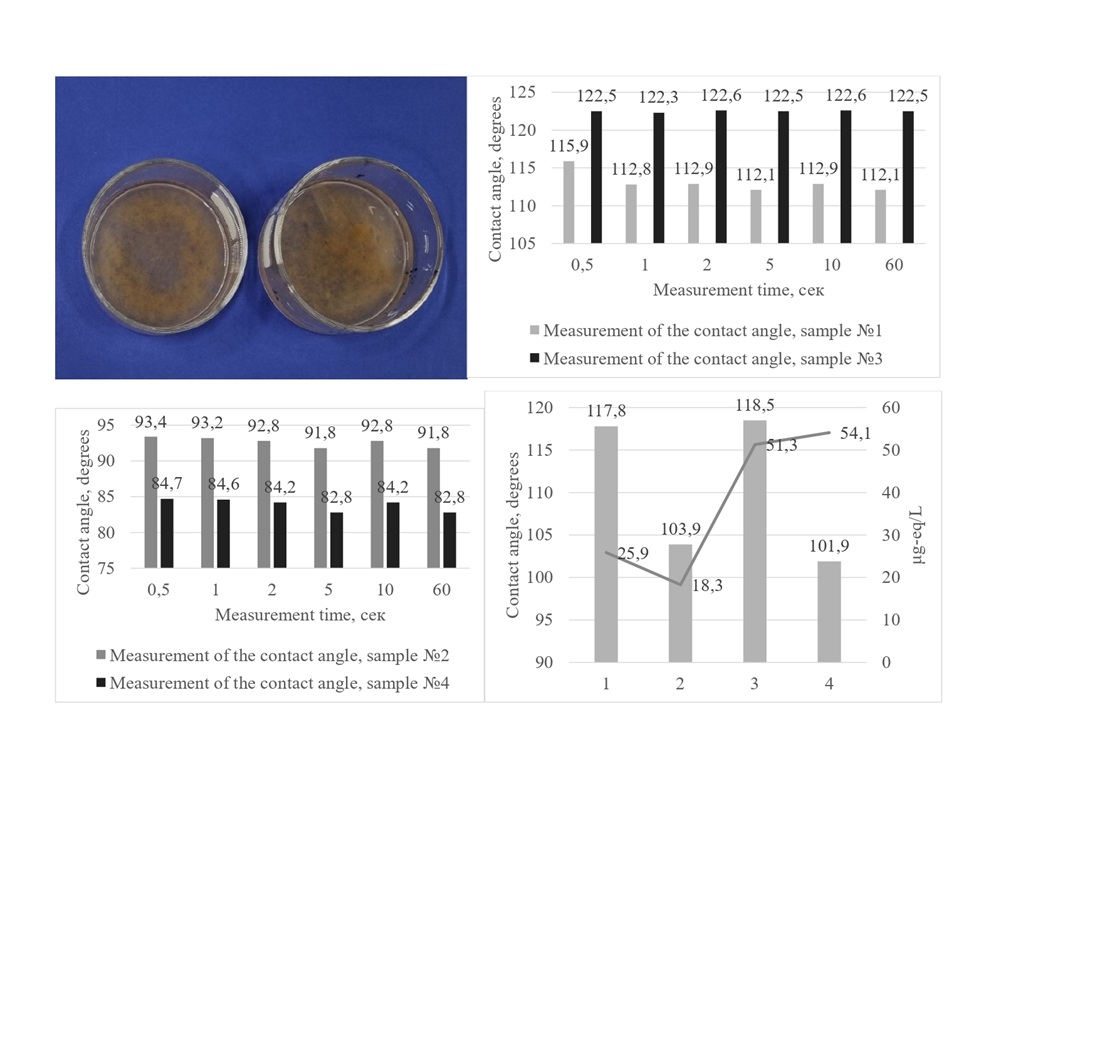
The experimental studies involved manufacturing a series of cardboard samples with different compositions, determining the contact angle by the lying drop method and the surface charge of dissolved substances. The effect of surface treatment on the indicators of the contact angle and surface charge of dissolved substances of cardboard for the manufacture of packaging and disposable tableware has been established. It was found that the contact angle decreases to 82.8–84.7° compared to 91.8–93.4° for unmodified samples (without applied polymer) and 116.1–116.6° versus 112.1–115.9°, respectively, for samples with a polymer coating. At the same time, the surface charge of dissolved substances increases from –18.3–25.9 to –51.3–54.1 μg-equiv./l, that is, by 2–3 times.
The results indicate that the treated cardboard samples have better wettability. This property will contribute to better contact between the cardboard surface and the polymer melt during its application and subsequent gluing of the structural elements of an article.
The proposed approach to modifying the cardboard sheet is promising for further implementation in industrial processes, in particular to produce packaging materials and disposable tableware. This will make it possible to influence the barrier properties of the finished cardboard paper, as well as to improve the functional properties of packaging and disposable tableware made of modified cardboard
References
- Yenidoğan, S. (2020). Nanocrystalline Cellulose and Polyvinyl Alcohol Coating Application to Cardboard Packaging Papers and Investigation of the Effects on Paper Properties. Materials Science, 26 (3), 317–322. https://doi.org/10.5755/j01.ms.26.3.21499
- Taboada-Rodríguez, A., García-García, I., Cava-Roda, R., López-Gómez, A., Marín-Iniesta, F. (2013). Hydrophobic properties of cardboard coated with polylactic acid and ethylene scavengers. Journal of Coatings Technology and Research, 10 (5), 749–755. https://doi.org/10.1007/s11998-013-9493-3
- Osyka, V. A., Koptiukh, L. A. (2018). Paperovi pakuvalni materialy. Kyiv: KNTEU, 464. https://doi.org/10.31617/m.knute.2018-302
- Yu, F., Wang, K., Li, H., Peng, L. (2023). Superhydrophobic and ethylene scavenging paper doped with halloysite nanotubes for food packaging applications. Colloids and Surfaces A: Physicochemical and Engineering Aspects, 656, 130457. https://doi.org/10.1016/j.colsurfa.2022.130457
- Lev, R., Tanninen, P., Lyytikäinen, J., Leminen, V. (2023). Converting and its effects on barrier properties of coated packaging materials: A Review. BioResources, 18 (4). https://doi.org/10.15376/biores.18.4.lev
- Ghahrani, N., Nazarnezhad, N., Ramezani, O., Asadpour, G. (2023). The impact of an acidic post-treatment on surface-modified old corrugated cardboard (OCC) with NaOH-urea as a reinforcing agent. BioResources, 18 (2), 4153–4167. https://doi.org/10.15376/biores.18.2.4153-4167
- Mascarenhas, A. R. P., Scatolino, M. V., Dias, M. C., Martins, M. A., Melo, R. R. de, Mendonça, M. C., Tonoli, G. H. D. (2022). Association of cellulose micro/nanofibrils and silicates for cardboard coating: Technological aspects for packaging. Industrial Crops and Products, 188, 115667. https://doi.org/10.1016/j.indcrop.2022.115667
- Beketov, G. V., Shynkarenko, O. V. (2022). Surface wetting and contact angle: basics and characterisation. Himia, Fizika Ta Tehnologia Poverhni, 13 (1), 3–35. https://doi.org/10.15407/hftp13.01.003
- Madeira, D. M. F., Vieira, O., Pinheiro, L. A., de Melo Carvalho, B. (2018). Correlation between Surface Energy and Adhesion Force of Polyethylene/Paperboard: A Predictive Tool for Quality Control in Laminated Packaging. International Journal of Chemical Engineering, 2018, 1–7. https://doi.org/10.1155/2018/2709037
- Tian, D., Song, Y., Jiang, L. (2013). Patterning of controllable surface wettability for printing techniques. Chemical Society Reviews, 42 (12), 5184. https://doi.org/10.1039/c3cs35501b
- Feng, X., Liu, B. (2024). Preparation, Characterization, and Application of P(aluminum chloride-co-diallyldimethylammonium chloride) Hybrid Flocculant. Applied Sciences, 14 (19), 8708. https://doi.org/10.3390/app14198708
- Chen, H., Wang, B., Li, J., Ying, G., Chen, K. (2022). High-strength and super-hydrophobic multilayered paper based on nano-silica coating and micro-fibrillated cellulose. Carbohydrate Polymers, 288, 119371. https://doi.org/10.1016/j.carbpol.2022.119371
- Halysh, V. V. (2023). Kompleksni resursoefektyvni tekhnolohiyi ochyshchennia vod paperovykh vyrobnytstv. Kyiv, 417. Available at: https://ela.kpi.ua/items/5006803c-88c2-46b3-973a-eec71160af93
- Keresztes, J., Csóka, L. (2023). Characterisation of the Surface Free Energy of the Recycled Cellulose Layer that Comprises the Middle Component of Corrugated Paperboards. Coatings, 13 (2), 259. https://doi.org/10.3390/coatings13020259
- Obradovic, D., Mishra, L. N. (2020). Mechanical Properties Of Recycled Paper And Cardboard. The Journal of Engineering and Exact Sciences, 6 (3), 0429–0434. https://doi.org/10.18540/jcecvl6iss3pp0429-0434
- Kordbacheh, F., Heidari, G. (2023). Water pollutants and approaches for their removal. Materials Chemistry Horizons, 2 (2), 139–153. https://doi.org/10.22128/mch.2023.684.1039
- Liu, Z., Li, W., Qin, Z., Jin, L., Sun, Z., Wu, H. (2024). Research on the Stability of Different Polar Surfaces in Aluminum Nitride Single Crystals. Crystals, 14 (4), 337. https://doi.org/10.3390/cryst14040337
- Buchkar, E., Roik, T., Khokhlova, R. (2023). Adhesion Features of Polymer Films to Cardboard. V International Scientific and Theoretical Conference «The current state of development of world science: characteristics and features». Lisbon. Available at: https://previous.scientia.report/index.php/archive/issue/view/02.06.2023?utm_source=eSputnik-promo&utm_medium=email&utm_campaign=SCIENTIA_Konferenc%D1%96ja_%7C_Status_:_opubl%D1%96kovano&utm_content=1121625536
- Bychkar, Ye. (2025). Analiz kraiovoho kuta zmochuvannia pry poverkhneviy obrobtsi kartonu dlia odnorazovoho posudu. Tezy dopovidi «Drukarstvo molode–2025». Kyiv: KPI im. Ihoria Sikorskoho.
- Roik, T. A., Bychkar, Ye. S. (2025). Vplyv poperednoi obrobky poverkhni kartonnoho polotna na pokaznyky zmochuvanosti pry nanesenni bariernoho polimernoho pokryttia. Tekhnolohiya i Tekhnika Drukarstva, 1 (87), 36–47. https://doi.org/10.20535/2077-7264.1(87).2025.322199
- Roik, T. A., Bychkar, Ye. S. (2025). Analiz vplyvu poverkhnevoi obrobky na zminu poverkhnevoi vilnoi enerhiyi ta dzeta-potentsialu kartonu dlia vyhotovlennia odnorazovoho posudu. Tekhnolohiya i Tekhnika Drukarstva, 3 (89), 22–33. https://doi.org/10.20535/2077-7264.3(89).2025.342986
- Khadzhynova, S. Ye., Zolotukhina, K. I., Kushlyk, B. R., Kushlyk-Dyvulska, O. I. (2018). Vyiavlennia zalezhnostei eksperymentalnykh doslidzhen kraiovoho kuta zmochuvannia. Tekhnolohiya i Tekhnika Drukarstva, 4 (62), 27–38. https://doi.org/10.20535/2077-7264.4(62).2018.167228
- Shen, Z., Rajabi-Abhari, A., Oh, K., Yang, G., Youn, H. J., Lee, H. L. (2021). Improving the Barrier Properties of Packaging Paper by Polyvinyl Alcohol Based Polymer Coating – Effect of the Base Paper and Nanoclay. Polymers, 13 (8), 1334. https://doi.org/10.3390/polym13081334
- Ghahremannezhad, F., Mohammadhosseini, B., Khani, M. R., Khanjani, J., Shokri, B. (2025). Plasma treatment of high-density polyethylene blow moulded substrates to improve surface adhesion properties: Increase in bondability to label films. Journal of Elastomers & Plastics, 57 (6), 897–916. https://doi.org/10.1177/00952443251339830
- Hurhal, N. S., Repeta, V. B., Novosad, I. V., Marshalok, I. Y., Shybanov, V. V. (2012). Vzaiemozviazok mizh pokaznykom odnostoronnoho zmochuvannia i poverkhnevoiu enerhieiu etyketkovykh paperiv. Naukovi zapysky [Ukrainskoi akademiyi drukarstva], 2, 163–167. Available at: http://nbuv.gov.ua/UJRN/Nz_2012_2_27
- Ahmed, A., Sanedrin, R., Willers, T., Waghmare, P. R. (2022). The effect of dynamic wetting pressure on contact angle measurements. Journal of Colloid and Interface Science, 608, 1086–1093. https://doi.org/10.1016/j.jcis.2021.10.003
- Kisil, I. S., Barna, O. B. (2015). Vymiriuvannia kraiovoho kuta zmochuvannia metodom aproksymatsiyi polinomamy konturu lezhachoi krapli. Metody ta prylady kontroliu yakosti, 2 (35), 38–41. Available at: https://search.library.nung.edu.ua/DocDescription?doc_id=421512
- Adibi, A., Valdesueiro, D., Mok, J., Behabtu, N., Lenges, C., Simon, L., Mekonnen, T. H. (2022). Sustainable barrier paper coating based on alpha-1,3 glucan and natural rubber latex. Carbohydrate Polymers, 282, 119121. https://doi.org/10.1016/j.carbpol.2022.119121
- Ilchenko, A. M., Kotvytska, K. A. (2023). Zastosuvannia znan pro elektrolitychnu dysotsiatsiu. The XV International Scientific and Practical Conference «Scientific fundamentals of solving modern scientific problems». Varna, 152–158. Available at: https://eu-conf.com/wp-content/uploads/2023/04/Scientific-fundamentals-of-solving-modern-scientific-problems.pdf
- Grasso, D., Subramaniam, K., Butkus, M., Strevett, K., Bergendahl, J. (2002). A review of non-DLVO interactions in environmental colloidal systems. Reviews in Environmental Science and Biotechnology, 1 (1), 17–38. https://doi.org/10.1023/a:1015146710500
Downloads
Published
How to Cite
Issue
Section
License
Copyright (c) 2026 Tetiana Roik, Yevheniia Bychkar, Volodymіr Oliynyk

This work is licensed under a Creative Commons Attribution 4.0 International License.
The consolidation and conditions for the transfer of copyright (identification of authorship) is carried out in the License Agreement. In particular, the authors reserve the right to the authorship of their manuscript and transfer the first publication of this work to the journal under the terms of the Creative Commons CC BY license. At the same time, they have the right to conclude on their own additional agreements concerning the non-exclusive distribution of the work in the form in which it was published by this journal, but provided that the link to the first publication of the article in this journal is preserved.
A license agreement is a document in which the author warrants that he/she owns all copyright for the work (manuscript, article, etc.).
The authors, signing the License Agreement with TECHNOLOGY CENTER PC, have all rights to the further use of their work, provided that they link to our edition in which the work was published.
According to the terms of the License Agreement, the Publisher TECHNOLOGY CENTER PC does not take away your copyrights and receives permission from the authors to use and dissemination of the publication through the world's scientific resources (own electronic resources, scientometric databases, repositories, libraries, etc.).
In the absence of a signed License Agreement or in the absence of this agreement of identifiers allowing to identify the identity of the author, the editors have no right to work with the manuscript.
It is important to remember that there is another type of agreement between authors and publishers – when copyright is transferred from the authors to the publisher. In this case, the authors lose ownership of their work and may not use it in any way.








