Improvement of information technology for synthesizing parallel-stream structures for vertical-group computing of multi-operand neural operations in real time
DOI:
https://doi.org/10.15587/1729-4061.2026.357361Keywords:
flow graphs, real-time systems, hardware costs, resource efficiencyAbstract
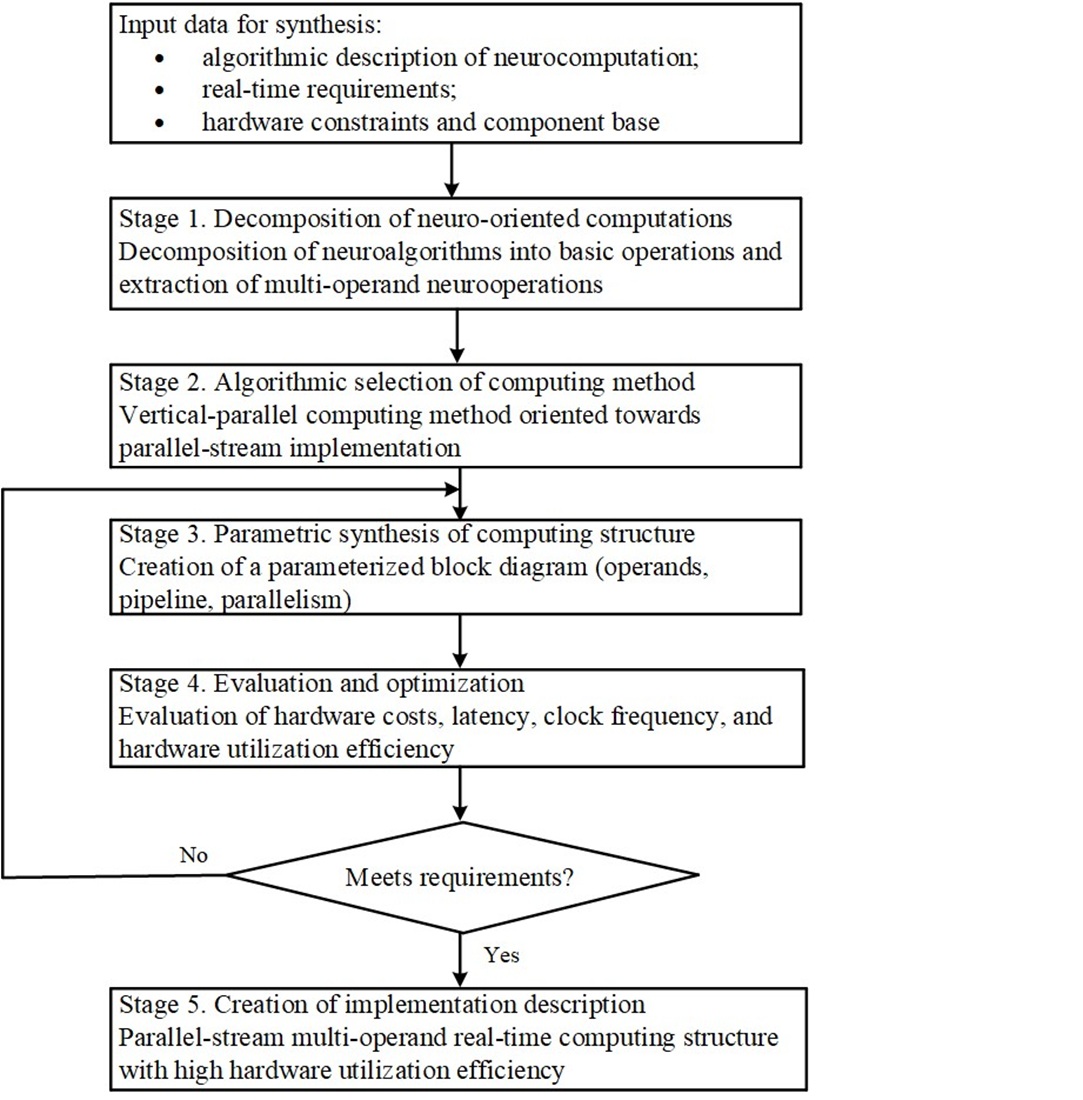
This study considers an approach to improving the information technology of structure synthesis for real-time multi-operand neural operation data processing. The task addressed relates to the lack of a formalized approach to the synthesis of such structures that would simultaneously take into account the parameters of data flows, the depth of the pipeline, the degree of parallelism, and hardware limitations while ensuring the specified time characteristics.
Methods for parallel vertical-group calculation of the scalar product, sum of squared differences, and search for maximum and minimum values have been devised. A method for concretizing flow graphs has been improved. Basic parallel-stream computing structures and analytical expressions for estimating hardware costs, pipeline cycle time, and efficiency of hardware resource use have been developed. Based on the above, the information technology for synthesizing parallel-stream structures for vertical-group calculation of real-time multi-operand neural operations has been improved. The task set was solved by combining vertical and group parallelism, conveyorization, modular organization, matching the intensity of data input with the intensity of their processing and a gradual transition from algorithmic description to hardware implementation.
The improved information technology provides a reduction in hardware costs, increased throughput, reduced latency, and the selection of optimal parameters of structures. Simultaneous processing of groups of bit slices reduces the number of pipeline steps, and the specification of flow graphs makes it possible to adapt the structure of calculations to real-time requirements.
In practice, the results could be used for synthesizing specialized FPGA-, ASIC-, SoC-tools for neural-oriented real-time systems with specified characteristics
Supporting Agency
- The research was carried out at the Lviv Polytechnic Na-tional University within the framework of the research work “Methods and means of intelligent measurement of move-ment parameters and determination of spatial orientation of ground mobile robotic platforms” (State registration number 0124U000822).
References
- Izonin, I., Tkachenko, R., Hovdysh, N., Berezsky, O., Yemets, K., Tsmots, I. (2025). Cascade-Based Input-Doubling Classifier for Predicting Survival in Allogeneic Bone Marrow Transplants: Small Data Case. Computation, 13 (4), 80. https://doi.org/10.3390/computation13040080
- Tsmots, I., Teslyuk, V., Łukaszewicz, A., Lukashchuk, Y., Kazymyra, I., Holovatyy, A., Opotyak, Y. (2023). An Approach to the Implementation of a Neural Network for Cryptographic Protection of Data Transmission at UAV. Drones, 7 (8), 507. https://doi.org/10.3390/drones7080507
- Juracy, L. R., Garibotti, R., Moraes, F. G. (2023). From CNN to DNN Hardware Accelerators: A Survey on Design, Exploration, Simulation, and Frameworks. Foundations and Trends® in Electronic Design Automation, 13 (4), 270–344. https://doi.org/10.1561/1000000060
- Deng, B. L., Li, G., Han, S., Shi, L., Xie, Y. (2020). Model Compression and Hardware Acceleration for Neural Networks: A Comprehensive Survey. Proceedings of the IEEE, 108 (4), 485–532. https://doi.org/10.1109/jproc.2020.2976475
- Mohaidat, T., Khalil, K. (2024). A Survey on Neural Network Hardware Accelerators. IEEE Transactions on Artificial Intelligence, 5 (8), 3801–3822. https://doi.org/10.1109/tai.2024.3377147
- Tsmots, I., Teslyuk, V., Kryvinska, N., Skorokhoda, O., Kazymyra, I. (2022). Development of a generalized model for parallel-streaming neural element and structures for scalar product calculation devices. The Journal of Supercomputing, 79 (5), 4820–4846. https://doi.org/10.1007/s11227-022-04838-0
- Xie, Y., Oniga, S. (2024). A Comprehensive Review of Hardware Acceleration Techniques and Convolutional Neural Networks for EEG Signals. Sensors, 24 (17), 5813. https://doi.org/10.3390/s24175813
- Wang, Z. (2025). Accelerating Transformer Models: FPGA-Based Hardware Optimization and Heterogeneous Computing Strategies. Applied and Computational Engineering, 138 (1), 86–92. https://doi.org/10.54254/2755-2721/2025.21360
- Zeng, K., Ma, Q., Wu, J. W., Chen, Z., Shen, T., Yan, C. (2022). FPGA-based accelerator for object detection: a comprehensive survey. The Journal of Supercomputing, 78 (12), 14096–14136. https://doi.org/10.1007/s11227-022-04415-5
- Tsmots, I., Teslyuk, V., Opotyak, Y., Mamchur, T., Oliinyk, O. (2025). Synthesis of recursive-type neural elements with parallel vertical-group data processing. Eastern-European Journal of Enterprise Technologies, 3 (2 (135)), 6–16. https://doi.org/10.15587/1729-4061.2025.329139
- Geng, S., Wang, Z., Liu, Z., Zhang, M., Zhu, X., Dan, Y. (2025). Hardware implementation of FPGA-based spiking attention neural network accelerator. PeerJ Computer Science, 11, e3077. https://doi.org/10.7717/peerj-cs.3077
- Carpegna, A., Savino, A., Carlo, S. D. (2025). Spiker+: A Framework for the Generation of Efficient Spiking Neural Networks FPGA Accelerators for Inference at the Edge. IEEE Transactions on Emerging Topics in Computing, 13 (3), 784–798. https://doi.org/10.1109/tetc.2024.3511676
- Gong, Y., Xu, Z., He, Z., Zhang, W., Tu, X., Liang, X., Jiang, L. (2022). N3H-Core. Proceedings of the 2022 ACM/SIGDA International Symposium on Field-Programmable Gate Arrays, 112–122. https://doi.org/10.1145/3490422.3502367
- Tsai, T.-H., Ho, Y.-C., Sheu, M.-H. (2019). Implementation of FPGA-based Accelerator for Deep Neural Networks. 2019 IEEE 22nd International Symposium on Design and Diagnostics of Electronic Circuits & Systems (DDECS), 1–4. https://doi.org/10.1109/ddecs.2019.8724665
- Kachris, C. (2025). A Survey on Hardware Accelerators for Large Language Models. Applied Sciences, 15 (2), 586. https://doi.org/10.3390/app15020586
- Silvano, C., Ielmini, D., Ferrandi, F., Fiorin, L., Curzel, S., Benini, L. et al. (2025). A Survey on Deep Learning Hardware Accelerators for Heterogeneous HPC Platforms. ACM Computing Surveys, 57 (11), 1–39. https://doi.org/10.1145/3729215
- Kang, B. J., Lee, H. I., Yoon, S. K., Kim, Y. C., Jeong, S. B., O, S. J., Kim, H. (2024). A survey of FPGA and ASIC designs for transformer inference acceleration and optimization. Journal of Systems Architecture, 155, 103247. https://doi.org/10.1016/j.sysarc.2024.103247
- Bjerge, K., Schougaard, J. H., Larsen, D. E. (2021). A scalable and efficient convolutional neural network accelerator using HLS for a system-on-chip design. Microprocessors and Microsystems, 87, 104363. https://doi.org/10.1016/j.micpro.2021.104363
- Yan, Y., Ling, Y., Huang, K., Chen, G. (2023). An efficient real-time accelerator for high-accuracy DNN-based optical flow estimation in FPGA. Journal of Systems Architecture, 136, 102818. https://doi.org/10.1016/j.sysarc.2022.102818
- Tasci, M., Istanbullu, A., Tumen, V., Kosunalp, S. (2025). FPGA-QNN: Quantized Neural Network Hardware Acceleration on FPGAs. Applied Sciences, 15 (2), 688. https://doi.org/10.3390/app15020688
- Liu, Y., Yenamachintala, S. S., Li, P. (2019). Energy-efficient FPGA Spiking Neural Accelerators with Supervised and Unsupervised Spike-timing-dependent-Plasticity. ACM Journal on Emerging Technologies in Computing Systems, 15 (3), 1–19. https://doi.org/10.1145/3313866
- Parashar, A., Raina, P., Shao, Y. S., Chen, Y.-H., Ying, V. A., Mukkara, A. et al. (2019). Timeloop: A Systematic Approach to DNN Accelerator Evaluation. 2019 IEEE International Symposium on Performance Analysis of Systems and Software (ISPASS), 304–315. https://doi.org/10.1109/ispass.2019.00042
- Chen, Y.-H., Yang, T.-J., Emer, J. S., Sze, V. (2019). Eyeriss v2: A Flexible Accelerator for Emerging Deep Neural Networks on Mobile Devices. IEEE Journal on Emerging and Selected Topics in Circuits and Systems, 9 (2), 292–308. https://doi.org/10.1109/jetcas.2019.2910232
- Jouppi, N. P., Young, C., Patil, N. et al. (2017) In-datacenter performance analysis of a tensor processing unit. arXiv. https://doi.org/10.48550/arXiv.1704.04760
- Dhilleswararao, P., Boppu, S., Manikandan, M. S., Cenkeramaddi, L. R. (2022). Efficient Hardware Architectures for Accelerating Deep Neural Networks: Survey. IEEE Access, 10, 131788–131828. https://doi.org/10.1109/access.2022.3229767
- Zhang, C., Li, P., Sun, G., Guan, Y., Xiao, B., Cong, J. (2015). Optimizing FPGA-based Accelerator Design for Deep Convolutional Neural Networks. Proceedings of the 2015 ACM/SIGDA International Symposium on Field-Programmable Gate Arrays, 161–170. https://doi.org/10.1145/2684746.2689060
- Chen, T., Moreau, T., Jiang, Z. et al. (2018). TVM: an automated end-to-end optimizing compiler for deep learning. In Proceedings of the 13th USENIX Symposium on Operating Systems Design and Implementation (OSDI), 579–594. Available at: https://www.usenix.org/system/files/osdi18-chen.pdf
- Sze, V., Chen, Y.-H., Yang, T.-J., Emer, J. S. (2017). Efficient Processing of Deep Neural Networks: A Tutorial and Survey. Proceedings of the IEEE, 105 (12), 2295–2329. https://doi.org/10.1109/jproc.2017.2761740
- Jouppi, N. P., Hyun Yoon, D., Ashcraft, M., Gottscho, M., Jablin, T. B., Kurian, G. et al. (2021). Ten Lessons From Three Generations Shaped Google’s TPUv4i : Industrial Product. 2021 ACM/IEEE 48th Annual International Symposium on Computer Architecture (ISCA), 1–14. https://doi.org/10.1109/isca52012.2021.00010
- Mittal, S. (2018). A survey of FPGA-based accelerators for convolutional neural networks. Neural Computing and Applications, 32 (4), 1109–1139. https://doi.org/10.1007/s00521-018-3761-1
Downloads
Published
How to Cite
Issue
Section
License
Copyright (c) 2026 Ivan Tsmots, Vasyl Teslyuk, Yurii Opotyak, Bohdan Shtohrinets

This work is licensed under a Creative Commons Attribution 4.0 International License.
The consolidation and conditions for the transfer of copyright (identification of authorship) is carried out in the License Agreement. In particular, the authors reserve the right to the authorship of their manuscript and transfer the first publication of this work to the journal under the terms of the Creative Commons CC BY license. At the same time, they have the right to conclude on their own additional agreements concerning the non-exclusive distribution of the work in the form in which it was published by this journal, but provided that the link to the first publication of the article in this journal is preserved.
A license agreement is a document in which the author warrants that he/she owns all copyright for the work (manuscript, article, etc.).
The authors, signing the License Agreement with TECHNOLOGY CENTER PC, have all rights to the further use of their work, provided that they link to our edition in which the work was published.
According to the terms of the License Agreement, the Publisher TECHNOLOGY CENTER PC does not take away your copyrights and receives permission from the authors to use and dissemination of the publication through the world's scientific resources (own electronic resources, scientometric databases, repositories, libraries, etc.).
In the absence of a signed License Agreement or in the absence of this agreement of identifiers allowing to identify the identity of the author, the editors have no right to work with the manuscript.
It is important to remember that there is another type of agreement between authors and publishers – when copyright is transferred from the authors to the publisher. In this case, the authors lose ownership of their work and may not use it in any way.








