Substantiating the design of equipment for preparing oil and gas field products for transportation
DOI:
https://doi.org/10.15587/1729-4061.2026.357605Keywords:
oil and gas fields, hydrocarbon transportation, hydrocarbon preparation, formation water, thermodynamic modelingAbstract
This study investigates processes that separate gas-liquid flows and purify formation water in the equipment for oil and gas field production preparation units.
At the late stage of field development, the efficiency of separation depends on the ability of the equipment to operate under conditions of waterlogging, an increase in the content of mechanical impurities, and a decrease in formation pressure. Under such conditions, conventional separation equipment does not provide the required quality of hydrocarbon separation and purification of formation water.
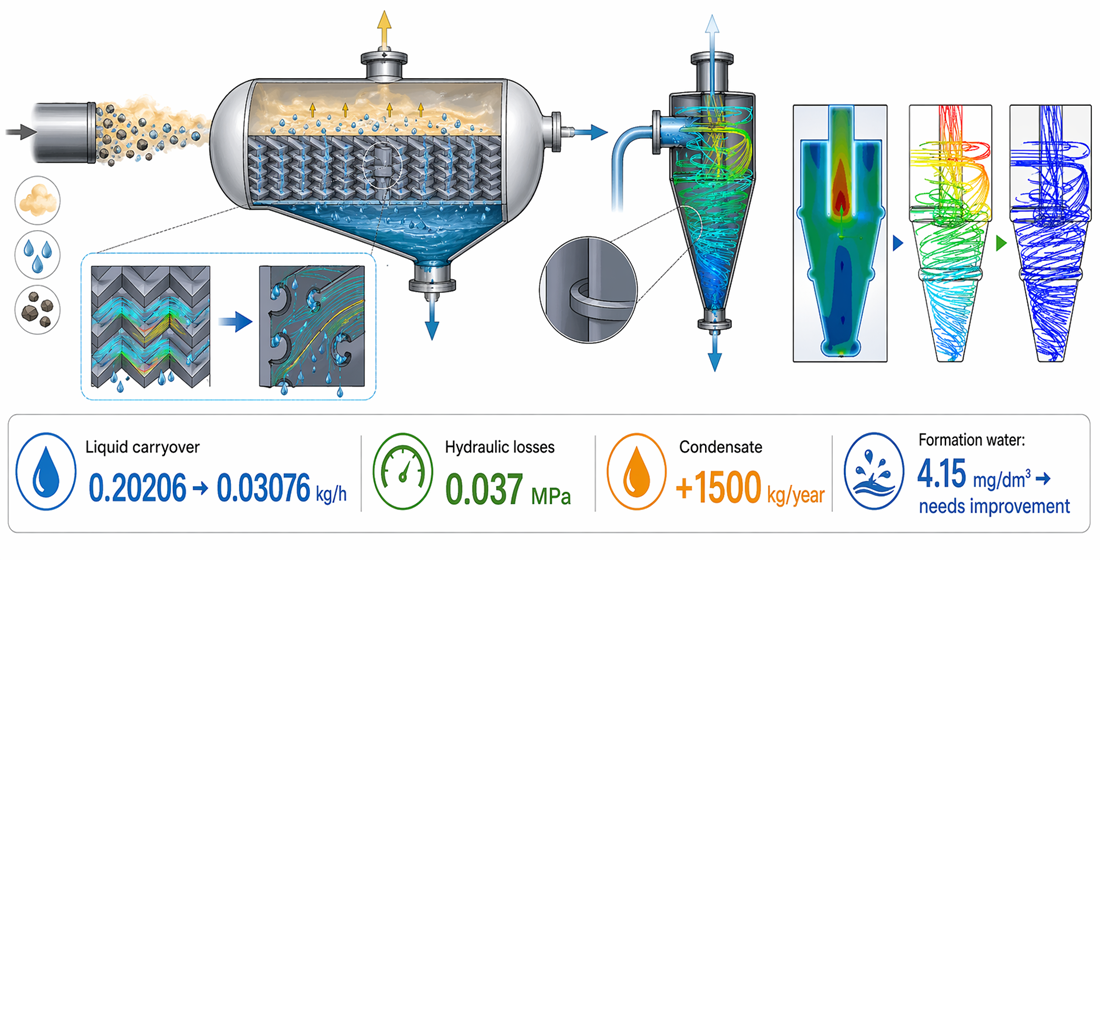
The task addressed in this work has been solved by improving the internal structural elements in the three-phase separator and a cyclone in the hydrocarbon preparation unit. Hydraulic losses were within permissible values; no secondary removal of drops into the gas stream occurred. That was confirmed by the results of thermodynamic and CFD modeling. This is a feature of the approach in comparison with those reported in which studies of new design solutions were not comprehensively conducted.
The issues of hydraulic losses and secondary removal of drops into the gas stream remained open. The design solutions proposed in this work affected the separation efficiency – the volume of the selected condensate increased while the total hydraulic losses did not exceed 0.037 MPa. It has been proven that new structural solutions for separation elements provide a more uniform distribution of speeds and form local zones with reduced speeds.
The results are explained by a change in the flow structure, an increase in inertial deposition of drops, and a decrease in low-mobility zones in the flow part of the separation elements. The findings could be implemented in the reconstruction of oil and gas treatment plants, in the design of internal separation elements, and when choosing structural solutions for cyclones in order to purify formation water
References
- Yang, L., Chen, X., Huang, C., Liu, S., Ning, B., Wang, K. (2024). A review of gas-liquid separation technologies: Separation mechanism, application scope, research status, and development prospects. Chemical Engineering Research and Design, 201, 257–274. https://doi.org/10.1016/j.cherd.2023.11.057
- Yuan, Y. (2024). The Analysis of Gas-liquid Separation Technology Research Progress. E3S Web of Conferences, 528, 01020. https://doi.org/10.1051/e3sconf/202452801020
- Chen, X., Liu, G., Jin, W. (2021). Natural gas purification by asymmetric membranes: An overview. Green Energy & Environment, 6 (2), 176–192. https://doi.org/10.1016/j.gee.2020.08.010
- Liu, G., Chernikova, V., Liu, Y., Zhang, K., Belmabkhout, Y., Shekhah, O. et al. (2018). Mixed matrix formulations with MOF molecular sieving for key energy-intensive separations. Nature Materials, 17 (3), 283–289. https://doi.org/10.1038/s41563-017-0013-1
- Liu, G., Cadiau, A., Liu, Y., Adil, K., Chernikova, V., Carja, I. et al. (2018). Enabling Fluorinated MOF‐Based Membranes for Simultaneous Removal of H2S and CO2 from Natural Gas. Angewandte Chemie International Edition, 57 (45), 14811–14816. https://doi.org/10.1002/anie.201808991
- Lai, X., Jiang, W., Chen, J., Ru, Y., Hu, W., Wang, S. (2021). Process Simulation Investigation of Purification and Deacidification in Supersonic Separation Process for Natural Gas Treatment. Proceedings of the International Petroleum and Petrochemical Technology Conference 2020, 266–284. https://doi.org/10.1007/978-981-16-1123-0_27
- Nesterenko, T., Nesterenko, M., Shevchenko, O., Omelchenko, O. (2023). Justification for the Choice of a Modeling Scheme for the Hydrocarbon Preparation Process for Transportation Using Supersonic Separation. Academic Journal Industrial Machine Building Civil Engineering, 2 (61), 86–93. https://doi.org/10.26906/znp.2023.61.3864
- James, P. W., Azzopardi, B. J., Wang, Y., Hughes, J. P. (2005). A Model for Liquid Film Flow and Separation in a Wave-Plate Mist Eliminator. Chemical Engineering Research and Design, 83 (5), 469–477. https://doi.org/10.1205/cherd.03363
- Makowski, Ł., Łaskowski, J., Tyrański, M. (2021). Influence of Modification of the Geometry of the Wave-Plate Mist Eliminators on the Droplet Removal Efficiency – CFD Modelling. Processes, 9 (9), 1499. https://doi.org/10.3390/pr9091499
- Moiseev, V., Manoilo, E., Liaposhchenko, A., Seif, H. (2020). Oilfield wastewater treatment. Bulletin of the National Technical University «KhPI» Series: New Solutions in Modern Technologies, 4 (6), 122–130. https://doi.org/10.20998/2413-4295.2020.04.18
- Li, Z. (2025). Optimization and experimental validation of a high-efficiency oil–water cyclone separator for well testing conditions. Journal of Engineering and Applied Science, 72 (1). https://doi.org/10.1186/s44147-025-00585-0
- Nunes, S. A., Magalhães, H. L. F., Gomez, R. S., Vilela, A. F., Figueiredo, M. J., Santos, R. S. et al. (2021). Oily Water Separation Process Using Hydrocyclone of Porous Membrane Wall: A Numerical Investigation. Membranes, 11 (2), 79. https://doi.org/10.3390/membranes11020079
- Simões, A., Macêdo-Júnior, R., Santos, B., Silva, L., Silva, D., Ruzene, D. (2020). Produced Water: An overview of treatment technologies. International Journal for Innovation Education and Research, 8 (4), 207–224. https://doi.org/10.31686/ijier.vol8.iss4.2283
- Khan, H., Lemma, T. A., Soon, W. P. K., Vijayakumaran, H., Marode, R. V. (2025). A Critical Review on the Comprehensive Assessment of Supersonic Separator Technologies for Enhanced Gas Processing and CO2 Removal Efficiency. Results in Engineering, 28, 106923. https://doi.org/10.1016/j.rineng.2025.106923
- Rahimpour, M. R., Makarem, M. A., Meshksar, M. (Eds.) (2024). Advances Natural Gas: Formation, Processing, and Applications. Volume 8: Natural Gas Process Modelling and Simulation. Elsevier. https://doi.org/10.1016/c2022-0-00187-2
Downloads
Published
How to Cite
Issue
Section
License
Copyright (c) 2026 Tetiana Nesterenko, Ivan Nazarenko, Mykola Nesterenko, Oleksandr Shevchenko, Andrii Khyzhniak, Iryna Bernyk, Artur Onyshchenko, Roman Moshkivskyi

This work is licensed under a Creative Commons Attribution 4.0 International License.
The consolidation and conditions for the transfer of copyright (identification of authorship) is carried out in the License Agreement. In particular, the authors reserve the right to the authorship of their manuscript and transfer the first publication of this work to the journal under the terms of the Creative Commons CC BY license. At the same time, they have the right to conclude on their own additional agreements concerning the non-exclusive distribution of the work in the form in which it was published by this journal, but provided that the link to the first publication of the article in this journal is preserved.
A license agreement is a document in which the author warrants that he/she owns all copyright for the work (manuscript, article, etc.).
The authors, signing the License Agreement with TECHNOLOGY CENTER PC, have all rights to the further use of their work, provided that they link to our edition in which the work was published.
According to the terms of the License Agreement, the Publisher TECHNOLOGY CENTER PC does not take away your copyrights and receives permission from the authors to use and dissemination of the publication through the world's scientific resources (own electronic resources, scientometric databases, repositories, libraries, etc.).
In the absence of a signed License Agreement or in the absence of this agreement of identifiers allowing to identify the identity of the author, the editors have no right to work with the manuscript.
It is important to remember that there is another type of agreement between authors and publishers – when copyright is transferred from the authors to the publisher. In this case, the authors lose ownership of their work and may not use it in any way.








