Improving a method of rational placement of base stations in a global navigation satellite system differential correction system
DOI:
https://doi.org/10.15587/1729-4061.2026.357607Keywords:
base station, global navigation satellite system, navigation corrections, optimal placementAbstract
This study investigates the process of deploying base stations of the global navigation satellite system’s differential correction system. The task addressed is to reduce complexity of the differential correction system by optimizing the number and placement of base stations in the global navigation satellite system.
The method for the rational placement of base stations of the global navigation satellite system’s differential correction system has been improved. In contrast to known ones, it involves the following:
– initially filling the predefined area with Voronoi diagram pole points;
– constructing the Voronoi diagram;
– finding the centroids of the resulting cells as the positions of the centers of the Voronoi cells;
– verifying that the condition for changing the positions of the centroids is satisfied;
– verifying that the condition for finding the centroids within prohibited zones is met;
– adjusting the positions of the centroids.
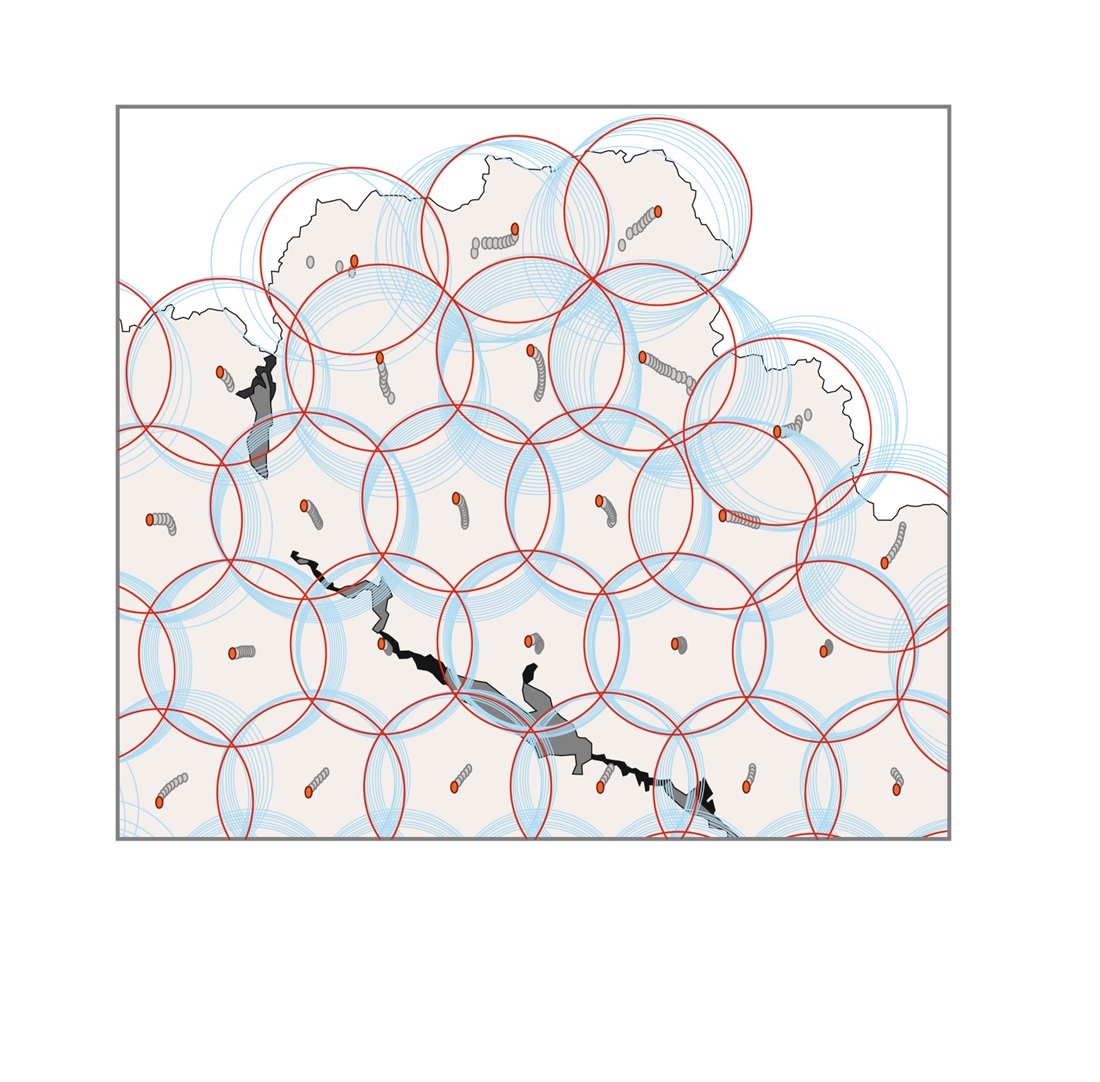
An experimental study was conducted on the optimal placement of base stations for the differential correction system in the global navigation satellite system. A visual analysis was performed of the results of base station placement using the improved method and known coverage methods. A comparative visual analysis reveals better coverage of the target area when using the same number of base stations. A quantitative analysis showed that using the improved method reduces the number of base stations by 21% compared to known methods. At the same time, the condition of full coverage of the specified area was met. This, in turn, has made it possible to reduce the complexity and cost of the global navigation satellite system’s differential correction system.
The scope of application of the improved method is the placement of base stations for the global navigation satellite system’s differential correction system.
Downloads
Published
How to Cite
Issue
Section
License
Copyright (c) 2026 Hennadii Khudov, Igor Taran, Serhii Lohachov, Kostiantyn Kulahin, Oleh Rybachuk

This work is licensed under a Creative Commons Attribution 4.0 International License.
The consolidation and conditions for the transfer of copyright (identification of authorship) is carried out in the License Agreement. In particular, the authors reserve the right to the authorship of their manuscript and transfer the first publication of this work to the journal under the terms of the Creative Commons CC BY license. At the same time, they have the right to conclude on their own additional agreements concerning the non-exclusive distribution of the work in the form in which it was published by this journal, but provided that the link to the first publication of the article in this journal is preserved.
A license agreement is a document in which the author warrants that he/she owns all copyright for the work (manuscript, article, etc.).
The authors, signing the License Agreement with TECHNOLOGY CENTER PC, have all rights to the further use of their work, provided that they link to our edition in which the work was published.
According to the terms of the License Agreement, the Publisher TECHNOLOGY CENTER PC does not take away your copyrights and receives permission from the authors to use and dissemination of the publication through the world's scientific resources (own electronic resources, scientometric databases, repositories, libraries, etc.).
In the absence of a signed License Agreement or in the absence of this agreement of identifiers allowing to identify the identity of the author, the editors have no right to work with the manuscript.
It is important to remember that there is another type of agreement between authors and publishers – when copyright is transferred from the authors to the publisher. In this case, the authors lose ownership of their work and may not use it in any way.








