Defining factors for the expedient use of aviation equipment in the process of growing agricultural crops
DOI:
https://doi.org/10.15587/1729-4061.2026.357889Keywords:
agricultural aircraft, agricultural drones, precision farming, environmental safety, sustainable developmentAbstract
Aviation transport system in the agricultural sector has been examined in this study. The task addressed relates to determining the factors of expedient use of air transport at certain stages of the technological process of growing agricultural crops, depending on aircraft technical parameters.
The global experience in the development of agricultural aviation has been analyzed; analysis of the areas cultivated by land and air transport in Ukraine in 2013–2024 was performed. The negative impact of vehicles on the environment was revealed. Directions for improving environmental safety through the introduction of promising new technologies for environmental preservation have been determined.
Basic aviation means used to protect plants from harmful objects during the growing season were analyzed. The selection of aviation means for the implementation of crop protection measures should be carried out on the basis of a preliminary scientific and economic justification, taking into account the type and scope of work.
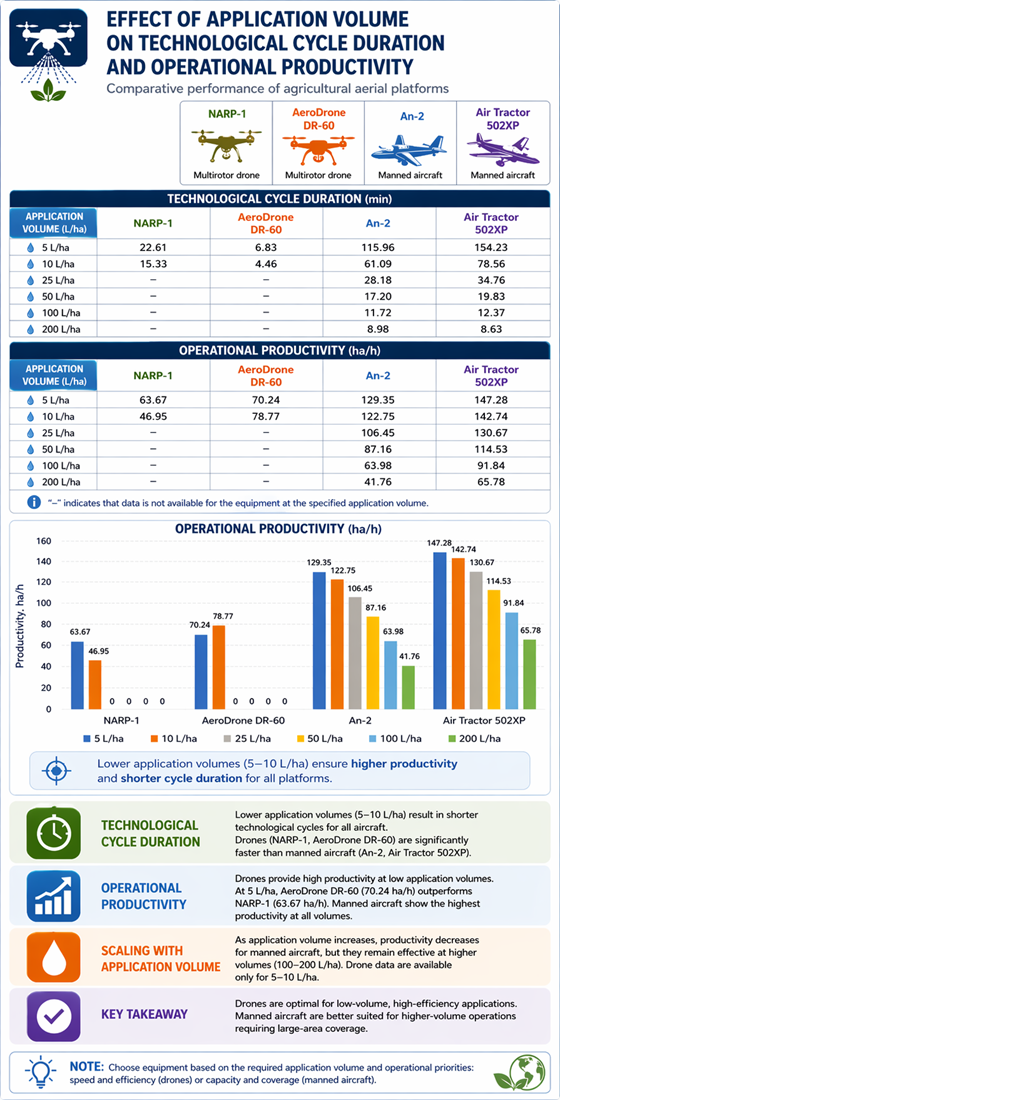
Ranges of the technological cycle duration and ranges of productivity by agricultural aviation activities based on the technical and operational characteristics of agricultural aviation means have been determined. The expediency of using aviation means under different standards of application of working substances has been clarified.
Under current conditions for precision agriculture, there is a need for wider use of air transport in the process of growing agricultural crops. An innovative tool for precision agriculture are unmanned aerial vehicles that help with field spraying, control and cartography of yield data, fertilization, as well as diagnosing crops for the presence of pests and diseases. That is why the market of unmanned technologies is rapidly evolving in Ukraine, which is a promising direction in the agricultural sector
References
- Sanyaolu, M., Sadowski, A. (2024). The Role of Precision Agriculture Technologies in Enhancing Sustainable Agriculture. Sustainability, 16 (15), 6668. https://doi.org/10.3390/su16156668
- Li, X., Giles, D. K., Andaloro, J. T., Long, R., Lang, E. B., Watson, L. J., Qandah, I. (2021). Comparison of UAV and fixed‐wing aerial application for alfalfa insect pest control: evaluating efficacy, residues, and spray quality. Pest Management Science, 77 (11), 4980–4992. https://doi.org/10.1002/ps.6540
- Giles, D., Billing, R. (2015). Deployment and performance of a UAV for crop spraying. Chemical Engineering Transactions, 44, 307–312. https://doi.org/10.3303/CET1544052
- Wang, C., Zeng, A., He, X., Song, J., Herbst, A., Gao, W. (2020). Spray drift characteristics test of unmanned aerial vehicle spray unit under wind tunnel conditions. International Journal of Agricultural and Biological Engineering, 13 (3), 13–21. https://doi.org/10.25165/j.ijabe.20201303.5716
- Delavarpour, N., Koparan, C., Zhang, Y., Steele, D. D., Betitame, K., Bajwa, S. G., Sun, X. (2023). A Review of the Current Unmanned Aerial Vehicle Sprayer Applications in Precision Agriculture. Journal of the ASABE, 66 (3), 703–721. https://doi.org/10.13031/ja.15128
- Talaeizadeh, A., Sharifi, I., Alasty, A., Ghatrehsamani, S. (2025). Agricultural spraying drones: A comprehensive review. Smart Agricultural Technology, 12, 101519. https://doi.org/10.1016/j.atech.2025.101519
- State of the knowledge literature review on unmanned aerial spray systems in agriculture (2021). OECD. Available at: https://www.oecd.org/content/dam/oecd/en/publications/reports/2021/04/report-on-the-state-of-the-knowledge-literature-review-on-unmanned-aerial-spray-systems-in-agriculture_ee9be37f/9240f8eb-en.pdf
- Castro-Tanzi, S., Winchell, M., Tang, Z., Teske, M. E., Whitehouse, G. R., Fritz, B., Martin, D. (2025). Validation of the spray drift modeling software AGDISPpro applied to remotely piloted aerial application systems. Science of The Total Environment, 966, 178725. https://doi.org/10.1016/j.scitotenv.2025.178725
- Byers, C., Virk, S., Rains, G., Li, S. (2024). Spray deposition and uniformity assessment of unmanned aerial application systems (UAAS) at varying operational parameters. Frontiers in Agronomy, 6. https://doi.org/10.3389/fagro.2024.1418623
- Psiroukis, V., Kasimati, A., Nychas, K., Anastasiou, E., Balafoutis, A., Fountas, S. (2026). Comparison of spray drift between spraying drone and conventional airblast sprayer in vineyards. Smart Agricultural Technology, 13, 101741. https://doi.org/10.1016/j.atech.2025.101741
- Burliai, A. P., Burliai, O. L., Nepochatenko, O. А. (2018). The influence of activity of agricultural enterprises on the environmental environment. Naukovyi visnyk Uzhhorodskoho natsionalnoho universytetu, 20, 64–69. Available at: http://www.visnyk-econom.uzhnu.uz.ua/archive/20_1_2018ua/16.pdf
- Normatyvno-pravove zabezpechennia okhorony atmosfernoho povitria (2022). Available at: https://dei.gov.ua/post/2321
- Za ostanni dva roky Kyiv vybuduvav naibilshu v Ukraini systemu monitorynhu yakosti povitria (+foto, zvit). Available at: https://kyivcity.gov.ua/news/za_ostanni_dva_roki_kiv_vibuduvav_naybilshu_v_ukrani_sistemu_monitoringu_yakosti_povitrya/
- Yakist atmosfernoho povitria v Ukraini do i pid chas povnomasshtabnoho vtorhnennia (2023). Kyiv. Available at: https://www.savednipro.org/wp-content/uploads/2023/10/zvit_doslidzhennya_101723.pdf
- Zaporozhets, A., Babak, V., Isaienko, V., Babikova, K. (2020). Analysis of the Air Pollution Monitoring System in Ukraine. Systems, Decision and Control in Energy I, 85–110. https://doi.org/10.1007/978-3-030-48583-2_6
- Radiation and Smog Alarm. Nastanovy ta pryntsypy opovishchennia naselennia pro yakist povitria, radiatsiinu ta khimichnu nebezpeku (2022). Praha - Ivano-Frankivsk: Arnika, 58. Available at: https://cleanair.org.ua/wp-content/uploads/2022/12/cleanair.org.ua-radiation-and-smog-alarm-uaqi-radiation-and-smog-alarm-2022-1.pdf
- Agricultural Drone Industry Insight Report. DJI. Available at: https://www1.djicdn.com/cms_uploads/ckeditor/attachments/9171/03e81f9a23cf4df447b66c91c43d929a.pdf
- China revises aviation law to regulate drones, tighten safety rules. Reuters. Available at: https://www.reuters.com/world/asia-pacific/china-revises-aviation-law-regulate-drones-tighten-safety-rules-2025-12-27/
- International Code of Conduct on Pesticide Management. Guidance for aerial application of pesticides. https://doi.org/10.4060/cc8321en
- Pron, S., Soloviova, O., Herasymenko, I., Borets, I. (2020). Modeling of the transport and production complex in the growing of agricultural crops, taking into account the aviation component. Eastern-European Journal of Enterprise Technologies, 2 (3 (104)), 30–39. https://doi.org/10.15587/1729-4061.2020.198742
- Vysotska, I., Vysotska, M., Soloviova, O. (2025). Implementation of innovative technologies for growing agricultural crops using unmanned aerial vehicles. International Sustainable Transportation Symposium (ISTRAS’25). Baku, 53. Available at: https://istras.org/wp-content/uploads/2025/11/ISTRAS-Abstract-Book_final.pdf
- hektar za hodynu roboty - Ukrainska rozrobka AeroDrone DR60 pidkoriuie rynok aerodroniv. Available at: https://www.agroblog.com.ua/post/100-gektar-za-godinu-roboti--ukrainska-rozrobka-aerodrone-dr60-pidkoryuye-rinok-aerodroniv
- Dobryva dlia ozymoi pshenytsi – etapy i stroky vnesennia dobryv i yikh vydy. Available at: https://uapg.ua/blog/dobriva-dlya-ozimoi-pshenici/
Downloads
Published
How to Cite
Issue
Section
License
Copyright (c) 2026 Iryna Vysotska, Svitlana Pron, Iryna Herasymenko, Oleksandr Pron, Oleksandr Yeroshenko, Fedir Vysotskyi

This work is licensed under a Creative Commons Attribution 4.0 International License.
The consolidation and conditions for the transfer of copyright (identification of authorship) is carried out in the License Agreement. In particular, the authors reserve the right to the authorship of their manuscript and transfer the first publication of this work to the journal under the terms of the Creative Commons CC BY license. At the same time, they have the right to conclude on their own additional agreements concerning the non-exclusive distribution of the work in the form in which it was published by this journal, but provided that the link to the first publication of the article in this journal is preserved.
A license agreement is a document in which the author warrants that he/she owns all copyright for the work (manuscript, article, etc.).
The authors, signing the License Agreement with TECHNOLOGY CENTER PC, have all rights to the further use of their work, provided that they link to our edition in which the work was published.
According to the terms of the License Agreement, the Publisher TECHNOLOGY CENTER PC does not take away your copyrights and receives permission from the authors to use and dissemination of the publication through the world's scientific resources (own electronic resources, scientometric databases, repositories, libraries, etc.).
In the absence of a signed License Agreement or in the absence of this agreement of identifiers allowing to identify the identity of the author, the editors have no right to work with the manuscript.
It is important to remember that there is another type of agreement between authors and publishers – when copyright is transferred from the authors to the publisher. In this case, the authors lose ownership of their work and may not use it in any way.








