Construction of a model of the impact interaction between a water jet and a vertical wall
DOI:
https://doi.org/10.15587/1729-4061.2026.357891Keywords:
two-phase jet, drop zone, fire hydrant, droplet-vertical wall interactionAbstract
This work investigates the process of interaction between the droplet phase of a two-phase flow "droplet-air" and a vertical wall; the subject of this study is the trajectory of motion and characteristics of water droplets in a two-phase flow when they collide with a vertical surface. The task addressed is to reduce water losses when it is supplied by a fire hose to a vertical wall while splashing upon impact.
The droplet motion was modeled within the framework of the Lagrangian approach, in which the dynamics of each droplet were described by the equations of motion in three-dimensional space taking into account the forces of aerodynamic resistance and gravity. To take into account the stochastic nature of droplet sizes and transverse velocity components, 105 trajectories with diameter distribution according to the Rosin-Ramler law were simulated.
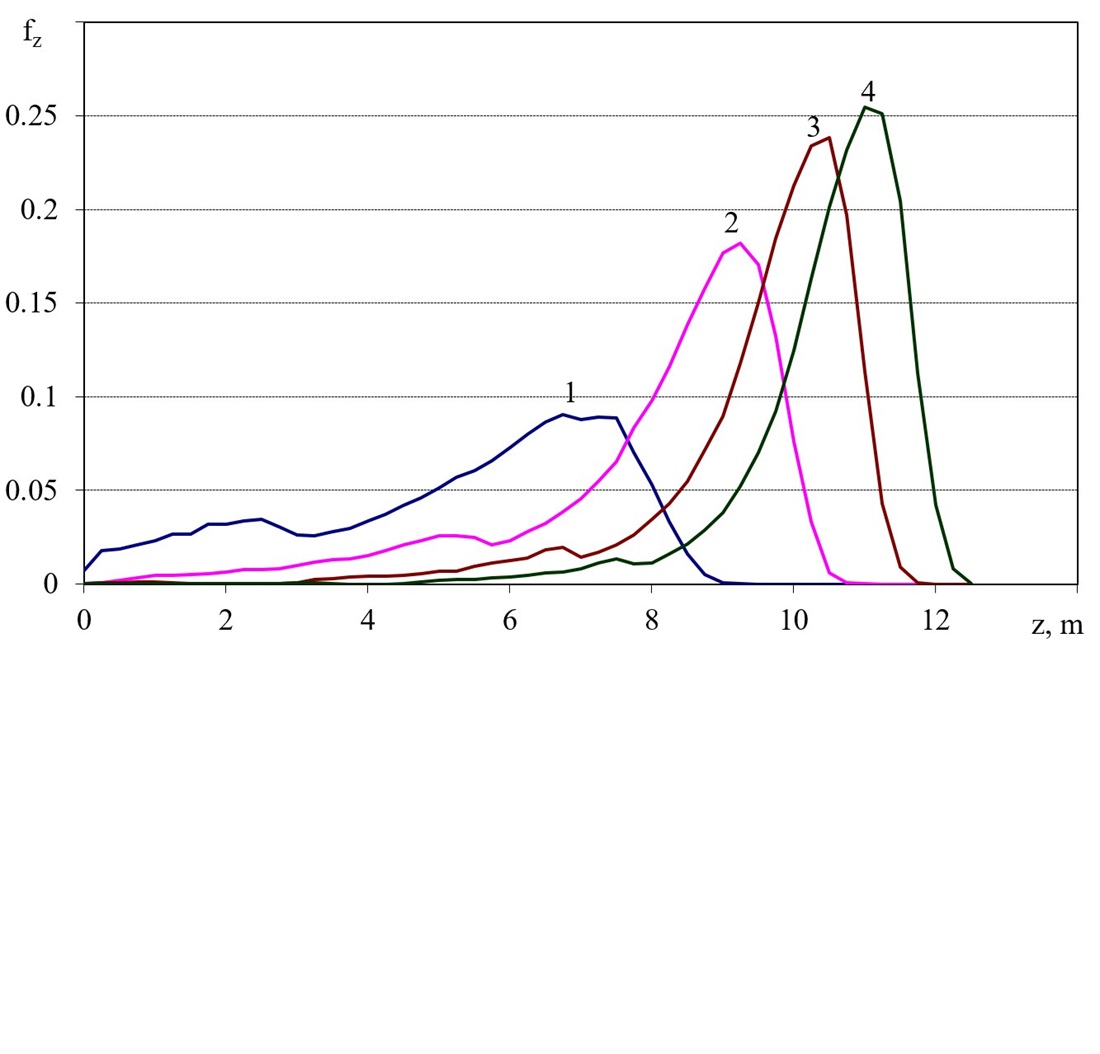
It was established that the density distribution of a water particle reaching the vertical wall has a unimodal character. With increasing water supply pressure, the fraction of water reaching the wall increases significantly, and the maximum of the distribution density becomes more pronounced. In particular, when water is supplied by a fire hose with a nozzle diameter of 19 mm at an angle of 35° from a distance of 25 m, the fraction of water that does not reach the wall decreases from 49% at a pressure of 40 m to 8% at a pressure of 70 m.
It is shown that the interaction of droplets with the wall occurs mainly under the spreading and splashing modes, while the deposition and reflection modes account for less than 1%. With increasing pressure, the fraction of spreading droplets decreases, and the fraction of splashing droplets increases. Under the splashing mode, on average, about 50% of the drop mass is lost. As a result of taking splashing into account, the water distribution density along the vertical wall changes from unimodal to bimodal, where the second maximum corresponds to the zone of predominant droplet spreading
References
- Rahman, F. S., Tannous, W. K., Avsar, G., Agho, K. E., Ghassempour, N., Harvey, L. A. (2023). Economic Costs of Residential Fires: A Systematic Review. Fire, 6 (10), 399. https://doi.org/10.3390/fire6100399
- Pospelov, B., Andronov, V., Rybka, E., Samoilov, M., Krainiukov, O., Biryukov, I. et al. (2021). Development of the method of operational forecasting of fire in the premises of objects under real conditions. Eastern-European Journal of Enterprise Technologies, 2 (10 (110)), 43–50. https://doi.org/10.15587/1729-4061.2021.226692
- Abramov, Y., Basmanov, O., Salamov, J., Mikhayluk, A., Yashchenko, O. (2019). Developing a model of tank cooling by water jets from hydraulic monitors under conditions of fire. Eastern-European Journal of Enterprise Technologies, 1 (10 (97)), 14–20. https://doi.org/10.15587/1729-4061.2019.154669
- Vasilchenko, A., Otrosh, Y., Adamenko, N., Doronin, E., Kovalov, A. (2018). Feature of fire resistance calculation of steel structures with intumescent coating. MATEC Web of Conferences, 230, 02036. https://doi.org/10.1051/matecconf/201823002036
- Kawade, A. U., Kawade, P. A., Kaware, A. P., Kkulthe, A. A., Amune, A. C. (2022). Smart Fire Fighting Robot. World Journal of Advanced Engineering Technology and Sciences, 7 (2), 157–162. https://doi.org/10.30574/wjaets.2022.7.2.0137
- Dubinin, D., Korytchenko, K., Lisnyak, A., Hrytsyna, I., Trigub, V. (2018). Improving the installation for fire extinguishing with finelydispersed water. Eastern-European Journal of Enterprise Technologies, 2 (10 (92)), 38–43. https://doi.org/10.15587/1729-4061.2018.127865
- Semko, A., Rusanova, O., Kazak, O., Beskrovnaya, M., Vinogradov, S., Gricina, I. (2015). The use of pulsed high-speed liquid jet for putting out gas blow-out. The International Journal of Multiphysics, 9 (1), 9–20. https://doi.org/10.1260/1750-9548.9.1.9
- Salyers, B. E. (2010). Spray Characteristics From Fire Hose Nozzles. University of Maryland. Available at: http://hdl.handle.net/1903/10486
- Privitera, S., Manetto, G., Pascuzzi, S., Pessina, D., Cerruto, E. (2023). Drop Size Measurement Techniques for Agricultural Sprays:A State-of-The-Art Review. Agronomy, 13 (3), 678. https://doi.org/10.3390/agronomy13030678
- Hou, X., Cao, Y., Mao, W., Wang, Z., Yuan, J. (2021). Models for Predicting the Jet Trajectory and Intensity Drop Point of Fire Monitors. Fluid Dynamics & Materials Processing, 17 (5), 859–869. https://doi.org/10.32604/fdmp.2021.015967
- Basmanov, O., Oliinyk, V., Zemlianskyi, O., Derevyanko, O., Karpova, D. (2025). Building a model of water jet motion exiting a fire hose. Eastern-European Journal of Enterprise Technologies, 5 (10 (137)), 77–86. https://doi.org/10.15587/1729-4061.2025.341606
- Trettel, B., Ezekoye, O. A. (2015). Theoretical Range and Trajectory of a Water Jet. Volume 7A: Fluids Engineering Systems and Technologies. https://doi.org/10.1115/imece2015-52103
- Ponziani, F. A., Tinaburri, A. (2015). Water jet streams modeling for firefighting activities with the aid of CDF. Safety and Security Engineering VI, 1, 323–334. https://doi.org/10.2495/safe150281
- Kim, H., Choi, H., Kim, D., Chung, J., Kim, H., Lee, K. (2020). Experimental study on splash phenomena of liquid jet impinging on a vertical wall. Experimental Thermal and Fluid Science, 116, 110111. https://doi.org/10.1016/j.expthermflusci.2020.110111
- Ersoy, N. E., Eslamian, M. (2020). Phenomenological study and comparison of droplet impact dynamics on a dry surface, thin liquid film, liquid film and shallow pool. Experimental Thermal and Fluid Science, 112, 109977. https://doi.org/10.1016/j.expthermflusci.2019.109977
- Bai, C. X., Rusche, H., Gosman, A. D. (2002). Modeling of gasoline spray impingement. Atomization and Sprays, 12 (1-3), 1–28. https://doi.org/10.1615/atomizspr.v12.i123.10
- Burzynski, D. A., Roisman, I. V., Bansmer, S. E. (2020). On the splashing of high-speed drops impacting a dry surface. Journal of Fluid Mechanics, 892. https://doi.org/10.1017/jfm.2020.168
- Subedi, K. K., Kong, S.-C., Kweon, C.-B. M. (2022). Numerical Study of Consecutive Drop/Wall Impacts Using Smoothed Particle Hydrodynamics. International Journal of Multiphase Flow, 151, 104060. https://doi.org/10.1016/j.ijmultiphaseflow.2022.104060
- Zhai, J., Lee, S.-Y. (2023). Determination of the single droplet post-impingement pattern on a dry wall: A data-driven approach. Results in Engineering, 17, 100887. https://doi.org/10.1016/j.rineng.2023.100887
- Qian, S., Zhu, D. Z., Xu, H. (2022). Splashing generation by water jet impinging on a horizontal plate. Experimental Thermal and Fluid Science, 130, 110518. https://doi.org/10.1016/j.expthermflusci.2021.110518
- Abramov, Y. A., Basmanov, O. E., Salamov, J., Mikhayluk, A. A. (2018). Model of thermal effect of fire within a dike on the oil tank. Naukovyi Visnyk Natsionalnoho Hirnychoho Universytetu, 2, 95–101. https://doi.org/10.29202/nvngu/2018-2/12
- Andronov, V., Pospelov, B., Rybka, E. (2017). Development of a method to improve the performance speed of maximal fire detectors. Eastern-European Journal of Enterprise Technologies, 2 (9 (86)), 32–37. https://doi.org/10.15587/1729-4061.2017.96694
Downloads
Published
How to Cite
Issue
Section
License
Copyright (c) 2026 Oleksii Basmanov, Volodymyr Oliinyk, Oleksandr Telelym, Dmytro Chalyy, Iryna Chala, Vasyl Maliarchuk, Anastasiia Hryshchenko, Artem Huz

This work is licensed under a Creative Commons Attribution 4.0 International License.
The consolidation and conditions for the transfer of copyright (identification of authorship) is carried out in the License Agreement. In particular, the authors reserve the right to the authorship of their manuscript and transfer the first publication of this work to the journal under the terms of the Creative Commons CC BY license. At the same time, they have the right to conclude on their own additional agreements concerning the non-exclusive distribution of the work in the form in which it was published by this journal, but provided that the link to the first publication of the article in this journal is preserved.
A license agreement is a document in which the author warrants that he/she owns all copyright for the work (manuscript, article, etc.).
The authors, signing the License Agreement with TECHNOLOGY CENTER PC, have all rights to the further use of their work, provided that they link to our edition in which the work was published.
According to the terms of the License Agreement, the Publisher TECHNOLOGY CENTER PC does not take away your copyrights and receives permission from the authors to use and dissemination of the publication through the world's scientific resources (own electronic resources, scientometric databases, repositories, libraries, etc.).
In the absence of a signed License Agreement or in the absence of this agreement of identifiers allowing to identify the identity of the author, the editors have no right to work with the manuscript.
It is important to remember that there is another type of agreement between authors and publishers – when copyright is transferred from the authors to the publisher. In this case, the authors lose ownership of their work and may not use it in any way.








