Defining the patterns of wood flammability reduction considering combustion processes and thermal oxidative destruction
DOI:
https://doi.org/10.15587/1729-4061.2026.358178Keywords:
pyrolysis zone, thermal oxidative destruction, charring rate, fire-retardant coatingsAbstract
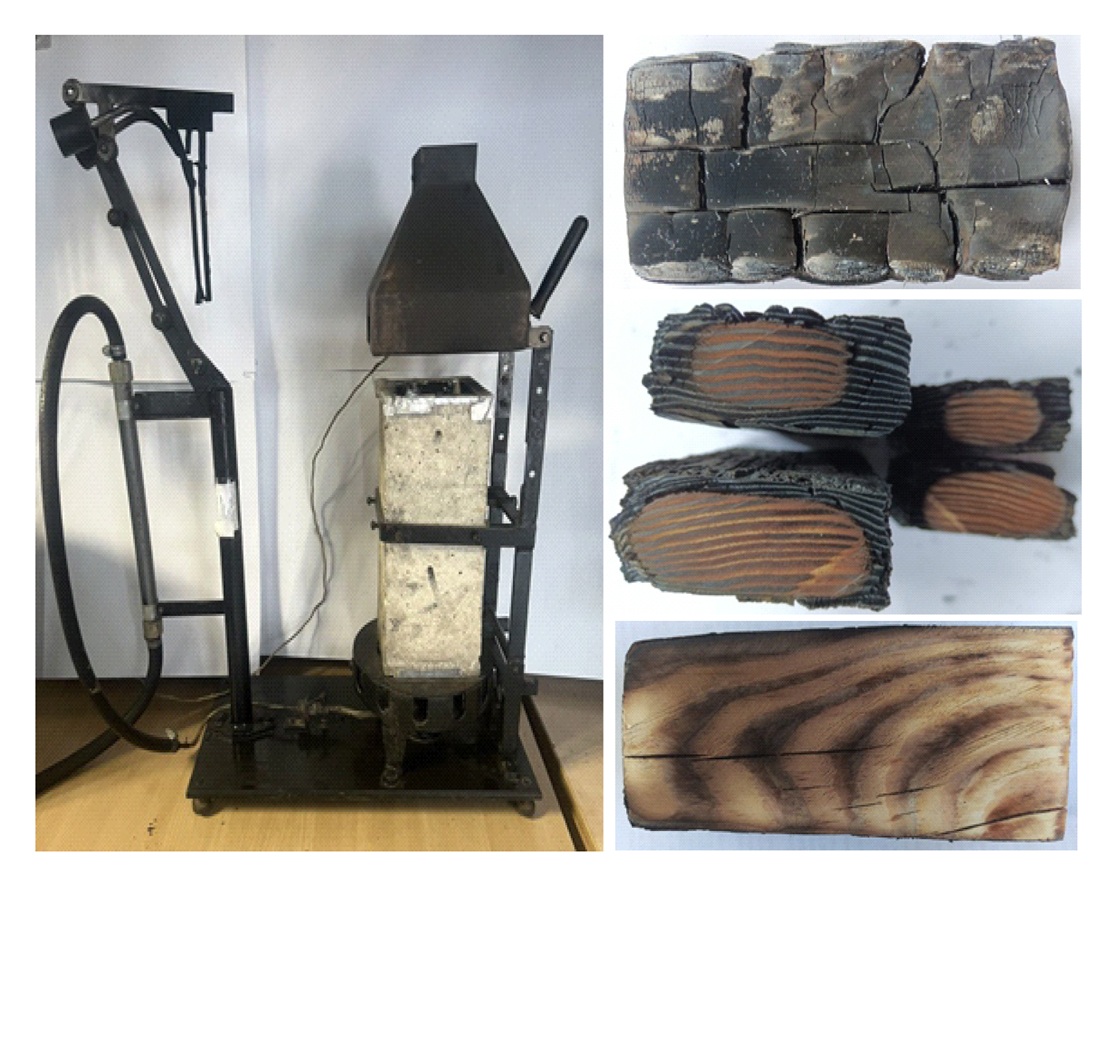
This study explores the mechanism and processes behind thermal oxidative destruction and the formation of char and pyrolysis layers in wood.
The task addressed is to establish patterns of wood combustibility and features in the formation of pyrolysis and char layers at heating in order to improve the effectiveness of fire protection.
The experimental results established that for untreated wood the average depth of the pyrolysis layer is 4 mm for birch and 7 mm for pine, while the char layer reaches 8 mm and 12 mm, respectively. When applying a fire-retardant coating, these values decrease to 1 mm (pyrolysis) and 2 mm (char) for birch, and to 2 mm (pyrolysis) and 4 mm (char) for pine. Thus, the use of fire-retardant compositions leads to a reduction in the depth of thermal oxidative destruction by 3–4 times and a significant decrease in the intensity of char formation.
The findings indicate that fire-retardant coatings modify the mechanism of thermal decomposition of wood, limit heat and mass transfer processes, reduce the release of combustible gaseous products, as well as promote the formation of a thinner but more stable protective char layer.
A quantitative relationship between the depth of pyrolysis and char layers and the type of wood (birch, pine) under surface fire-retardant treatment has been established. The results show a reduction in combustibility parameters compared to untreated samples.
The findings could be used in the design and optimization of fire-retardant compositions, as well as for improving fire protection measures for wooden structures
References
- Statystychni dovidky. 2025 rik. Available at: https://dsns.gov.ua/statisticni-dovidki/2025-rik
- Sekizawa, A., Goto, O. (2022). Challenges in Fire Protection for Cultural Property Buildings Based on the Lessons from the Shurijo Castle Fire. Fire Technology, 61 (3), 1079–1097. https://doi.org/10.1007/s10694-022-01330-2
- Laban, M., Milanko, V., Kočetov Mišulić, T., Draganić, S. (2017). Fire statistics and risk analysis in wooden building structures in Serbia. International Wood Products Journal, 8 (2), 62–70. https://doi.org/10.1080/20426445.2017.1309808
- Can we learn from the heritage lost in a fire? Experiences and practises on the fire protection of historic buildings in Finland, Norway and Sweden (2004). Stockholm: Riksantikvarieämbetet. Available at: https://www.raa.se/publicerat/9516161170.pdf
- Mensah, R. A., Jiang, L., Renner, J. S., Xu, Q. (2022). Characterisation of the fire behaviour of wood: From pyrolysis to fire retardant mechanisms. Journal of Thermal Analysis and Calorimetry, 148 (4), 1407–1422. https://doi.org/10.1007/s10973-022-11442-0
- Berhanu, S., Hervy, M., Weiss-Hortala, E., Proudhon, H., Berger, M.-H., Chesnaud, A. et al. (2018). Advanced characterization unravels the structure and reactivity of wood-based chars. Journal of Analytical and Applied Pyrolysis, 130, 79–89. https://doi.org/10.1016/j.jaap.2018.01.024
- Guizani, C., Jeguirim, M., Valin, S., Limousy, L., Salvador, S. (2017). Biomass Chars: The Effects of Pyrolysis Conditions on Their Morphology, Structure, Chemical Properties and Reactivity. Energies, 10 (6), 796. https://doi.org/10.3390/en10060796
- Lee, Y. X., Wang, W., Lei, Y., Xu, L., Agarwal, V., Wang, C., Yeoh, G. H. (2025). Flame-retardant coatings for wooden structures. Progress in Organic Coatings, 198, 108903. https://doi.org/10.1016/j.porgcoat.2024.108903
- de Hoyos-Martínez, P. L., Issaoui, H., Herrera, R., Labidi, J., Charrier-El Bouhtoury, F. (2021). Wood Fireproofing Coatings Based on Biobased Phenolic Resins. ACS Sustainable Chemistry & Engineering, 9 (4), 1729–1740. https://doi.org/10.1021/acssuschemeng.0c07505
- Xie, Y., Xu, J., Militz, H., Wang, F., Wang, Q., Mai, C., Xiao, Z. (2016). Thermo-oxidative decomposition and combustion behavior of Scots pine (Pinus sylvestris L.) sapwood modified with phenol- and melamine-formaldehyde resins. Wood Science and Technology, 50 (6), 1125–1143. https://doi.org/10.1007/s00226-016-0857-6
- Xiao, Z., Xu, J., Mai, C., Militz, H., Wang, Q., Xie, Y. (2016). Combustion behavior of Scots pine (Pinus sylvestris L.) sapwood treated with a dispersion of aluminum oxychloride-modified silica. Holzforschung, 70 (12), 1165–1173. https://doi.org/10.1515/hf-2016-0062
- Lainioti, G. C., Koukoumtzis, V., Andrikopoulos, K. S., Tsantaridis, L., Östman, B., Voyiatzis, G. A., Kallitsis, J. K. (2022). Environmentally Friendly Hybrid Organic–Inorganic Halogen-Free Coatings for Wood Fire-Retardant Applications. Polymers, 14 (22), 4959. https://doi.org/10.3390/polym14224959
- Rowell, R., Pettersen, R., Tshabalala, M. (2012). Cell Wall Chemistry. Handbook of Wood Chemistry and Wood Composites, Second Edition, 33–72. https://doi.org/10.1201/b12487-5
- Yang, H., Yan, R., Chen, H., Lee, D. H., Zheng, C. (2007). Characteristics of hemicellulose, cellulose and lignin pyrolysis. Fuel, 86 (12-13), 1781–1788. https://doi.org/10.1016/j.fuel.2006.12.013
- Boerjan, W., Ralph, J., Baucher, M. (2003). Lignin Biosynthesis. Annual Review of Plant Biology, 54 (1), 519–546. https://doi.org/10.1146/annurev.arplant.54.031902.134938
- Lin, S., Qin, Y., Huang, X., Gollner, M. (2023). Use of pre-charred surfaces to improve fire performance of wood. Fire Safety Journal, 136, 103745. https://doi.org/10.1016/j.firesaf.2023.103745
- Commandré, J.-M., Lahmidi, H., Salvador, S., Dupassieux, N. (2011). Pyrolysis of wood at high temperature: The influence of experimental parameters on gaseous products. Fuel Processing Technology, 92 (5), 837–844. https://doi.org/10.1016/j.fuproc.2010.07.009
- Turns, R. E. (2012). An Introduction to Combustion: Concepts and Applications. McGraw Hill. Available at: https://dokumen.pub/an-introduction-to-combustion-concepts-and-applications-3rd-ed-978-0-07-338019-3-0-07-338019-9.html#Stephen+R.+Turns
- Laidler, K. J. (1984). The development of the Arrhenius equation. Journal of Chemical Education, 61 (6), 494. https://doi.org/10.1021/ed061p494
- Almagro-Herrera, N., Lozano-Calvo, S., Palma, A., García, J. C., Díaz, M. J. (2024). Assessing the influence of biomass origin and fractionation methods on pyrolysis of primary biomass fractions. Fuel, 367, 131501. https://doi.org/10.1016/j.fuel.2024.131501
- NIST-JANAF Thermochemical Tables. NIST. https://doi.org/10.18434/T42S31
- Balanyuk, V., Pykus, V. (2026). Study of the effectiveness of a complex polymer flame-retardant system based on amino-formaldehyde resins. Herald of Khmelnytskyi National University. Technical Sciences, 363 (2), 118–124. https://doi.org/10.31891/2307-5732-2026-363-15
- Balanyuk, V. M. (2015). The effectiveness of open space fire extinguishing with flammable liquid fighting aerosols. Eastern-European Journal of Enterprise Technologies, 5 (10 (77)), 4–11. https://doi.org/10.15587/1729-4061.2015.51399
- Balanyuk, V., Kozyar, N., Garasyumyk, O. (2016). Study of fire-extinguishing efficiency of environmentally friendly binary aerosol-nitrogen mixtures. Eastern-European Journal of Enterprise Technologies, 3 (10 (81)), 4–11. https://doi.org/10.15587/1729-4061.2016.72399
- Balanyuk, V. M., Koziar, N. M., Harasymiuk, O. I. (2016). The usage of gas and aerosol powder extinguishing mixtures for protection of incendiary mixtures. ScienceRise, 5 (2 (22)), 10–14. https://doi.org/10.15587/2313-8416.2016.69333
Downloads
Published
How to Cite
Issue
Section
License
Copyright (c) 2026 Volodymyr Balanyuk, Viktor Pykus, Oleksandr Harasymiuk, Kateryna Kudrynska, Pavlo Pastukhov, Yurii Kopystynskyi

This work is licensed under a Creative Commons Attribution 4.0 International License.
The consolidation and conditions for the transfer of copyright (identification of authorship) is carried out in the License Agreement. In particular, the authors reserve the right to the authorship of their manuscript and transfer the first publication of this work to the journal under the terms of the Creative Commons CC BY license. At the same time, they have the right to conclude on their own additional agreements concerning the non-exclusive distribution of the work in the form in which it was published by this journal, but provided that the link to the first publication of the article in this journal is preserved.
A license agreement is a document in which the author warrants that he/she owns all copyright for the work (manuscript, article, etc.).
The authors, signing the License Agreement with TECHNOLOGY CENTER PC, have all rights to the further use of their work, provided that they link to our edition in which the work was published.
According to the terms of the License Agreement, the Publisher TECHNOLOGY CENTER PC does not take away your copyrights and receives permission from the authors to use and dissemination of the publication through the world's scientific resources (own electronic resources, scientometric databases, repositories, libraries, etc.).
In the absence of a signed License Agreement or in the absence of this agreement of identifiers allowing to identify the identity of the author, the editors have no right to work with the manuscript.
It is important to remember that there is another type of agreement between authors and publishers – when copyright is transferred from the authors to the publisher. In this case, the authors lose ownership of their work and may not use it in any way.








