Assessing the stability of a protective soil-cement structure in the soil massif under the action of critical explosive impacts
DOI:
https://doi.org/10.15587/1729-4061.2026.358194Keywords:
blast waves, soil massif, soil-cement screen, mathematical modeling, stability predictionAbstract
This study investigates dynamic interaction between the soil and an obstacle under explosive loading. The task addressed is to protect underground structures with shallow laying in the soil massif from the effect of critical explosive influences, which is becoming increasingly relevant under conditions of military threats.
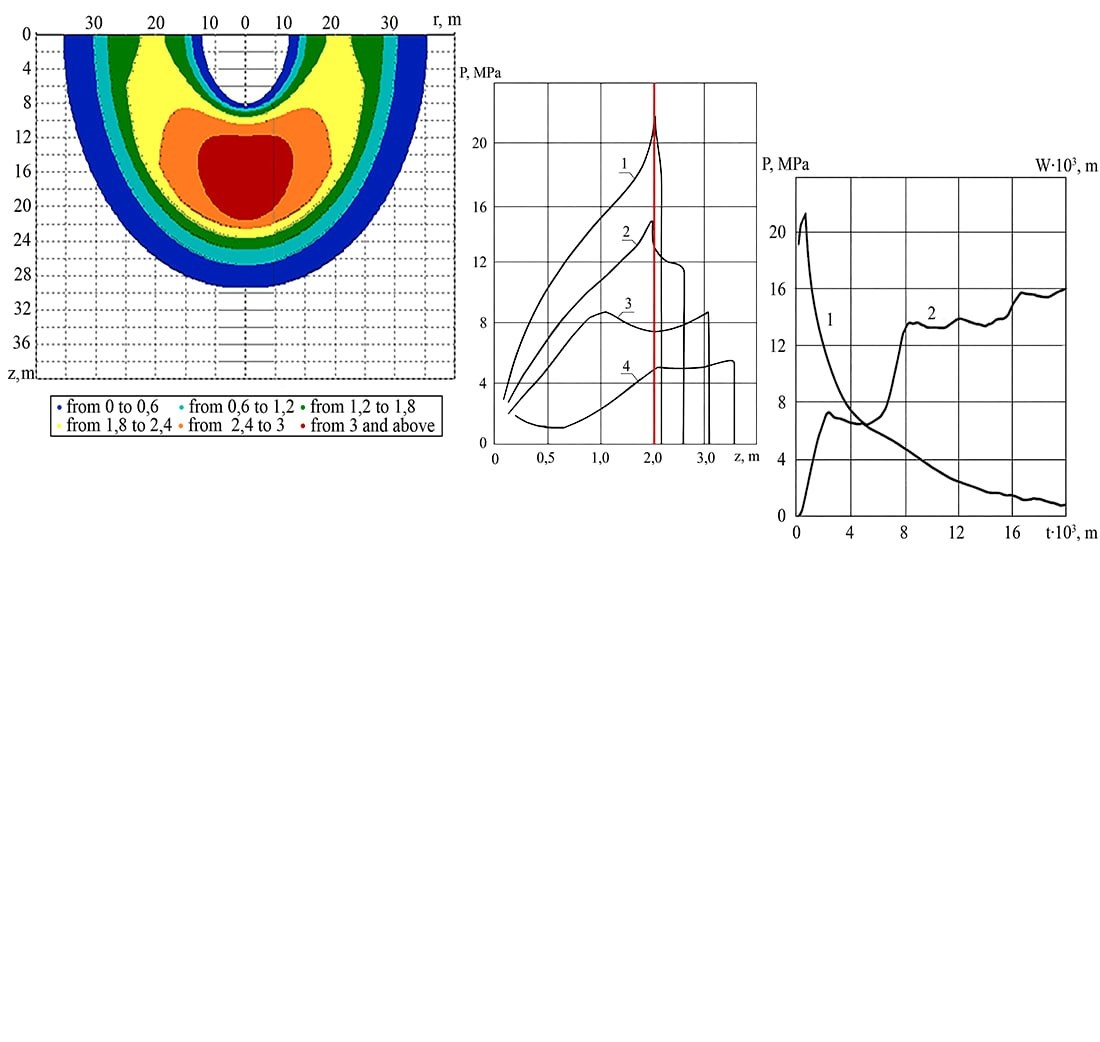
A methodology has been devised to numerically solve the problem of a cylindrical warhead explosion on the surface of the soil massif, taking into account the interaction with the foundation-cement obstacle. That has made it possible to investigate the patterns of change in wave processes in the soil and obstacle depending on time, charge mass, and depth of the screen.
The wave interaction between the explosion and the soil massif with an obstacle was numerically simulated. The isobar field was determined at different times and velocity isoseisms were defined, which show the dynamics of wave propagation deep into the soil massif and changes in their velocity. Dependences of the peak stress on the depth for different warhead masses (50, 150, and 500 kg) were derived, as well as the resulting peak stresses and the minimum safe horizontal distances to the epicenter of the explosion for the obstacle. The dependences between the deflection and pressure of the protective soil-cement structure were determined, which makes it possible to predict the stability of the protective screen at its different thickness.
It has been established that the peak stress decreases rapidly with distance from the epicenter of the explosion. For R < 3.7 m, the screen (obstacle) is in the zone of high tensile stresses (σmax > 2 MPa), which leads to crushing, loss of shape, and stability of the structure. For R ≈ 7.4 m, the tensile stress decreases to approximately 0.3–0.5 MPa. These values should be considered as a threshold value for maintaining the holding (protective) function of the soil-cement obstacle.
A nomogram has been constructed to assess the mechanical properties of a soil-cement barrier located at a certain depth during a surface explosion of a warhead of different mass depending on the cement content. This facilitates practical management of the stability of the protective structure by adjusting the parameters of the bonding mixture.
The prospects of engineering protection of underground facilities by forming a continuous soil-cement screen in the path of the blast wave, formed by jet cementing of soils, have been proven
References
- Remez, N., Bronytskyi, V., Hrebeniuk, T. (2024). Risk assessment for the development of the exemplified territories. POWER ENGINEERING: Economics, Technique, Ecology, 1. https://doi.org/10.20535/1813-5420.1.2024.300835
- Remez, N., Dychko, A., Bronytskyi, V., Hrebeniuk, T., Bambirra Pereira, R., Ekel, P. (2021). Simulation of the influence of dynamic loading on the stress-strain state of the natural and geoengineering environment. E3S Web of Conferences, 280, 01008. https://doi.org/10.1051/e3sconf/202128001008
- Remez, N. S., Dychko, A. O., Hrebeniuk, T. V., Kraichuk, S. O., Pereira, R. B. (2022). Interaction behaviors of longitudinal and transverse seismic waves with underground objects. Book of Abstracts of the 3rd International Conference on Sustainable Futures: Environmental, Technological, Social and Economic Matters, 25. Available at: https://www.igns.gov.ua/wp-content/uploads/2022/05/book-of-abstracts_icsf-2022.pdf
- Haiko, H., Savchenko, I., Shelestov, A. (2025). Ensuring resilience and safety of the transportation system of Kyiv in planning the network of road tunnels. Case Studies on Transport Policy, 19, 101355. https://doi.org/10.1016/j.cstp.2024.101355
- Haiko, H., Hollander, J. B., Savchenko, I. (2025). Priority ranking of alternative Odesa metro plan variants: using modified morphological analysis method. International Journal of Urban Sciences, 29 (4), 910–938. https://doi.org/10.1080/12265934.2025.2452509
- Lin, Q., Feng, C., Gan, Y., Yuan, J., Jiao, W., Yang, Y. (2024). Study of Difference in Dynamic Response of Underground Structure at Different Blast Angles. Advances in Frontier Research on Engineering Structures II, 393–401. https://doi.org/10.1007/978-981-97-6238-5_32
- Krauthammer, T. (2008). Modern Protective Structures (Civil and Environmental Engineering). CRC Press. Available at: https://openlibrary.org/books/OL8125346M/Modern_Protective_Structures_%28Civil_and_Environmental_Engineering%29
- UFC 3-340-02. Structures to Resist the Effects of Accidental Explosions (2008). Washington. Available at: https://www.wbdg.org/FFC/DOD/UFC/ARCHIVES/ufc_3_340_02.pdf
- Belytschko, T., Liu, W. K., Moran, B., Elkhodary, K. I. (2014). Nonlinear finite elements for continua and structures. John Wiley & Sons. Available at: https://download.e-bookshelf.de/download/0004/0349/97/L-G-0004034997-0002588474.pdf
- Johnson, G. R., Holmquist, T. J. (1993). A computational constitutive model for concrete subjected to large strains, high strain rates, and high pressures. In: 14th International Symposium on Ballistics. Available at: https://ftp.lstc.com/anonymous/outgoing/jday/concrete/scanned_mat111.pdf
- Dowding, C. H. (2000). Construction Vibrations. Upper Saddle River, NJ: Prentice Hall. Available at: https://openlibrary.org/books/OL8526402M/
- Mandal, J., Agarwal, A. K., Goel, M. D. (2020). Numerical Modeling of Shallow Buried Tunnel Subject to Surface Blast Loading. Journal of Performance of Constructed Facilities, 34 (6). https://doi.org/10.1061/(asce)cf.1943-5509.0001518
- Zhou, Q., He, H., Liu, S., Chen, X., Tang, Z., Liu, Y. et al. (2021). Blast resistance evaluation of urban utility tunnel reinforced with BFRP bars. Defence Technology, 17 (2), 512–530. https://doi.org/10.1016/j.dt.2020.03.015
- Kolsky, H. (1949). An Investigation of the Mechanical Properties of Materials at very High Rates of Loading. Proceedings of the Physical Society. Section B, 62 (11), 676–700. https://doi.org/10.1088/0370-1301/62/11/302
- Zhao, H., Yu, H., Yuan, Y., Zhu, H. (2015). Blast mitigation effect of the foamed cement-base sacrificial cladding for tunnel structures. Construction and Building Materials, 94, 710–718. https://doi.org/10.1016/j.conbuildmat.2015.07.076
- Remez, N. S., Dychko, A. O., Sini, L., Minaieva, Yu. Yu. (2025). Recovery of bombturations and unstable soils by drilling mixing technology. Scientific Notes of Taurida National V.I. Vernadsky University. Series: Technical Sciences, 2 (1), 284–290. https://doi.org/10.32782/2663-5941/2025.1.2/41
- Remez, N. S. (2019). Vzaiemodiya vybukhovykh khvyl z gruntamy i elementamy tekhnourbosystem. Kyiv: Tsentr uchbovoi literatury, 334.
- Remez, N., Haiko, H., Dychko, A., Boiko, V., Haiko, S., Antoniuk, O. (2024). Development of a mathematical model of dynamic soil deformation taking into account the variable coefficient of volumetric viscosity. E3S Web of Conferences, 567, 01010. https://doi.org/10.1051/e3sconf/202456701010
- Remez, N., Haiko, H., Hrebeniuk, T., Woźniak, G. (2025). Assessment of the risks of dispersion of harmful gases during the detonation of non-Tentyl emulsion explosives. IOP Conference Series: Earth and Environmental Science, 1457 (1), 012020. https://doi.org/10.1088/1755-1315/1457/1/012020
- Horpibulsuk, S., Rachan, R., Chinkulkijniwat, A., Raksachon, Y., Suddeepong, A. (2010). Analysis of strength development in cement-stabilized silty clay from microstructural considerations. Construction and Building Materials, 24 (10), 2011–2021. https://doi.org/10.1016/j.conbuildmat.2010.03.011
Downloads
Published
How to Cite
Issue
Section
License
Copyright (c) 2026 Natalia Remez, Hennadii Haiko, Vadym Bronytskyi, Tetiana Hrebeniuk, Svitlana Haiko

This work is licensed under a Creative Commons Attribution 4.0 International License.
The consolidation and conditions for the transfer of copyright (identification of authorship) is carried out in the License Agreement. In particular, the authors reserve the right to the authorship of their manuscript and transfer the first publication of this work to the journal under the terms of the Creative Commons CC BY license. At the same time, they have the right to conclude on their own additional agreements concerning the non-exclusive distribution of the work in the form in which it was published by this journal, but provided that the link to the first publication of the article in this journal is preserved.
A license agreement is a document in which the author warrants that he/she owns all copyright for the work (manuscript, article, etc.).
The authors, signing the License Agreement with TECHNOLOGY CENTER PC, have all rights to the further use of their work, provided that they link to our edition in which the work was published.
According to the terms of the License Agreement, the Publisher TECHNOLOGY CENTER PC does not take away your copyrights and receives permission from the authors to use and dissemination of the publication through the world's scientific resources (own electronic resources, scientometric databases, repositories, libraries, etc.).
In the absence of a signed License Agreement or in the absence of this agreement of identifiers allowing to identify the identity of the author, the editors have no right to work with the manuscript.
It is important to remember that there is another type of agreement between authors and publishers – when copyright is transferred from the authors to the publisher. In this case, the authors lose ownership of their work and may not use it in any way.








