Assessing the potential for improving production efficiency through digitalization by implementing a specialized industry digital platform
DOI:
https://doi.org/10.15587/1729-4061.2026.358840Keywords:
digitalization of agriculture, crop production, digital platform, economic effectAbstract
The object of the study is the digitalization of enterprises in the field of crop production to increase production efficiency. The problem of assessing the level of digitalization of enterprises in the crop industry and the effectiveness of implementing an industry-specific regional digital platform has been solved.
The results of the study were obtained:
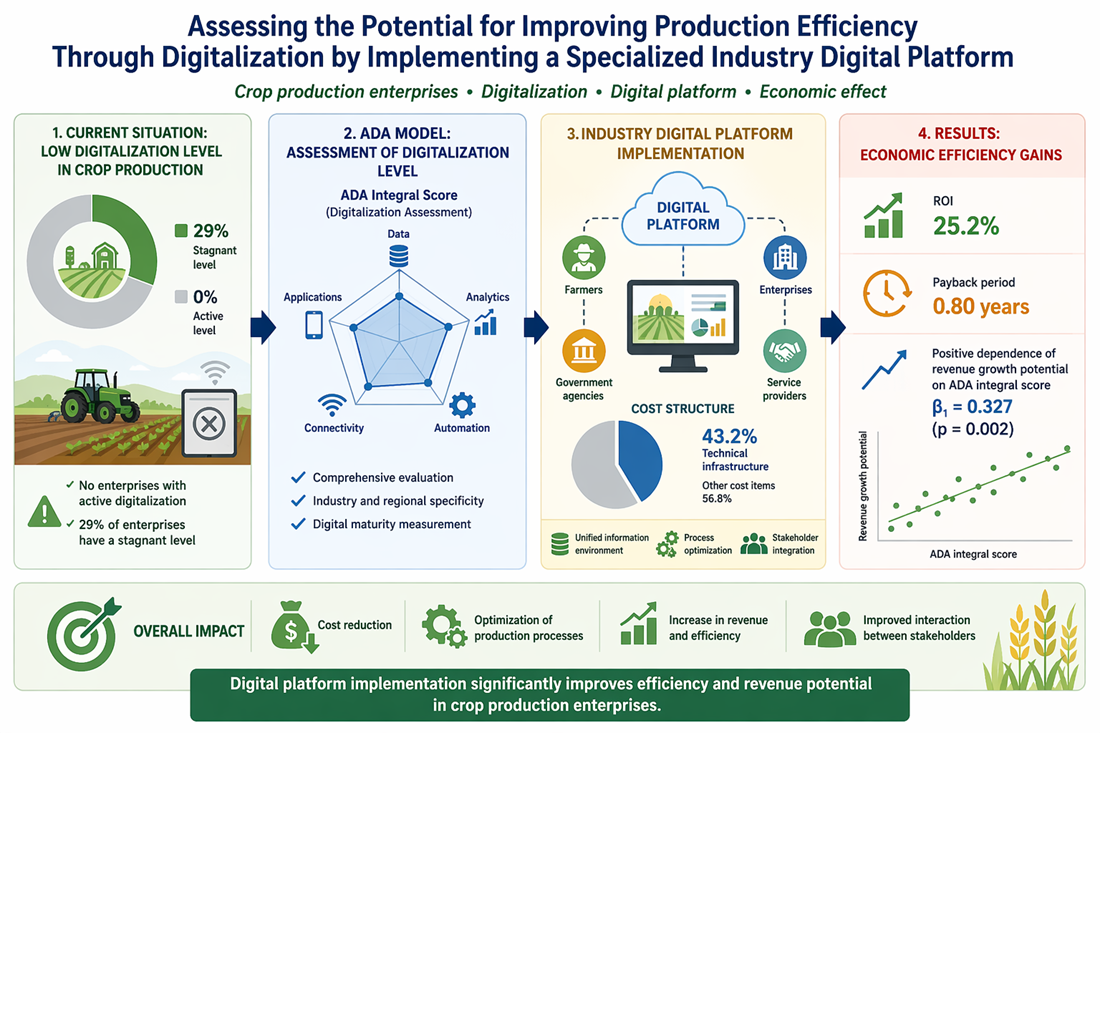
– the analysis showed the absence of companies with an active level of digitalization, while a third (29%) have a stagnant level;
– the implementation of the digital platform provides a return on investment of 25.2%;
– a positive dependence of the revenue growth potential on the ADA integral score (β1 = 0.327, p = 0.002) was revealed;
– the analysis showed a payback period of 0.80 years in a realistic scenario;
– in the cost structure for the implementation of the digital platform, the majority (43.2%) is allocated to the technical infrastructure.
The results of the study are explained by the use of the ADA model, which allows a comprehensive assessment of the level of digitalization of crop production enterprises, taking into account industry and regional specifics. The specifics of the results obtained are that this paper offers not only an assessment of the current state of digitalization, but also practical recommendations for the implementation of a digital platform adapted to the needs of the region.
The practical significance of the study lies in the proposal of a specific methodology for assessing the level of digitalization of crop production enterprises. In addition, the implementation of the digital platform will create a unified information environment for all market participants, reduce costs, optimize production processes and improve interaction between stakeholders. The results of the study can be used by government agencies, agricultural enterprises and developers of digital solutions for agriculture
References
- Bratukhina, E. A., Beisengaliyev, B. T., Sozinova, A. A., Borzenko, K. V. (2023). Monitoring the Compliance of Today’s Agriculture with Food Security Needs for Sustainable Development. Food Security in the Economy of the Future, 37–43. https://doi.org/10.1007/978-3-031-23511-5_5
- Status of digital agriculture in 18 countries of Europe and Central Asia (2020). Geneva: FAO and ITU, 102. Available at: https://openknowledge.fao.org/handle/20.500.14283/ca9578en
- Xue, C., Tian, W., Zhao, X. (2020). The Literature Review of Platform Economy. Scientific Programming, 2020, 1–7. https://doi.org/10.1155/2020/8877128
- Acs, Z. J., Song, A. K., Szerb, L., Audretsch, D. B., Komlósi, É. (2021). The evolution of the global digital platform economy: 1971–2021. Small Business Economics, 57 (4), 1629–1659. https://doi.org/10.1007/s11187-021-00561-x
- Lampridi, M., Marinoudi, V., Benos, L., Pearson, S., Bochtis, D. D., Pardalos, P. M. (2021). Towards Sustainable Agriculture: Challenges from the Transition to the New Digital Era. Information and Communication Technologies for Agriculture—Theme IV: Actions, 3–28. https://doi.org/10.1007/978-3-030-84156-0_1
- Varga, M., Gyalog, G., Raso, J., Kucska, B., Csukas, B. (2022). Programmable Process Structures of Unified Elements for Model-Based Planning and Operation of Complex Agri-environmental Processes. Information and Communication Technologies for Agriculture—Theme III: Decision, 223–249. https://doi.org/10.1007/978-3-030-84152-2_11
- Hardjomidjojo, H., Yusianto, R., Marimin, M., Suprihatin, S. (2022). Sustainable Agro-industry Logistics Solutions using Spatial Analysis. Operations and Supply Chain Management: An International Journal, 41–55. https://doi.org/10.31387/oscm0480329
- Bezpartochnyi, M., Britchenko, I. (2022). Digitalization for agriculture and rural development in Ukraine. Economic Science for Rural Development, 56, 398–406. https://doi.org/10.22616/esrd.2022.56.039
- Mishra, M., Satapathy, S. (2024). Adoption Challenges of Industry 4.0 in Agrisector and Designing a Framework to Reduce It. Advanced Computational Methods for Agri-Business Sustainability, 305–316. https://doi.org/10.4018/979-8-3693-3583-3.ch017
- Bhatnagar, R., Tripathi, N. K., Bhatnagar, N., Panda, C. K. (Eds.) (2022). The Digital Agricultural Revolution. Wiley. https://doi.org/10.1002/9781119823469
- Phasinam, T., Phasinam, K., U-kaew, A., Piyathamrongchai, K., Hataitara, R., Raghavan, V. et al. (2024). Real-time monitoring and positioning of agricultural tractors using a low-cost GPS and IoT device. International Journal of Geoinformatics, 21 (1), 111–120. https://doi.org/10.52939/ijg.v21i1.3799
- Ramachandran, R. P. (2022). Integrated approach on stored grain quality management with CO2 monitoring-A review. Journal of Stored Products Research, 96, 101950. https://doi.org/10.1016/j.jspr.2022.101950
- Zghurska, O., Korchynska, O., Rubel, K., Kubiv, S., Tarasiuk, A., Holovchenko, O. (2022). Digitalization of the national agro-industrial complex: new challenges, realities and prospects. Financial and Credit Activity Problems of Theory and Practice, 6 (47), 388–399. https://doi.org/10.55643/fcaptp.6.47.2022.3929
- Vlachopoulou, M., Ziakis, C., Vergidis, K., Madas, M. (2021). Analyzing AgriFood-Tech e-Business Models. Sustainability, 13 (10), 5516. https://doi.org/10.3390/su13105516
- Jha, S. K. (2023). Need for an Orchestration Platform to Unlock the Potential of Remote Sensing Data for Agriculture. Digital Ecosystem for Innovation in Agriculture, 61–73. https://doi.org/10.1007/978-981-99-0577-5_3
- Podaras, A. (2022). Data-Based Agricultural Business Continuity Management Policies. Information and Communication Technologies for Agriculture—Theme II: Data, 209–233. https://doi.org/10.1007/978-3-030-84148-5_9
- Mahdad, M., Hasanov, M., Isakhanyan, G., Dolfsma, W. (2022). A smart web of firms, farms and internet of things (IOT): enabling collaboration-based business models in the agri-food industry. British Food Journal, 124 (6), 1857–1874. https://doi.org/10.1108/bfj-07-2021-0756
- Chadha, D., Inaniya, N., Misra, S. (2020). Digitalization of agriculture in India: pathway to prosperity. Agribusiness Development Planning and Management, 21–34. https://doi.org/10.30954/ndp.agribusiness.2020.3
- Birner, R., Daum, T., Pray, C. (2021). Who drives the digital revolution in agriculture? A review of supply‐side trends, players and challenges. Applied Economic Perspectives and Policy, 43 (4), 1260–1285. https://doi.org/10.1002/aepp.13145
- Amiri-Zarandi, M., Hazrati Fard, M., Yousefinaghani, S., Kaviani, M., Dara, R. (2022). A Platform Approach to Smart Farm Information Processing. Agriculture, 12 (6), 838. https://doi.org/10.3390/agriculture12060838
- Rathore, N. S., Joshi, S., Choudhary, N. (2022). Digital technologies for agriculture. New Delhi: Nipa, 188. https://doi.org/10.59317/9789394490369
- Deming, W. E. (1968). Walter A. Shewhart, 1891-1967. Revue de l’Institut International de Statistique / Review of the International Statistical Institute, 36 (3), 372–375. Available at: http://www.jstor.org/stable/1401495
- Hariri, M. A., Goli, A. (2024). Issues and research challenges for implementing cyber-physical agricultural supply chains. Agri 4.0 and the Future of Cyber-Physical Agricultural Systems, 73–89. https://doi.org/10.1016/b978-0-443-13185-1.00005-8
- Zhou, X., Chen, T., Zhang, B. (2023). Research on the Impact of Digital Agriculture Development on Agricultural Green Total Factor Productivity. Land, 12 (1), 195. https://doi.org/10.3390/land12010195
- Gulyaeva, T. I., Kalinicheva, E. Yu., Buraeva, E. V., Sidorenko, O. V. (2023). Human Resource Development with Respect to Digital Challenges in Agriculture. Unlocking Digital Transformation of Agricultural Enterprises, 291–298. https://doi.org/10.1007/978-3-031-13913-0_30
- Abate, G. T., Abay, K. A., Chamberlin, J., Kassim, Y., Spielman, D. J., Paul Jr Tabe-Ojong, M. (2023). Digital tools and agricultural market transformation in Africa: Why are they not at scale yet, and what will it take to get there? Food Policy, 116, 102439. https://doi.org/10.1016/j.foodpol.2023.102439
- Kashina, E., Yanovskaya, G., Fedotkina, E., Tesalovsky, A., Vetrova, E., Shaimerdenova, A., Aitkazina, M. (2022). Impact of Digital Farming on Sustainable Development and Planning in Agriculture and Increasing the Competitiveness of the Agricultural Business. International Journal of Sustainable Development and Planning, 17 (8), 2413–2420. https://doi.org/10.18280/ijsdp.170808
- Zhang, X., Fan, D. (2023). Can agricultural digital transformation help farmers increase income? An empirical study based on thousands of farmers in Hubei Province. Environment, Development and Sustainability, 26 (6), 14405–14431. https://doi.org/10.1007/s10668-023-03200-5
- Coelho, A. L. d. F., de Oliveira, T. F., Netto, M. N. (2022). Platforms, Applications, and Software. Digital Agriculture, 259–272. https://doi.org/10.1007/978-3-031-14533-9_15
- Oplanić, M., Težak Damijanić, A., Saftić, D., Čehić, A. (2019). The internet as a source of information about local agro - food products. Journal of Central European Agriculture, 20 (2), 759–769. https://doi.org/10.5513/jcea01/20.2.2127
- Potryvaieva, N., Dubinina, M., Cheban, Y., Syrtseva, S., Luhova, O. (2024). Digitalization of control and accounting processes of agricultural enterprises: Risk assessment and management. Ekonomika APK, 31 (5), 45–58. https://doi.org/10.32317/ekon.apk/5.2024.45
Downloads
Published
How to Cite
Issue
Section
License
Copyright (c) 2026 Botagoz Duissenbayeva, Raushan Gabdualiyeva, Gulnar Kunurkulzhayeva, Zhaxat Kenzhin, Aisulu Parmanasova, Yerlan Onlassynov, Shynar Nurgaliyeva, Almagul Ibrasheva, Gaukhar Kairliyeva, Wasiu Abiodun Sanyaolu

This work is licensed under a Creative Commons Attribution 4.0 International License.
The consolidation and conditions for the transfer of copyright (identification of authorship) is carried out in the License Agreement. In particular, the authors reserve the right to the authorship of their manuscript and transfer the first publication of this work to the journal under the terms of the Creative Commons CC BY license. At the same time, they have the right to conclude on their own additional agreements concerning the non-exclusive distribution of the work in the form in which it was published by this journal, but provided that the link to the first publication of the article in this journal is preserved.
A license agreement is a document in which the author warrants that he/she owns all copyright for the work (manuscript, article, etc.).
The authors, signing the License Agreement with TECHNOLOGY CENTER PC, have all rights to the further use of their work, provided that they link to our edition in which the work was published.
According to the terms of the License Agreement, the Publisher TECHNOLOGY CENTER PC does not take away your copyrights and receives permission from the authors to use and dissemination of the publication through the world's scientific resources (own electronic resources, scientometric databases, repositories, libraries, etc.).
In the absence of a signed License Agreement or in the absence of this agreement of identifiers allowing to identify the identity of the author, the editors have no right to work with the manuscript.
It is important to remember that there is another type of agreement between authors and publishers – when copyright is transferred from the authors to the publisher. In this case, the authors lose ownership of their work and may not use it in any way.








