Development of a system for monitoring and managing climate-dependent process risks based on hidden Markov models (using grain crop yields as an example)
DOI:
https://doi.org/10.15587/1729-4061.2026.359355Keywords:
hidden Markov models, probabilistic risk monitoring, TO-BE architecture, process managementAbstract
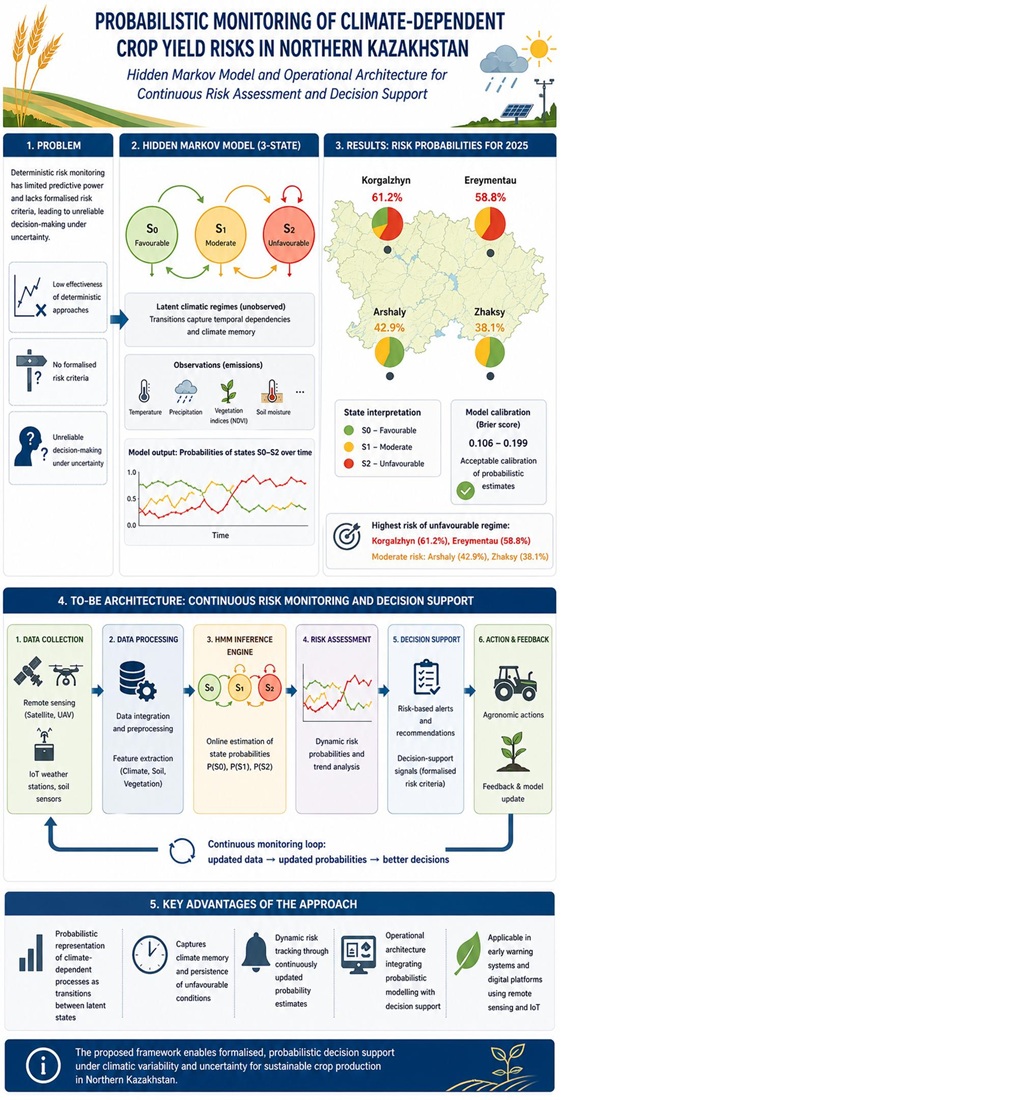
This study focuses on climate-dependent production processes, in particular grain crop yields, under conditions of climatic variability and uncertainty in Northern Kazakhstan. The problem addressed is the low effectiveness of deterministic risk monitoring approaches due to limited predictive power and the lack of formalized risk criteria, which leads to unreliable decision-making under uncertainty.
The results include the development of a three-state hidden Markov model (S0–S2) and a TO-BE architecture for continuous risk monitoring and decision support. The model enabled the identification of latent climatic regimes and probabilistic assessment of risk states for 2025. The highest probability of an unfavorable regime was observed in Korgalzhyn (61.2%) and Ereymentau (58.8%), while Arshaly (42.9%) and Zhaksy (38.1%) showed moderate risk levels. The Brier score ranged from 0.106 to 0.199, confirming acceptable calibration of probabilistic estimates.
The key feature of the approach is the representation of climate-dependent processes as transitions between latent probabilistic states, allowing the capture of temporal dependencies (climate memory) and the persistence of unfavorable conditions. Unlike deterministic models, the proposed framework enables dynamic risk tracking through continuously updated probability estimates integrated into a monitoring loop.
The advantage of the approach lies in combining probabilistic modelling with an operational architecture, where risk probabilities serve as formalized decision-support signals. The results can be applied in early warning systems and digital monitoring platforms using remote sensing and IoT
References
- Karatayev, M., Clarke, M., Salnikov, V., Bekseitova, R., Nizamova, M. (2022). Monitoring climate change, drought conditions and wheat production in Eurasia: the case study of Kazakhstan. Heliyon, 8 (1), e08660. https://doi.org/10.1016/j.heliyon.2021.e08660
- Teleubay, Z., Yermekov, F., Rustembayev, A., Topayev, S., Zhabayev, A., Tokbergenov, I. et al. (2023). Comparison of Climate Change Effects on Wheat Production under Different Representative Concentration Pathway Scenarios in North Kazakhstan. Sustainability, 16 (1), 293. https://doi.org/10.3390/su16010293
- Schauberger, B., Jägermeyr, J., Gornott, C. (2020). A systematic review of local to regional yield forecasting approaches and frequently used data resources. European Journal of Agronomy, 120, 126153. https://doi.org/10.1016/j.eja.2020.126153
- Anderson, W., Shukla, S., Verdin, J., Hoell, A., Justice, C., Barker, B. et al. (2024). Preseason maize and wheat yield forecasts for early warning of crop failure. Nature Communications, 15 (1). https://doi.org/10.1038/s41467-024-51555-8
- van Klompenburg, T., Kassahun, A., Catal, C. (2020). Crop yield prediction using machine learning: A systematic literature review. Computers and Electronics in Agriculture, 177, 105709. https://doi.org/10.1016/j.compag.2020.105709
- Corcoran, E., Afshar, M., Curceac, S., Lashkari, A., Raza, M. M., Ahnert, S. et al. (2023). Current data and modeling bottlenecks for predicting crop yields in the United Kingdom. Frontiers in Sustainable Food Systems, 7. https://doi.org/10.3389/fsufs.2023.1023169
- Ceglar, A., Toreti, A. (2021). Seasonal climate forecast can inform the European agricultural sector well in advance of harvesting. Npj Climate and Atmospheric Science, 4 (1). https://doi.org/10.1038/s41612-021-00198-3
- Risbey, J. S., Squire, D. T., Black, A. S., DelSole, T., Lepore, C., Matear, R. J. et al. (2021). Standard assessments of climate forecast skill can be misleading. Nature Communications, 12 (1). https://doi.org/10.1038/s41467-021-23771-z
- Darra, N., Anastasiou, E., Kriezi, O., Lazarou, E., Kalivas, D., Fountas, S. (2023). Can Yield Prediction Be Fully Digitilized? A Systematic Review. Agronomy, 13 (9), 2441. https://doi.org/10.3390/agronomy13092441
- Romanovska, P., Schauberger, B., Gornott, C. (2023). Wheat yields in Kazakhstan can successfully be forecasted using a statistical crop model. European Journal of Agronomy, 147, 126843. https://doi.org/10.1016/j.eja.2023.126843
- Iizumi, T., Shin, Y., Kim, W., Kim, M., Choi, J. (2018). Global crop yield forecasting using seasonal climate information from a multi-model ensemble. Climate Services, 11, 13–23. https://doi.org/10.1016/j.cliser.2018.06.003
- Doi, T., Sakurai, G., Iizumi, T. (2020). Seasonal Predictability of Four Major Crop Yields Worldwide by a Hybrid System of Dynamical Climate Prediction and Eco-Physiological Crop-Growth Simulation. Frontiers in Sustainable Food Systems, 4. https://doi.org/10.3389/fsufs.2020.00084
- Iizumi, T., Takaya, Y., Kim, W., Nakaegawa, T., Maeda, S. (2021). Global Within-Season Yield Anomaly Prediction for Major Crops Derived Using Seasonal Forecasts of Large-Scale Climate Indices and Regional Temperature and Precipitation. Weather and Forecasting, 36 (1), 285–299. https://doi.org/10.1175/waf-d-20-0097.1
- Jin, H., Li, M., Hopwood, G., Hochman, Z., Bakar, K. S. (2022). Improving early-season wheat yield forecasts driven by probabilistic seasonal climate forecasts. Agricultural and Forest Meteorology, 315, 108832. https://doi.org/10.1016/j.agrformet.2022.108832
- Ding, H., Newman, M., Alexander, M. A., Wittenberg, A. T. (2019). Diagnosing Secular Variations in Retrospective ENSO Seasonal Forecast Skill Using CMIP5 Model‐Analogs. Geophysical Research Letters, 46 (3), 1721–1730. https://doi.org/10.1029/2018gl080598
- Bento, V. A., Russo, A., Dutra, E., Ribeiro, A. F. S., Gouveia, C. M., Trigo, R. M. (2022). Persistence versus dynamical seasonal forecasts of cereal crop yields. Scientific Reports, 12 (1). https://doi.org/10.1038/s41598-022-11228-2
- Lou, J., Newman, M., Hoell, A. (2023). Multi-decadal variation of ENSO forecast skill since the late 1800s. Npj Climate and Atmospheric Science, 6 (1). https://doi.org/10.1038/s41612-023-00417-z
- Rahmati, M., Amelung, W., Brogi, C., Dari, J., Flammini, A., Bogena, H. et al. (2024). Soil Moisture Memory: State‐Of‐The‐Art and the Way Forward. Reviews of Geophysics, 62 (2). https://doi.org/10.1029/2023rg000828
- O’Connell, E., O’Donnell, G., Koutsoyiannis, D. (2023). On the Spatial Scale Dependence of Long‐Term Persistence in Global Annual Precipitation Data and the Hurst Phenomenon. Water Resources Research, 59 (4). https://doi.org/10.1029/2022wr033133
- Ho, M., Lall, U., Cook, E. R. (2018). How Wet and Dry Spells Evolve across the Conterminous United States Based on 555 Years of Paleoclimate Data. Journal of Climate, 31 (16), 6633–6647. https://doi.org/10.1175/jcli-d-18-0182.1
- Mehrabi, Z., Ramankutty, N. (2019). Synchronized failure of global crop production. Nature Ecology & Evolution, 3 (5), 780–786. https://doi.org/10.1038/s41559-019-0862-x
- Hewamalage, H., Ackermann, K., Bergmeir, C. (2022). Forecast evaluation for data scientists: common pitfalls and best practices. Data Mining and Knowledge Discovery, 37 (2), 788–832. https://doi.org/10.1007/s10618-022-00894-5
- Petropoulos, T., Benos, L., Berruto, R., Miserendino, G., Marinoudi, V., Busato, P. et al. (2025). Interpretable Machine Learning for Legume Yield Prediction Using Satellite Remote Sensing Data. Applied Sciences, 15 (13), 7074. https://doi.org/10.3390/app15137074
- Jabed, Md. A., Azmi Murad, M. A. (2024). Crop yield prediction in agriculture: A comprehensive review of machine learning and deep learning approaches, with insights for future research and sustainability. Heliyon, 10 (24), e40836. https://doi.org/10.1016/j.heliyon.2024.e40836
- Gold, D. F., Gupta, R. S., Reed, P. M. (2024). Exploring the Spatially Compounding Multi‐Sectoral Drought Vulnerabilities in Colorado’s West Slope River Basins. Earth’s Future, 12 (11). https://doi.org/10.1029/2024ef004841
- Lenssen, N. J. L., Goddard, L., Mason, S. (2020). Seasonal Forecast Skill of ENSO Teleconnection Maps. Weather and Forecasting, 35 (6), 2387–2406. https://doi.org/10.1175/waf-d-19-0235.1
- Ryssaliyeva, L., Salnikov, V., Lin, Z., Raimbekova, Z. (2025). Seasonal Sensitivity of Drought Indices in Northern Kazakhstan: A Comparative Evaluation and Selection of Optimal Indicators. Sustainability, 17 (21), 9413. https://doi.org/10.3390/su17219413
- Nurgaliyeva, S., Amangali, M., Basheyeva, Z., Kashkimbayeva, N., Amantayev, D. (2025). Design and evaluation of an intelligent waste monitoring system based on RGIS integration for smart cities. Eastern-European Journal of Enterprise Technologies, 4 (9 (136)), 70–78. https://doi.org/10.15587/1729-4061.2025.337033
- Zhao, Y., Potgieter, A. B., Zhang, M., Wu, B., Hammer, G. L. (2020). Predicting Wheat Yield at the Field Scale by Combining High-Resolution Sentinel-2 Satellite Imagery and Crop Modelling. Remote Sensing, 12 (6), 1024. https://doi.org/10.3390/rs12061024
- Becker-Reshef, I., Barker, B., Whitcraft, A., Oliva, P., Mobley, K., Justice, C., Sahajpal, R. (2023). Crop Type Maps for Operational Global Agricultural Monitoring. Scientific Data, 10 (1). https://doi.org/10.1038/s41597-023-02047-9
Downloads
Published
How to Cite
Issue
Section
License
Copyright (c) 2026 Dulat Kali, Nurzhamal Kashkimbayeva, Ayan Kemel, Botagoz Mirzagalikova, Zhuldyz Basheyeva

This work is licensed under a Creative Commons Attribution 4.0 International License.
The consolidation and conditions for the transfer of copyright (identification of authorship) is carried out in the License Agreement. In particular, the authors reserve the right to the authorship of their manuscript and transfer the first publication of this work to the journal under the terms of the Creative Commons CC BY license. At the same time, they have the right to conclude on their own additional agreements concerning the non-exclusive distribution of the work in the form in which it was published by this journal, but provided that the link to the first publication of the article in this journal is preserved.
A license agreement is a document in which the author warrants that he/she owns all copyright for the work (manuscript, article, etc.).
The authors, signing the License Agreement with TECHNOLOGY CENTER PC, have all rights to the further use of their work, provided that they link to our edition in which the work was published.
According to the terms of the License Agreement, the Publisher TECHNOLOGY CENTER PC does not take away your copyrights and receives permission from the authors to use and dissemination of the publication through the world's scientific resources (own electronic resources, scientometric databases, repositories, libraries, etc.).
In the absence of a signed License Agreement or in the absence of this agreement of identifiers allowing to identify the identity of the author, the editors have no right to work with the manuscript.
It is important to remember that there is another type of agreement between authors and publishers – when copyright is transferred from the authors to the publisher. In this case, the authors lose ownership of their work and may not use it in any way.








