Identifying the hardness level of recycled aluminum with the addition of cu powder through a melting mechanism below the melting point and precipitation reinforcement
DOI:
https://doi.org/10.15587/1729-4061.2026.359420Keywords:
Abstract
The object of this study is the alloy of Al-Cu with recycled aluminum and the addition of copper powder. The current problem is the use of aluminum waste, which is still very limited, and the mechanical properties of aluminum waste are declining, so material manufacturing engineering technology is needed to process the aluminum waste into new materials used for various applications, so that it can reduce the energy consumption of the manufacturing process and improve mechanical properties.
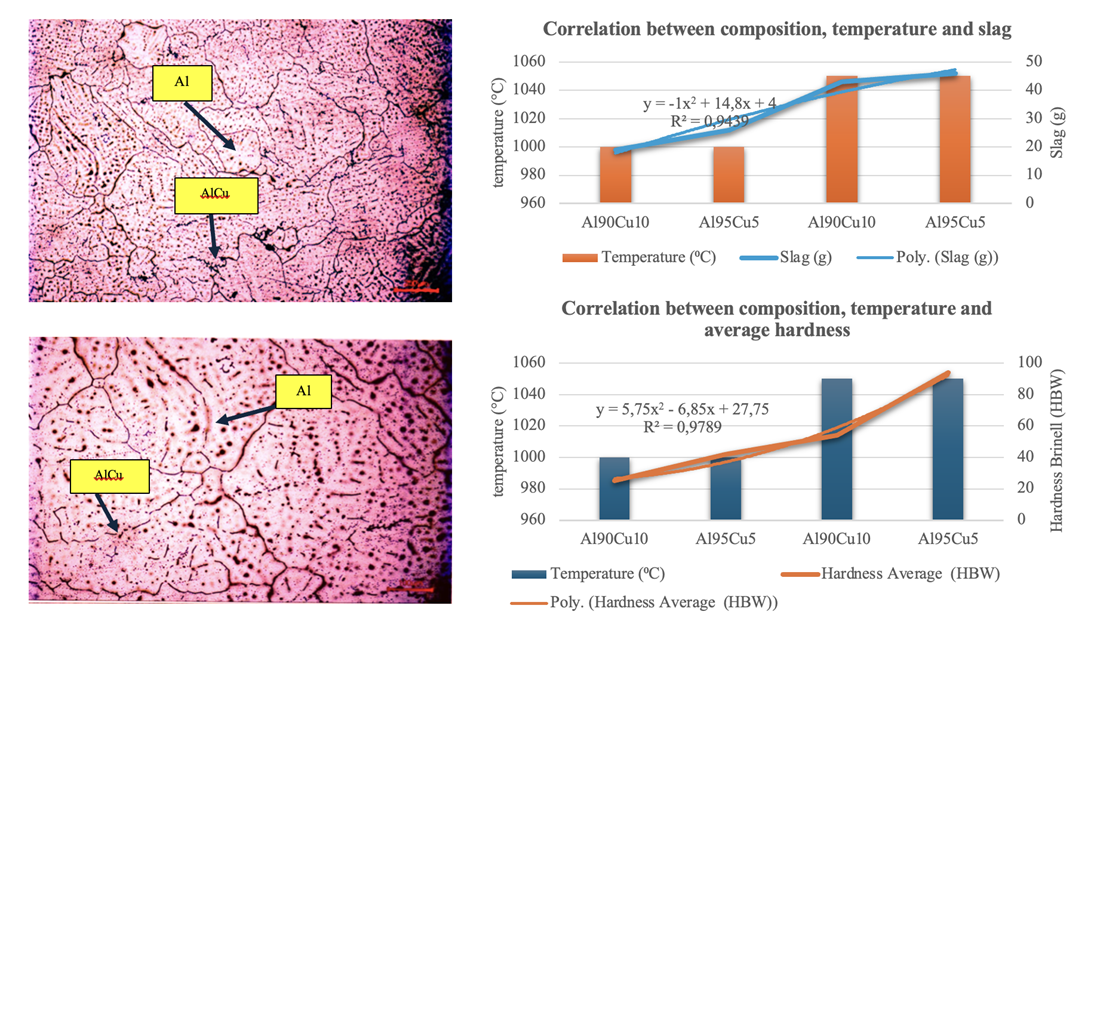
This study aims to increase alloy hardness by adding recycled aluminum in the form of copper powder, using sub-melting-point processing and precipitation. It addresses rising industrial demand for aluminum and the need for superior mechanical properties, focusing on eco-friendly products, recycled materials, and energy-saving smelting practices. Results show that aluminum combined with copper powder can be processed below copper’s melting point via diffusion in Al90Cu10 and Al95Cu5 at 1000°C and 1050°C, respectively, with both aged at 300°C. Hardness increased from 25 HBW to 94 HBW in Al90Cu10 over the temperature range of 1000°C to 1050°C.
This research addresses the growing problem of aluminum waste by recycling it into products with enhanced mechanical properties. Adding copper powder and melting at a low temperature reduces energy use during smelting. The aging strengthening mechanism increases the hardness of aluminum alloys, meeting industrial needs. The increased hardness and wear resistance of the recycled products of AL-Cu alloys developed in this study can have the potential to be applied to non-structural mechanical elements that have an impact on environmentally friendly and energy-efficient manufacturing processes
References
- Cui, L., Liu, K., Chen, X.-G. (2025). Recent advances in cost-effective aluminum alloys with enhanced mechanical performance for high-temperature applications: A review. Materials & Design, 253, 113869. https://doi.org/10.1016/j.matdes.2025.113869
- Starink, M. J., Yan, J. L. (2006). Precipitation Hardening in Al-Cu-Mg Alloys: Analysis of Precipitates, Modelling of Kinetics, Strength Predictions. Materials Science Forum, 519-521, 251–258. https://doi.org/10.4028/www.scientific.net/msf.519-521.251
- Hu, Y., Wang, G., Jiang, Q., Xiao, W., Rong, Y. (2017). Precipitation Strengthening Behavior of Al-Cu-Mn Alloys with the Effect of Casting Segregation. Contributed Papers from MS&T17, 193–200. https://doi.org/10.7449/2017/mst_2017_193_200
- Amer, S., Yakovtseva, O., Loginova, I., Medvedeva, S., Prosviryakov, A., Bazlov, A. et al. (2020). The Phase Composition and Mechanical Properties of the Novel Precipitation-Strengthening Al-Cu-Er-Mn-Zr Alloy. Applied Sciences, 10 (15), 5345. https://doi.org/10.3390/app10155345
- Yang, M., Liu, S., Zhang, Y., Tang, J., Zhang, M. (2023). Mechanism for enhanced precipitation strengthening due to the addition of copper to Al-Zn-Mg alloys with high Zn/Mg ratio. Materials & Design, 234, 112295. https://doi.org/10.1016/j.matdes.2023.112295
- Uzun, M., Karabiyik, S., Alemdag, Y., Savaşkan, T. (2025). Effect of thermomechanical treatment on the microstructure and mechanical properties of Al-40Zn-3Cu alloy. Journal of Alloys and Compounds, 1022, 179894. https://doi.org/10.1016/j.jallcom.2025.179894
- Xu, X., Tong, X., Wu, G., Zhang, L. (2025). Ameliorating the microstructure and mechanical properties of Al-Cu-Li alloy through aging temperature in a novel thermo-mechanical treatment. Microstructures, 5 (4). https://doi.org/10.20517/microstructures.2024.143
- Bui, T. N. M., Vu, A. T., Nguyen, D. N., Tran, D. H. (2022). Research on microstructure and mechanical properties of Al-Zn-Mg-Cu alloy when modified by La, Ce and thermo-mechanical treatment. EUREKA: Physics and Engineering, 3, 101–111. https://doi.org/10.21303/2461-4262.2022.001792
- Chang, K.-C., Miu, C.-F., Hung, F.-Y. (2025). Enhanced microstructure, mechanical properties, and thermal stability of powder metallurgy Al-Ni-Cu-Fe alloy through thermomechanical processing and recrystallization. Materials Today Advances, 26, 100581. https://doi.org/10.1016/j.mtadv.2025.100581
- JIS H 4000. Aluminium and aluminium alloy sheets, strips and plates. Japanese Standards Association. Available at: https://webdesk.jsa.or.jp/preview/pre_jis_h_04000_000_000_2014_e_ed10_i4.pdf
- JIS H 2501. Phosphor copper metal. Japanese Standards Association.
- ASTM E3. Standard guide for preparation of metallographic specimens. ASTM International.
- ASTM E407. Standard practice for microetching metals and alloys. ASTM International.
- ASTM E10-23. Standard test method for Brinell hardness of metallic materials. ASTM International. https://doi.org/10.1520/e0010-23
- Chen, P., Li, X., Lin, H., Wen, K., Li, Y., Wang, S. et al. (2025). Influence of Cu Content on Precipitation Behavior and Mechanical Properties Under Aging Treatment of Al-Cu-Li Alloys. Materials, 18 (10), 2172. https://doi.org/10.3390/ma18102172
- Shen, G., Xiang, Z., Ma, X., Huang, J., Li, J., Wang, B. et al. (2023). Microstructures and Mechanical Properties of a Nanostructured Al-Zn-Mg-Cu-Zr-Sc Alloy under Natural Aging. Materials, 16 (12), 4346. https://doi.org/10.3390/ma16124346
- Soeprapto, W., Erwin, Sudjito, Irawan, Y. S., Lubay, A., Rasta Satya, I. (2025). Effect of nickel solubility in ADC12 melt on its characteristic. Journal of Physics: Conference Series, 2972 (1), 12043. https://doi.org/10.1088/1742-6596/2972/1/012043
- Erwin, Suprapto, W., Sugiarto, Setyarini, P. H. (2025). Ternary diagram of Cu-Zn-Ni alloy fabricated by casting process. The 5th International Conference on Information Technology, Advanced Mechanical and Electrical Engineering, 3320, 60003. https://doi.org/10.1063/5.0286919
- Erwin, E., Sugiyanto, D., Faturahman, D., Chan, Y., Asbanu, H. (2024). Effect of the brass waste recycling process on mechanical properties with investment casting for gear materials. Eastern-European Journal of Enterprise Technologies, 4 (12 (130)), 34–41. https://doi.org/10.15587/1729-4061.2024.299764
- Erwin, Suprapto, W., Sugiarto, Setyarini, P. H. (2024). Comparison of the accuracy of OES and EDX tests on nickel dissolving in brass casting. EUREKA: Physics and Engineering, 3, 148–158. https://doi.org/10.21303/2461-4262.2024.003284
- Erwin, Suprapto, W., Sugiarto, Setyarini, P. H. (2025). Effect of lead elimination by adding nickel to brass on mechanical properties through a permanent casting process. EUREKA: Physics and Engineering, 3, 192–206. https://doi.org/10.21303/2461-4262.2025.003477
Downloads
Published
How to Cite
Issue
Section
License
Copyright (c) 2026 Erwin Erwin, Juan Pratama, Didik Sugiyanto, Yefri Chan, Trisna Ardi Wiradinata, M. Arik Febrian, Dien Alma Ariz

This work is licensed under a Creative Commons Attribution 4.0 International License.
The consolidation and conditions for the transfer of copyright (identification of authorship) is carried out in the License Agreement. In particular, the authors reserve the right to the authorship of their manuscript and transfer the first publication of this work to the journal under the terms of the Creative Commons CC BY license. At the same time, they have the right to conclude on their own additional agreements concerning the non-exclusive distribution of the work in the form in which it was published by this journal, but provided that the link to the first publication of the article in this journal is preserved.
A license agreement is a document in which the author warrants that he/she owns all copyright for the work (manuscript, article, etc.).
The authors, signing the License Agreement with TECHNOLOGY CENTER PC, have all rights to the further use of their work, provided that they link to our edition in which the work was published.
According to the terms of the License Agreement, the Publisher TECHNOLOGY CENTER PC does not take away your copyrights and receives permission from the authors to use and dissemination of the publication through the world's scientific resources (own electronic resources, scientometric databases, repositories, libraries, etc.).
In the absence of a signed License Agreement or in the absence of this agreement of identifiers allowing to identify the identity of the author, the editors have no right to work with the manuscript.
It is important to remember that there is another type of agreement between authors and publishers – when copyright is transferred from the authors to the publisher. In this case, the authors lose ownership of their work and may not use it in any way.








