Identifying the operational characteristics of an ammonia synthesis column, taking into account changes in the operating parameters of the process plant
DOI:
https://doi.org/10.15587/1729-4061.2026.359439Keywords:
combined mathematical model, ammonia synthesis column, transport delay, stability margin, catalyst degradation, steady-state errorAbstract
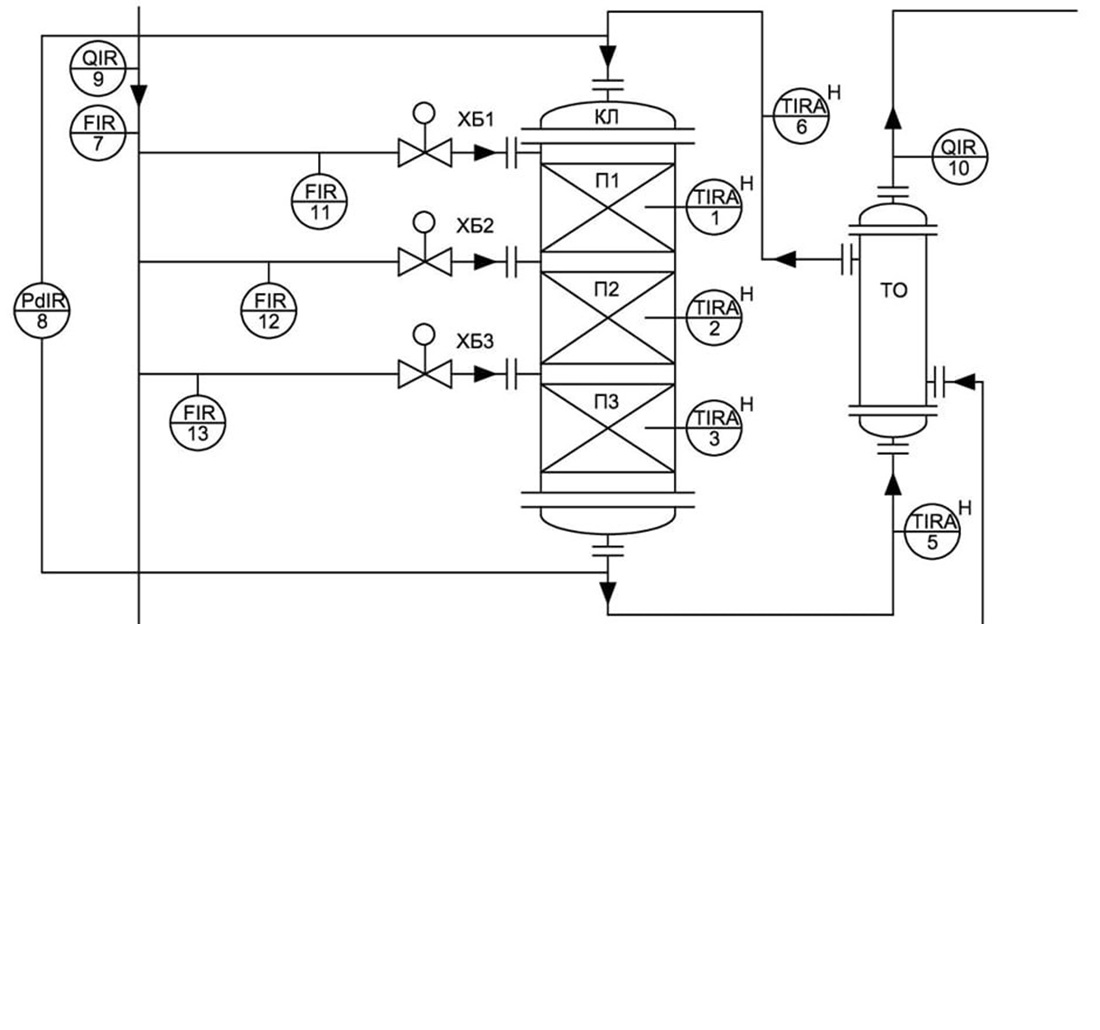
This study explores the technological process of ammonia synthesis in a synthesis column as a complex multi-tonnage chemical and technological facility with a transport delay and variable state parameters. The task addressed relates to the lack of quantitative assessment of the impact of catalyst degradation on the dynamic characteristics of the facility, in particular on the transport delay and the stability margin, which complicates the determination of the limits of effective equipment operation and timely adoption of technological decisions.
As a result of analysis, it was established that a decrease in the synthesis gas flow rate by 10% leads to an increase in the transport delay time from 61 s to 67 s and a decrease in the stability margin in terms of modulus from 15.7 dB to 15.0 dB. It is shown that restoring the stability margin to the base level is possible by reducing the gain factor by 8%, which, in turn, is accompanied by an increase in the steady-state error to 8.39%, that is, a deterioration in the control accuracy and deviation of technological parameters from the set values.
The results are based on the use of the stability margin in terms of the modulus as an integral indicator sensitive to changes in the parameters of the object's state, which makes it possible to quantitatively link the degradation of the catalyst with the dynamic characteristics of the control system. The established patterns are explained by the fact that an increase in the transport delay causes an additional phase shift in the system and reduces the stability margin, while a decrease in the gain factor increases stability, but leads to an increase in the steady-state error, forming a compromise between stability and accuracy.
The practical value of the results is the possibility of their use for assessing the technical condition of the ammonia synthesis column, determining the limit modes of its operation, and substantiating the time of catalyst replacement. The application of the findings is appropriate under conditions of quasi-stationarity of the process, limited disturbances. and the use of linearized mathematical models of the object
References
- Ellis, M., Durand, H., Christofides, P. D. (2014). A tutorial review of economic model predictive control methods. Journal of Process Control, 24 (8), 1156–1178. https://doi.org/10.1016/j.jprocont.2014.03.010
- Rosbo, J. W., Ritschel, T. K. S., Hørsholt, S., Huusom, J. K., Jørgensen, J. B. (2023). Flexible operation, optimisation and stabilising control of a quench cooled ammonia reactor for power-to-ammonia. Computers & Chemical Engineering, 176, 108316. https://doi.org/10.1016/j.compchemeng.2023.108316
- Schwenzer, M., Ay, M., Bergs, T., Abel, D. (2021). Review on model predictive control: an engineering perspective. The International Journal of Advanced Manufacturing Technology, 117 (5-6), 1327–1349. https://doi.org/10.1007/s00170-021-07682-3
- Qin, S. J. (2012). Survey on data-driven industrial process monitoring and diagnosis. Annual Reviews in Control, 36 (2), 220–234. https://doi.org/10.1016/j.arcontrol.2012.09.004
- Ghavam, S., Vahdati, M., Wilson, I. A. G., Styring, P. (2021). Sustainable Ammonia Production Processes. Frontiers in Energy Research, 9. https://doi.org/10.3389/fenrg.2021.580808
- Wu, H., Zhao, J. (2020). Self-adaptive deep learning for multimode process monitoring. Computers & Chemical Engineering, 141, 107024. https://doi.org/10.1016/j.compchemeng.2020.107024
- Giraldo, S. A. C., Melo, P. A., Secchi, A. R. (2024). Enhanced control in time-delay processes: Diagnostic, monitoring, and self-tuning strategies for the filtered smith predictor in response to model-plant mismatch and abrupt load disturbances. Control Engineering Practice, 145, 105869. https://doi.org/10.1016/j.conengprac.2024.105869
- Eliseyev, P., Loriia, M., Tselishchev, O., Gurin, O., Kupina, O., Sotnikova, T. (2023). Use of additive test methods in the simulation of the methanol synthesis column for the creation of a control system from the model. EUREKA: Physics and Engineering, 5, 94–104. https://doi.org/10.21303/2461-4262.2023.003110
- Loriia, M. G., Tselishchev, O. B., Yeliseyev, P. Y., Porkuian, O. V., Gurin, O. M., Loriia, M. et al. (2022). Principles and stages of creation of automatic control systems with a model of complex technological processes. Eastern-European Journal of Enterprise Technologies, 6 (6 (120)), 20–29. https://doi.org/10.15587/1729-4061.2022.270519
- Mayne, D. Q. (2014). Model predictive control: Recent developments and future promise. Automatica, 50 (12), 2967–2986. https://doi.org/10.1016/j.automatica.2014.10.128
Downloads
Published
How to Cite
Issue
Section
License
Copyright (c) 2026 Petro Yeliseyev, Maryna Loriia, Olexii Tselishchev, Liudmyla Karpiuk, Oleksandr Duryshev, Yevgen Kobzarev

This work is licensed under a Creative Commons Attribution 4.0 International License.
The consolidation and conditions for the transfer of copyright (identification of authorship) is carried out in the License Agreement. In particular, the authors reserve the right to the authorship of their manuscript and transfer the first publication of this work to the journal under the terms of the Creative Commons CC BY license. At the same time, they have the right to conclude on their own additional agreements concerning the non-exclusive distribution of the work in the form in which it was published by this journal, but provided that the link to the first publication of the article in this journal is preserved.
A license agreement is a document in which the author warrants that he/she owns all copyright for the work (manuscript, article, etc.).
The authors, signing the License Agreement with TECHNOLOGY CENTER PC, have all rights to the further use of their work, provided that they link to our edition in which the work was published.
According to the terms of the License Agreement, the Publisher TECHNOLOGY CENTER PC does not take away your copyrights and receives permission from the authors to use and dissemination of the publication through the world's scientific resources (own electronic resources, scientometric databases, repositories, libraries, etc.).
In the absence of a signed License Agreement or in the absence of this agreement of identifiers allowing to identify the identity of the author, the editors have no right to work with the manuscript.
It is important to remember that there is another type of agreement between authors and publishers – when copyright is transferred from the authors to the publisher. In this case, the authors lose ownership of their work and may not use it in any way.








