Revealing the influence of structural joints location in a dry cargo ship on durability parameters
DOI:
https://doi.org/10.15587/1729-4061.2026.360197Keywords:
ship hull, finite element method, load, stress range, fatigue damageAbstract
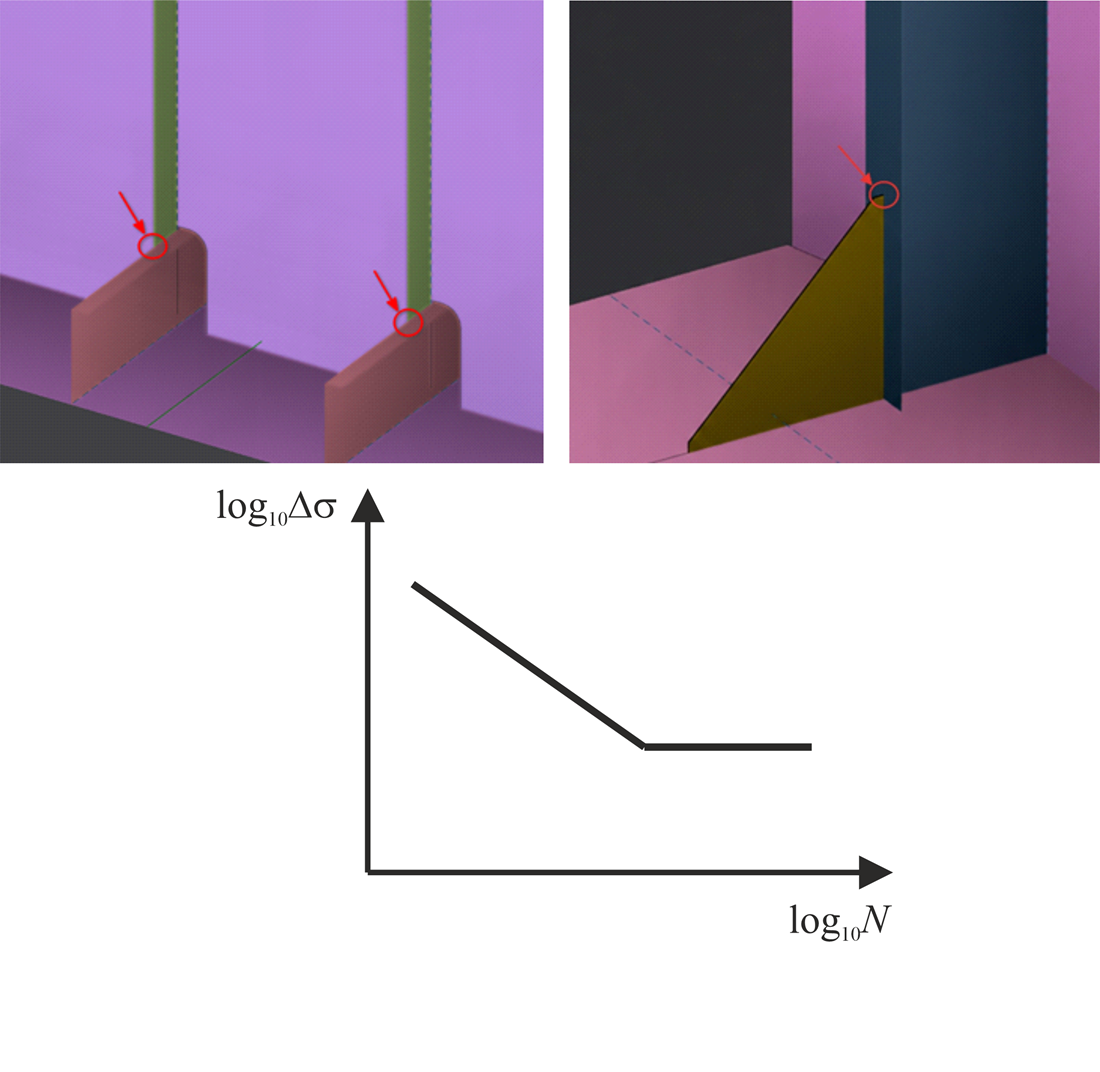
This work investigates the process of fatigue crack initiation in the structural joints of a dry cargo ship. The study addresses problematic issues related to changing the durability of the joints in the intersection of the longitudinal stiffener of the bottom and the floor, as well as the intersection of side structures and the double bottom along the length of the dry cargo ship.
Underlying the study is a simplified approach to determining external loads, the finite element method, the linear fatigue damage summation hypothesis, as well as the nominal stress approach.
Scientific ideas have been deepened about the regularities of changes in the parameters of the long-term load distribution on structural joints along the length of the dry cargo ship. The distribution scale parameter was taken as the criterion in the calculations. For the joint in the intersection of the longitudinal stiffener of the bottom and the floor, the distribution scale parameter increased when moving from the middle compartments of the ship to the bow by 5% for the loading condition "fully loaded vessel" and was unchanged for the loading condition "ship in ballast". For the junction of the bottom and frame structures, this parameter increased by 11–12% for the loading condition “fully loaded vessel” and by 11.8–13.7% for the loading condition “vessel in ballast”.
It was established that the durability of both joints decreases from the middle part of the hull to the bow as follows: the junction of the longitudinal stiffener of the bottom and the floor – by 21%; the junction of the frame with a double bottom – by 42%.
The results are explained by the determining influence of local loads in the bow of the vessel. They could be applied in the field of shipbuilding and ship repair when designing dry cargo vessel structures and when planning hull condition inspections
References
- Kozak, J., Górski, Z. (2011). Fatigue strength determination of ship structural joints. Polish Maritime Research, 18 (2). https://doi.org/10.2478/v10012-011-0009-8
- Corigliano, P., Frisone, F., Chianese, C., Altosole, M., Piscopo, V., Scamardella, A. (2024). Fatigue Overview of Ship Structures under Induced Wave Loads. Journal of Marine Science and Engineering, 12 (9), 1608. https://doi.org/10.3390/jmse12091608
- Fatigue assessment of ship structures: DNVGL-CG-0129 (2015). DNV GL.
- Hobbacher, A. F. (2016). Recommendations for Fatigue Design of Welded Joints and Components. IIW Collection. Springer International Publishing. https://doi.org/10.1007/978-3-319-23757-2
- No. 56. Fatigue assessment of ship structures (1999). IACS Recommendation. Available at: https://iacs.s3.af-south-1.amazonaws.com/wp-content/uploads/2022/05/20100843/rec_56_pdf231.pdf
- Niemi, E., Fricke, W., Maddox, S. J. (2018). Structural Hot-Spot Stress Approach to Fatigue Analysis of Welded Components. IIW Collection. Springer Singapore. https://doi.org/10.1007/978-981-10-5568-3
- Fricke, W. (2010). Guideline for the Fatigue Assessment by Notch Stress Analysis for Welded Structures. International Institute of Welding. IIW-Doc. XIII-2240r2-08/XV-1289r2-08. Available at: https://www.researchgate.net/publication/266038561_Guideline_for_the_Fatigue_Assessment_by_Notch_Stress_Analysis_for_Welded_Structures
- Ozguc, O. (2020). Simplified Fatigue Assessment of Hull Longitudinals Connections of an LNG Vessel. GMO Journal of Ship and Marine Technology Journal, 218, 21–35. Available at: https://www.jnamt.org/pdf/25021570-dd5c-48cc-b052-771af43e75cc/articles/deneme.456457/21-35.pdf
- Jurišić, P., Parunov, J., Senjanović, I. (2007). Assessment of Aframax Tanker Hull-Girder Fatigue Strength According to New Common Structural Rules. Brodogradnja, 58 (3), 262–267. Available at: https://hrcak.srce.hr/file/25138
- Review of Maritime Transport (2024). Geneva: United Nations. Available at: https://unctad.org/system/files/official-document/rmt2024_en.pdf
- Korostylov, L., Lytvynenko, D., Sharun, H., Davydov, I. (2021). Improvement of trawler hull structure under condition of ensuring fatigue strength. Eastern-European Journal of Enterprise Technologies, 4 (7 (112)), 50–59. https://doi.org/10.15587/1729-4061.2021.239159
- Ozguc, O. (2017). Simplified fatigue analysis of structural details of an ageing LPG carrier. Journal of Marine Engineering & Technology, 17 (1), 33–42. https://doi.org/10.1080/20464177.2017.1282075
- Ozguc, O. (2021). Oil Tanker Simplified Fatigue Assessment with Inspection and Repair Approach and Parameters. Transactions on Maritime Science, 10 (1). https://doi.org/10.7225/toms.v10.n01.003
- Fricke, W., Cui, W., Kierkegaard, H., Kihl, D., Koval, M., Mikkola, T. et al. (2002). Comparative fatigue strength assessment of a structural detail in a containership using various approaches of classification societies. Marine Structures, 15 (1), 1–13. https://doi.org/10.1016/s0951-8339(01)00016-8
- Blagojevic, B., Domazet, Ž. (2002). Simplified procedures for fatigue assesement of ship structures. 10th International Congress of the International Maritime Association of the Mediterranean IMAM 2002. Rethymnon, Crete. Available at: https://www.researchgate.net/publication/310363752_SIMPLIFIED_PROCEDURES_FOR_FATIGUE_ASSESEMENT_OF_SHIP_STRUCTURES
- Li, Z., Mao, W., Ringsberg, J. W., Johnson, E., Storhaug, G. (2014). A comparative study of fatigue assessments of container ship structures using various direct calculation approaches. Ocean Engineering, 82, 65–74. https://doi.org/10.1016/j.oceaneng.2014.02.022
- Watanabe, E., Inoue, S., Hashimoto, K., Sato, K., Sueoka, H. (1995). Proposal of simplified fatigue design method for side longitudinals. Journal of the Society of Naval Architects of Japan, 177, 391–398. Available at: https://www.jstage.jst.go.jp/article/jjasnaoe1968/1995/177/1995_177_391/_pdf
- Logan, D. L. (2022). A First Course in the Finite Element Method. Boston: Cengage Learning, 976.
- Lytvynenko, D. Yu. (2017). Metodyky rozviazku zadach vtomnoi mitsnosti sudnokorpusnykh vuzliv pry nerehuliarnomu navantazhenni na bazi eksperymentalno-teoretychnoho metodu. Visnyk Odeskoho natsionalnoho morskoho universytetu, 4 (53), 110–125. Available at: http://visnyk.onmu.org.ua/index.php/1/issue/view/55/10
- Serdiuchenko, A. M. (Ed.) (2012). Osnovy teoriyi pruzhnosti, budivelnoi mekhaniky, mitsnosti ta vibratsiyi suden. Mykolaiv: NUK, 422.
- Rehistr sudnoplavstva Ukrainy. Pravyla klasyfikatsiyi ta pobudovy morskykh suden. Vol. 2 (2020). Kyiv: RSU, 792. Available at: https://ur.ua/wp-content/uploads/2022/09/PCBSSt2_2020.pdf
- Glen, I. F., Dinovitzer, A., Paterson, R. B., Luznik, L., Bayley, C. (1999). Fatigue Resistant Detail Design Guide for Ship Structures. The Society of Naval Architects and Marine Engineers. https://doi.org/10.5957/SSC405
Downloads
Published
How to Cite
Issue
Section
License
Copyright (c) 2026 Dmytro Lytvynenko, Oleksandr Shchedrolosiev, Yuliia Kazymyrenko, Hanna Konovalova

This work is licensed under a Creative Commons Attribution 4.0 International License.
The consolidation and conditions for the transfer of copyright (identification of authorship) is carried out in the License Agreement. In particular, the authors reserve the right to the authorship of their manuscript and transfer the first publication of this work to the journal under the terms of the Creative Commons CC BY license. At the same time, they have the right to conclude on their own additional agreements concerning the non-exclusive distribution of the work in the form in which it was published by this journal, but provided that the link to the first publication of the article in this journal is preserved.
A license agreement is a document in which the author warrants that he/she owns all copyright for the work (manuscript, article, etc.).
The authors, signing the License Agreement with TECHNOLOGY CENTER PC, have all rights to the further use of their work, provided that they link to our edition in which the work was published.
According to the terms of the License Agreement, the Publisher TECHNOLOGY CENTER PC does not take away your copyrights and receives permission from the authors to use and dissemination of the publication through the world's scientific resources (own electronic resources, scientometric databases, repositories, libraries, etc.).
In the absence of a signed License Agreement or in the absence of this agreement of identifiers allowing to identify the identity of the author, the editors have no right to work with the manuscript.
It is important to remember that there is another type of agreement between authors and publishers – when copyright is transferred from the authors to the publisher. In this case, the authors lose ownership of their work and may not use it in any way.








