Determining the degree of unevenness in the working cycle of an internal combustion engine when operating on different types of fuel
DOI:
https://doi.org/10.15587/1729-4061.2026.360311Keywords:
hydrogen, excess air ratio, indicator diagram, degree of unevenness in operation cycleAbstract
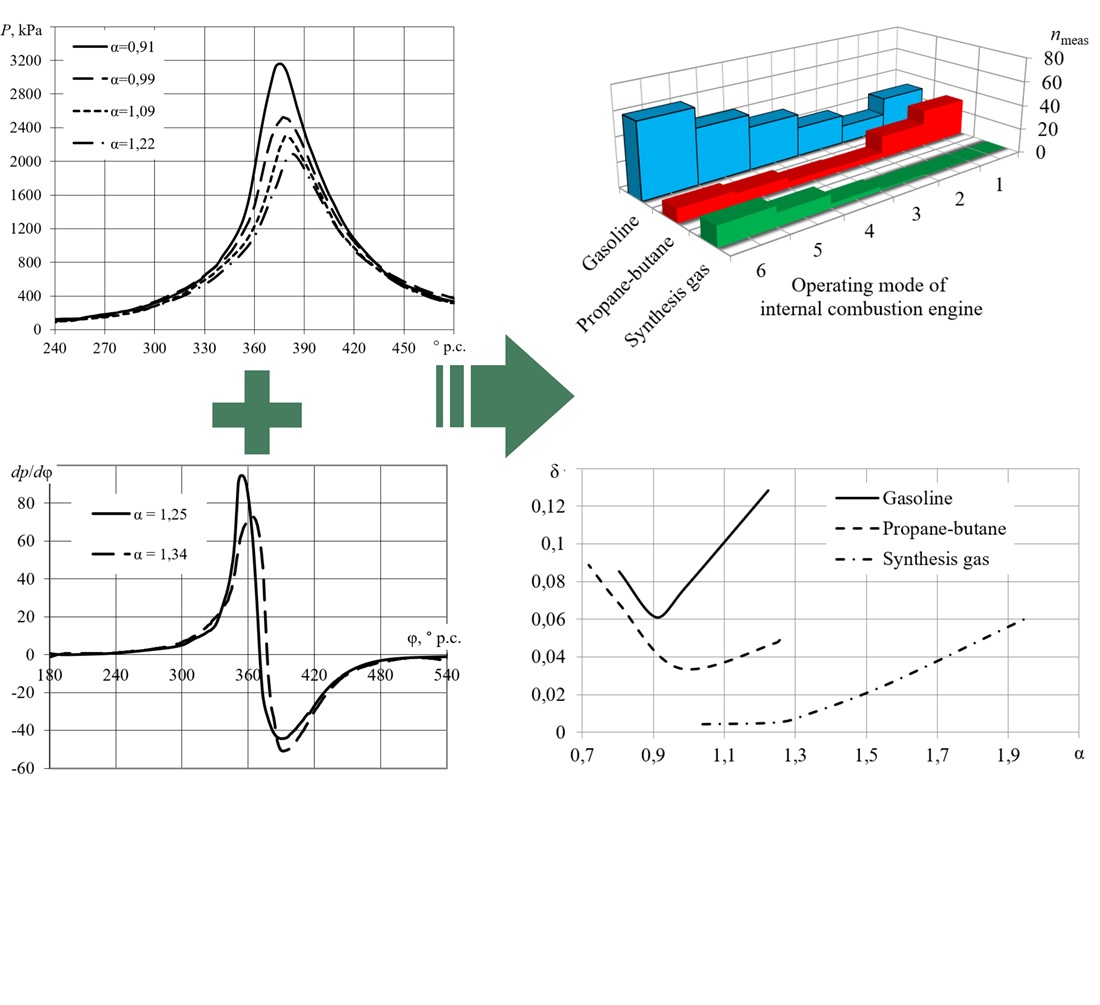
This study investigates the degree of non-uniformity in the working cycle of an internal combustion engine with spark ignition when using different types of fuel. The task addressed relates to the lack of comprehensive experimental studies that take into account the influence of the type of fuel, the composition of the fuel-air mixture, and the statistical characteristics of the working cycle parameters based on a large array of indicator diagrams.
This work reports experimental indicator diagrams of partial engine operating modes when using gasoline, propane-butane, and synthesis gas with a hydrogen content of 43%. It was established that normal engine operation on synthesis gas is ensured at an excess air coefficient of 1.35…1.75. The correspondence of the distribution of maximum combustion pressure to the normal law according to the χ2 criterion has been confirmed.
It was shown that the presence of hydrogen in the composition of synthesis gas significantly reduced the degree of non-uniformity of the working cycle of the spark ignition engine. It was found that the minimum value of the degree of unevenness of the working cycle is observed within the range of the excess air coefficient of 1.05...1.25. As the mixture is depleted, a gradual increase in the degree of unevenness of the working cycle is observed. When α ≈ 2 is reached, the unevenness of the working cycle on synthesis gas reaches the minimum value of unevenness when the engine is operating on gasoline at α = 0.9...1.0.
A feature of the results is the combination of an experimental approach with a statistical analysis of a large sample of indicator diagrams, which made it possible to reliably estimate the degree of unevenness and establish the optimal ranges of the excess air coefficient for different fuels.
The results could be used in optimizing the working processes of spark-ignition engines, designing mixture control systems, as well as in using alternative fuels, in particular synthesis gas, under partial load conditions
References
- Rakopoulos, D. C., Rakopoulos, C. D., Kosmadakis, G. M., Mavropoulos, G. C. (2024). Assessing the cyclic variability of combustion and NO emissions in hydrogen-methane fueled HSSI engine via quasi-dimensional modeling under the influence of flame-kernel turbulence and equivalence ratio variation mechanisms. Energy, 288, 129813. https://doi.org/10.1016/j.energy.2023.129813
- Duan, X., Feng, L., Xia, Y. (2024). The mechanism and effect factors of the combustion cycle‐to‐cycle variations in the spark ignition engine. Energy Science & Engineering, 12 (10), 4773–4787. https://doi.org/10.1002/ese3.1879
- Azeem, N., Beatrice, C., Vassallo, A., Pesce, F., Gessaroli, D., Biet, C., Guido, C. (2024). Experimental study of cycle-by-cycle variations in a spark ignition internal combustion engine fueled with hydrogen. International Journal of Hydrogen Energy, 60, 1224–1238. https://doi.org/10.1016/j.ijhydene.2024.02.182
- Kosmadakis, G. M., Rakopoulos, D. C., Rakopoulos, C. D. (2021). Assessing the cyclic-variability of spark-ignition engine running on methane-hydrogen blends with high hydrogen contents of up to 50%. International Journal of Hydrogen Energy, 46 (34), 17955–17968. https://doi.org/10.1016/j.ijhydene.2021.02.158
- Martínez-Boggio, S. D., Curto-Risso, P. L., Medina, A., Hernández, A. C. (2016). Simulation of cycle-to-cycle variations on spark ignition engines fueled with gasoline-hydrogen blends. International Journal of Hydrogen Energy, 41 (21), 9087–9099. https://doi.org/10.1016/j.ijhydene.2016.03.120
- Kosmadakis, G. M., Rakopoulos, D. C., Rakopoulos, C. D. (2023). Effect of Two Mechanisms Contributing to the Cyclic Variability of a Methane–Hydrogen-Fueled Spark-Ignition Engine by Using a Fast CFD Methodology. Journal of Energy Engineering, 149 (1). https://doi.org/10.1061/jleed9.eyeng-4620
- Cuisano, J., Flores, F., Chirinos, L., Vaudrey, A. (2022). In-cylinder pressure statistical analysis and digital signal processing methods for studying the combustion of a natural gas/diesel heavy-duty engine at low load conditions. Energy Conversion and Management, 269, 116089. https://doi.org/10.1016/j.enconman.2022.116089
- Georgescu, R., Pană, C., Negurescu, N., Cernat, A., Nuțu, C., Sandu, C. (2024). The Influence of Hydrogen Addition on a SI Engine – Theoretical and Experimental Investigations. Sustainability, 16 (16), 6873. https://doi.org/10.3390/su16166873
- Leyko, J., Słobiński, K., Jaworski, J., Mitukiewicz, G., Bou Nader, W., Batory, D. (2023). Study on SI Engine Operation Stability at Lean Condition – The Effect of a Small Amount of Hydrogen Addition. Energies, 16 (18), 6659. https://doi.org/10.3390/en16186659
- Pan, S., Wang, J., Liang, B., Duan, H., Huang, Z. (2022). Experimental Study on the Effects of Hydrogen Injection Strategy on the Combustion and Emissions of a Hydrogen/Gasoline Dual Fuel SI Engine under Lean Burn Condition. Applied Sciences, 12 (20), 10549. https://doi.org/10.3390/app122010549
Downloads
Published
How to Cite
Issue
Section
License
Copyright (c) 2026 Oleksandr Mytrofanov, Arkadii Proskurin

This work is licensed under a Creative Commons Attribution 4.0 International License.
The consolidation and conditions for the transfer of copyright (identification of authorship) is carried out in the License Agreement. In particular, the authors reserve the right to the authorship of their manuscript and transfer the first publication of this work to the journal under the terms of the Creative Commons CC BY license. At the same time, they have the right to conclude on their own additional agreements concerning the non-exclusive distribution of the work in the form in which it was published by this journal, but provided that the link to the first publication of the article in this journal is preserved.
A license agreement is a document in which the author warrants that he/she owns all copyright for the work (manuscript, article, etc.).
The authors, signing the License Agreement with TECHNOLOGY CENTER PC, have all rights to the further use of their work, provided that they link to our edition in which the work was published.
According to the terms of the License Agreement, the Publisher TECHNOLOGY CENTER PC does not take away your copyrights and receives permission from the authors to use and dissemination of the publication through the world's scientific resources (own electronic resources, scientometric databases, repositories, libraries, etc.).
In the absence of a signed License Agreement or in the absence of this agreement of identifiers allowing to identify the identity of the author, the editors have no right to work with the manuscript.
It is important to remember that there is another type of agreement between authors and publishers – when copyright is transferred from the authors to the publisher. In this case, the authors lose ownership of their work and may not use it in any way.








