Devising a methodology to compare methods for selecting the optimal architectural variation of command query responsibility segregation with event sourcing
DOI:
https://doi.org/10.15587/1729-4061.2026.360407Keywords:
optimization, computational experiment, ATAM, DSAV-CQRSES, data analysis, comparative analysisAbstract
This study compares methods for evaluating software architecture. The work is aimed at improving the objectivity of such a comparison by using quantitative indicators obtained on the basis of a parametric model whose adequacy has been verified experimentally.
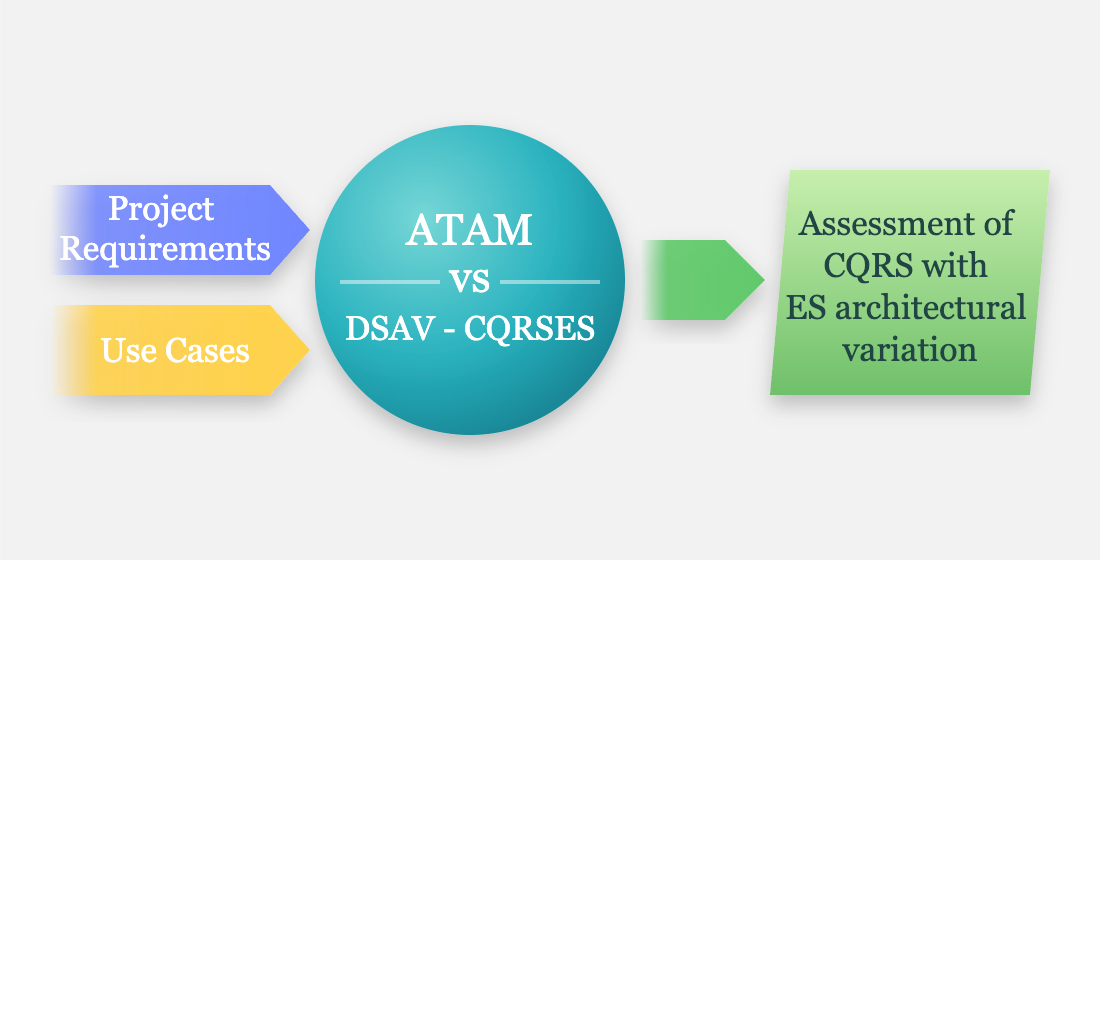
This paper proposes a methodology to quantitatively compare methods for evaluating software architecture. This methodology enabled a comparison between the architectural trade-off analysis method (ATAM) and decision support technology for architectural variations in the Command Query Responsibility Segregation (CQRS) architecture with the event sourcing approach (DSAV-CQRSES).
The methodology's feature is a parametric model built on the basis of an analysis of real projects, which makes it possible to substantiate the correctness of reference variation, as well as quantitative evaluation of the methods, in particular by the duration of application and the discrepancy of results.
The proposed methodology has made it possible to quantitatively confirm the advantages of DSAV-CQRSES over ATAM for solving the task of choosing the optimal variation of CQRSES architecture.
The duration of ATAM application was 32 hours with the participation of four specialists (total costs of 88 person-hours). The DSAV-CQRSES technology was used by one specialist for 40 hours. With the average and limit parameters of the model, DSAV-CQRSES robustly determined the recommended variation at a variance coefficient of 2.8%. In contrast, ATAM demonstrated lower accuracy and provided the correct choice in three out of five cases with a variation coefficient of 33.64%.
The results of the experiment could be used in practice to select tools for comparing variations in the CQRSES architecture
References
- Betts, D., Dominguez, J., Melnik, G., Simonazzi, F., Subramanian, M. (2013). Exploring CQRS and Event Sourcing: A Journey into High Scalability, Availability, and Maintainability with Windows Azure. Microsoft patterns & practices, 376. Available at: https://download.microsoft.com/download/e/a/8/ea8c6e1f-01d8-43ba-992b-35cfcaa4fae3/cqrs_journey_guide.pdf
- CQRS Documents by Greg Young. Available at: https://cqrs.files.wordpress.com/2010/11/cqrs_documents.pdf
- Breivold, H. P., Crnkovic, I., Larsson, M. (2012). A systematic review of software architecture evolution research. Information and Software Technology, 54 (1), 16–40. https://doi.org/10.1016/j.infsof.2011.06.002
- Ford, N., Parsons, R., Kua, P., Sadalage, P. (2022). Building Evolutionary Architectures. O'Reilly Media, 262. Available at: https://www.oreilly.com/library/view/building-evolutionary-architectures/9781492097532/
- Soliman, M., Avgeriou, P., Li, Y. (2021). Architectural design decisions that incur technical debt – An industrial case study. Information and Software Technology, 139, 106669. https://doi.org/10.1016/j.infsof.2021.106669
- Sobhy, D., Bahsoon, R., Minku, L., Kazman, R. (2021). Evaluation of Software Architectures under Uncertainty. ACM Transactions on Software Engineering and Methodology, 30 (4), 1–50. https://doi.org/10.1145/3464305
- Babar, M. A., Zhu, L., Jeffery, R. (2004). A framework for classifying and comparing software architecture evaluation methods. 2004 Australian Software Engineering Conference. Proceedings, 309–318. https://doi.org/10.1109/aswec.2004.1290484
- Roy, B., Graham, N. (2008). Methods for Evaluating Software Architecture: A Survey. Technical Report No. 2008-545. School of Computing Queen’s University at Kingston Ontario. Available at: https://research.cs.queensu.ca/TechReports/Reports/2008-545.pdf?utm_source=chatgpt.com
- Mattsson, M., Grahn, H., Mårtensson, F. (2006). Software Architecture Evaluation Methods for Performance, Maintainability, Testability, and Portability. Presented at the Second International Conference on the Quality of Software Architectures (QoSA 2006). Västerås. Available at: https://www.researchgate.net/publication/200622064_Software_Architecture_Evaluation_Methods_for_Performance_Maintainability_Testability_and_Portability
- Kazman, R., Klein, M., Clements, P. (2000). ATAM: Method for Architecture Evaluation. Technical report: CMU/SEI-2000-TR-004, ESC-TR-2000-004. Pittsburgh: Product Line Systems, 71. Available at: https://www.researchgate.net/publication/2814191_ATAM_Method_for_Architecture_Evaluation
- Lytvynov, O., Hruzin, D. (2025). Decision-making on Command Query Responsibility Segregation with Event Sourcing architectural variations. Technology Audit and Production Reserves, 4 (2 (84)), 37–59. https://doi.org/10.15587/2706-5448.2025.337168
- Abrahão, S., Insfran, E. (2017). Evaluating Software Architecture Evaluation Methods. Proceedings of the 21st International Conference on Evaluation and Assessment in Software Engineering, 144–153. https://doi.org/10.1145/3084226.3084253
- Gonzalez-Huerta, J., Insfran, E., Abrahão, S., Scanniello, G. (2015). Validating a model-driven software architecture evaluation and improvement method: A family of experiments. Information and Software Technology, 57, 405–429. https://doi.org/10.1016/j.infsof.2014.05.018
- Eloranta, V.-P., van Heesch, U., Avgeriou, P., Harrison, N., Koskimies, K. (2014). Lightweight Evaluation of Software Architecture Decisions. Relating System Quality and Software Architecture, 157–179. https://doi.org/10.1016/b978-0-12-417009-4.00006-5
- Babar, M. A., Kitchenham, B. (2007). Assessment of a Framework for Comparing Software Architecture Analysis Methods. Electronic Workshops in Computing. https://doi.org/10.14236/ewic/ease2007.2
- Babar, M. A., Gorton, I. (2004). Comparison of Scenario-Based Software Architecture Evaluation Methods. 11th Asia-Pacific Software Engineering Conference, 600–607. https://doi.org/10.1109/apsec.2004.38
- Hruzin, D. L., Lytvynov, O. A. (2025). The impact of quality attribute selection on comparing CQRS with event sourcing architectural variations. Proceding of the XVIII International Scientific and Practical Conference. Odesa, 614–616. Available at: https://if.uu.edu.ua/wp-content/uploads/2025/11/zbirnyk-tez-konferentsii-itia-2025.pdf
- Le Thi Kim Nhung, H., Van Hai, V., Hoc, H. T. (2021). Analyzing Correlation of the Relationship Between Technical Complexity Factors and Environmental Complexity Factors for Software Development Effort Estimation. Software Engineering Application in Informatics, 835–848. https://doi.org/10.1007/978-3-030-90318-3_65
- da Silva, A. R., Savić, D., Vlajić, S., Antović, I., Lazarević, S., Stanojević, V., Milić, M. (2015). A pattern language for use cases specification. Proceedings of the 20th European Conference on Pattern Languages of Programs, 1–18. https://doi.org/10.1145/2855321.2855330
- Minsky, M. (1974). A Framework for Representing Knowledge. MIT Research Lab Technical Report. Massachusetts Institute of Technology, Cambridge, MA, United States. Available at: https://courses.media.mit.edu/2004spring/mas966/Minsky%201974%20Framework%20for%20knowledge.pdf
- Hruzin, D. (2026). Classification of Use Cases in Systems Based on CQRS with Event Sourcing. Zenodo. https://doi.org/10.5281/zenodo.18621093
- Janssen, P., Stouffs, R. (2015). Types of Parametric Modelling. Proceedings of the 20th Conference on Computer Aided Architectural Design Research in Asia (CAADRIA), 157–166. https://doi.org/10.52842/conf.caadria.2015.157
- Friedman, J. H. (2001). Greedy function approximation: A gradient boosting machine. The Annals of Statistics, 29 (5). https://doi.org/10.1214/aos/1013203451
- Kohl, M., Ruckdeschel, P. (2010). R Package distrMod: S4 Classes and Methods for Probability Models. Journal of Statistical Software, 35 (10). https://doi.org/10.18637/jss.v035.i10
- General Data Protection Regulation. Available at: https://gdpr-info.eu/
- Aljoumah, E., Al-Mousawi, F., Ahmad, I., Al-Shammri, M., Al-Jady, Z. (2015). SLA in Cloud Computing Architectures: A Comprehensive Study. International Journal of Grid and Distributed Computing, 8 (5), 7–32. https://doi.org/10.14257/ijgdc.2015.8.5.02
- Application Performance Index – Apdex Final Technical Specification (2005). Apdex Alliance. Available at: https://www.apdex.org/wp-content/uploads/2020/09/Apdex_Technical_Specification.pdf
- Tsyganok, I. (2016). Pair-Programming from a Beginner’s Perspective. Agile Processes, in Software Engineering, and Extreme Programming, 270–277. https://doi.org/10.1007/978-3-319-33515-5_25
- Hruzin, D. (2026). dmytrohruzin/DSAV-CQRSES-ATAM-parametic-model: TODOs for MVP (1.0.2). Zenodo. https://doi.org/10.5281/zenodo.18473292
- DSAV-CQRSES-ATAM-parametic-model. Available at: https://sonarcloud.io/summary/overall?id=dmytrohruzin_DSAV-CQRSES-ATAM-parametic-model&branch=main
- CQRS pattern. Available at: https://learn.microsoft.com/en-us/azure/architecture/patterns/cqrs
- Event Sourcing pattern. Available at: https://learn.microsoft.com/en-us/azure/architecture/patterns/event-sourcing
- Fowler, M. (2011). CQRS. Available at: https://martinfowler.com/bliki/CQRS.html
- Di Pompeo, D., Tucci, M. (2023). Quality Attributes Optimization of Software Architecture: Research Challenges and Directions. 2023 IEEE 20th International Conference on Software Architecture Companion (ICSA-C), 252–255. https://doi.org/10.1109/icsa-c57050.2023.00061
- Hruzin, D. (2026). Presentation: Choose the optimal variation of CQRS with ES architecture with ATAM. https://doi.org/10.5281/zenodo.18472924
- Taguchi, G., Chowdhury, S., Wu, Y. (2004). Taguchi’s Quality Engineering Handbook. Wiley. https://doi.org/10.1002/9780470258354
- Lytvynov, O., Khandetskyi, V., Lytvynov, M. (2025). The Estimation of Effort for Domain-Driven Architectural Variations Migration using Modified Use Case Size Points Method. Proceding of the 1st International Scientific and Practical Conference (MIT@AIS’2025s). Kharkiv-Yaremche, 149–152. Available at: https://drive.usercontent.google.com/u/0/uc?id=1iVEiy8u0IJ9jgcQyvyhRiId3vKpAyGf-
- Hruzin, D. (2026). Calculation of cognitive functional complexity of activities for processes in the CQRS with Event sourcing systems. Zenodo. https://doi.org/10.5281/zenodo.18509043
- Wang, Y., Shao, J. (2003). Measurement of the cognitive functional complexity of software. The Second IEEE International Conference on Cognitive Informatics, 2003. Proceedings, 67–74. https://doi.org/10.1109/coginf.2003.1225955
- Ionita, M. T., America, P., Hammer, D. K., Obbink, H., Trienekens, J. J. M. A scenario-driven approach for value, risk, and cost analysis in system architecting for innovation. Proceedings. Fourth Working IEEE/IFIP Conference on Software Architecture (WICSA 2004), 277–280. https://doi.org/10.1109/wicsa.2004.1310709
- Zadeh, L. A. (1965). Fuzzy sets. Information and Control, 8 (3), 338–353. https://doi.org/10.1016/s0019-9958(65)90241-x
- Brunelli, M. (2015). Introduction to the Analytic Hierarchy Process. In (Editor), SpringerBriefs in Operations Research. Springer International Publishing. https://doi.org/10.1007/978-3-319-12502-2
- DBBSoftware. Available at: https://dbbsoftware.com/
Downloads
Published
How to Cite
Issue
Section
License
Copyright (c) 2026 Dmytro Hruzin, Oleksandr Lytvynov

This work is licensed under a Creative Commons Attribution 4.0 International License.
The consolidation and conditions for the transfer of copyright (identification of authorship) is carried out in the License Agreement. In particular, the authors reserve the right to the authorship of their manuscript and transfer the first publication of this work to the journal under the terms of the Creative Commons CC BY license. At the same time, they have the right to conclude on their own additional agreements concerning the non-exclusive distribution of the work in the form in which it was published by this journal, but provided that the link to the first publication of the article in this journal is preserved.
A license agreement is a document in which the author warrants that he/she owns all copyright for the work (manuscript, article, etc.).
The authors, signing the License Agreement with TECHNOLOGY CENTER PC, have all rights to the further use of their work, provided that they link to our edition in which the work was published.
According to the terms of the License Agreement, the Publisher TECHNOLOGY CENTER PC does not take away your copyrights and receives permission from the authors to use and dissemination of the publication through the world's scientific resources (own electronic resources, scientometric databases, repositories, libraries, etc.).
In the absence of a signed License Agreement or in the absence of this agreement of identifiers allowing to identify the identity of the author, the editors have no right to work with the manuscript.
It is important to remember that there is another type of agreement between authors and publishers – when copyright is transferred from the authors to the publisher. In this case, the authors lose ownership of their work and may not use it in any way.








