Assessing the influence of lactic acid fermentation on the biochemical indicators of plant substrates and substantiating the rational process duration
DOI:
https://doi.org/10.15587/1729-4061.2026.360605Keywords:
lactic acid fermentation, plant substrates, biochemical indicators of Lactiplantibacillus plantarum, fermentation durationAbstract
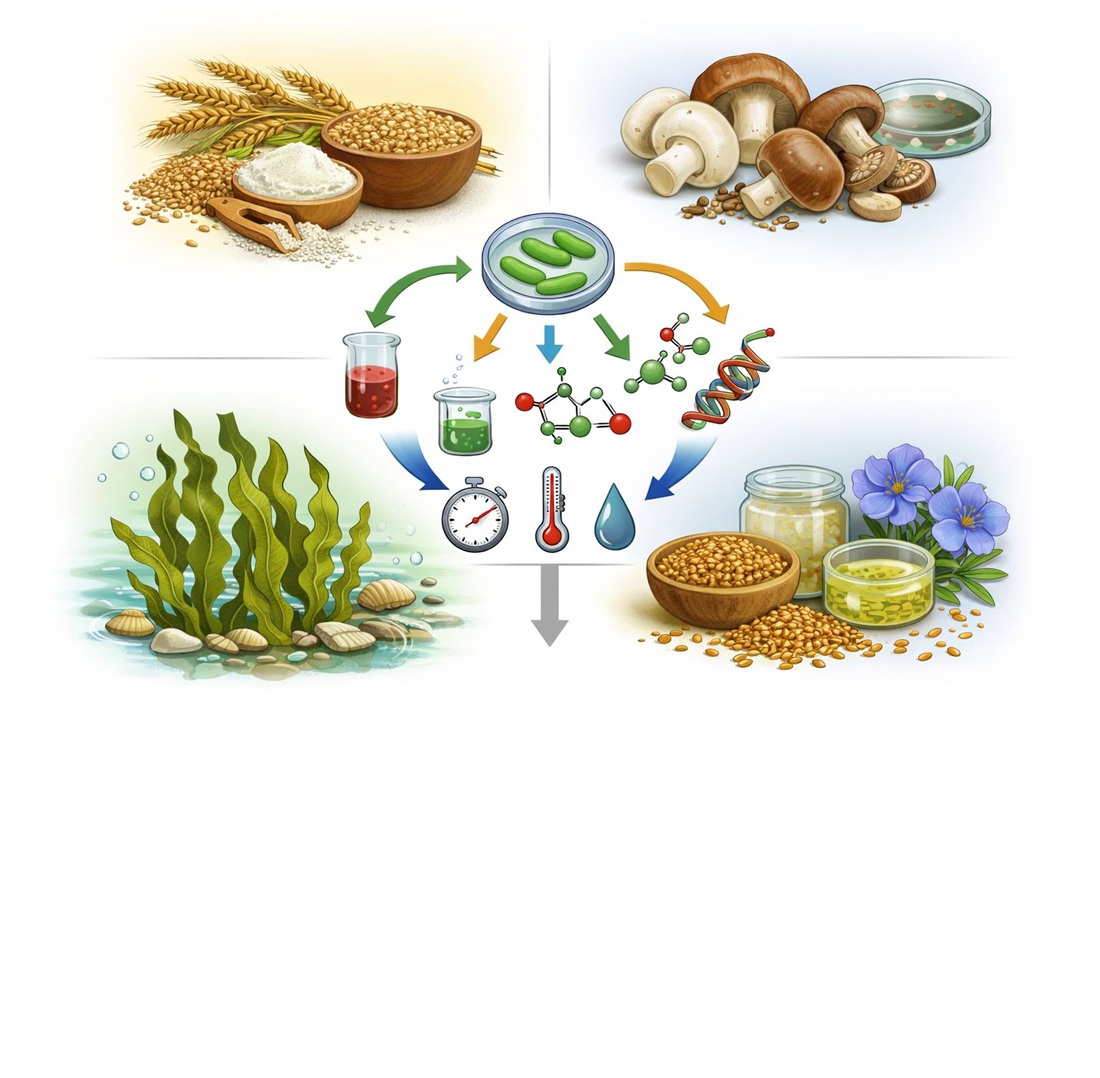
This study investigates the lactic acid fermentation process involving plant substrates of various natures (spelt, flax seeds, kelp, oyster mushrooms) with the participation of Lactiplantibacillus plantarum. The task addressed relates to the insufficient certainty of the patterns in biochemical transformations in plant substrates of various natures in the lactic acid fermentation process. This complicates their targeted selection and use as fermented ingredients in food products.
Fermentation was carried out at a temperature of 32 ± 2°C for 24 hours with sampling every 6 hours. It was established that the pH dynamics have a phase character: the most intensive decrease occurs in the interval of 0–6 hours. The total pH decrease was 33.0% for spelt, 28.5% for oyster mushrooms, 20.2% for flax, and 12.2% for kelp. The average rate of pH decrease over 24 hours was from –0.088 units/h (spelt) to –0.034 units/h (kelp).
An increase in titrated acidity was found in all substrates, the most intense for spelt and oyster mushrooms: 9.35 and 9.5 times, respectively, with average rates of 0.042 and 0.040 g/100 g/h. For flax and kelp, the increase was lower – 0.48 and 0.28 g/100 g, respectively. A strong inverse correlation was found between pH and titrated acidity (r = –0.98 ± 0.03). The decrease in soluble carbohydrates was 46.2% in oyster mushrooms and 42.3% in spelt, while in kelp and flax – 6.7% and 13.8%. The content of soluble protein increased by 58% in kelp, 50% in flax, 43% in spelt and 33% in oyster mushrooms in the absence of significant changes in total protein.
It was found that after 18 hours of fermentation, the rate of change of all indicators is significantly reduced. It was substantiated that the rational duration of fermentation is 18 hours, which enables a balanced acid profile and effective transformation of the carbohydrate-protein complex without excessive acidification
References
- Koistinen, V. M., Hedberg, M., Shi, L., Johansson, A., Savolainen, O., Lehtonen, M. et al. (2022). Metabolite Pattern Derived from Lactiplantibacillus plantarum – Fermented Rye Foods and In Vitro Gut Fermentation Synergistically Inhibits Bacterial Growth. Molecular Nutrition Food Research, 66 (21). https://doi.org/10.1002/mnfr.202101096
- Ashaolu, T. J. (2020). Safety and quality of bacterially fermented functional foods and beverages: a mini review. Food Quality and Safety, 4 (3), 123–127. https://doi.org/10.1093/fqsafe/fyaa003
- Petrova, P., Petrov, K. (2020). Lactic Acid Fermentation of Cereals and Pseudocereals: Ancient Nutritional Biotechnologies with Modern Applications. Nutrients, 12 (4), 1118. https://doi.org/10.3390/nu12041118
- Kandić, V., Nikolić, V., Simić, M., Žilić, S., Stevanović, M., Mandić, D., Dodig, D. (2023). Spelt wheat (Triticum spelta) and common bread wheat compared for nutritional contents and functional-technological properties. Chilean Journal of Agricultural Research, 83 (2), 146–158. https://doi.org/10.4067/s0718-58392023000200146
- Żuk-Gołaszewska, K., Żuk-Gołaszewska, K., Gołaszewski, J., Majewska, K., Tyburski, J. (2022). Nutritional properties of organic spelt wheats in different growth stages and the resulting flours. Journal of Elementology, 3. https://doi.org/10.5601/jelem.2022.27.1.2267
- Mueed, A., Shibli, S., Korma, S. A., Madjirebaye, P., Esatbeyoglu, T., Deng, Z. (2022). Flaxseed Bioactive Compounds: Chemical Composition, Functional Properties, Food Applications and Health Benefits-Related Gut Microbes. Foods, 11 (20), 3307. https://doi.org/10.3390/foods11203307
- Puligundla, P., Lim, S. (2022). A Review of Extraction Techniques and Food Applications of Flaxseed Mucilage. Foods, 11 (12), 1677. https://doi.org/10.3390/foods11121677
- Lorenc, F., Jarošová, M., Bedrníček, J., Smetana, P., Bárta, J. (2024). Recent trends in food and dietary applications of flaxseed mucilage: a mini review. International Journal of Food Science & Technology, 59 (4), 2111–2121. https://doi.org/10.1111/ijfs.16978
- Allahgholi, L., Jönsson, M., Christensen, M. D., Jasilionis, A., Nouri, M., Lavasani, S. et al. (2023). Fermentation of the Brown Seaweed Alaria esculenta by a Lactic Acid Bacteria Consortium Able to Utilize Mannitol and Laminari-Oligosaccharides. Fermentation, 9 (6), 499. https://doi.org/10.3390/fermentation9060499
- Healy, L. E., Zhu, X., Kakagianni, M., Poojary, M. M., Sullivan, C., Tiwari, U. et al. (2023). Fermentation of brown seaweeds Alaria esculenta and Saccharina latissima for new product development using Lactiplantbacillus plantarum, Saccharomyces cerevisiae and kombucha SCOBY. Algal Research, 76, 103322. https://doi.org/10.1016/j.algal.2023.103322
- Rondilla, R. R., Mikneviciute, I., Edrada-Ebel, R. (2025). Lactic acid fermentation enhances the functional metabolome and antibiofilm potential of edible Scottish seaweeds. International Journal of Food Science and Technology, 61 (1). https://doi.org/10.1093/ijfood/vvag016
- Effiong, M. E., Umeokwochi, C. P., Afolabi, I. S., Chinedu, S. N. (2024). Assessing the nutritional quality of Pleurotus ostreatus (oyster mushroom). Frontiers in Nutrition, 10. https://doi.org/10.3389/fnut.2023.1279208
- Wal, P., Dwivedi, J., Kushwaha, S., Yadav, A., Singh, S. P., Hanumanthachar, K. J. (2023). A Comprehensive Review on Nutritional and Medicinal Properties of Pleurotus ostreatus: An Oyster Mushroom. Current Nutrition & Food Science, 19 (4), 386–398. https://doi.org/10.2174/1573401318666220901144438
- Bal-Prylypko, L., Nikolaenko, M., Mushtruk, M., Nazarenko, M., Beiko, L. (2024). Physical and mathematical modelling of the process of cooking minced meat with spelt flour and champignon mushrooms. Animal Science and Food Technology, 15 (2), 38–55. https://doi.org/10.31548/animal.2.2024.38
- Bal-Prylypko, L., Danylenko, S., Mykhailova, O., Nedorizanyuk, L., Bovkun, A., Slobodyanyuk, N. et al. (2024). Influence of starter cultures on microbiological and physical-chemical parameters of dry-cured products. Potravinarstvo Slovak Journal of Food Sciences, 18, 313–330. https://doi.org/10.5219/1960
- Kurzyna-Szklarek, M., Cybulska, J., Zdunek, A. (2022). Analysis of the chemical composition of natural carbohydrates – An overview of methods. Food Chemistry, 394, 133466. https://doi.org/10.1016/j.foodchem.2022.133466
- Coronel-León, J., Maza, D., García-Álvarez de Toledo, I., Jofré, A., Martín, B., Serra, X., Bover-Cid, S. (2025). Fermentation Technologies to Produce and Improve Alternative Protein Sources. Foods, 15 (1), 117. https://doi.org/10.3390/foods15010117
- Jabłońska-Ryś, E., Przygoński, K. (2025). Possibilities of Using the New Lactiplantibacillus plantarum EK11 Strain as a Starter Culture for the Fermentation of the Fruiting Bodies of Edible Mushrooms. Foods, 14 (16), 2833. https://doi.org/10.3390/foods14162833
- Jabłońska-Ryś, E., Sławińska, A., Skrzypczak, K., Goral, K. (2022). Dynamics of Changes in pH and the Contents of Free Sugars, Organic Acids and LAB in Button Mushrooms during Controlled Lactic Fermentation. Foods, 11 (11), 1553. https://doi.org/10.3390/foods11111553
- Skonberg, D. I., Fader, S., Perkins, L. B., Perry, J. J. (2021). Lactic acid fermentation in the development of a seaweed sauerkraut‐style product: Microbiological, physicochemical, and sensory evaluation. Journal of Food Science, 86 (2), 334–342. https://doi.org/10.1111/1750-3841.15602
- Agarwal, D., Kharangarh, P., Hao, P., Bradbury, M. I., Maharjan, P., Timilsena, Y. P. et al. (2025). Structure and Functionality of Fermented Faba Bean: Influence of Particle Size and Rhizopus spp. Foods, 14 (23), 4105. https://doi.org/10.3390/foods14234105
- Stone, A. K., Shi, D., Liu, E., Jafarian, Z., Xu, C., Bhagwat, A. et al. (2024). Effect of solid-state fermentation on the functionality, digestibility, and volatile profiles of pulse protein isolates. Food Bioscience, 61, 104580. https://doi.org/10.1016/j.fbio.2024.104580
- Ghelichi, S., Jacobsen, C. (2025). Seaweed Proteins: Properties, Extraction, Challenges, and Prospects. Journal of Food Science, 90 (7). https://doi.org/10.1111/1750-3841.70418
- Bauer Petrovska, B. (2001). Protein Fraction in Edible Macedonian Mushrooms. European Food Research and Technology, 212 (4), 469–472. https://doi.org/10.1007/s002170000285
- Di Cagno, R., Coda, R., De Angelis, M., Gobbetti, M. (2013). Exploitation of vegetables and fruits through lactic acid fermentation. Food Microbiology, 33 (1), 1–10. https://doi.org/10.1016/j.fm.2012.09.003
- De Pasquale, I., Pontonio, E., Gobbetti, M., Rizzello, C. G. (2020). Nutritional and functional effects of the lactic acid bacteria fermentation on gelatinized legume flours. International Journal of Food Microbiology, 316, 108426. https://doi.org/10.1016/j.ijfoodmicro.2019.108426
- Emkani, M., Oliete, B., Saurel, R. (2022). Effect of Lactic Acid Fermentation on Legume Protein Properties, a Review. Fermentation, 8 (6), 244. https://doi.org/10.3390/fermentation8060244
- Ayar-Sümer, E. N., Verheust, Y., Özçelik, B., Raes, K. (2024). Impact of Lactic Acid Bacteria Fermentation Based on Biotransformation of Phenolic Compounds and Antioxidant Capacity of Mushrooms. Foods, 13 (11), 1616. https://doi.org/10.3390/foods13111616
- Monteiro, P., Lomartire, S., Cotas, J., Pacheco, D., Marques, J. C., Pereira, L., Gonçalves, A. M. M. (2021). Seaweeds as a Fermentation Substrate: A Challenge for the Food Processing Industry. Processes, 9 (11), 1953. https://doi.org/10.3390/pr9111953
- Raveschot, C., Cudennec, B., Coutte, F., Flahaut, C., Fremont, M., Drider, D., Dhulster, P. (2018). Production of Bioactive Peptides by Lactobacillus Species: From Gene to Application. Frontiers in Microbiology, 9. https://doi.org/10.3389/fmicb.2018.02354
- Verni, M., De Mastro, G., De Cillis, F., Gobbetti, M., Rizzello, C. G. (2019). Lactic acid bacteria fermentation to exploit the nutritional potential of Mediterranean faba bean local biotypes. Food Research International, 125, 108571. https://doi.org/10.1016/j.foodres.2019.108571
Downloads
Published
How to Cite
Issue
Section
License
Copyright (c) 2026 Larysa Bal-Prylypko, Mykola Nikolaenko, Marina Serdyuk, Valentyna Bandura, Svitlana Danylenko, Olena Sydorenko, Inna Kurbatova, Natalia Nesterenko

This work is licensed under a Creative Commons Attribution 4.0 International License.
The consolidation and conditions for the transfer of copyright (identification of authorship) is carried out in the License Agreement. In particular, the authors reserve the right to the authorship of their manuscript and transfer the first publication of this work to the journal under the terms of the Creative Commons CC BY license. At the same time, they have the right to conclude on their own additional agreements concerning the non-exclusive distribution of the work in the form in which it was published by this journal, but provided that the link to the first publication of the article in this journal is preserved.
A license agreement is a document in which the author warrants that he/she owns all copyright for the work (manuscript, article, etc.).
The authors, signing the License Agreement with TECHNOLOGY CENTER PC, have all rights to the further use of their work, provided that they link to our edition in which the work was published.
According to the terms of the License Agreement, the Publisher TECHNOLOGY CENTER PC does not take away your copyrights and receives permission from the authors to use and dissemination of the publication through the world's scientific resources (own electronic resources, scientometric databases, repositories, libraries, etc.).
In the absence of a signed License Agreement or in the absence of this agreement of identifiers allowing to identify the identity of the author, the editors have no right to work with the manuscript.
It is important to remember that there is another type of agreement between authors and publishers – when copyright is transferred from the authors to the publisher. In this case, the authors lose ownership of their work and may not use it in any way.








