Development of a method for automated integration of the “Pentagon” testing model into a continuous integration and delivery pipeline for microservice software
DOI:
https://doi.org/10.15587/1729-4061.2026.360693Keywords:
microservice architecture, continuous integration and delivery pipeline, software reliabilityAbstract
This study investigates the process of verifying the reliability of software with a microservice architecture, developed by several teams in parallel. The task addressed relates to the lack of cost-effective methods for automated integration of testing models into continuous integration and delivery (CI/CD) pipelines adapted to the microservice architecture. This leads to the emergence of "blind spots" in the field of functional and non-functional requirements and excessive time consumption of developers.
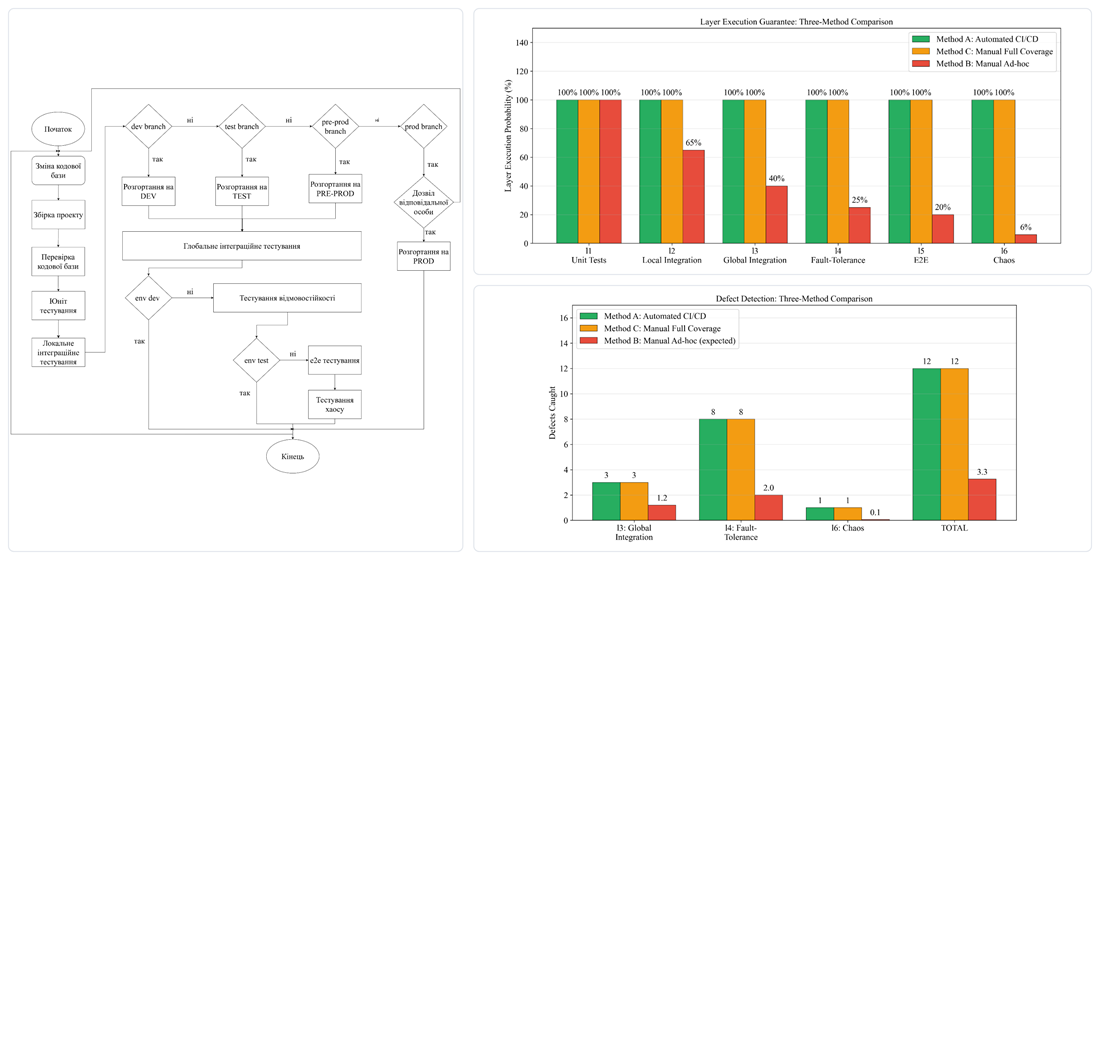
This paper reports a method devised for automated integration of the Pentagon testing model into a multi-stage continuous integration and delivery pipeline. The method implements the cumulative principle of progressive distribution of six testing layers between four isolated environments: DEV (development), TEST (test), PRE-PROD (pre-production), and PROD (production). The devised method guarantees coverage of all six layers during each change in the code base.
The key feature of the method is to eliminate the influence of human factor on decisions to launch tests. This makes it possible to achieve increased reliability values, namely Defect Removal Efficiency (DRE), while the manual method detects on average only 27% of defects. The devised method reduces the time when the developer is involved in the process of running tests by 70% compared to the manual approach. For 100 commits (fixing the current state of authentic code and files in the local repository) per month, the savings compared to the manual method are 37%.
The method is suitable for verifying software with a microservice architecture, which is deployed on cloud platforms (Amazon Web Services, USA; Azure, USA; Google Cloud, USA) with support for automated testing and container orchestration
References
- Humble, J., Forsgren, N., Kim, G. (2018). Accelerate: The Science of Lean Software and DevOps: Building and Scaling High Performing Technology Organizations. Portland: IT Revolution Press, 286. Available at: https://ebooks.karbust.me/Technology/Accelerate%20The%20Science%20of%20Lean%20Software%20and%20DevOps%20Building%20and%20Scaling%20High%20Performing%20Technology%20Organizations%20by%20Nicole%20Forsgren%20Jez%20Humble%20Gene%20Kim.pdf
- Boehm, B., Basili, V. R. (2001). Top 10 list [software development]. Computer, 34 (1), 135–137. https://doi.org/10.1109/2.962984
- Ponce, F., Verdecchia, R., Miranda, B., Soldani, J. (2025). Microservices testing: A systematic literature review. Information and Software Technology, 188, 107870. https://doi.org/10.1016/j.infsof.2025.107870
- Waseem, M., Liang, P., Marquez, G., Salle, A. D. (2020). Testing Microservices Architecture-Based Applications: A Systematic Mapping Study. 2020 27th Asia-Pacific Software Engineering Conference (APSEC), 119–128. https://doi.org/10.1109/apsec51365.2020.00020
- Wang, Y., Mäntylä, M. V., Liu, Z., Markkula, J. (2022). Test automation maturity improves product quality – Quantitative study of open source projects using continuous integration. Journal of Systems and Software, 188, 111259. https://doi.org/10.1016/j.jss.2022.111259
- Laukkanen, E., Itkonen, J., Lassenius, C. (2017). Problems, causes and solutions when adopting continuous delivery – A systematic literature review. Information and Software Technology, 82, 55–79. https://doi.org/10.1016/j.infsof.2016.10.001
- Shahin, M., Ali Babar, M., Zhu, L. (2017). Continuous Integration, Delivery and Deployment: A Systematic Review on Approaches, Tools, Challenges and Practices. IEEE Access, 5, 3909–3943. https://doi.org/10.1109/access.2017.2685629
- Mascheroni, M. A., Irrazábal, E. (2018). Continuous Testing and Solutions for Testing Problems in Continuous Delivery: A Systematic Literature Review. Computación Y Sistemas, 22 (3). https://doi.org/10.13053/cys-22-3-2794
- Zhang, Y., Vasilescu, B., Wang, H., Filkov, V. (2018). One size does not fit all: an empirical study of containerized continuous deployment workflows. Proceedings of the 2018 26th ACM Joint Meeting on European Software Engineering Conference and Symposium on the Foundations of Software Engineering, 295–306. https://doi.org/10.1145/3236024.3236033
- Zhou, X., Peng, X., Xie, T., Sun, J., Ji, C., Li, W., Ding, D. (2021). Fault Analysis and Debugging of Microservice Systems: Industrial Survey, Benchmark System, and Empirical Study. IEEE Transactions on Software Engineering, 47 (2), 243–260. https://doi.org/10.1109/tse.2018.2887384
- Jernberg, H., Runeson, P., Engström, E. (2020). Getting Started with Chaos Engineering - design of an implementation framework in practice. Proceedings of the 14th ACM / IEEE International Symposium on Empirical Software Engineering and Measurement (ESEM), 1–10. https://doi.org/10.1145/3382494.3421464
- Basiri, A., Behnam, N., de Rooij, R., Hochstein, L., Kosewski, L., Reynolds, J., Rosenthal, C. (2016). Chaos Engineering. IEEE Software, 33 (3), 35–41. https://doi.org/10.1109/ms.2016.60
- Heorhiadi, V., Rajagopalan, S., Jamjoom, H., Reiter, M. K., Sekar, V. (2016). Gremlin: Systematic Resilience Testing of Microservices. 2016 IEEE 36th International Conference on Distributed Computing Systems (ICDCS), 57–66. https://doi.org/10.1109/icdcs.2016.11
- Meiklejohn, C. S., Estrada, A., Song, Y., Miller, H., Padhye, R. (2021). Service-Level Fault Injection Testing. Proceedings of the ACM Symposium on Cloud Computing, 388–402. https://doi.org/10.1145/3472883.3487005
- Bouizem, Y., Dib, D., Parlavantzas, N., Morin, C. (2023). Integrating request replication into FaaS platforms: an experimental evaluation. Journal of Cloud Computing, 12 (1). https://doi.org/10.1186/s13677-023-00457-z
- Kuzmych, O., Seniv, M. (2024). An Improved Approach to Increase the Fault Tolerance of Microservice Software Through Automated Functional and Fault Tolerance Testing. 2024 IEEE 19th International Conference on Computer Science and Information Technologies (CSIT), 1–4. https://doi.org/10.1109/csit65290.2024.10982594
- Cohn, M. (2009). Succeeding with Agile: Software Development Using Scrum. Boston: Addison-Wesley Professional, 504. Available at: https://www.researchgate.net/publication/234803335_Succeeding_with_Agile_Software_Development_Using_Scrum
- Welcome to the State of Developer Ecosystem Report 2024. JetBrains. Available at: https://www.jetbrains.com/lp/devecosystem-2024/
- State of Cloud Native Development Q3 2025. CNCF. Available at: https://www.cncf.io/wp-content/uploads/2025/11/cncf_report_stateofcloud_111025a.pdf
- The State of Chaos Engineering in 2021. Gremlin Inc. Available at: https://www.gremlin.com/blog/the-state-of-chaos-engineering-in-2021
- Rubinstein, R. Y., Kroese, D. P. (2016). Simulation and the Monte Carlo Method. Wiley Series in Probability and Statistics. https://doi.org/10.1002/9781118631980
- AWS Pricing. Amazon Web Services. Available at: https://aws.amazon.com/pricing/
- Developer Survey 2024. Stack Overflow. Available at: https://survey.stackoverflow.co/2024/
- The Economic Impacts of Inadequate Infrastructure for Software Testing (Planning Report 02-3). National Institute of Standards and Technology (NIST). Available at: https://www.nist.gov/system/files/documents/director/planning/report02-3.pdf
- Yakovyna, V., Seniv, M., Symets, I. (2020). The Relation between Software Development Methodologies and Factors Affecting Software Reliability. 2020 IEEE 15th International Conference on Computer Sciences and Information Technologies (CSIT), 377–381. https://doi.org/10.1109/csit49958.2020.9321937
Downloads
Published
How to Cite
Issue
Section
License
Copyright (c) 2026 Oleh Kuzmych, Maksym Seniv

This work is licensed under a Creative Commons Attribution 4.0 International License.
The consolidation and conditions for the transfer of copyright (identification of authorship) is carried out in the License Agreement. In particular, the authors reserve the right to the authorship of their manuscript and transfer the first publication of this work to the journal under the terms of the Creative Commons CC BY license. At the same time, they have the right to conclude on their own additional agreements concerning the non-exclusive distribution of the work in the form in which it was published by this journal, but provided that the link to the first publication of the article in this journal is preserved.
A license agreement is a document in which the author warrants that he/she owns all copyright for the work (manuscript, article, etc.).
The authors, signing the License Agreement with TECHNOLOGY CENTER PC, have all rights to the further use of their work, provided that they link to our edition in which the work was published.
According to the terms of the License Agreement, the Publisher TECHNOLOGY CENTER PC does not take away your copyrights and receives permission from the authors to use and dissemination of the publication through the world's scientific resources (own electronic resources, scientometric databases, repositories, libraries, etc.).
In the absence of a signed License Agreement or in the absence of this agreement of identifiers allowing to identify the identity of the author, the editors have no right to work with the manuscript.
It is important to remember that there is another type of agreement between authors and publishers – when copyright is transferred from the authors to the publisher. In this case, the authors lose ownership of their work and may not use it in any way.








