Revealing the effect of explosion on the performance of reinforced concrete structures in protective shelters under air attacks
DOI:
https://doi.org/10.15587/1729-4061.2026.360862Keywords:
explosive load, explosion resistance, protective shelters, concrete structures, stressed-strained state, LS-DYNAAbstract
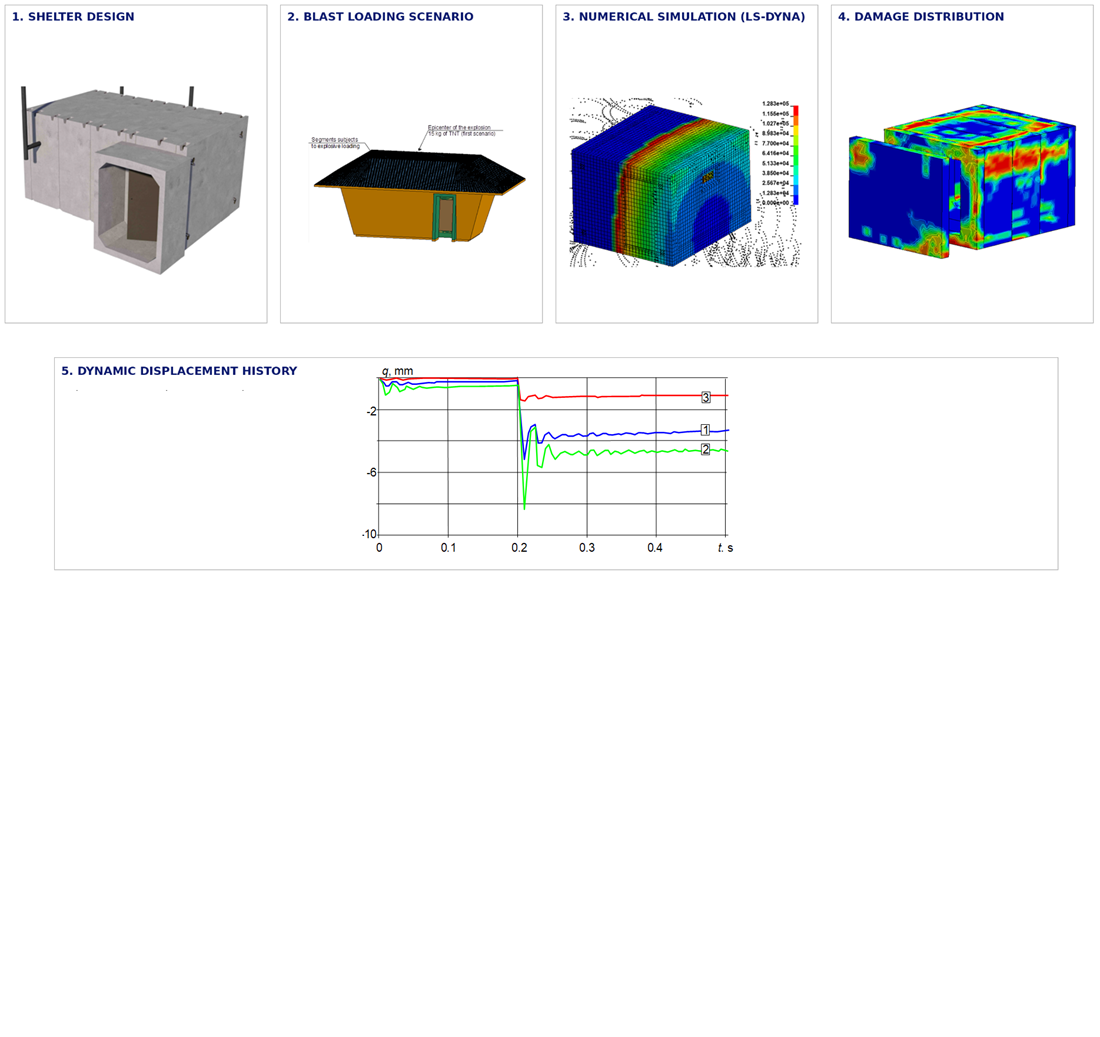
This study explores reinforced concrete structures at the UFS-1 and SHS VS-1-3 series block protective facilities under explosive conditions. The task addressed relates to the insufficiently studied patterns of their stressed-strained state taking into account contact interaction between structural elements and the soil base.
To solve the specified task, numerical modeling was performed using the finite element method. Calculations were carried out in the LS-DYNA software package (USA) taking into account physical and geometric nonlinearity and contact interaction of structural elements. The functional suitability of reinforced concrete structures at block protective facilities under explosive conditions was investigated.
The explosive impact scenarios provided for a TNT equivalent charge of 15 kg at distances to the structure of 0.55 m and 5 m. The calculation results showed that the maximum values of excess pressure reach 1.16 · 106 kPa and 1.01 · 103 kPa, respectively. It was found that the greatest stresses and displacements are localized in the junctions of blocks and near-surface areas of structures, which made it possible to identify the most vulnerable elements and justify directions for improving structural solutions.
It was found that at the assumed values of explosive effects, the facilities retain their functional suitability and stability while damage is localized in small areas and does not lead to progressive destruction of the shelter. This is explained by the spatial work of the structure and the redistribution of dynamic forces among individual blocks and the soil base.
The research results could prove useful for assessing explosion resistance and implementing engineering solutions in the design of civil defense structures with the aim of improving them
References
- Zhang, C., Gholipour, G., Mousavi, A. A. (2020). Blast loads induced responses of RC structural members: State-of-the-art review. Composites Part B: Engineering, 195, 108066. https://doi.org/10.1016/j.compositesb.2020.108066
- Anas, S. M., Alam, M., Umair, M. (2021). Experimental and numerical investigations on performance of reinforced concrete slabs under explosive-induced air-blast loading: A state-of-the-art review. Structures, 31, 428–461. https://doi.org/10.1016/j.istruc.2021.01.102
- Park, Y., Kim, K., Park, S.-w., Yum, S.-G., Baek, J.-W. (2024). Experimental Evaluation on Blast Resistance of Reinforced Concrete Structures under Partially Confined Explosion. International Journal of Concrete Structures and Materials, 18 (1). https://doi.org/10.1186/s40069-024-00663-2
- Guo, X., Li, Y., McCrum, D. P., Hu, Y., Bai, Z., Zhang, H., Li, Z., Wang, X. (2024). A reinforced concrete shear wall building structure subjected to internal TNT explosions: Test results and numerical validation. International Journal of Impact Engineering, 190, 104950. https://doi.org/10.1016/j.ijimpeng.2024.104950
- Draganić, H., Jeleč, M., Gazić, G., Lukić, S. (2025). Numerical Investigations of Reinforced Concrete Slabs Subjected to Contact Explosions. Buildings, 15 (7), 1063. https://doi.org/10.3390/buildings15071063
- Li, H., Chen, W., Hao, H. (2024). Performance of reinforced concrete slabs subjected to simultaneous fire and blast loads. Engineering Structures, 311, 118133. https://doi.org/10.1016/j.engstruct.2024.118133
- Ivanchenko, G., Getun, G., Bezklubenko, I., Solomin, A., Posternak, O. (2023). Іnfluence of explosive loads on buildings and structures of the population civil protection. Strength of Materials and Theory of Structures, 111, 39–48. https://doi.org/10.32347/2410-2547.2023.111.39-48
- Kostopoulos, V., Kalimeris, G. D., Giannaros, E. (2022). Blast protection of steel reinforced concrete structures using composite foam-core sacrificial cladding. Composites Science and Technology, 230, 109330. https://doi.org/10.1016/j.compscitech.2022.109330
- Fatima, A., Sangi, A. J., Mohammad, A. F., Joohi, M. (2023). Global response of reinforced concrete framed building under varying blast load pulse shapes. Structures, 50, 482–493. https://doi.org/10.1016/j.istruc.2023.02.001
- Belytschko, T., Liu, W. K., Moran, B. (2013). Nonlinear finite elements for continua and structures. John Wiley & Sons. Available at: https://scispace.com/pdf/nonlinear-finite-elements-for-continua-and-structures-1qwp4eb2pg.pdf
- Grassl, P., Jirásek, M. (2006). Damage-plastic model for concrete failure. International Journal of Solids and Structures, 43 (22-23), 7166–7196. https://doi.org/10.1016/j.ijsolstr.2006.06.032
- Murray, Y. D., Abu-Odeh, A., Bligh, R. (2007). Evaluation of LS-DYNA Concrete Material Model 159 (2007). FHWA-HRT-05-063. Available at: https://www.fhwa.dot.gov/publications/research/infrastructure/structures/05063/
- Hallquist, J. O. (2006). LS-DYNA® Theory Manual. Livermore Software Technology Corporation, 680. Available at: https://ftp.lstc.com/anonymous/outgoing/jday/manuals/ls-dyna_theory_manual_2006.pdf
- Kingery, C. N., Bulmash, G. (1984). Airblast Parameters from TNT Spherical Air Burst and Hemispherical Surface Burst. Aberdeen Proving Ground. Available at: https://erdclibrary.on.worldcat.org/search?databaseList=&queryString=867650613
- Structures to resist the effects of accidental explosions (UFC 3-340-02) (2008). Unified Facilities Criteria (UFC). Available at: https://nibs-s3-wbdg3-production.s3.us-east-1.amazonaws.com/FFC/DOD/UFC/ufc_3_340_02_2008_c2.pdf
- Kingery-Bulmash blast parameter calculator. UN SaferGuard. Available at: https://unsaferguard.org/un-saferguard/kingery-bulmash
- Index of /~gyebro/files/ans_help_v182/ans_thry. Available at: https://www.mm.bme.hu/~gyebro/files/ans_help_v182/ans_thry/ans_thry.html
- Protokol naturnykh vyprobuvan No. 366-V/2024 vid 18.07.2024 r. Shvydkosporudzhuvani zakhysni sporudy typiv «ShS VS-1-3» ta «ShS UFS-1».
Downloads
Published
How to Cite
Issue
Section
License
Copyright (c) 2026 Serhii Pozdieiev, Volodymyr Bashynskyi, Andrii Shvydenko, Serhii Bisyk, Serhii Holets, Olga Nekora, Oleh Dmitriiev, Volodymyr Krivtsun, Viktor Nikitchenko, Ihor Chastokolenko

This work is licensed under a Creative Commons Attribution 4.0 International License.
The consolidation and conditions for the transfer of copyright (identification of authorship) is carried out in the License Agreement. In particular, the authors reserve the right to the authorship of their manuscript and transfer the first publication of this work to the journal under the terms of the Creative Commons CC BY license. At the same time, they have the right to conclude on their own additional agreements concerning the non-exclusive distribution of the work in the form in which it was published by this journal, but provided that the link to the first publication of the article in this journal is preserved.
A license agreement is a document in which the author warrants that he/she owns all copyright for the work (manuscript, article, etc.).
The authors, signing the License Agreement with TECHNOLOGY CENTER PC, have all rights to the further use of their work, provided that they link to our edition in which the work was published.
According to the terms of the License Agreement, the Publisher TECHNOLOGY CENTER PC does not take away your copyrights and receives permission from the authors to use and dissemination of the publication through the world's scientific resources (own electronic resources, scientometric databases, repositories, libraries, etc.).
In the absence of a signed License Agreement or in the absence of this agreement of identifiers allowing to identify the identity of the author, the editors have no right to work with the manuscript.
It is important to remember that there is another type of agreement between authors and publishers – when copyright is transferred from the authors to the publisher. In this case, the authors lose ownership of their work and may not use it in any way.








