Revealing the influence of the mode of controlled oscillations of the liquid pool on the surfaced bead geometry
DOI:
https://doi.org/10.15587/1729-4061.2026.361773Keywords:
electric arc surfacing, controlled workpiece oscillations, surfacing parameters, bead geometry, surfacing productivityAbstract
This study investigates geometric dimensions of the weld bead produced by gas metal arc surfacing with a consumable electrode. Standard surfacing is characterized by low productivity because of the significant number of runs and the need for machining tall beads. Deep penetration causes a significant proportion of the base metal in the surfaced layer and inhomogeneity of the chemical composition. Existing approaches to controlling the geometry of the weld bead (pulsed arc modes, electrode oscillations, electromagnetic arc control) have a limited effect on the width or complicate the design of the welding head.
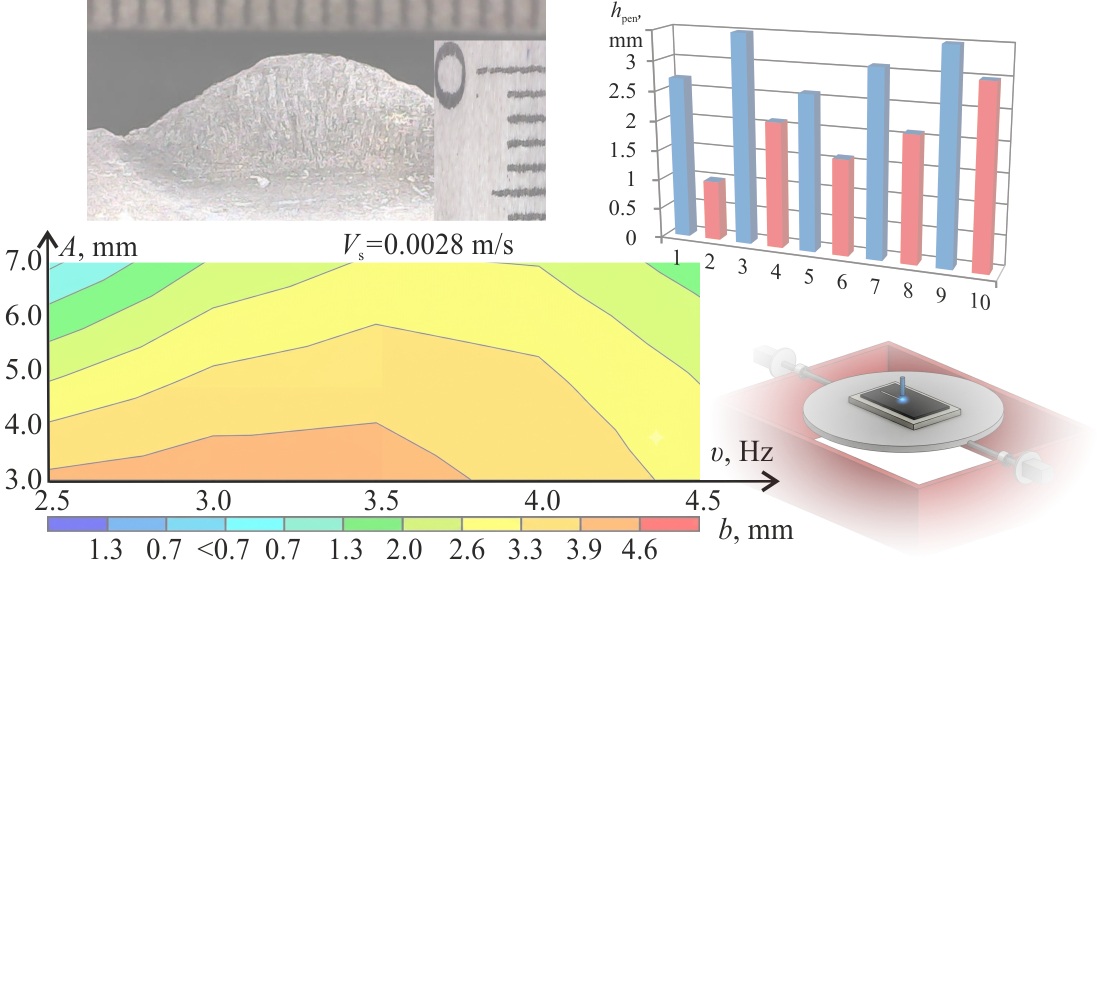
This work considers gas metal arc surfacing with controlled low-frequency oscillations of the workpiece with a liquid weld pool. The installation is built on an adjustable electric drive with a stepper motor with a programmable setting of the frequency and amplitude of oscillations. These parameters, together with energy parameters and speed, affect the geometric dimensions of the weld bead and the mechanical properties of the surfaced metal.
The width, height, and depth of the weld bead penetration were determined from macrographic cross-sections. A mathematical model of bead geometry as a function of surfacing parameters has been built by using experimental data regression analysis. The errors in predicting the width and height did not exceed 21.7% and 15%, respectively, thereby confirming its practical applicability.
Controlled oscillations were found to increase bead width by a factor of 1.5–2 and reduce bead height by up to a factor of 6 compared with vibration-free surfacing. This is attributed to redistribution of thermal energy and intensification of horizontal melt flows. Changing the weld bead geometry increases surfacing productivity and control accuracy. The method is suitable for use in adaptive welding systems
References
- Tandon, D., Li, H., Pan, Z., Yu, D., Pang, W. (2023). A Review on Hardfacing, Process Variables, Challenges, and Future Works. Metals, 13 (9), 1512. https://doi.org/10.3390/met13091512
- Ingram, E., Golan, O., Haj-Ali, R., Eliaz, N. (2019). The Effect of Localized Vibration during Welding on the Microstructure and Mechanical Behavior of Steel Welds. Materials, 12 (16), 2553. https://doi.org/10.3390/ma12162553
- Wang, Z.-L., Zheng, Z.-T., Zhao, L.-B., Lei, Y.-F., Yang, K. (2018). Microstructure evolution and nucleation mechanism of Inconel 601H alloy welds by vibration-assisted GTAW. International Journal of Minerals, Metallurgy, and Materials, 25 (7), 788–799. https://doi.org/10.1007/s12613-018-1627-2
- Kalpana, J., Srinivasa Rao, P., Govinda Rao, P. (2016). Effect of frequency on impact strength of dissimilar weldments produced with vibration. International Journal of Chemical Sciences, 14 (3), 1797–1804. https://doi.org/10.13140/RG.2.2.17394.91840
- Gill, J. S., Kalyan Reddy, T. (2018). Effect of weld pool vibration on fatigue strength and tensile strength of stainless-steel butt-welded joints by GTAW process. Proceedings of the World Congress on Engineering 2018. London, 2. Available at: https://www.iaeng.org/publication/WCE2018/WCE2018_pp721-726.pdf?
- Gao, L., Yao, Q., Yang, Y., Sun, D., Xu, G., Gu, B., Yang, C., Li, S. (2024). Effects of Vibratory Stress Relief on Microstructure and Mechanical Properties of Marine Welded Structures. Journal of Marine Science and Engineering, 13 (1), 11. https://doi.org/10.3390/jmse13010011
- Hamed Zargari, H., Ito, K., Miwa, T., Parchuri, P. K., Yamamoto, H., Sharma, A. (2020). Metallurgical Characterization of Penetration Shape Change in Workpiece Vibration-Assisted Tandem-Pulsed Gas Metal Arc Welding. Materials, 13 (14), 3096. https://doi.org/10.3390/ma13143096
- Lara, M., Díaz, V. V., Camus, M., Da Cunha, T. V. (2020). Effect of transverse arc oscillation on morphology, dilution and microstructural aspects of weld beads produced with short-circuiting transfer in GMAW. Journal of the Brazilian Society of Mechanical Sciences and Engineering, 42 (9). https://doi.org/10.1007/s40430-020-02533-w
- Lebedev, V. A., Novykov, S. V. (2020). Vibrator of product for the automatic arc surfacing. Technical Sciences and Technologies, 2 (20), 11–21. https://doi.org/10.25140/2411-5363-2020-2(20)-11-21
- Lebedev, V., Zhuk, G. (2018). Analysis of parameters of technical controlled vibrations in electrode wire systems mechanized and automatic equipment for electric arc welding and surfacing. Bulletin of the National Technical University «KhPI» Series: New Solutions in Modern Technologies, 45 (1321), 16–24. https://doi.org/10.20998/2413-4295.2018.45.03
- Montgomery, D. C. (2020). Design and analysis of experiments. Hoboken: John Wiley & Sons, 688.
- Kumar Singh, P., Patel, D., Prasad, S. B. (2016). Development of Vibratory Welding Technique and Tensile Properties Investigation of Shielded Metal Arc Welded Joints. Indian Journal of Science and Technology, 9 (35). https://doi.org/10.17485/ijst/2016/v9i35/92846
- Singh, R. (2020). Applied Welding Engineering: Processes, Codes, and Standards. Oxford: Butterworth-Heinemann, 472. https://doi.org/10.1016/C2019-0-03490-5
- Chen, K., Chen, H., Liu, L., Chen, S. (2018). Prediction of weld bead geometry of MAG welding based on XGBoost algorithm. The International Journal of Advanced Manufacturing Technology, 101 (9-12), 2283–2295. https://doi.org/10.1007/s00170-018-3083-6
- Hamed Zargari, H., Ito, K., Sharma, A. (2023). Effect of workpiece vibration frequency on heat distribution and material flow in the molten pool in tandem-pulsed gas metal arc welding. The International Journal of Advanced Manufacturing Technology, 129 (5-6), 2507–2522. https://doi.org/10.1007/s00170-023-12424-8
- Liu, H., Xue, R., Zhou, J., Bao, Y., Xu, Y. (2023). Applying Statistical Models to Optimize the Weld Bead Geometry in the Vertical Oscillation Arc Narrow Gap All-Position GMAW. Applied Sciences, 13 (11), 6801. https://doi.org/10.3390/app13116801
- Singh, P. K., Kumar, S. D., Patel, D., Prasad, S. B. (2017). Optimization of vibratory welding process parameters using response surface methodology. Journal of Mechanical Science and Technology, 31 (5), 2487–2495. https://doi.org/10.1007/s12206-017-0446-0
- Ranjan, R., Cep, R., Kumar, A., Srivastava, M., Altarazi, F., Dogra, N. et al. (2025). Comprehensive review of vibration-assisted welding processes: Mechanisms, applications, and future directions. Frontiers in Mechanical Engineering, 11. https://doi.org/10.3389/fmech.2025.1550928
- Jose, M. J., Kumar, S. S., Sharma, A. (2016). Vibration assisted welding processes and their influence on quality of welds. Science and Technology of Welding and Joining, 21 (4), 243–258. https://doi.org/10.1179/1362171815y.0000000088
- Lebedev, V. A., Solomiichuk, T. G., Novykov, S. V. (2019). Study of a Welding Pool Harmonic Oscillations Influence on the Welded Metal Hardness and Weld Bead Width. Journal of Engineering Sciences, 6 (1), c16–c21. https://doi.org/10.21272/jes.2019.6(1).c4
- Li, C., Shi, Y., Du, L., Yufen, G., Zhu, M. (2017). Real-time Measurement of Weld Pool Oscillation Frequency in GTAW-P Process. Journal of Manufacturing Processes, 29, 419–426. https://doi.org/10.1016/j.jmapro.2017.08.011
Downloads
Published
How to Cite
Issue
Section
License
Copyright (c) 2026 Volodymyr Lebediev, Sergii Novykov, Serhii Loi, Volodymyr Spihtarenko, Maksym Matviienko

This work is licensed under a Creative Commons Attribution 4.0 International License.
The consolidation and conditions for the transfer of copyright (identification of authorship) is carried out in the License Agreement. In particular, the authors reserve the right to the authorship of their manuscript and transfer the first publication of this work to the journal under the terms of the Creative Commons CC BY license. At the same time, they have the right to conclude on their own additional agreements concerning the non-exclusive distribution of the work in the form in which it was published by this journal, but provided that the link to the first publication of the article in this journal is preserved.
A license agreement is a document in which the author warrants that he/she owns all copyright for the work (manuscript, article, etc.).
The authors, signing the License Agreement with TECHNOLOGY CENTER PC, have all rights to the further use of their work, provided that they link to our edition in which the work was published.
According to the terms of the License Agreement, the Publisher TECHNOLOGY CENTER PC does not take away your copyrights and receives permission from the authors to use and dissemination of the publication through the world's scientific resources (own electronic resources, scientometric databases, repositories, libraries, etc.).
In the absence of a signed License Agreement or in the absence of this agreement of identifiers allowing to identify the identity of the author, the editors have no right to work with the manuscript.
It is important to remember that there is another type of agreement between authors and publishers – when copyright is transferred from the authors to the publisher. In this case, the authors lose ownership of their work and may not use it in any way.








