Determining an analytical criterion for the effective speed of a spindle unit for the automatic machining of long workpieces
DOI:
https://doi.org/10.15587/1729-4061.2026.362733Keywords:
critical frequency, long workpiece, bar turning, elastic-flexible support, spindle speedAbstract
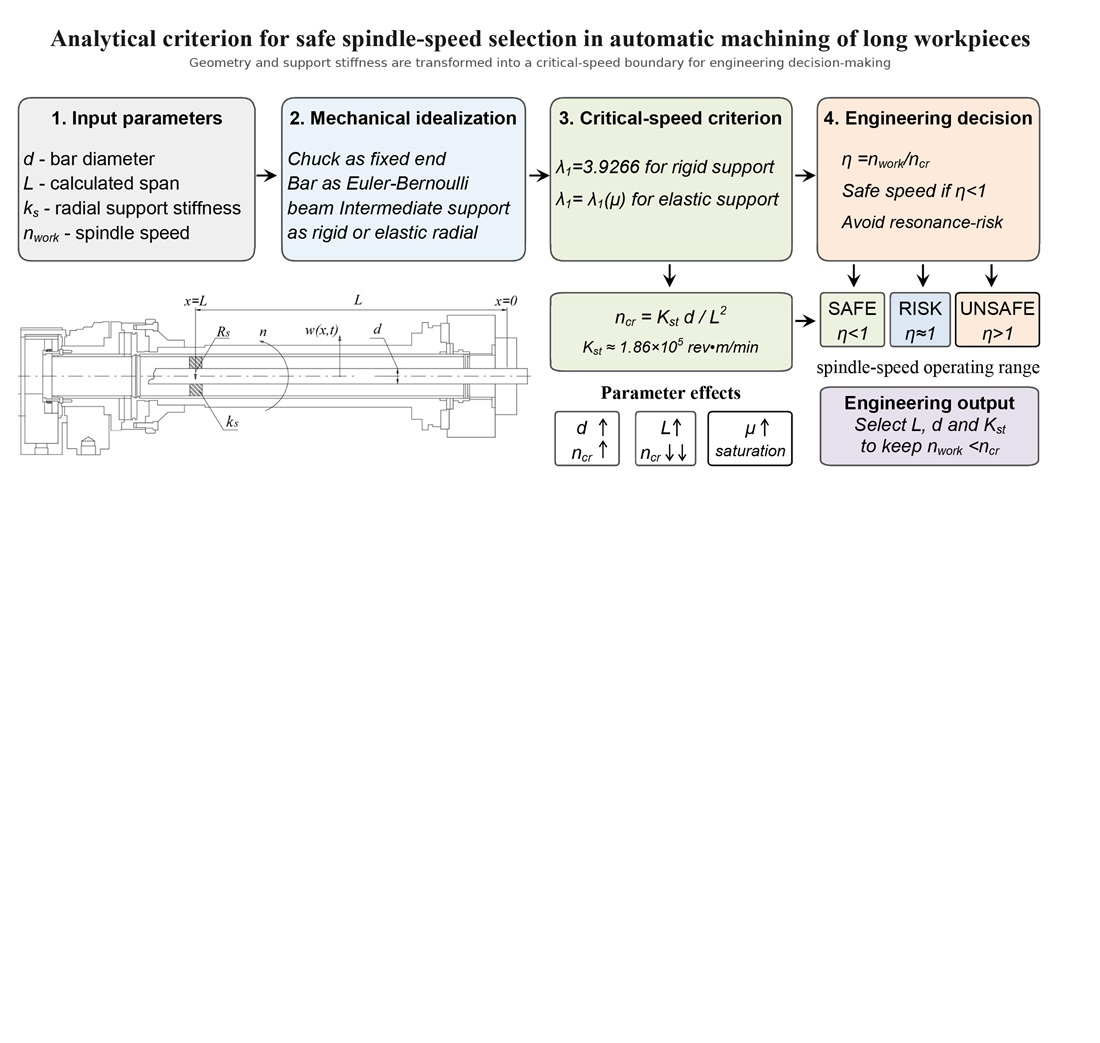
This study considers a long bar workpiece fixed in the spindle assembly of a bar lathe according to the “clamping chuck-intermediate radial support” scheme. The task addressed relates to the limitation in the effective spindle speed because of the operating speed approaching the first critical frequency of transverse vibrations of the bar.
A distinctive feature of the results is the representation of the critical speed as a function of three controlled parameters: the diameter of the bar, the length of the calculated span, and the stiffness of the intermediate radial support of the bar. That makes it possible to obtain an engineering criterion for the effective speed of the spindle assembly when machining a long bar workpiece.
Practically significant results are attributed to the features of the adopted model in which the clamping chuck is represented as an equivalent clamping, the intermediate support is considered to be a rigid or elastic-flexible radial support and the dimensionless parameter of relative stiffness μ is used. That has made it possible to reflect the transition from virtually no support to perfectly rigid support and to establish a nonlinear saturable effect of the support stiffness on the critical frequency.
For a solid round steel bar, a compact dependence nkp = Kcm · d/L2 was obtained, where Kcm ≈ 1.86 · 105 rev m/min. It was established that the span length has a quadratic effect on the critical frequency, the diameter has a linear effect, and an increase in the support stiffness is effective only up to the saturation zone. Based on the resulting relations, the limiting dependences of the effective operation of the system on the frequency load coefficient were constructed.
The results are suitable for the preliminary selection of the inter-support distance, the bar diameter, as well as the conditions of its support when designing, modernizing, and adjusting bar automatic lathes
References
- Siddhpura, M., Paurobally, R. (2012). A review of chatter vibration research in turning. International Journal of Machine Tools and Manufacture, 61, 27–47. https://doi.org/10.1016/j.ijmachtools.2012.05.007
- Otto, A., Khasawneh, F. A., Radons, G. (2015). Position-dependent stability analysis of turning with tool and workpiece compliance. The International Journal of Advanced Manufacturing Technology, 79 (9-12), 1453–1463. https://doi.org/10.1007/s00170-015-6929-1
- Urbikain, G., López de Lacalle, L. N., Campa, F. J., Fernández, A., Elías, A. (2012). Stability prediction in straight turning of a flexible workpiece by collocation method. International Journal of Machine Tools and Manufacture, 54-55, 73–81. https://doi.org/10.1016/j.ijmachtools.2011.11.008
- Sekar, M., Srinivas, J., Kotaiah, K. R., Yang, S. H. (2008). Stability analysis of turning process with tailstock-supported workpiece. The International Journal of Advanced Manufacturing Technology, 43 (9-10), 862–871. https://doi.org/10.1007/s00170-008-1764-2
- Siddhpura, M., Siddhpura, A., Paurobally, R. (2017). Chatter stability prediction for a flexible tool-workpiece system in a turning process. The International Journal of Advanced Manufacturing Technology, 92 (1-4), 881–896. https://doi.org/10.1007/s00170-017-0208-2
- Lu, K., Wang, Y., Gu, F., Pang, X., Ball, A. (2019). Dynamic modeling and chatter analysis of a spindle-workpiece-tailstock system for the turning of flexible parts. The International Journal of Advanced Manufacturing Technology, 104 (5-8), 3007–3015. https://doi.org/10.1007/s00170-019-04224-w
- Stepan, G., Kiss, A. K., Ghalamchi, B., Sopanen, J., Bachrathy, D. (2017). Chatter avoidance in cutting highly flexible workpieces. CIRP Annals, 66 (1), 377–380. https://doi.org/10.1016/j.cirp.2017.04.054
- Chanda, A., Dwivedy, S. K. (2018). Nonlinear dynamic analysis of flexible workpiece and tool in turning operation with delay and internal resonance. Journal of Sound and Vibration, 434, 358–378. https://doi.org/10.1016/j.jsv.2018.05.043
- Yan, S., Kong, J., Sun, Y. (2021). Continuum model based chatter stability prediction for highly flexible parts in turning process with accurate dynamic force modeling. Journal of Manufacturing Processes, 62, 221–233. https://doi.org/10.1016/j.jmapro.2020.12.003
- Beri, B., Meszaros, G., Stepan, G. (2021). Machining of slender workpieces subjected to time-periodic axial force: stability and chatter suppression. Journal of Sound and Vibration, 504, 116114. https://doi.org/10.1016/j.jsv.2021.116114
- Prydalnyi, B. (2020). Characteristics of Electromechanical Clamping Mechanism with Asynchronous Electric Motor. 2020 International Conference Mechatronic Systems and Materials (MSM), 1–5. https://doi.org/10.1109/msm49833.2020.9202186
- Prydalnyi, B. (2022). Creation of automatic clamping mechanisms for spindle assemblies of machine tools using a formalized description of structural elements. Eastern-European Journal of Enterprise Technologies, 5 (1 (119)), 26–35. https://doi.org/10.15587/1729-4061.2022.265191
- Prydalnyi, B., Kuznetsov, Y., Lyshuk, V. (2021). Methodology and Tools for Computer-Aided Calculation of Characteristics of Electromechanical Clamping Drive Actuated by Induction Motor. Proceedings of the 6th International Conference on Industrial Engineering (ICIE 2020), 256–266. https://doi.org/10.1007/978-3-030-54817-9_30
- Pasternak, V., Samchuk, L., Huliieva, N., Andrushchak, I., Ruban, A. (2021). Investigation of the Properties of Powder Materials Using Computer Modeling. Materials Science Forum, 1038, 33–39. https://doi.org/10.4028/www.scientific.net/msf.1038.33
Downloads
Published
How to Cite
Issue
Section
License
Copyright (c) 2026 Borys Prydalnyi, Dmytro Seleznov, Eduard Seleznov, Yuliia Muravynets

This work is licensed under a Creative Commons Attribution 4.0 International License.
The consolidation and conditions for the transfer of copyright (identification of authorship) is carried out in the License Agreement. In particular, the authors reserve the right to the authorship of their manuscript and transfer the first publication of this work to the journal under the terms of the Creative Commons CC BY license. At the same time, they have the right to conclude on their own additional agreements concerning the non-exclusive distribution of the work in the form in which it was published by this journal, but provided that the link to the first publication of the article in this journal is preserved.
A license agreement is a document in which the author warrants that he/she owns all copyright for the work (manuscript, article, etc.).
The authors, signing the License Agreement with TECHNOLOGY CENTER PC, have all rights to the further use of their work, provided that they link to our edition in which the work was published.
According to the terms of the License Agreement, the Publisher TECHNOLOGY CENTER PC does not take away your copyrights and receives permission from the authors to use and dissemination of the publication through the world's scientific resources (own electronic resources, scientometric databases, repositories, libraries, etc.).
In the absence of a signed License Agreement or in the absence of this agreement of identifiers allowing to identify the identity of the author, the editors have no right to work with the manuscript.
It is important to remember that there is another type of agreement between authors and publishers – when copyright is transferred from the authors to the publisher. In this case, the authors lose ownership of their work and may not use it in any way.








