Implementation of a multi-stage double-slope solar still for salt and distilled water production under tropical rainy conditions
DOI:
https://doi.org/10.15587/1729-4061.2026.362859Keywords:
solar still, multi-stage, double-slope, salt production, distilled water, rainy conditionsAbstract
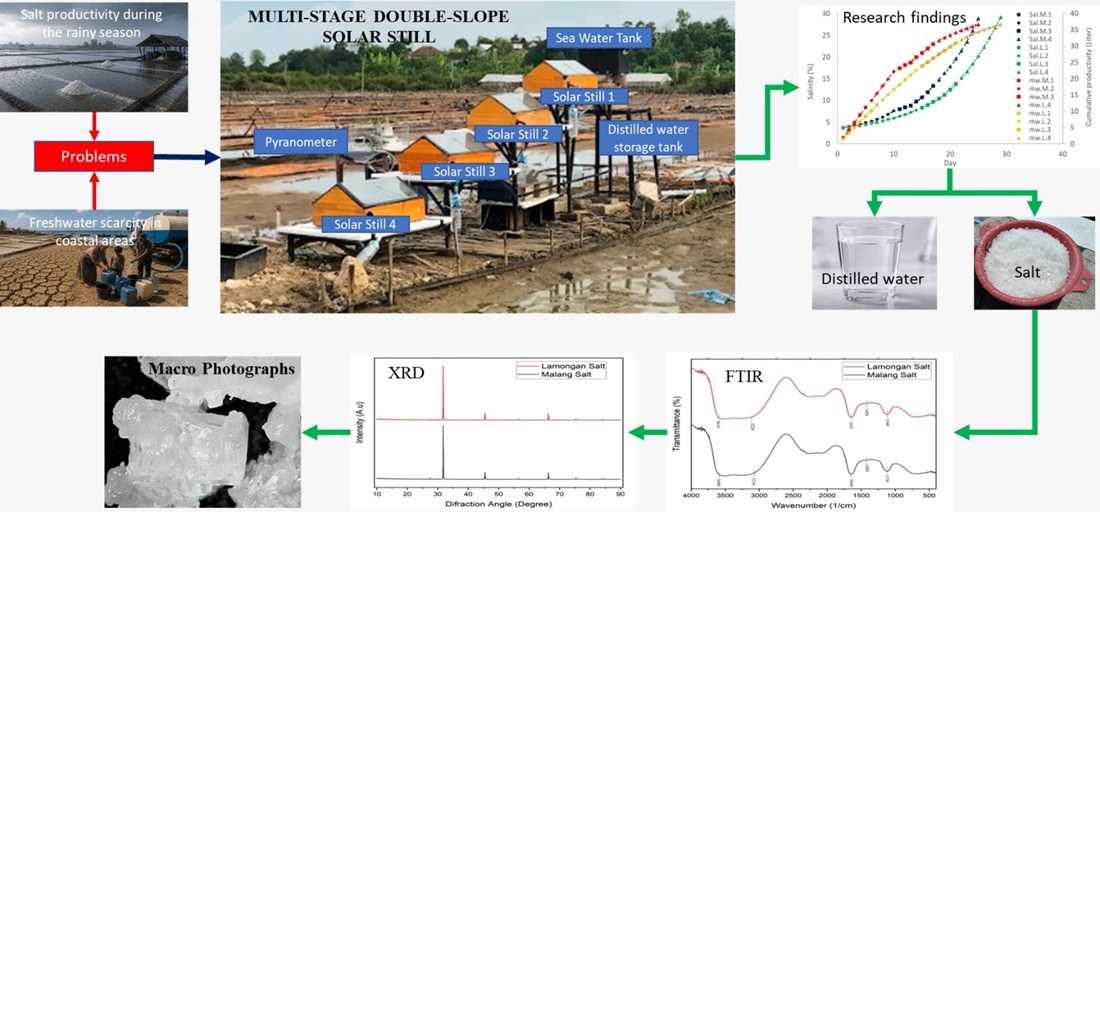
The object of this study is a multi-stage double-slope solar still used for simultaneous distilled water production and seawater concentration into salt crystals under tropical rainy conditions. The problem solved in this study is the discontinuity of conventional salt production during the rainy season, when open evaporation ponds become less effective because of rainfall, high humidity, and unstable solar radiation. Experiments were conducted in Malang as a laboratory environment and in Lamongan as a coastal salt production area. The results showed that the system could operate continuously during the rainy season and increase seawater salinity from 3.5% to about 29%. The cumulative distilled water production was almost identical in both locations, reaching 36.57–36.58 L/m2. However, seawater concentration was faster in Malang, requiring 25 days, compared with 29 days in Lamongan. This difference was explained by the larger temperature gradients between water, fins, glass cover, and ambient air in Malang, which improved evaporation and condensation. Salt from Malang also had higher NaCl content, 92.33%, than salt from Lamongan, 86.95%, supported by lower Mg and S contents. FTIR detected O–H, sulfate, and carbonate groups, while XRD confirmed halite as the dominant crystalline phase. Macro images showed that Malang salt crystals were more uniform and regular. The distinctive feature of the system is the tiered double-slope configuration, which enables gradual brine concentration while still producing distilled water in a closed solar-driven process. These results show that the system can be practically applied in tropical coastal salt-producing areas with high rainfall to support more continuous salt and distilled water production
Supporting Agency
- Directorate of Research and Innovation Funding, National Research and Innovation Agency of Indonesia (BRIN)
References
- Ary Giri Dwi Kartika, Makhfud Efendy, Onie Wiwid Jayanthi (2121). Evaporation rate, meteorological and physical condition of salt crystallizer pond in Pamekasan, Indonesia. Journal Universitas Muhammadiyah Gresik Engineering, Social Science, and Health International Conference (UMGESHIC), 1 (1), 116–120.
- Amin, Abd. A., Yanuar, A. T., Kurniaty, R., Hakim, L., Ardian, G., Amenan, M., Kurniawan, A. (2023). Greenhouse Salt Tunnel as Innovation to Create Salt Production in the South Coast Malang Regency, Indonesia. Jurnal Pembangunan Dan Alam Lestari, 14 (1). https://doi.org/10.21776/ub.jpal.2023.014.01.03
- Setiyono, H., Muslim, M., Arifa, A. N., Rifai, A., Satriadi, A., Ridlo, A., Soenardjo, N. (2025). The Relationship Between Climate Patterns, El Nino And La Nina With People’s Salt Production In Jepara Regency, Central Java Province, Indonesia In 2015-2023. African Journal of Biomedical Research, 28 (4S), 204–209. Available at: https://www.africanjournalofbiomedicalresearch.com/index.php/AJBR/article/view/8419
- Pambudi, N. A., Yusafiadi, J., Biddinika, M. K., Estriyanto, Y., Sarifudin, A. (2022). An experimental investigation of salt production improvement by spraying and heating. Case Studies in Thermal Engineering, 30, 101739. https://doi.org/10.1016/j.csite.2021.101739
- Ren, J., Gu, T., Ma, S., Li, X., Zhou, Z., Hao, D. et al. (2025). Key factor in continuous salt harvesting via solar interfacial evaporation: Water supply to evaporation ratio. Desalination, 607, 118800. https://doi.org/10.1016/j.desal.2025.118800
- Khalaf, M. O., Özdemir, M. R., Sultan, H. S. (2025). A Comprehensive Review of Solar Still Technologies and Cost: Innovations in Materials, Design, and Techniques for Enhanced Water Desalination Efficiency. Water, 17 (10), 1515. https://doi.org/10.3390/w17101515
- Peng, G., Sharshir, S. W. (2023). Progress and performance of multi-stage solar still – A review. Desalination, 565, 116829. https://doi.org/10.1016/j.desal.2023.116829
- Elsheikh, A., Hammoodi, K. A., Ibrahim, A. M. M., Mourad, A.-H. I., Fujii, M., Abd-Elaziem, W. (2024). Augmentation and evaluation of solar still performance: A comprehensive review. Desalination, 574, 117239. https://doi.org/10.1016/j.desal.2023.117239
- Yeang, J. Y. K., Bahar, R., Koo, C. H., Lee, S. S. (2023). Performance evaluation of a multi-stage solar distiller associated with Fresnel lens in Malaysian weather. Frontiers in Energy Research, 11. https://doi.org/10.3389/fenrg.2023.1137941
- Tony, M. A., Nabwey, H. A. (2024). Recent advances in solar still technology for solar water desalination. Applied Water Science, 14 (7). https://doi.org/10.1007/s13201-024-02188-1
- Gao, J., Zhang, L., You, J., Ye, Z., Zhong, Y., Wang, R. et al. (2023). Extreme salt-resisting multistage solar distillation with thermohaline convection. Joule, 7 (10), 2274–2290. https://doi.org/10.1016/j.joule.2023.08.012
- Abdelsalam, M. A., Sajjad, M., Raza, A., AlMarzooqi, F., Zhang, T. (2024). Sustainable biomimetic solar distillation with edge crystallization for passive salt collection and zero brine discharge. Nature Communications, 15 (1). https://doi.org/10.1038/s41467-024-45108-2
- Bian, Y., Ye, Z., Zhao, G., Tang, K., Teng, Y., Chen, S. et al. (2022). Enhanced Contactless Salt-Collecting Solar Desalination. ACS Applied Materials & Interfaces, 14 (29), 34151–34158. https://doi.org/10.1021/acsami.2c09063
- Mokhtar, O., ELSihy, E. S., Xu, C., Du, X. (2026). Stable freshwater production of multi-stage solar still unit by latent and sensible heat packed bed thermal energy storage. Journal of Energy Storage, 141, 119216. https://doi.org/10.1016/j.est.2025.119216
- Davani, E., Jafarpur, K., Estahbanati, M. R. K. (2023). A novel analytical performance investigation of varying water depth in an active multi-stage basin solar still in addition to optimization of water depth in a single stage basin still. Energy Reports, 10, 581–590. https://doi.org/10.1016/j.egyr.2023.07.013
- Alasadi, M. Q., Smaisim, G. F. (2026). Performance enhancement of a pyramid solar still using an integrated condensing tube and ultrasonic humidifier: an experimental study, energy, exergy, and economic evaluation. Separation and Purification Technology, 397, 138035. https://doi.org/10.1016/j.seppur.2026.138035
- Zeng, P., Sun, X., Farnham, D. J. (2020). Skillful statistical models to predict seasonal wind speed and solar radiation in a Yangtze River estuary case study. Scientific Reports, 10 (1). https://doi.org/10.1038/s41598-020-65281-w
- Kandasamy, S., Vellingiri, M., Sengottain, S., Balasundaram, J. (2013). Performance correlation for single-basin double-slope solar still. International Journal of Energy and Environmental Engineering, 4 (1), 4. https://doi.org/10.1186/2251-6832-4-4
- Issaq, S. Z., Talal, S. K., Azooz, A. A. (2023). Effects of varying weather parameters on solar still performance. Desalination and Water Treatment, 298, 12–22. https://doi.org/10.5004/dwt.2023.29673
- Nomor, E., Islam, R., Alim, M. A., Rahman, A. (2021). Production of Fresh Water by a Solar Still: An Experimental Case Study in Australia. Water, 13 (23), 3373. https://doi.org/10.3390/w13233373
- Li, D., Bou-Zeid, E. (2013). Synergistic Interactions between Urban Heat Islands and Heat Waves: The Impact in Cities Is Larger than the Sum of Its Parts. Journal of Applied Meteorology and Climatology, 52 (9), 2051–2064. https://doi.org/10.1175/jamc-d-13-02.1
- Zakaria, M. M., Esmail, M. F. C., Abdel-Fadeel, W. A., Abdel-Ghany, Ahmed. M., Hares, E. (2025). Latest advanced techniques applied to solar still configurations to enhance performance: A review. Process Safety and Environmental Protection, 195, 106806. https://doi.org/10.1016/j.psep.2025.106806
- Kim, H., Rao, S. R., Kapustin, E. A., Zhao, L., Yang, S., Yaghi, O. M., Wang, E. N. (2018). Adsorption-based atmospheric water harvesting device for arid climates. Nature Communications, 9 (1). https://doi.org/10.1038/s41467-018-03162-7
- Dhivagar, R., Mohanraj, M., Raj, P., Gopidesi, R. K. (2021). Thermodynamic analysis of single slope solar still using graphite plates and block magnets at seasonal climatic conditions. Water Science and Technology, 84 (10-11), 2635–2651. https://doi.org/10.2166/wst.2021.156
- Tiwari, G. N., Sahota, L. (2017). Review on the energy and economic efficiencies of passive and active solar distillation systems. Desalination, 401, 151–179. https://doi.org/10.1016/j.desal.2016.08.023
- Saada, Y., Benmenine, D., Settou, B., Korichi, Z. (2025). Experimental investigation of solar desalination in Algeria: Performance, economic feasibility, and climatic variability analysis of geothermal-integrated and glass-cooled solar stills. Energy, 333, 136875. https://doi.org/10.1016/j.energy.2025.136875
- Velmurugan, V., Srithar, K. (2011). Performance analysis of solar stills based on various factors affecting the productivity – A review. Renewable and Sustainable Energy Reviews, 15 (2), 1294–1304. https://doi.org/10.1016/j.rser.2010.10.012
- Keshtkar, M., Eslami, M., Jafarpur, K. (2020). Effect of design parameters on performance of passive basin solar stills considering instantaneous ambient conditions: A transient CFD modeling. Solar Energy, 201, 884–907. https://doi.org/10.1016/j.solener.2020.03.068
- Ghadamgahi, M., Ahmadi‐Danesh‐Ashtiani, H., Delfani, S. (2020). Experimental investigation of multi‐stage solar still using phase‐change material. Environmental Progress & Sustainable Energy, 40 (1). https://doi.org/10.1002/ep.13477
- Baharvand, R., Assari, M. R., Basirat Tabrizi, H., Jafar Gholi Beik, A., Setareh, M. (2025). Enhanced productivity in stepped solar stills: An experimental comparative study of brine flow rates, absorber-glass distances, and cooling mechanisms. Desalination and Water Treatment, 323, 101251. https://doi.org/10.1016/j.dwt.2025.101251
Downloads
Published
How to Cite
Issue
Section
License
Copyright (c) 2026 Nova Risdiyanto Ismail, Purbo Suwandono, Dadang Hermawan, Frida Dwi Anggraeni, Dzulfikar Johan Akbar

This work is licensed under a Creative Commons Attribution 4.0 International License.
The consolidation and conditions for the transfer of copyright (identification of authorship) is carried out in the License Agreement. In particular, the authors reserve the right to the authorship of their manuscript and transfer the first publication of this work to the journal under the terms of the Creative Commons CC BY license. At the same time, they have the right to conclude on their own additional agreements concerning the non-exclusive distribution of the work in the form in which it was published by this journal, but provided that the link to the first publication of the article in this journal is preserved.
A license agreement is a document in which the author warrants that he/she owns all copyright for the work (manuscript, article, etc.).
The authors, signing the License Agreement with TECHNOLOGY CENTER PC, have all rights to the further use of their work, provided that they link to our edition in which the work was published.
According to the terms of the License Agreement, the Publisher TECHNOLOGY CENTER PC does not take away your copyrights and receives permission from the authors to use and dissemination of the publication through the world's scientific resources (own electronic resources, scientometric databases, repositories, libraries, etc.).
In the absence of a signed License Agreement or in the absence of this agreement of identifiers allowing to identify the identity of the author, the editors have no right to work with the manuscript.
It is important to remember that there is another type of agreement between authors and publishers – when copyright is transferred from the authors to the publisher. In this case, the authors lose ownership of their work and may not use it in any way.








