Devising a technique for constructing approximate sweeps of helicoids based on the theory of surface bending
DOI:
https://doi.org/10.15587/1729-4061.2026.362946Keywords:
surface pitch, flat ring, flat workpiece, screw turn, straight helicoidAbstract
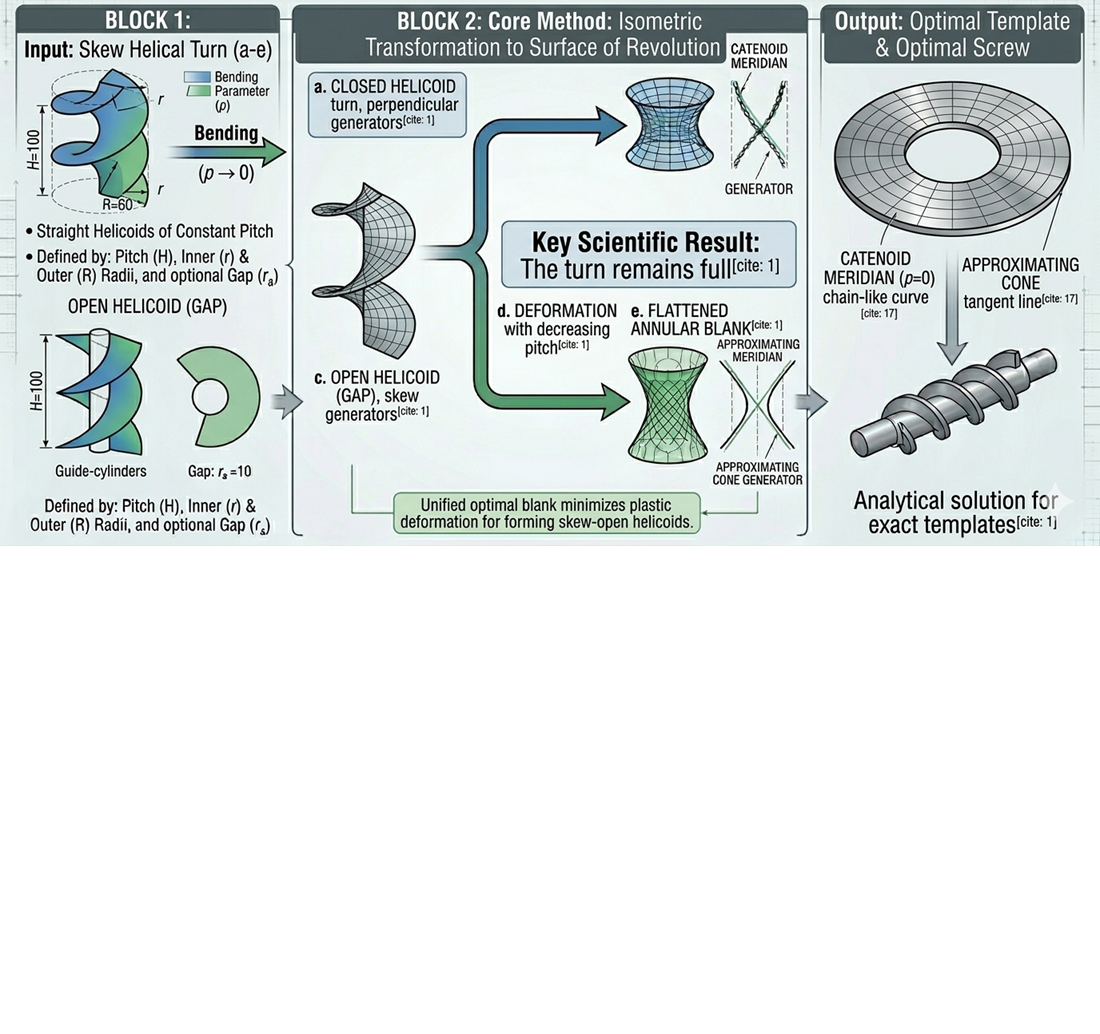
This study investigates the process of constructing approximate helicoid sweeps based on the classical theory of their continuous bending in the surface of revolution. Straight helicoids are non-sweep surfaces; therefore, a flat workpiece for fabricating them can only be an approximate sweep. Such an approximate sweep is a flat ring bounded by the inner and outer arcs of circles whose radii are tabular data. The dimensions of the ring must be such as to ensure a minimum of plastic deformations when forming them into a helicoid coil.
To find the dimensions of the ring, the classical theory of bending of non-sweep surfaces has been applied. According to the theorem of differential geometry, any helical surface can be bent into a surface of revolution. Such bending is carried out by reducing the pitch of the surface to zero: that makes it possible to visually observe the deformation of the surface. The resulting surface of revolution can be approximated by a truncated cone. The exact sweep of the truncated cone will be an approximate sweep of the helicoid turn. This approach is based not on experimental data but on theoretical approaches to the bending process. Depending on the type of helicoid, the surface of revolution can be a catenoid or a single-cavity hyperboloid of revolution. This makes it possible to choose such sections of the surface of revolution for approximation by a truncated cone where it most closely fits it. This will correspond to the minimum of plastic deformations when forming the sweep of the cone into a helicoid turn.
In this work, approximate sweeps have been constructed for straight closed and open helicoids with the same design data: surface pitch, H = 100 linear units; radii of the cylinders bounding the surface, r = 20 linear units; and R = 60 linear units. The results are attributed to a new approach to finding approximate sweeps using the theory of bending of non-sweeping surfaces
References
- Diachun, A., Gevko, I., Lyashuk, O., Stanko, A., Pik, A., Omelyanskyi, Y. (2024). Study of fiber deformation of elastic brush-like screws during grain material transportation. INMATEH Agricultural Engineering, 72 (1), 579–588. https://doi.org/10.35633/inmateh-72-51
- Minglani, D., Sharma, A., Pandey, H., Dayal, R., Joshi, J. B., Subramaniam, S. (2020). A review of granular flow in screw feeders and conveyors. Powder Technology, 366, 369–381. https://doi.org/10.1016/j.powtec.2020.02.066
- Nоvitskiy, A., Banniy, O., Novitskyi, Y., Antal, M. (2023). A study of mixer-feeder equipment operational reliability. Naukovij Žurnal «Tehnìka Ta Energetika», 14 (4), 101–110. https://doi.org/10.31548/machinery/4.2023.101
- Tarelnyk, V. B., Gaponova, O. P., Konoplianchenko, Ye. V., Martsynkovskyy, V. S., Tarelnyk, N. V., Vasylenko, O. O. (2019). Improvement of Quality of the Surface Electroerosive Alloyed Layers by the Combined Coatings and the Surface Plastic Deformation. II. The Analysis of a Stressedly-Deformed State of Surface Layer after a Surface Plastic Deformation of Electroerosive Coatings. Metallofizika I Noveishie Tekhnologii, 41 (2), 173–192. https://doi.org/10.15407/mfint.41.02.0173
- Klendii, M., Logusch, I., Dragan, A., Tsvartazkii, I., Grabar, A. (2022). Justification and calculation of design and strength parameters of screw loaders. Naukovij Žurnal «Tehnìka Ta Energetika», 13 (4). https://doi.org/10.31548/machenergy.13(4).2022.48-59
- Rogatinskiy, R., Hevko, I., Gypka, A., Garmatyk, O., Martsenko, S. (2017). Feasibility Study of the Method Choice of Manufacturing Screw Cleaning Elements with the Development and Use of Software. Acta Technologica Agriculturae, 20 (2), 36–41. https://doi.org/10.1515/ata-2017-0007
- Gómez Sánchez, M. I., González Uriel, A., García Ríos, I. (2018). Ruled Surfaces and Parametric Design. Graphic Imprints, 231–241. https://doi.org/10.1007/978-3-319-93749-6_19
- Scurtu, L. I., Bodea, S. M., Jurco, A. N., Crisan, H. G. (2017). Methods for the representation of the helicoidal surface. Journal of Industrial Design and Engineering Graphics, 12 (1). Available at: http://www.sorging.ro/jideg/index.php/jideg/article/view/148/144
- Vasylkiv, V., Pylypets, M., Danylchenko, L., Radyk, D. (2021). Research of technology of winding of the sector ring billets for production of screw flights. Perspective technologies and devices, 19, 161–168. https://doi.org/10.36910/6775-2313-5352-2021-19-26
- Zhou, L., Fang, S., Ding, K., Kawasaki, Y. (2022). An accurate calculation method of side mill profile from the coordinates of discrete points of helicoid section curve. The International Journal of Advanced Manufacturing Technology, 120 (7-8), 4849–4861. https://doi.org/10.1007/s00170-022-08932-8
- Lyashuk, O. L., Gypka, A. B., Pundys, Y. I., Gypka, V. V. (2019). Development of design and study of screw working surfaces of auger mechanisms of agricultural machines. Machinery & Energetics, 10 (4), 71–78. Available at: https://technicalscience.com.ua/uk/journals/t-10-4-2019/rozrobka-konstruktsiyi-ta-doslidzhyennya-gvintovikh-robochikh-povyerkhon-shnyekovikh-myekhanizmiv-silskogospodarskikh-mashin
- Volina, T., Pylypaka, S., Hropost, V., Kresan, T., Zabolotnii, O. (2023). Construction of a flat workpiece for manufacturing a turn of the right helicoid. Eastern-European Journal of Enterprise Technologies, 2 (1 (122)), 6–11. https://doi.org/10.15587/1729-4061.2023.275508
- Pylypaka, S., Kresan, Т., Hropost, V., Babka, V. (2022). Rolling of a developable helicoid of the screw line along its bending. Applied Geometry and Engineering Graphics, 102, 157–164. https://doi.org/10.32347/0131-579x.2022.102.157-164
- Nesvidomin, A., Pylypaka, S., Volina, T., Lokhonia, M., Borodai, Y. (2025). Forming helical blades from flat blanks with minimal deformation. Machinery Energetics, 16 (3), 9–19. https://doi.org/10.31548/machinery/3.2025.09
Downloads
Published
How to Cite
Issue
Section
License
Copyright (c) 2026 Andrii Nesvidomin, Serhii Pylypaka, Tetiana Volina, Tetiana Kresan, Oleksandr Savoiskyi, Oksana Yurchenko, Oleksandr Savchenko, Serhii Borodai, Olha Zalevska, Olena Nalobina

This work is licensed under a Creative Commons Attribution 4.0 International License.
The consolidation and conditions for the transfer of copyright (identification of authorship) is carried out in the License Agreement. In particular, the authors reserve the right to the authorship of their manuscript and transfer the first publication of this work to the journal under the terms of the Creative Commons CC BY license. At the same time, they have the right to conclude on their own additional agreements concerning the non-exclusive distribution of the work in the form in which it was published by this journal, but provided that the link to the first publication of the article in this journal is preserved.
A license agreement is a document in which the author warrants that he/she owns all copyright for the work (manuscript, article, etc.).
The authors, signing the License Agreement with TECHNOLOGY CENTER PC, have all rights to the further use of their work, provided that they link to our edition in which the work was published.
According to the terms of the License Agreement, the Publisher TECHNOLOGY CENTER PC does not take away your copyrights and receives permission from the authors to use and dissemination of the publication through the world's scientific resources (own electronic resources, scientometric databases, repositories, libraries, etc.).
In the absence of a signed License Agreement or in the absence of this agreement of identifiers allowing to identify the identity of the author, the editors have no right to work with the manuscript.
It is important to remember that there is another type of agreement between authors and publishers – when copyright is transferred from the authors to the publisher. In this case, the authors lose ownership of their work and may not use it in any way.








