Development of a mathematical model for size estimation of Java Spring web applications using regression analysis
DOI:
https://doi.org/10.15587/1729-4061.2026.363077Keywords:
size estimation, normalization, nonlinear regression, outlier, Java, Spring, softwareAbstract
This study investigates the process to estimate the size of web applications developed in Java (country of origin – USA) using the Spring framework (country of origin – USA).
The task addressed is to improve reliability in estimating the size of the corresponding web applications. Estimating the size of web applications developed in Java using the Spring framework is an important task in software engineering. This makes it possible to assess the required time frame for implementing the functionality and to plan a project budget.
As a result of the work, a mathematical model was built for estimating the size of web applications in Java and Spring based on the normalizing transformation of the decimal logarithm; a corresponding program was developed to automate calculations. Quality parameters of the constructed model are as follows: R2 = 0.9173, MMRE = 0.1511, PRED(0.25) = 0.7931.
That has made it possible to improve the reliability of estimating the size of such web applications, namely, to reduce the value of average relative error and increase the level of prediction, as well as to narrow the widths of the confidence and prediction intervals.
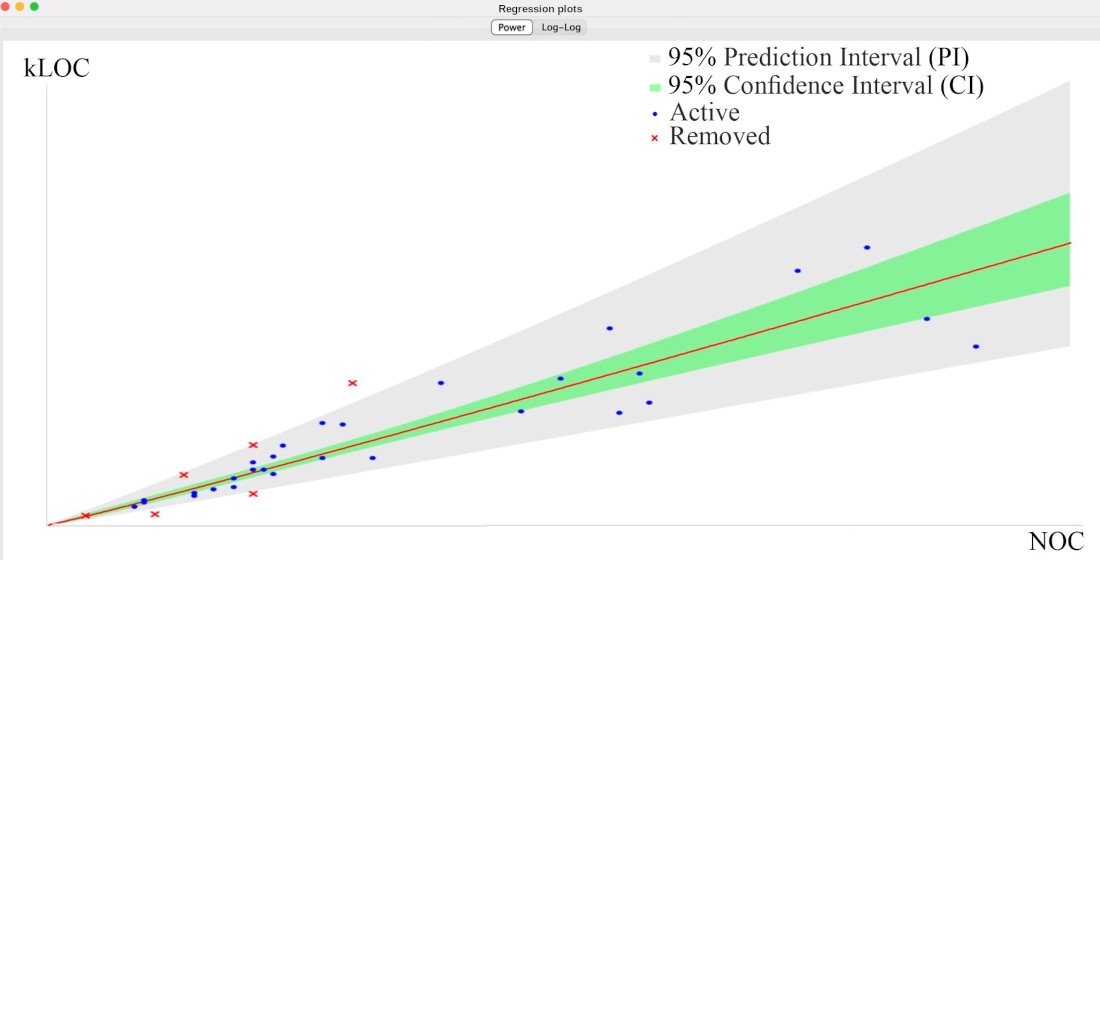
A data set consisting of 36 projects was collected; its preprocessing was performed, which included checking for multivariate normality of the distribution and normalization by logarithmization. An appropriate nonlinear regression model was constructed. To improve the reliability of the model, an algorithm was applied that includes iterative removal of outliers using the square of the Mahalanobis distance and Fisher's criterion. A program was developed based on the constructed nonlinear regression model; the results were analyzed.
Analysis of the quality of the constructed model reveals its adequacy and applicability for solving tasks of estimating the size of the corresponding software
References
- TIOBE Index. Available at: https://www.tiobe.com/tiobe-index/
- Tan, H. B. K., Zhao, Y., Zhang, H. (2009). Conceptual data model-based software size estimation for information systems. ACM Transactions on Software Engineering and Methodology, 19 (2), 1–37. https://doi.org/10.1145/1571629.1571630
- Daud, M., Afzal Malik, A. (2022). Construction and Validation of Early Software Size Estimation Models Based on ADAF-Adjusted ACD Metrics. The Computer Journal, 66 (9), 2123–2137. https://doi.org/10.1093/comjnl/bxac065
- Daud, M., Malik, A. A. (2024). Exploring the Impact of Security-Based Non-Functional Requirements on Early Software Size Estimation. Computing and Informatics, 43 (5), 1234–1255. https://doi.org/10.31577/cai_2024_5_1234
- Chatterjee, S., Hadi, A. S. (2006). Regression Analysis by Example. Wiley Series in Probability and Statistics. John Wiley & Sons, Inc. https://doi.org/10.1002/0470055464
- Oriekhov, O., Farionova, T., Chernova, L., Chernova, L., Vorona, M. (2024). Nonlinear regression models for software size estimation of Data Science and Machine Learning Java-applications. CEUR Workshop Proceedings, 3709, 54–66. Available at: https://ceur-ws.org/Vol-3709/paper5.pdf
- Prykhodko, S. B., Prykhodko, N. V., Koltsov, A. V. (2024). A Nonlinear Regression Model for Early Loc Estimation of Open-Source Kotlin-Based Applications. Radio Electronics, Computer Science, Control, 1, 85. https://doi.org/10.15588/1607-3274-2024-1-8
- Prykhodko, S., Prykhodko, A., Shutko, I. (2021). Estimating the Size of Web Apps Created Using the CakePHP Framework by Nonlinear Regression Models with Three Predictors. 2021 IEEE 16th International Conference on Computer Sciences and Information Technologies (CSIT), 333–336. https://doi.org/10.1109/csit52700.2021.9648680
- Prykhodko, S. B., Prykhodko, N. V. (2021). A modified technique for constructing nonlinear regression models based on the multivariate normalizing transformations. CEUR Workshop Proceedings, 3179, 156–166. Available at: https://ceur-ws.org/Vol-3179/Paper_15.pdf
- Makarova, L. M., Prykhodko, N. V., Kudin, O. O. (2019). Constructing the non-linear regression model for size estimation of web-applications implemented in Java. Visnyk KhNTU, 2 (69), 145–153. Available at: https://journals.kntu.net.ua/index.php/visnyk/article/view/417
- Aniche, M. Java code metrics calculator (CK). GitHub. Available at: https://github.com/mauricioaniche/ck
- Java. Oracle. Available at: https://www.oracle.com/java/technologies/
- IntelliJ IDEA. The Leading IDE for Professional Development in Java and Kotlin. Available at: https://www.jetbrains.com/idea/
- Alasadi, S. A., Bhaya, W. S. (2017). Review of data preprocessing techniques in data mining. Journal of Engineering and Applied Sciences, 12 (16), 4102–4107. Available at: https://www.researchgate.net/publication/319990923_Review_of_Data_Preprocessing_Techniques_in_Data_Mining
- Mardia, K. V. (1970). Measures of multivariate skewness and kurtosis with applications. Biometrika, 57 (3), 519–530. https://doi.org/10.1093/biomet/57.3.519
- Mardia, K. V., Kent, J. T., Taylor, C. C. (2024). Multivariate Analysis. John Wiley & Sons, 592. Available at: https://www.wiley.com/Multivariate+Analysis%2C+2nd+Edition-p-9781118738023
- Prykhodko, S., Prykhodko, N., Makarova, L. (2018). Estimating the software size of open-source PHP-based systems using non-linear regression analysis. CEUR Workshop Proceedings, 2300, 199–202. Available at: https://ceur-ws.org/Vol-2300/Paper48.pdf
- Prykhodko, S., Prykhodko, N., Makarova, L., Pukhalevych, A. (2018). Application of the squared mahalanobis distance for detecting outliers in multivariate non-Gaussian data. 2018 14th International Conference on Advanced Trends in Radioelecrtronics, Telecommunications and Computer Engineering (TCSET), 962–965. https://doi.org/10.1109/tcset.2018.8336353
- Larose, D. T., Larose, C. D. (2015). Data Mining and Predictive Analytics. John Wiley & Sons, 824. Available at: https://lmsspada.kemdiktisaintek.go.id/pluginfile.php/749864/mod_resource/content/4/Data%20Mining%20and%20Predictive%20Analytics.pdf
- GitHub. Available at: https://github.com/
- Oriekhov, O., Farionova, T., Chernova, L. (2024). Three-factor nonlinear regression model of estimating the size of Java-software. CEUR Workshop Proceedings, 3790, 506–518. Available at: https://ceur-ws.org/Vol-3790/paper44.pdf
Downloads
Published
How to Cite
Issue
Section
License
Copyright (c) 2026 Lidiia Makarova, Liudmyla Latanska, Andrii Pukhalevych, Vladimir Kairov, Maksym Dzhurynksyi

This work is licensed under a Creative Commons Attribution 4.0 International License.
The consolidation and conditions for the transfer of copyright (identification of authorship) is carried out in the License Agreement. In particular, the authors reserve the right to the authorship of their manuscript and transfer the first publication of this work to the journal under the terms of the Creative Commons CC BY license. At the same time, they have the right to conclude on their own additional agreements concerning the non-exclusive distribution of the work in the form in which it was published by this journal, but provided that the link to the first publication of the article in this journal is preserved.
A license agreement is a document in which the author warrants that he/she owns all copyright for the work (manuscript, article, etc.).
The authors, signing the License Agreement with TECHNOLOGY CENTER PC, have all rights to the further use of their work, provided that they link to our edition in which the work was published.
According to the terms of the License Agreement, the Publisher TECHNOLOGY CENTER PC does not take away your copyrights and receives permission from the authors to use and dissemination of the publication through the world's scientific resources (own electronic resources, scientometric databases, repositories, libraries, etc.).
In the absence of a signed License Agreement or in the absence of this agreement of identifiers allowing to identify the identity of the author, the editors have no right to work with the manuscript.
It is important to remember that there is another type of agreement between authors and publishers – when copyright is transferred from the authors to the publisher. In this case, the authors lose ownership of their work and may not use it in any way.








