Evaluation of edge-based data stream processing scenarios in industrial automation systems: data reduction, latency, and resource utilization
DOI:
https://doi.org/10.15587/1729-4061.2026.363630Keywords:
process data, stream processing, edge processing, SCADA system, stream reductionAbstract
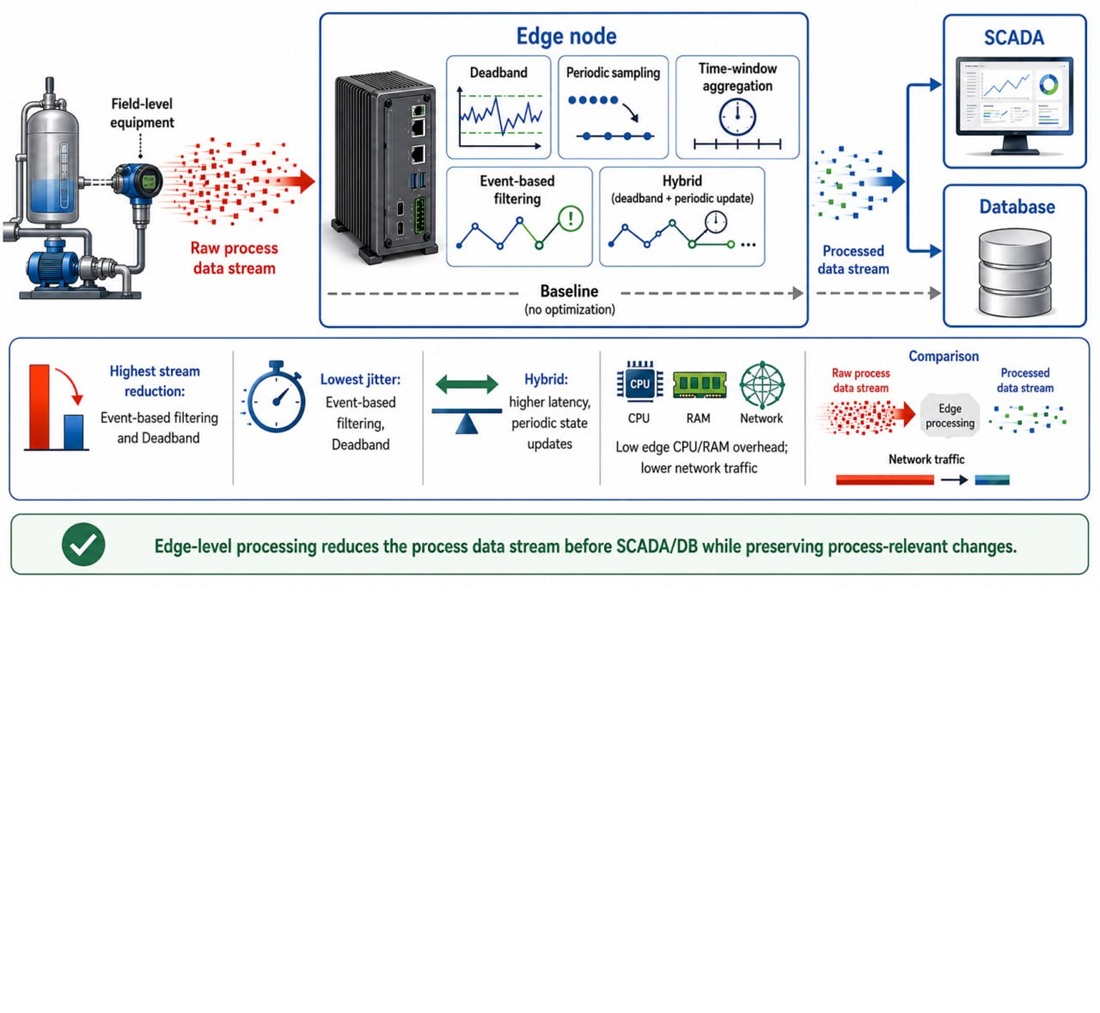
This study explores the stream of process measurements after processing at the edge node in the chain “field-level equipment → edge node → SCADA → database”. The task addressed relates to the insufficient quantitative assessment of the impact of processing scenarios at the edge level on the stream intensity, time characteristics, and load of system nodes.
This paper considers an edge-based approach to the stream processing of process data from industrial automation systems. 5 scenarios for processing the stream of process data at the edge node have been considered. A comparative analysis was performed by the number of records after processing, end-to-end latency, reduction ratio, jitter, and resource load. To that end, a bench was implemented that reproduces data transmission from field-level equipment through an edge node to the SCADA system and database. The basic mode without optimization, filtering by the change threshold, periodic selection, aggregation in a time window, event filtering, and a hybrid scheme were investigated.
All edge processing scenarios reduced the stream intensity compared to the baseline. The largest reduction was provided by EV and DB: 0.976 and 0.962. For most scenarios, the end-to-end latency was 71.064–81.197 ms, for HYB – 112.457 ms. The lowest jitter was obtained for EV – 25.98 ms and DB – 38.521 ms. This is explained by the fact that event and threshold selection cut off background signal changes. Preprocessing reduces the network load without a noticeable increase in the load of the edge node. This makes it possible to consider processing at the edge node as a means of data reduction and formation of a controlled stream for the SCADA system and database.
The practical significance implies using the results for comparative selection of processing scenarios for process data taking into account network traffic, latency stability, as well as edge node resources
References
- Wang, S., Wan, J., Zhang, D., Li, D., Zhang, C. (2016). Towards smart factory for industry 4.0: a self-organized multi-agent system with big data based feedback and coordination. Computer Networks, 101, 158–168. https://doi.org/10.1016/j.comnet.2015.12.017
- Farooq, M. S., Abdullah, M., Riaz, S., Alvi, A., Rustam, F., Flores, M. A. L. et al. (2023). A Survey on the Role of Industrial IoT in Manufacturing for Implementation of Smart Industry. Sensors, 23 (21), 8958. https://doi.org/10.3390/s23218958
- Fragkoulis, M., Carbone, P., Kalavri, V., Katsifodimos, A. (2023). A survey on the evolution of stream processing systems. The VLDB Journal, 33 (2), 507–541. https://doi.org/10.1007/s00778-023-00819-8
- Vikash, Mishra, L., Varma, S. (2020). Performance evaluation of real-time stream processing systems for Internet of Things applications. Future Generation Computer Systems, 113, 207–217. https://doi.org/10.1016/j.future.2020.07.012
- Kammerer, K., Pryss, R., Hoppenstedt, B., Sommer, K., Reichert, M. (2020). Process-Driven and Flow-Based Processing of Industrial Sensor Data. Sensors, 20 (18), 5245. https://doi.org/10.3390/s20185245
- Kumar, R., Agrawal, N. (2023). Analysis of multi-dimensional Industrial IoT (IIoT) data in Edge–Fog–Cloud based architectural frameworks: A survey on current state and research challenges. Journal of Industrial Information Integration, 35, 100504. https://doi.org/10.1016/j.jii.2023.100504
- Qiu, T., Chi, J., Zhou, X., Ning, Z., Atiquzzaman, M., Wu, D. O. (2020). Edge Computing in Industrial Internet of Things: Architecture, Advances and Challenges. IEEE Communications Surveys & Tutorials, 22 (4), 2462–2488. https://doi.org/10.1109/comst.2020.3009103
- Xhafa, F., Kilic, B., Krause, P. (2020). Evaluation of IoT stream processing at edge computing layer for semantic data enrichment. Future Generation Computer Systems, 105, 730–736. https://doi.org/10.1016/j.future.2019.12.031
- Sarasola, T. F. D. B., García, A., Ferrando, J. L. (2024). IIoT Protocols for Edge/Fog and Cloud Computing in Industrial AI. International Journal of Cloud Applications and Computing, 14 (1), 1–30. https://doi.org/10.4018/ijcac.342128
- Lu, D., Wang, K., Wang, Y., Shen, Y. (2025). The Proposal and Validation of a Distributed Real-Time Data Management Framework Based on Edge Computing with OPC Unified Architecture and Kafka. Applied Sciences, 15 (12), 6862. https://doi.org/10.3390/app15126862
- Krasnikov, I., Hallyamov, K. (2026). Theoretical Foundations of Streaming Processing of Technological Data in Industrial Automation Systems. Bulletin of the National Technical University “KhPI” A Series of “Information and Modeling”, 1 (1 (15)), 69–82. https://doi.org/10.20998/2411-0558.2026.01.04
Downloads
Published
How to Cite
Issue
Section
License
Copyright (c) 2026 Igor Krasnikov, Kyrylo Halliamov, Ihor Lysachenko

This work is licensed under a Creative Commons Attribution 4.0 International License.
The consolidation and conditions for the transfer of copyright (identification of authorship) is carried out in the License Agreement. In particular, the authors reserve the right to the authorship of their manuscript and transfer the first publication of this work to the journal under the terms of the Creative Commons CC BY license. At the same time, they have the right to conclude on their own additional agreements concerning the non-exclusive distribution of the work in the form in which it was published by this journal, but provided that the link to the first publication of the article in this journal is preserved.
A license agreement is a document in which the author warrants that he/she owns all copyright for the work (manuscript, article, etc.).
The authors, signing the License Agreement with TECHNOLOGY CENTER PC, have all rights to the further use of their work, provided that they link to our edition in which the work was published.
According to the terms of the License Agreement, the Publisher TECHNOLOGY CENTER PC does not take away your copyrights and receives permission from the authors to use and dissemination of the publication through the world's scientific resources (own electronic resources, scientometric databases, repositories, libraries, etc.).
In the absence of a signed License Agreement or in the absence of this agreement of identifiers allowing to identify the identity of the author, the editors have no right to work with the manuscript.
It is important to remember that there is another type of agreement between authors and publishers – when copyright is transferred from the authors to the publisher. In this case, the authors lose ownership of their work and may not use it in any way.








