Development of entropy technologies for analysis and optimization of energy efficiency of technological systems
DOI:
https://doi.org/10.15587/1729-4061.2026.363631Keywords:
energy efficiency, thermodynamic analysis, entropy, entropic analysis technologies, sustainabilityAbstract
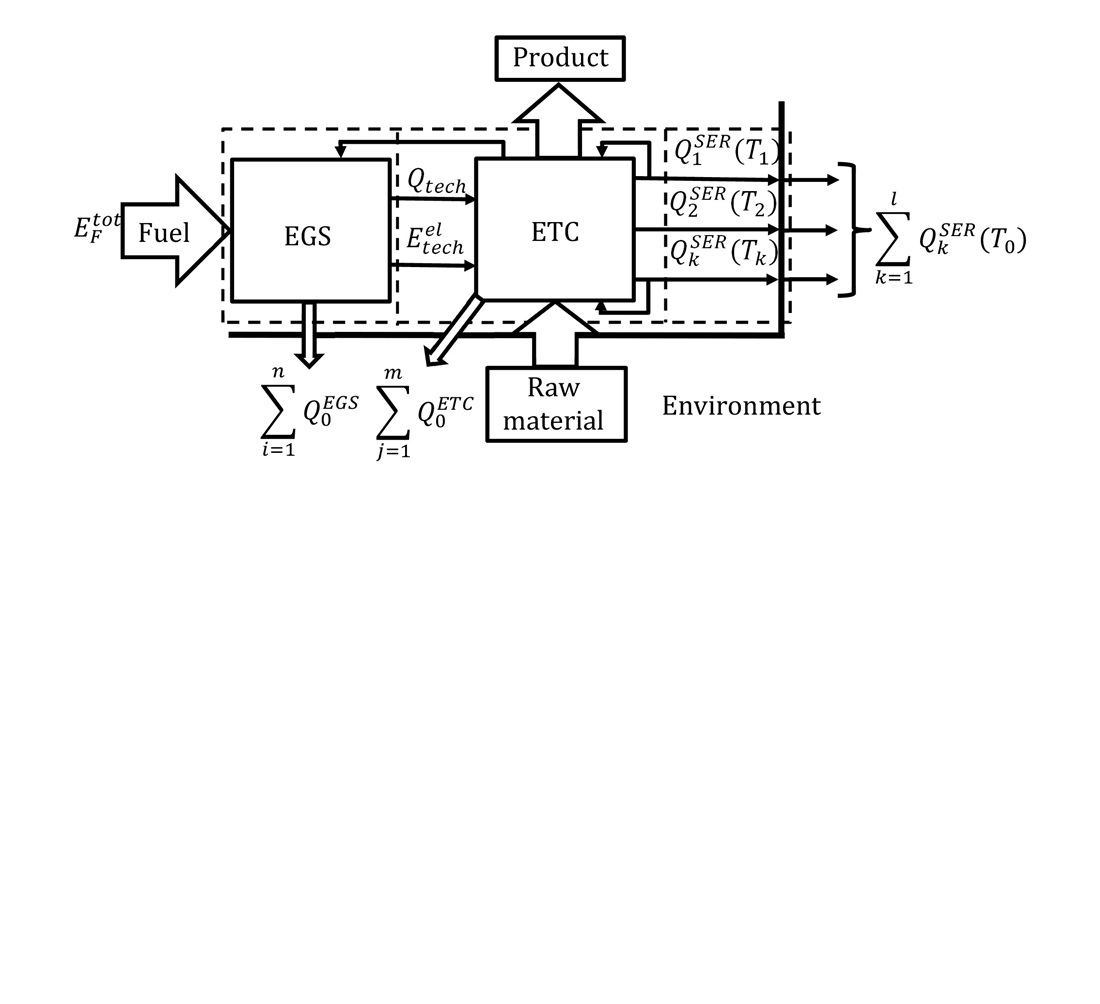
The object of the study is the energy efficiency of technological systems and complexes of enterprises. The study solved the problem of scientifically based technologies for system analysis and optimization of energy efficiency of multi-purpose systems. It is proved that the traditional definition of energy efficiency fails to identify the fundamental causes of inefficiency and assess the energy efficiency potential of the system. The use of exergy technologies is effective for optimizing heat engines, but for heat technology systems it gives rise to methodological contradictions.
The presented entropic technologies for analyzing and optimizing energy efficiency do not have the indicated disadvantages. By combining entropic characteristics with energy characteristics, the “principle of energy compensation of irreversibility” was formulated, which is the basis of the analysis methodology.
The results of the applied analysis of sugar production, which has an energy generation system and an energy technological complex of complicated configuration, showed the effectiveness of this technology. It was determined that compensation only for the internal irreversibility of the processes of the energy generating system consumes about 55% of the primary energy resource, which can change the classical concept of energy efficiency measures.
The results obtained were made possible by establishing the dependence between the irreversibility of processes, entropy and compensatory energy costs. This allowed to approach the idea of energy efficiency in a new way, prioritizing the qualitative characteristics of processes and focusing on the thermodynamic perfection of systems.
The proposed entropic technologies can be the basis for the formation of a comprehensive energy optimization strategy that has both economic and environmental effects, contributing to compliance with international standards of sustainable development
References
- Jan, B., Asif, M., Qannan, M. (2026). Energy efficiency and energy conservation: An analysis of global research trends, disparities, and future directions. Energy Nexus, 22, 100693. https://doi.org/10.1016/j.nexus.2026.100693
- Nimesh, A. K., Srinivas, T. (2026). Energy Analysis of Organic Rankine Ejector Cooling Cogeneration Systems. Process Integration and Optimization for Sustainability. https://doi.org/10.1007/s41660-026-00749-2
- Elhelw, M., Al Dahma, K. S., Attia, A. e. H. (2019). Utilizing exergy analysis in studying the performance of steam power plant at two different operation mode. Applied Thermal Engineering, 150, 285–293. https://doi.org/10.1016/j.applthermaleng.2019.01.003
- Zhang, Q., Yi, H., Yu, Z., Gao, J., Wang, X., Lin, H., Shen, B. (2018). Energy-exergy analysis and energy efficiency improvement of coal-fired industrial boilers based on thermal test data. Applied Thermal Engineering, 144, 614–627. https://doi.org/10.1016/j.applthermaleng.2018.08.069
- Menberg, K., Heo, Y., Choi, W., Ooka, R., Choudhary, R., Shukuya, M. (2017). Exergy analysis of a hybrid ground-source heat pump system. Applied Energy, 204, 31–46. https://doi.org/10.1016/j.apenergy.2017.06.076
- Karellas, S., Braimakis, K. (2016). Energy–exergy analysis and economic investigation of a cogeneration and trigeneration ORC–VCC hybrid system utilizing biomass fuel and solar power. Energy Conversion and Management, 107, 103–113. https://doi.org/10.1016/j.enconman.2015.06.080
- Wu, J., Wang, J., Wu, J., Ma, C. (2019). Exergy and Exergoeconomic Analysis of a Combined Cooling, Heating, and Power System Based on Solar Thermal Biomass Gasification. Energies, 12 (12), 2418. https://doi.org/10.3390/en12122418
- Ahmadi, G., Toghraie, D., Akbari, O. (2019). Energy, exergy and environmental (3E) analysis of the existing CHP system in a petrochemical plant. Renewable and Sustainable Energy Reviews, 99, 234–242. https://doi.org/10.1016/j.rser.2018.10.009
- Vazini Modabber, H., Khoshgoftar Manesh, M. H. (2021). Optimal exergetic, exergoeconomic and exergoenvironmental design of polygeneration system based on gas Turbine-Absorption Chiller-Solar parabolic trough collector units integrated with multi-effect desalination-thermal vapor compressor- reverse osmosis desalination systems. Renewable Energy, 165, 533–552. https://doi.org/10.1016/j.renene.2020.11.001
- Zhao, B. (2024). Entropy transfer efficiency-effectiveness method for heat exchangers, part 1: Local entropy generation number and operation performance limits. Energy, 304, 132133. https://doi.org/10.1016/j.energy.2024.132133
- Ghazi, H., Emami, M. R. S., Seif, M., Pirzaman, A. K. (2025). Thermodynamic analysis of entropy generation in thermosyphon heat pipes using Al2O3 nanofluid and distilled water. Journal of Thermal Analysis and Calorimetry, 150 (19), 15805–15816. https://doi.org/10.1007/s10973-025-14846-w
- Shende, A., Mishra, S. K., Tripure, A., Ghritlahre, H. K. (2025). Heat Transfer and Entropy Generation Analysis of an Artificially Roughened Solar Air Heater With a Rib-Fin Profile Absorber. Journal of Solar Energy Engineering, 147 (6). https://doi.org/10.1115/1.4069862
- Vasilenko, S., Samiilenko, S., Bondar, Vоlоdymyr, Bilyk, O. (2020). Complex thermodynamic analysis of the heat-technological complex of sugar production: analysis method. Technology Audit and Production Reserves, 2 (1 (52)), 4–11. https://doi.org/10.15587/2706-5448.2020.202026
- Vasilenko, S., Samiilenko, S., Bondar, Vоlоdymyr, Bilyk, O., Mokretskyy, V., Przybylski, W. (2020). Thermodynamic analysis of the thermal-technological complex of sugar production: the energy and entropy characteristics of an enterprise. Eastern-European Journal of Enterprise Technologies, 3 (8 (105)), 24–31. https://doi.org/10.15587/1729-4061.2020.205148
Downloads
Published
How to Cite
Issue
Section
License
Copyright (c) 2026 Sergii Samiilenko, Roman Hryshchenko, Maksym Kryvosheiev

This work is licensed under a Creative Commons Attribution 4.0 International License.
The consolidation and conditions for the transfer of copyright (identification of authorship) is carried out in the License Agreement. In particular, the authors reserve the right to the authorship of their manuscript and transfer the first publication of this work to the journal under the terms of the Creative Commons CC BY license. At the same time, they have the right to conclude on their own additional agreements concerning the non-exclusive distribution of the work in the form in which it was published by this journal, but provided that the link to the first publication of the article in this journal is preserved.
A license agreement is a document in which the author warrants that he/she owns all copyright for the work (manuscript, article, etc.).
The authors, signing the License Agreement with TECHNOLOGY CENTER PC, have all rights to the further use of their work, provided that they link to our edition in which the work was published.
According to the terms of the License Agreement, the Publisher TECHNOLOGY CENTER PC does not take away your copyrights and receives permission from the authors to use and dissemination of the publication through the world's scientific resources (own electronic resources, scientometric databases, repositories, libraries, etc.).
In the absence of a signed License Agreement or in the absence of this agreement of identifiers allowing to identify the identity of the author, the editors have no right to work with the manuscript.
It is important to remember that there is another type of agreement between authors and publishers – when copyright is transferred from the authors to the publisher. In this case, the authors lose ownership of their work and may not use it in any way.








