Development of a two-layer agentic architecture for automated generation and validation of wagon user interface schemas using multimodal large language models
DOI:
https://doi.org/10.15587/1729-4061.2026.363741Keywords:
ticketing automation, reasoning-execution separation, production validation, computer vision, serverless deploymentAbstract
The object of the study is automated generation and validation of wagon interface schemas in railway ticket booking systems. Manual updating of one configuration takes approximately 24 hours. It depends on software releases, requires engineer involvement, and increases the risk of production errors.
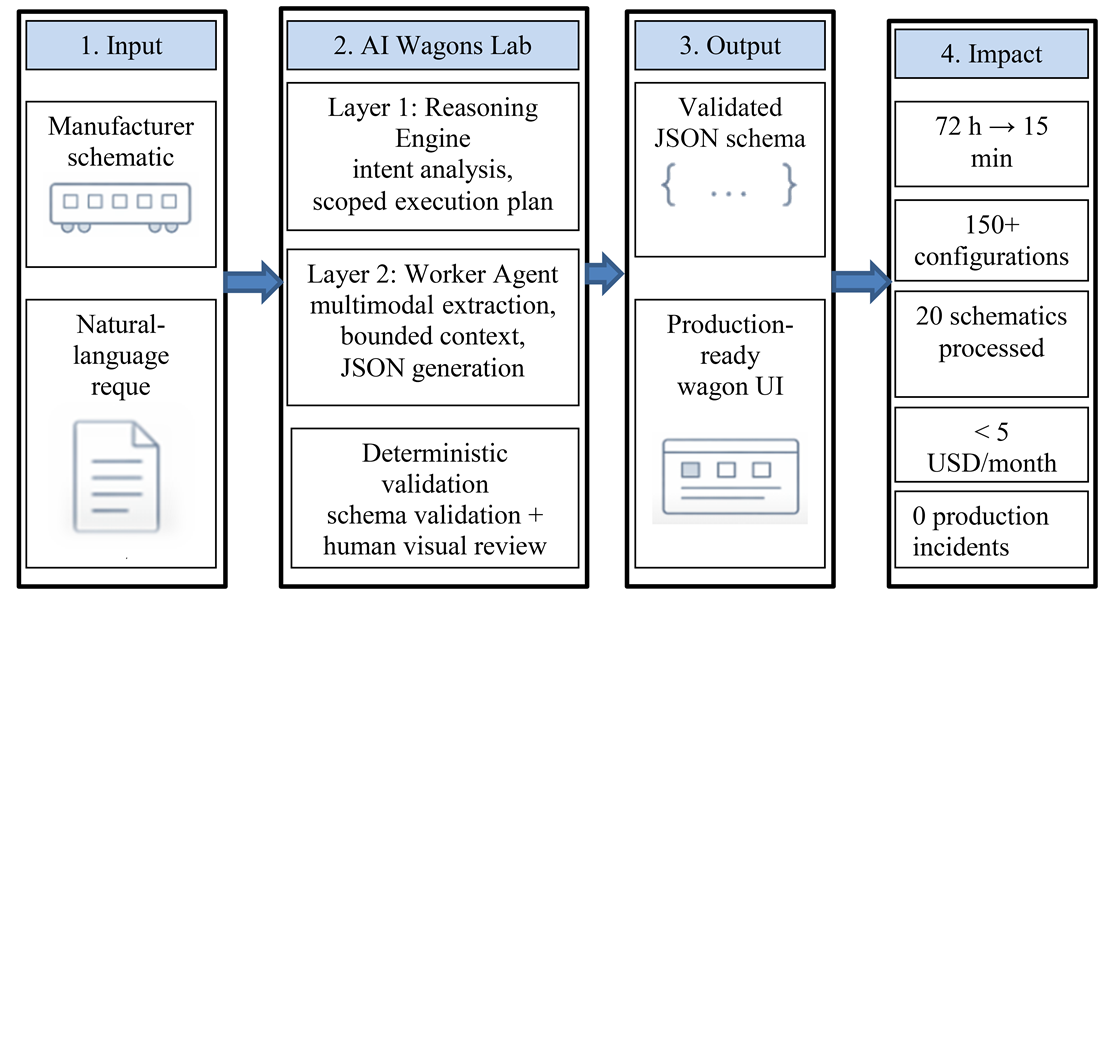
A two-layer agentic architecture is proposed. It includes separation of reasoning and execution, multimodal conversion of schematics into structured configurations, and deterministic validation. The architecture was tested on the Ukrzaliznytsia platform. The platform supports more than 150 wagon configurations and serves over 20 million passengers per year.
Twenty production schematics of different wagon classes were processed. One schematic required manual correction. The others were refined through one or two additional prompts. The time required to create a new wagon type decreased from approximately 24 hours to 15 minutes. This corresponds to an approximately 99% reduction. Monthly engineering involvement was largely replaced by a serverless workflow with infrastructure costs of less than 5 USD per month. No incidents caused by model hallucinations were recorded.
The solution supports more than 150 configurations without loading all schemas into a single context. It enables non-technical administrators to update configurations outside release cycles and reduces dependence on engineering teams. The approach integrates mandatory pre-deployment validation into the configuration creation process. Structure, format, and correctness remain subject to formal control. This reduces manual engineering work without changes to the core application code. The approach is applicable to railway ticketing and related systems where physical objects are represented as digital interface schemas
References
- Dpty PM Kuleba announces record transportation of Ukrzaliznytsia in 2024. Interfax-Ukraine. Available at: https://en.interfax.com.ua/news/economic/1034288.html
- According to the results of 2024, 86% of railway tickets were purchased online (2025). Ukrzaliznytsia. Available at: https://t.me/UkrzalInfo/6461
- Berrios Villalba, A. (2020). How to Speed Up Digitization in the Railway [Viewpoint]. IEEE Electrification Magazine, 8 (1), 76–75. https://doi.org/10.1109/mele.2019.2962895
- Cecchetti, G., Lina, A., Ruscelli, Ulianov, C., Hyde, P., Liu, J. et al. (2023). Toward new generation railway Traffic Management Systems: the contribution of the OPTIMA project. Transportation Research Procedia, 72, 3166–3173. https://doi.org/10.1016/j.trpro.2023.11.882
- Bezuidenhout, M., Jooste, J. L., Lucke, D., Fourie, C. J. (2023). Leveraging digitilisation and machine learning for improved railway operations and maintenance. Procedia CIRP, 120, 702–707. https://doi.org/10.1016/j.procir.2023.09.062
- Jiang, J., Wang, F., Shen, J., Kim, S., Kim, S. (2026). A Survey on Large Language Models for Code Generation. ACM Transactions on Software Engineering and Methodology, 35 (2), 1–72. https://doi.org/10.1145/3747588
- Chen, M., Tworek, J., Jun, H., Yuan, Q., Pinto, H. P. d. O., Kaplan, J. et al. (2021). Evaluating large language models trained on code. arXiv. https://doi.org/10.48550/arXiv.2107.03374
- Anil, R., Borgeaud, S., Alayrac, J.-B., Yu, J., Soricut, R., Schalkwyk, J. et al. (2023). Gemini: a family of highly capable multimodal models. arXiv. https://doi.org/10.48550/arXiv.2312.11805
- Georgiev, P., Lei, V. I., Burnell, R., Bai, L., Gulati, A., Tanzer, G. et al. (2024). Gemini 1.5: unlocking multimodal understanding across millions of tokens of context. arXiv. https://doi.org/10.48550/arXiv.2403.05530
- Pasichnyk, V., Horlatch, V. (2025). Automated extraction of key parameters and detection of inconsistencies in clinical documentation using large language models. Eastern-European Journal of Enterprise Technologies, 6 (2 (138)), 6–14. https://doi.org/10.15587/1729-4061.2025.337915
- Zhuravchak, A., Piskozub, A., Skorynovych, B., Lakh, Y., Zhuravchak, D., Hlushchenko, P. et al. (2025). Design and development of a large language model-based tool for vulnerability detection. Eastern-European Journal of Enterprise Technologies, 2 (2 (134)), 75–83. https://doi.org/10.15587/1729-4061.2025.325251
- Sarp, S., Kuzlu, M., Jovanovic, V., Polat, Z., Guler, O. (2024). Digitalization of railway transportation through AI-powered services: digital twin trains. European Transport Research Review, 16 (1). https://doi.org/10.1186/s12544-024-00679-5
- De Donato, L., Dirnfeld, R., Somma, A., De Benedictis, A., Flammini, F., Marrone, S. et al. (2023). Towards AI-assisted digital twins for smart railways: preliminary guideline and reference architecture. Journal of Reliable Intelligent Environments, 9 (3), 303–317. https://doi.org/10.1007/s40860-023-00208-6
- Dirnfeld, R., De Donato, L., Somma, A., Azari, M. S., Marrone, S., Flammini, F., Vittorini, V. (2024). Integrating AI and DTs: challenges and opportunities in railway maintenance application and beyond. Simulation, 100 (9), 903–917. https://doi.org/10.1177/00375497241229756
- Bobyl, V., Matusevych, O., Dron, M., Taranenko, A. (2024). The concept of forming a system of change management in the domain of railroad passenger transportation in Ukraine under the conditions of war. Eastern-European Journal of Enterprise Technologies, 1 (13 (127)), 14–21. https://doi.org/10.15587/1729-4061.2024.297067
- Thompson, E. A., Lu, P., Alimo, P. K., Atuobi, H. B., Akoto, E. T., Abbew, C. K. (2025). Revolutionizing railway systems: A systematic review of digital twin technologies. High-Speed Railway, 3 (3), 238–250. https://doi.org/10.1016/j.hspr.2025.05.005
- Zhao, W. X., Zhou, K., Li, J., Tang, T., Dong, Z., Hou, Y. et al. (2026). A Survey of Large Language Models. Frontiers of Computer Science, 20 (12). https://doi.org/10.1007/s11704-026-60308-3
- Lee, K., Joshi, M., Turc, I., Hu, H., Liu, F., Eisenschlos, J. et al. (2023). Pix2Struct: screenshot parsing as pretraining for visual language understanding. Proceedings of the 40th International Conference on Machine Learning (ICML), PMLR 202. Available at: https://proceedings.mlr.press/v202/lee23g.html
- Dong, Y., Jiang, X., Qian, J., Wang, T., Zhang, K., Jin, Z., Li, G. (2025). A survey on code generation with LLM-based agents. arXiv. https://doi.org/10.48550/arXiv.2508.00083
- Wang, L., Ma, C., Feng, X., Zhang, Z., Yang, H., Zhang, J. et al. (2024). A survey on large language model based autonomous agents. Frontiers of Computer Science, 18 (6). https://doi.org/10.1007/s11704-024-40231-1
- Bosma, M., Chi, E., Ichter, B., Le, Q. V., Schuurmans, D., Wang, X. et al. (2022). Chain-Of-Thought Prompting Elicits Reasoning in Large Language Models. Advances in Neural Information Processing Systems 35, 24824–24837. https://doi.org/10.52202/068431-1800
- Brown, T. B., Mann, B., Ryder, N., Subbiah, M., Kaplan, J., Dhariwal, P. et al. (2020). Language models are few-shot learners. Advances in Neural Information Processing Systems, 33, 1877–1901. https://doi.org/10.48550/arXiv.2005.14165
- Lewis, P., Perez, E., Piktus, A., Petroni, F., Karpukhin, V., Goyal, N. et al. (2020). Retrieval-augmented generation for knowledge-intensive NLP tasks. Advances in Neural Information Processing Systems, 33, 9459–9474. https://doi.org/10.48550/arXiv.2005.11401
- Ji, Z., Lee, N., Frieske, R., Yu, T., Su, D., Xu, Y. et al. (2023). Survey of Hallucination in Natural Language Generation. ACM Computing Surveys, 55 (12), 1–38. https://doi.org/10.1145/3571730
- Tonmoy, S. M. T. I., Zaman, S. M. M., Jain, V., Rani, A., Rawte, V., Chadha, A., Das, A. (2024). A comprehensive survey of hallucination mitigation techniques in large language models. arXiv. https://doi.org/10.48550/arXiv.2401.01313
- Manakul, P., Liusie, A., Gales, M. (2023). SelfCheckGPT: Zero-Resource Black-Box Hallucination Detection for Generative Large Language Models. Proceedings of the 2023 Conference on Empirical Methods in Natural Language Processing, 9004–9017. https://doi.org/10.18653/v1/2023.emnlp-main.557
- Cancedda, N., Dessi, R., Dwivedi-Yu, J., Hambro, E., Lomeli, M., Raileanu, R. et al. (2023). Toolformer: Language Models Can Teach Themselves to Use Tools. Advances in Neural Information Processing Systems 36, 68539–68551. https://doi.org/10.52202/075280-2997
- Jonas, E., Schleier-Smith, J., Sreekanti, V., Tsai, C.-C., Khandelwal, A., Pu, Q. et al. (2019). Cloud programming simplified: a Berkeley view on serverless computing. Technical Report No. UCB/EECS-2019-3. Berkeley: EECS Department, University of California. Available at: https://www2.eecs.berkeley.edu/Pubs/TechRpts/2019/EECS-2019-3.html
- Shahrad, M., Fonseca, R., Goiri, Í., Chaudhry, G., Batum, P., Cooke, J. et al. (2020). Serverless in the wild: characterizing and optimizing the serverless workload at a large cloud provider. 2020 USENIX Annual Technical Conference (USENIX ATC 20), 205–218. Available at: https://www.usenix.org/conference/atc20/presentation/shahrad
- Baldini, I., Castro, P., Chang, K., Cheng, P., Fink, S., Ishakian, V. et al. (2017). Serverless Computing: Current Trends and Open Problems. Research Advances in Cloud Computing, 1–20. https://doi.org/10.1007/978-981-10-5026-8_1
Downloads
Published
How to Cite
Issue
Section
License
Copyright (c) 2026 Ivan Dobrovolskyi

This work is licensed under a Creative Commons Attribution 4.0 International License.
The consolidation and conditions for the transfer of copyright (identification of authorship) is carried out in the License Agreement. In particular, the authors reserve the right to the authorship of their manuscript and transfer the first publication of this work to the journal under the terms of the Creative Commons CC BY license. At the same time, they have the right to conclude on their own additional agreements concerning the non-exclusive distribution of the work in the form in which it was published by this journal, but provided that the link to the first publication of the article in this journal is preserved.
A license agreement is a document in which the author warrants that he/she owns all copyright for the work (manuscript, article, etc.).
The authors, signing the License Agreement with TECHNOLOGY CENTER PC, have all rights to the further use of their work, provided that they link to our edition in which the work was published.
According to the terms of the License Agreement, the Publisher TECHNOLOGY CENTER PC does not take away your copyrights and receives permission from the authors to use and dissemination of the publication through the world's scientific resources (own electronic resources, scientometric databases, repositories, libraries, etc.).
In the absence of a signed License Agreement or in the absence of this agreement of identifiers allowing to identify the identity of the author, the editors have no right to work with the manuscript.
It is important to remember that there is another type of agreement between authors and publishers – when copyright is transferred from the authors to the publisher. In this case, the authors lose ownership of their work and may not use it in any way.








