Identifying digitalization’s impact on how energy sector companies perform environmentally and financially
DOI:
https://doi.org/10.15587/1729-4061.2026.364001Keywords:
carbon intensity, digitalization, fixed effects, energy logistics, the Republic of KazakhstanAbstract
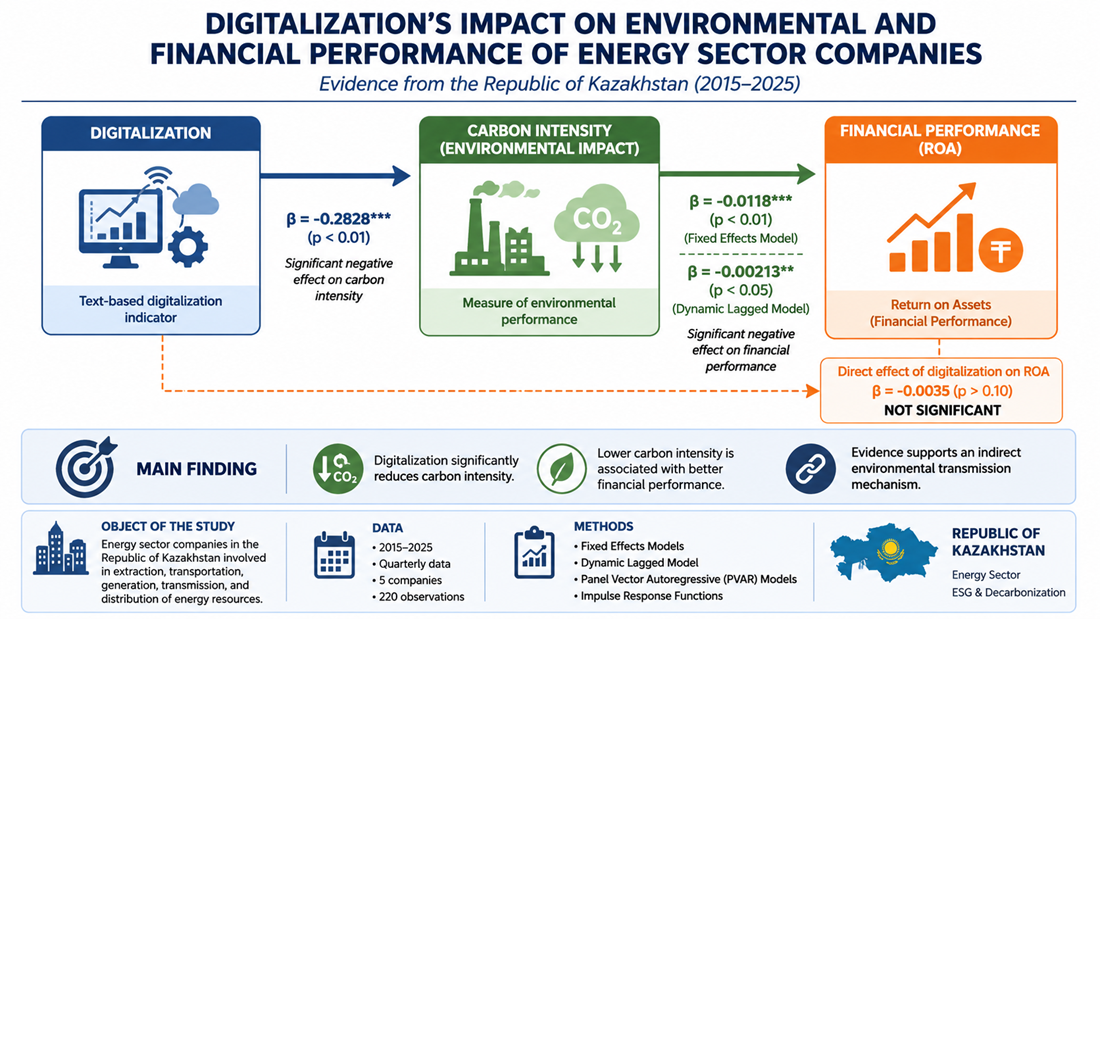
The object of the study is energy sector companies in the Republic of Kazakhstan involved in the extraction, transportation, generation, transmission, and distribution of energy resources. The problem addressed is the insufficient understanding of the mechanism through which digitalization affects financial performance, since it remains unclear whether this effect is direct or transmitted through environmental performance indicators.
The empirical basis of the study is a balanced quarterly panel dataset for 2015–2025, comprising 220 observations across five companies. Fixed-effects models, a dynamic lagged model, panel vector autoregressive models, and impulse response functions were used in the study.
The results show that digitalization has a statistically significant negative effect on carbon intensity in the fixed-effects model (β = −0.2828; p < 0.01), whereas its direct effect on return on assets is not statistically confirmed (β = −0.0035; p > 0.10). Carbon intensity has a significant negative effect on financial performance in both the static fixed-effects model (β = −0.0118; p < 0.01) and the dynamic lagged model (β = −0.00213; p < 0.05). These findings provide indirect empirical support for a possible environmental transmission channel, in which digitalization is associated with a lower environmental burden that may subsequently contribute to financial performance.
The study uses quarterly corporate data, a text-based digitalization indicator, and carbon intensity as a measure of environmental performance, allowing an indirect assessment of a possible environmental transmission mechanism.
The results can be used by energy companies, regulators, and investors when developing digital transformation and decarbonization strategies and making ESG-related investment decisions
References
- Nazari, Z., Musilek, P. (2023). Impact of Digital Transformation on the Energy Sector: A Review. Algorithms, 16 (4), 211. https://doi.org/10.3390/a16040211
- Borowski, P. (2021). Digitization, Digital Twins, Blockchain, and Industry 4.0 as Elements of Management Process in Enterprises in the Energy Sector. Energies, 14 (7), 1885. https://doi.org/10.3390/en14071885
- Burritt, R., Christ, K. (2016). Industry 4.0 and environmental accounting: a new revolution? Asian Journal of Sustainability and Social Responsibility, 1 (1), 23–38. https://doi.org/10.1186/s41180-016-0007-y
- Ricci, F., Scafarto, V., Ferri, S., Tron, A. (2020). Value relevance of digitalization: The moderating role of corporate sustainability. An empirical study of Italian listed companies. Journal of Cleaner Production, 276, 123282. https://doi.org/10.1016/j.jclepro.2020.123282
- Șerban, R.-A. (2017). The Impact of Big Data, Sustainability, and Digitalization on Company Performance. Studies in Business and Economics, 12 (3), 181–189. https://doi.org/10.1515/sbe-2017-0045
- Ahmad, M. U., Murray, J. (2019). Understanding the connect between digitalisation, sustainability and performance of an organisation. International Journal of Business Excellence, 17 (1), 83. https://doi.org/10.1504/ijbex.2019.096909
- Lastauskaite, A., Vaitiekuniene, R., Kartanaite, I., Staugaitis, A. J., Krusinskas, R. (2026). Environmental-Practices, Digitalization and Financial Performance: Evidence from Industrial Firms in Eastern and Western Europe. Sustainability, 18 (6), 3127. https://doi.org/10.3390/su18063127
- Ionascu, I., Ionascu, M., Nechita, E., Sacarin, M., Minu, M. (2022). Digital Transformation, Financial Performance and Sustainability: Evidence for European Union Listed Companies. www.amfiteatrueconomic.ro, 24 (59), 94. https://doi.org/10.24818/ea/2022/59/94
- Broccardo, L., Truant, E., Dana, L.-P. (2023). The interlink between digitalization, sustainability, and performance: An Italian context. Journal of Business Research, 158, 113621. https://doi.org/10.1016/j.jbusres.2022.113621
- Abou-foul, M., Ruiz-Alba, J. L., Soares, A. (2020). The impact of digitalization and servitization on the financial performance of a firm: an empirical analysis. Production Planning & Control, 32 (12), 975–989. https://doi.org/10.1080/09537287.2020.1780508
- Kurmanov, N., Aliyev, U., Satbayeva, A., Kabdullina, G., Baxultanov, D. (2020). Energy intensity of Kazakhstan’s GDP: factors for its decrease in a resource-export developing economy. International Journal of Energy Economics and Policy, 10 (5), 447–453. https://doi.org/10.32479/ijeep.9817
- Lastauskaite, A., Krusinskas, R. (2024). The Impact of Production Digitalization Investments on European Companies’ Financial Performance. Economies, 12 (6), 138. https://doi.org/10.3390/economies12060138
- Hossain, M. S., Sultana, M. (2024). Digitalization of corporate finance and firm performance: global evidence and analysis. Journal of Financial Economic Policy, 16 (4), 501–539. https://doi.org/10.1108/jfep-04-2023-0109
- Abakpa, A., Dvouletý, O. (2025). How does digitalization shape the business financial performance: a systematic review. Future Business Journal, 11 (1). https://doi.org/10.1186/s43093-025-00659-8
- Wen, H., Lee, C.-C., Song, Z. (2021). Digitalization and environment: how does ICT affect enterprise environmental performance? Environmental Science and Pollution Research, 28 (39), 54826–54841. https://doi.org/10.1007/s11356-021-14474-5
- Diófási-Kovács, O., Nagy, J. (2023). Beyond CO2 emissions – The role of digitalization in multi-dimensional environmental performance measurement. Environmental and Sustainability Indicators, 18, 100252. https://doi.org/10.1016/j.indic.2023.100252
- Ren, X., Zeng, G., Sun, X. (2023). The peer effect of digital transformation and corporate environmental performance: Empirical evidence from listed companies in China. Economic Modelling, 128, 106515. https://doi.org/10.1016/j.econmod.2023.106515
- Haq, I. U., Huo, C. (2023). Digital strategy and environmental performance: the mediating role of digitalization in SMEs. Digital Economy and Sustainable Development, 1 (1). https://doi.org/10.1007/s44265-023-00010-5
- Cardinali, P. G., De Giovanni, P. (2022). Responsible digitalization through digital technologies and green practices. Corporate Social Responsibility and Environmental Management, 29 (4), 984–995. https://doi.org/10.1002/csr.2249
- Zulfiqar, M., Tahir, S. H., Ullah, M. R., Ghafoor, S. (2023). Digitalized world and carbon footprints: does digitalization really matter for sustainable environment? Environmental Science and Pollution Research, 30 (38), 88789–88802. https://doi.org/10.1007/s11356-023-28332-z
- Chen, X., Despeisse, M., Johansson, B. (2020). Environmental Sustainability of Digitalization in Manufacturing: A Review. Sustainability, 12 (24), 10298. https://doi.org/10.3390/su122410298
- Eriandani, R., Winarno, W. A. (2023). ESG and firm performance: The role of digitalization. Journal of Accounting and Investment, 24 (3), 993–1010. https://doi.org/10.18196/jai.v24i3.20044
- Wu, Y., Wang, J., Yang, P. (2024). How supply chain digitalization investment affects firm’s financial and non-financial performance: Evidence from listed companies in China. International Review of Financial Analysis, 96, 103639. https://doi.org/10.1016/j.irfa.2024.103639
- Ukko, J., Nasiri, M., Saunila, M., Rantala, T. (2019). Sustainability strategy as a moderator in the relationship between digital business strategy and financial performance. Journal of Cleaner Production, 236, 117626. https://doi.org/10.1016/j.jclepro.2019.117626
- Duong, H. K., Nguyen, H. C. (2025). The impact of digitalisation on firm value, financial performance, and green initiatives: evidence from Vietnam, an emerging economy. Journal of Applied Accounting Research, 27 (1), 110–140. https://doi.org/10.1108/jaar-01-2025-0015
- Morea, D., Iazzolino, G., Giglio, C., Bruni, M. E., Baldissarro, G., Farinelli, E. (2025). The role of digitalization and ESG on financial performance: An empirical analysis on the Energy and Utilities sectors. Plos One, 20 (2), e0314078. https://doi.org/10.1371/journal.pone.0314078
- Chwiłkowska-Kubala, A., Cyfert, S., Malewska, K., Mierzejewska, K., Szumowski, W. (2021). The Relationships among Social, Environmental, Economic CSR Practices and Digitalization in Polish Energy Companies. Energies, 14 (22), 7666. https://doi.org/10.3390/en14227666
- Li, Y., Liu, H., Kim, Y., Lee, H. Y. (2024). Focus on the impact and predictive analysis of digitalization and green finance on the transformation of mineral and energy companies. Finance Research Letters, 59, 104777. https://doi.org/10.1016/j.frl.2023.104777
- Liu, Y., Li, W. (2025). From technological empowerment to green performance: empirical evidence on Digitalization-driven energy conservation and emission reduction in logistics enterprises – a case study of SF holding. Energy Informatics, 8 (1). https://doi.org/10.1186/s42162-025-00570-0
- Horvath, A., Papp, A. T., Liptak, K., Molnar, L., Markovics, K. S., Manafi, I., Musinszki, Z. (2022). Decarbonisation and financial performance of energy companies. Amfiteatru Economic, 24 (61), 701. https://doi.org/10.24818/ea/2022/61/70
- Ren, Y., Li, B. (2022). Digital Transformation, Green Technology Innovation and Enterprise Financial Performance: Empirical Evidence from the Textual Analysis of the Annual Reports of Listed Renewable Energy Enterprises in China. Sustainability, 15 (1), 712. https://doi.org/10.3390/su15010712
- Ren, Y., Li, B., Liang, D. (2023). Impact of digital transformation on renewable energy companies’ performance: Evidence from China. Frontiers in Environmental Science, 10. https://doi.org/10.3389/fenvs.2022.1105686
- Kurmanov, N. (2022). Medium and High-Tech Enterprises of Kazakhstan: Factors of Organization and Development of Innovation. Montenegrin Journal of Economics, 18 (3), 7–22. https://doi.org/10.14254/1800-5845/2022.18-3.1
- Wang, Y., Ullah, S. (2023). Effects of digitalization on energy security risk: do financial development and environmental trade matter? Environmental Science and Pollution Research, 31 (1), 249–261. https://doi.org/10.1007/s11356-023-31055-w
- Kurmanov, N., Bakirbekova, A., Adiyetova, E., Satbayeva, A., Rakhimbekova, A., Nabiyeva, M. (2025). ICTs’ Impact on Energy Consumption and Economic Growth in the Countries of Central Asia: An Empirical Analysis. International Journal of Energy Economics and Policy, 15 (3), 8–16. https://doi.org/10.32479/ijeep.18779
- Jóźwik, B., Doğan, M., Gürsoy, S. (2023). The Impact of Renewable Energy Consumption on Environmental Quality in Central European Countries: The Mediating Role of Digitalization and Financial Development. Energies, 16 (20), 7041. https://doi.org/10.3390/en16207041
Downloads
Published
How to Cite
Issue
Section
License
Copyright (c) 2026 Zhaxat Kenzhin, Ali Sabyrzhan, Dinara Mussabalina, Aizhan Nurbaeva, Kenzhessulu Kuptleuova, Natalya Lelesh, Andrey Shunko, Akmaral Zhakypova, Arman Maralov

This work is licensed under a Creative Commons Attribution 4.0 International License.
The consolidation and conditions for the transfer of copyright (identification of authorship) is carried out in the License Agreement. In particular, the authors reserve the right to the authorship of their manuscript and transfer the first publication of this work to the journal under the terms of the Creative Commons CC BY license. At the same time, they have the right to conclude on their own additional agreements concerning the non-exclusive distribution of the work in the form in which it was published by this journal, but provided that the link to the first publication of the article in this journal is preserved.
A license agreement is a document in which the author warrants that he/she owns all copyright for the work (manuscript, article, etc.).
The authors, signing the License Agreement with TECHNOLOGY CENTER PC, have all rights to the further use of their work, provided that they link to our edition in which the work was published.
According to the terms of the License Agreement, the Publisher TECHNOLOGY CENTER PC does not take away your copyrights and receives permission from the authors to use and dissemination of the publication through the world's scientific resources (own electronic resources, scientometric databases, repositories, libraries, etc.).
In the absence of a signed License Agreement or in the absence of this agreement of identifiers allowing to identify the identity of the author, the editors have no right to work with the manuscript.
It is important to remember that there is another type of agreement between authors and publishers – when copyright is transferred from the authors to the publisher. In this case, the authors lose ownership of their work and may not use it in any way.








