Identifying the design and technical parameters of a mixing and dosing unit of the process of preparation of compound feeds with dispersing forced mixing
DOI:
https://doi.org/10.15587/1729-4061.2026.364305Keywords:
design, screw-loop, dispersed feed, system, mixer dispenser, optimization, mixingAbstract
The object of research in this study is a screw dispenser that dispenses dry, dispersed feed. The problem to be solved is this: when using dispensers of complex design, labor and material costs for their repair and maintenance increase, as well as the efficiency of their use decreases.
When using the proposed model of a device for preparing mixed feed with a scattering force, it is possible to determine the following rational design modes and kinematic parameters: rotation speed of the screw of the mixing section ω = 4...12 s⁻1, number of blades 6...8, feed rate or component u = 0.005...0.045 m/s.
Using a model of a device for preparing feed for forced mixing using appropriate methods and measurements, the following rational constructive, modal and kinematic parameters were determined: rotation speed of the screw of the mixing section ω = 4–12 s–1; number of blades 6...8 pcs.; feed rate or feed component v = 0.005...0.045 m/s.
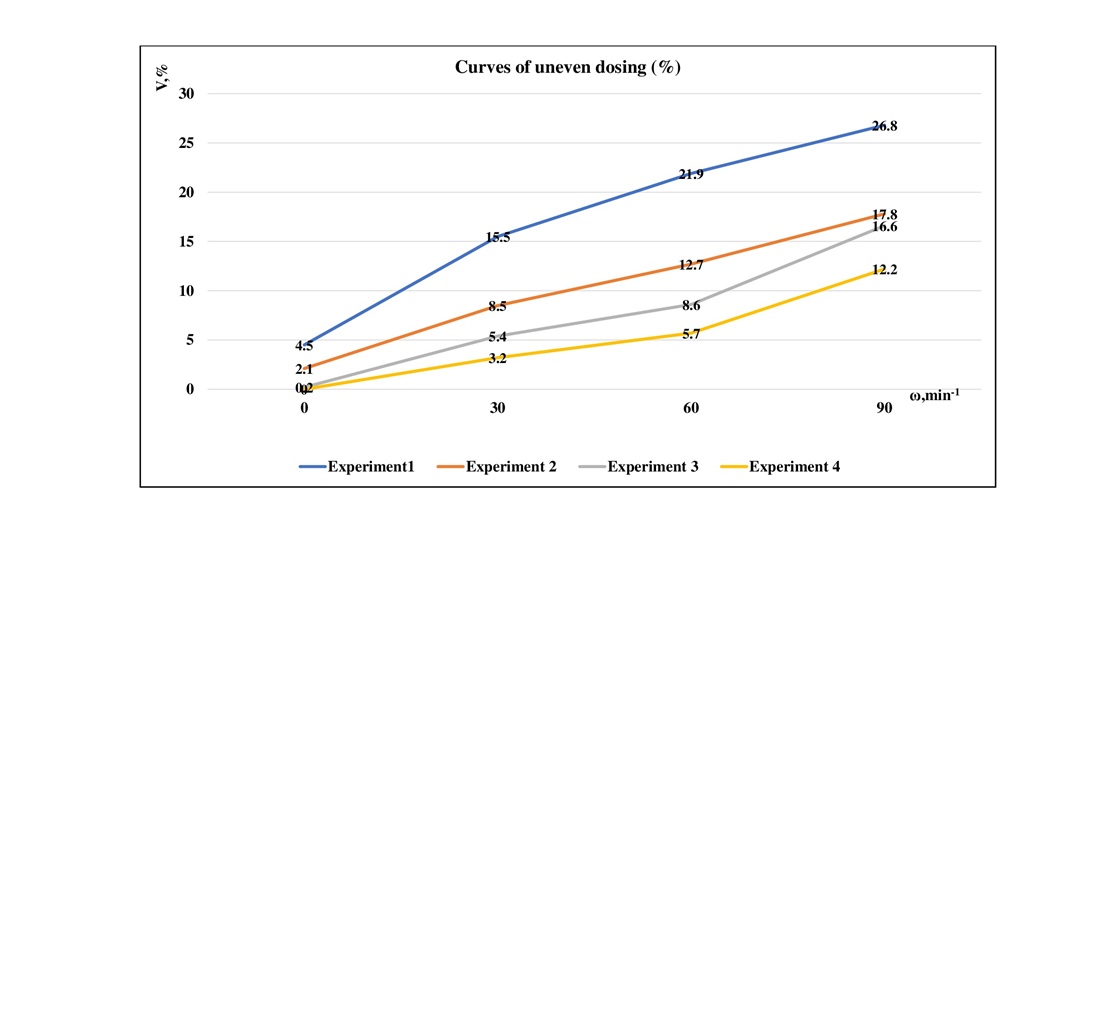
With the specified values of parameters, heterogeneity or uniformity of the feed mixture, the total required power, respectively, was: δ = 7...11; λ = 93...89%; N = 3.5...4.94 kW. The design features of the metering mixer, the parameters of the constructive mode of operation and practical recommendations for use, justified as a result of the study, are of practical importance for feed mills.
The results and optimized values obtained during the dosing of feed material in the preparation of concentrated feed mixtures, in comparison with their continuous operation over time, are of theoretical importance for subject programs, scientific research and experimental design work on the preparation of feed mixtures
References
- Intensive Animal Production System. Available at: https://www.sciencedirect.com/topics/agricultural-and-biological-sciences/intensive-animal-production-system
- Chapter 7. Applied Animal Nutrition. Available at: https://www.scribd.com/document/984372270/Chapter-7-and-Eight
- César Mugabe, L., Pereira Lents, M., Emydio Gomes Pinheiro, E., Alexandre Muchanga, R. (2023). Alternative Animal Feeding for Intensive Livestock Farming Systems and Their Impact on Reproductive Performance of Ruminants. Intensive Animal Farming - A Cost-Effective Tactic. https://doi.org/10.5772/intechopen.106061
- Boev, E. V., Afanasenko, V. G., Boeva, N. I. (2020). Development of a design of the mixer for an intensification of chemical and technological processes in the industry. Journal of Physics: Conference Series, 1515 (4), 42001. https://doi.org/10.1088/1742-6596/1515/4/042001
- Agaev, E. F. o., Bagirov, B. M. o. (2023). Improvement of the design of the feed mixer and analysis of its performance. Tractors and Agricultural Machinery, 89 (6), 439–444. https://doi.org/10.17816/0321-4443-109969
- Jadidi, B., Ebrahimi, M., Ein-Mozaffari, F., Lohi, A. (2023). Effect of the Mixer Design Parameters on the Performance of a Twin Paddle Blender: A DEM Study. Processes, 11 (3), 733. https://doi.org/10.3390/pr11030733
- Akdeniz, R. C. (2001). Türkiye Karma Yem Sanayinin Durumu. Tarımsal Mekanizasyon 20. Ulusal Kongresi Harran Üniversitesi Ziraat Fakültesi Tarım Makinaları Bölümü, Şanlıurfa, 340–346.
- Adusei-Bonsu, M., Amanor, I. N., Obeng, G. Y., Mensah, E. (2021). Performance evaluation of mechanical feed mixers using machine parameters, operational parameters and feed characteristics in Ashanti and Brong-Ahafo regions, Ghana. Alexandria Engineering Journal, 60 (5), 4905–4918. https://doi.org/10.1016/j.aej.2021.03.061
- Öztürk, E. (2023). Rasyon hazırlama. Ankara, 136. Available at: https://iksadyayinevi.com/wp-content/uploads/2023/12/RASYON-HAZIRLAMA.pdf
- Chen, T., Geni, M., Tohti, G. (2024). Vibration characteristics analysis and structural optimization of a small-scale fully mixed feed mixer based on finite element method. Fourth International Conference on Mechanical Engineering, Intelligent Manufacturing, and Automation Technology (MEMAT 2023), 20. https://doi.org/10.1117/12.3026013
- Uzunoğlu, G., Tan, F. (2022). Mixing Time and Homogeneity in Feed Mixing Machines with Small Capacity. Osmaniye Korkut Ata Üniversitesi Fen Bilimleri Enstitüsü Dergisi, 5 (2), 668–680. https://doi.org/10.47495/okufbed.1021709
- Kuvat, Ö., Abatay, G. (2020). Application of quality function deployment to meet customer requirements in compound feed production. Balıkesir Üniversitesi Fen Bilimleri Enstitüsü Dergisi, 22 (2), 717–740. https://doi.org/10.25092/baunfbed.757345
- Barba, F. J., Gavahian, M., Es, I., Zhu, Z., Chemat, F., Lorenzo, J. M., Mousavi Khaneghah, A. (2019). Solar radiation as a prospective energy source for green and economic processes in the food industry: From waste biomass valorization to dehydration, cooking, and baking. Journal of Cleaner Production, 220, 1121–1130. https://doi.org/10.1016/j.jclepro.2019.02.175
- Mammadov, G., Saidov, R., Hajiyev, R., Huseynova, M., Taghiyev, U., Abdiyeva, N. et al. (2025). Justification of the effective design and operating parameters of the dosing and mixing device for the preparation of compound feed. Edelweiss Applied Science and Technology, 9 (9), 456–464. https://doi.org/10.55214/2576-8484.v9i9.9820
- Ayou, D. S., Hargiyanto, R., Coronas, A. (2022). Ammonia-based compression heat pumps for simultaneous heating and cooling applications in milk pasteurization processes: Performance evaluation. Applied Thermal Engineering, 217, 119168. https://doi.org/10.1016/j.applthermaleng.2022.119168
- Leeuwis, C. (2000). Reconceptualizing Participation for Sustainable Rural Development: Towards a Negotiation Approach. Development and Change, 31 (5), 931–959. https://doi.org/10.1111/1467-7660.00184
- Oktay, Y. (2023). A review of fermented milks: potential beneficial effects on human nutrition and health. African Health Sciences, 23 (4), 498–507. https://doi.org/10.4314/ahs.v23i4.54
- Liu, Y., Xiong, L., Kontopodi, E., Boeren, S., Zhang, L., Zhou, P., Hettinga, K. (2020). Changes in the milk serum proteome after thermal and non-thermal treatment. Innovative Food Science & Emerging Technologies, 66, 102544. https://doi.org/10.1016/j.ifset.2020.102544
- Mamedov, N. K., Salmanov, B. Z., Mamedov, G. B., Taghiyev, U. T. (2021). Opimization of the main design and operating parameters of the micronization device. The Agrarian Scientific Journal, 8, 100–103. https://doi.org/10.28983/asj.y2021i8pp100-103
- Iskenderova, A. D., Mamedov, N. H., Veliev, I. A., Mamedov, G. B., Tagiev, U. T. (2021). Investigation of the main design and operating optimal parameters of the micronizer when processing grain feed with infrared radiation. Vestnik Omskogo Gosudarstvennogo Agrarnogo Universiteta, 3, 113–119. https://doi.org/10.48136/2222-0364_2021_3_113
Downloads
Published
How to Cite
Issue
Section
License
Copyright (c) 2026 Gabil Mammadov, Narmin Abdiyeva, Rasim Saidov, Rovshan Hajiyev, Urfan Taghiyev, Gahira Allahverdiyeva, Natavan Imanova, Bahruz Aliyev, Aynur Iskenderova

This work is licensed under a Creative Commons Attribution 4.0 International License.
The consolidation and conditions for the transfer of copyright (identification of authorship) is carried out in the License Agreement. In particular, the authors reserve the right to the authorship of their manuscript and transfer the first publication of this work to the journal under the terms of the Creative Commons CC BY license. At the same time, they have the right to conclude on their own additional agreements concerning the non-exclusive distribution of the work in the form in which it was published by this journal, but provided that the link to the first publication of the article in this journal is preserved.
A license agreement is a document in which the author warrants that he/she owns all copyright for the work (manuscript, article, etc.).
The authors, signing the License Agreement with TECHNOLOGY CENTER PC, have all rights to the further use of their work, provided that they link to our edition in which the work was published.
According to the terms of the License Agreement, the Publisher TECHNOLOGY CENTER PC does not take away your copyrights and receives permission from the authors to use and dissemination of the publication through the world's scientific resources (own electronic resources, scientometric databases, repositories, libraries, etc.).
In the absence of a signed License Agreement or in the absence of this agreement of identifiers allowing to identify the identity of the author, the editors have no right to work with the manuscript.
It is important to remember that there is another type of agreement between authors and publishers – when copyright is transferred from the authors to the publisher. In this case, the authors lose ownership of their work and may not use it in any way.








