Assessing the fracture hazard of railroad rolling stock wheel flange based on bending stresses and contact fatigue
DOI:
https://doi.org/10.15587/1729-4061.2026.364307Keywords:
railroad transport, bending stresses, contact fatigue, lateral force, flange thicknessAbstract
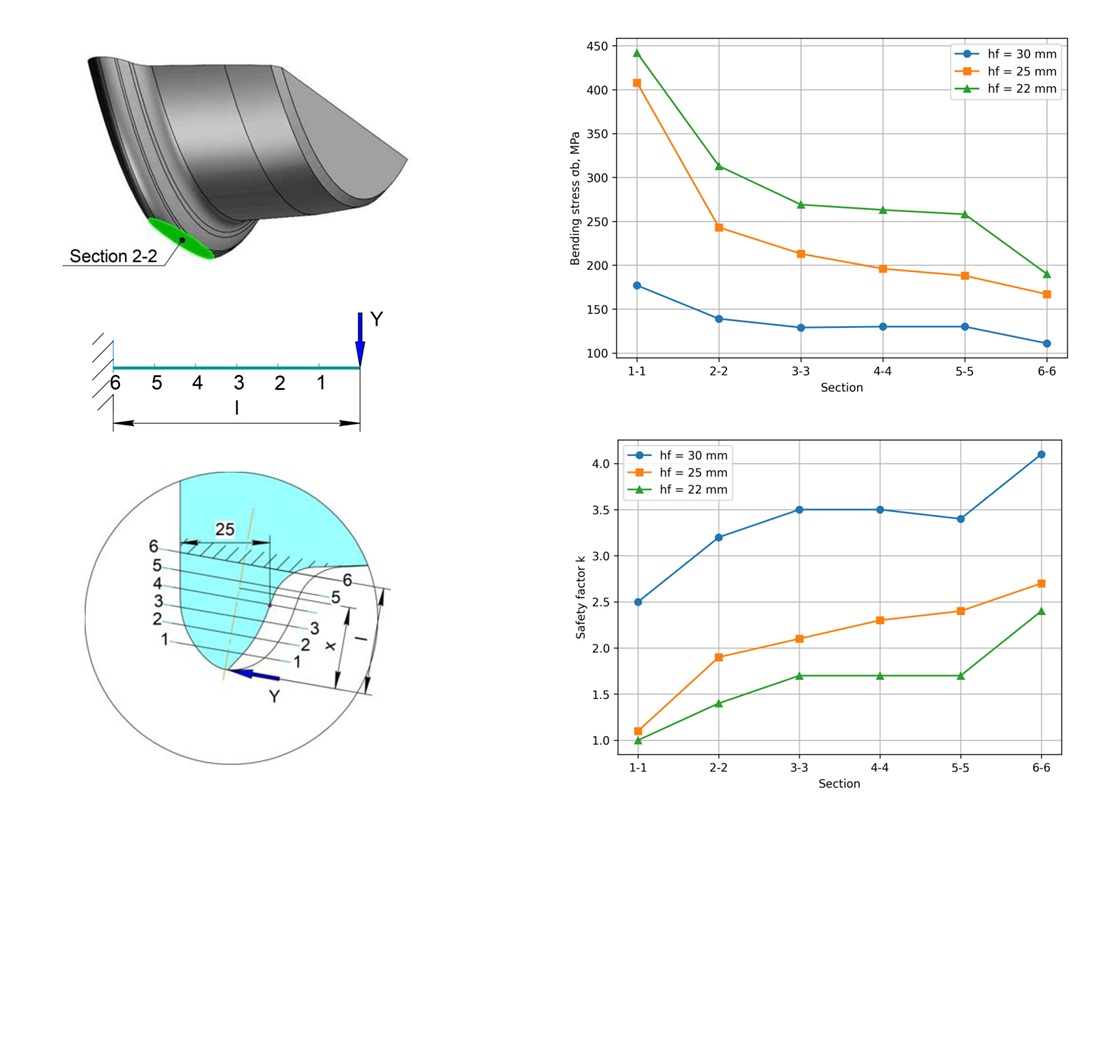
This study investigates the stressed-strained state of a wheel flange in railroad rolling stock under the action of lateral forces of the wheel-rail interaction and the evolution of contact-fatigue damage. The task addressed relates to the lack of a comprehensive assessment of the risk of wheel flange failure, which would simultaneously take into account bending stresses, contact fatigue, and changes in the thickness of the flange due to operational wear.
The wheel flange is proposed as a bending element loaded by the lateral force of the wheel-rail interaction. An analytical dependence has been derived for determining bending stresses depending on the thickness of the flange and the magnitude of the lateral force. A hazard index is proposed, constructed by normalizing equivalent contact stresses relative to the contact endurance limit of the wheel material. Based on the combination of the contact index and the fatigue safety factor, a combined criterion for assessing the risk of flange failure has been devised.
A feature of the results is the established analytical dependence between the thickness of the flange and the fatigue stresses of bending. It was found that reducing the thickness of the flange from 30 to 22 mm leads to an increase in fatigue stresses by almost 1.9 times. A map of the risk of fracture in the coordinates "flange thickness-lateral force" was constructed, which makes it possible to determine the areas of safe and dangerous operation.
The scope of practical implementation of the results is railroad transport.
A condition for applying the findings is to assess the technical condition and predict the resource of rolling stock wheel flanges under the action of lateral loads in the flange contact.
This study could contribute to increasing the efficiency of the maintenance system of wheelsets for railroad transportation
References
- Ekberg, A., Vernersson, T., Hjertsén, D. (2026). Railway wheel failure caused by flange crack, part 2: Fatigue and fracture assessment. Engineering Failure Analysis, 193, 110880. https://doi.org/10.1016/j.engfailanal.2026.110880
- Sieberg, P. M., Hanke, S. (2023). Challenges and potentials in the classification of wear mechanisms by artificial intelligence. Wear, 522, 204725. https://doi.org/10.1016/j.wear.2023.204725
- Akama, M. (2025). Rolling Contact Fatigue and Wear of Rails and Wheels: A Comprehensive Review. Machines, 13 (10), 970. https://doi.org/10.3390/machines13100970
- Vollebregt, E., Six, K., Polach, O. (2021). Challenges and progress in the understanding and modelling of the wheel–rail creep forces. Vehicle System Dynamics, 59(7), 1026–1068. https://doi.org/10.1080/00423114.2021.1912367
- Namayanja, Z., Nkundineza, C., Zewdie, B. M. (2024). Analyzing the impact of curved tracks on wheel flange thickness reduction in railway systems. Open Engineering, 14 (1). https://doi.org/10.1515/eng-2024-0089
- Zub, E., Tkachenko, V., Sapronova, S., Syvakivskiy, S. (2024). Determining the influence of wheelset arrangement in the model 18-100 bogies on the level of steering efforts in the wheel-rail flange contacts. Eastern-European Journal of Enterprise Technologies, 3 (7 (129)), 38–46. https://doi.org/10.15587/1729-4061.2024.304328
- Zhang, J., Zhou, S., Sun, L., Kou, J. (2026). Optimization of wheel profile for flange wear of rail vehicles on worn rails. Journal of Mechanical Science and Technology, 40 (2), 1259–1268. https://doi.org/10.1007/s12206-026-0141-0
- Kwak, J., Lee, S. (2025). Parametric optimisation of tramway wheel profiles using surrogate modelling and multibody simulation. Vehicle System Dynamics, 1–32. https://doi.org/10.1080/00423114.2025.2558915
- Ye, Y., Vuitton, J., Sun, Y., Hecht, M. (2021). Railway wheel profile fine-tuning system for profile recommendation. Railway Engineering Science, 29 (1), 74–93. https://doi.org/10.1007/s40534-021-00234-1
- Muhamedsalih, Y., Tucker, G., Stow, J. (2022). Optimisation of wheelset maintenance by using a reduced flange wear wheel profile. Proceedings of the Institution of Mechanical Engineers, Part F: Journal of Rail and Rapid Transit, 237 (2), 253–265. https://doi.org/10.1177/09544097221105959
- Maglio, M., Vernersson, T., Nielsen, J. C. O., Pieringer, A., Söderström, P., Regazzi, D., Cervello, S. (2021). Railway wheel tread damage and axle bending stress – Instrumented wheelset measurements and numerical simulations. International Journal of Rail Transportation, 10 (3), 275–297. https://doi.org/10.1080/23248378.2021.1932621
- Kumar, N., Ahmadian, M., Marquis, B. (2026). Wheel–rail-induced derailment analysis: a comprehensive literature review of experimental and simulation-based approaches. Railway Engineering Science. https://doi.org/10.1007/s40534-025-00425-0
- Srivastava, J. P., Sarkar, P. K., Ranjan, V. (2016). Effects of thermal load on wheel–rail contacts: A review. Journal of Thermal Stresses, 39 (11), 1389–1418. https://doi.org/10.1080/01495739.2016.1216060
- Su, J., Huang, X., Ding, H., Meli, E., Wang, W., Zhang, S. (2026). On the transition behavior between rolling contact fatigue and thermal fatigue of freight wheels under various contact parameters/modes during tread braking process. International Journal of Fatigue, 209, 109650. https://doi.org/10.1016/j.ijfatigue.2026.109650
- Turabimana, P., Nkundineza, C. (2020). Development of an On-Board Measurement System for Railway Vehicle Wheel Flange Wear. Sensors, 20 (1), 303. https://doi.org/10.3390/s20010303
- Hao, C., Chen, J., Sun, X., Xu, F., Xu, J., Wang, P. (2022). Effects of flange wear on dynamic vehicle-turnout interaction. Proceedings of the Institution of Mechanical Engineers, Part F: Journal of Rail and Rapid Transit, 237 (5), 642–654. https://doi.org/10.1177/09544097221127783
- Jelila, Y. D., Lemu, H. G., Pamuła, W., Sirata, G. G. (2021). Fatigue life analysis of wheel-rail contacts at railway turnouts using finite element modelling approach. IOP Conference Series: Materials Science and Engineering, 1201 (1), 12047. https://doi.org/10.1088/1757-899x/1201/1/012047
- dos Santos, G. F. M., Lopes, L. A. S., Kina, E. J., Tunna, J. (2010). The Influence of Wheel Profile on the Safety Index. Proceedings of the Institution of Mechanical Engineers, Part F: Journal of Rail and Rapid Transit, 224 (5), 429–434. https://doi.org/10.1243/09544097jrrt360
- Young, W. C., Budynas, R. G. (2020). Roark's formulas for stress and strain. McGraw-Hill Education. Available at: http://nguyen.hong.hai.free.fr/EBOOKS/SCIENCE%20AND%20ENGINEERING/MECANIQUE/THEORIE%20DE%20BASE/Roark's%20Formulas%20For%20Stress%20And%20Strain.pdf
- Johnson, K. L. (1985). Contact Mechanics. Cambridge University Press.
- Pysarenko, H. S., Kvitka, O. L., Umanskyi, E. S. (2004). Opir materialiv. Kyiv: Vyshcha shk., 655. Available at: https://btpm.nmu.org.ua/ua/download/Писаренко%20Г.С.%20Опір%20матеріалів.pdf
Downloads
Published
How to Cite
Issue
Section
License
Copyright (c) 2026 Svitlana Sapronova, Oleksandr Vorobiov, Andriy Klymash

This work is licensed under a Creative Commons Attribution 4.0 International License.
The consolidation and conditions for the transfer of copyright (identification of authorship) is carried out in the License Agreement. In particular, the authors reserve the right to the authorship of their manuscript and transfer the first publication of this work to the journal under the terms of the Creative Commons CC BY license. At the same time, they have the right to conclude on their own additional agreements concerning the non-exclusive distribution of the work in the form in which it was published by this journal, but provided that the link to the first publication of the article in this journal is preserved.
A license agreement is a document in which the author warrants that he/she owns all copyright for the work (manuscript, article, etc.).
The authors, signing the License Agreement with TECHNOLOGY CENTER PC, have all rights to the further use of their work, provided that they link to our edition in which the work was published.
According to the terms of the License Agreement, the Publisher TECHNOLOGY CENTER PC does not take away your copyrights and receives permission from the authors to use and dissemination of the publication through the world's scientific resources (own electronic resources, scientometric databases, repositories, libraries, etc.).
In the absence of a signed License Agreement or in the absence of this agreement of identifiers allowing to identify the identity of the author, the editors have no right to work with the manuscript.
It is important to remember that there is another type of agreement between authors and publishers – when copyright is transferred from the authors to the publisher. In this case, the authors lose ownership of their work and may not use it in any way.








