Identifying patterns of change in fire protection of the tent fabric treated with an epoxy resin-based intumescent coating
DOI:
https://doi.org/10.15587/1729-4061.2026.364439Keywords:
tent fabric, epoxy resin, mixture of ammonium polyphosphate and aluminum hydroxide, fire resistance of the fabric, surface energyAbstract
This study investigates the process of forming a fire-retardant coating based on modified epoxy resin on the surface of tent fabric. The task addressed is to ensure fire protection of tent fabric when treated with a coating based on modified epoxy resin. This is important given the relevance of fire-resistant materials for modern construction.
It has been proven that when treating tent fabric with epoxy resin, the free energy component of the fabric surface decreased by more than 2.3 times, while the polar component increased by 1.6 times, which indicates a change in the surface. At the same time, the tensile strength of tent fabric after treatment with epoxy resin increased by more than 4.1 times.
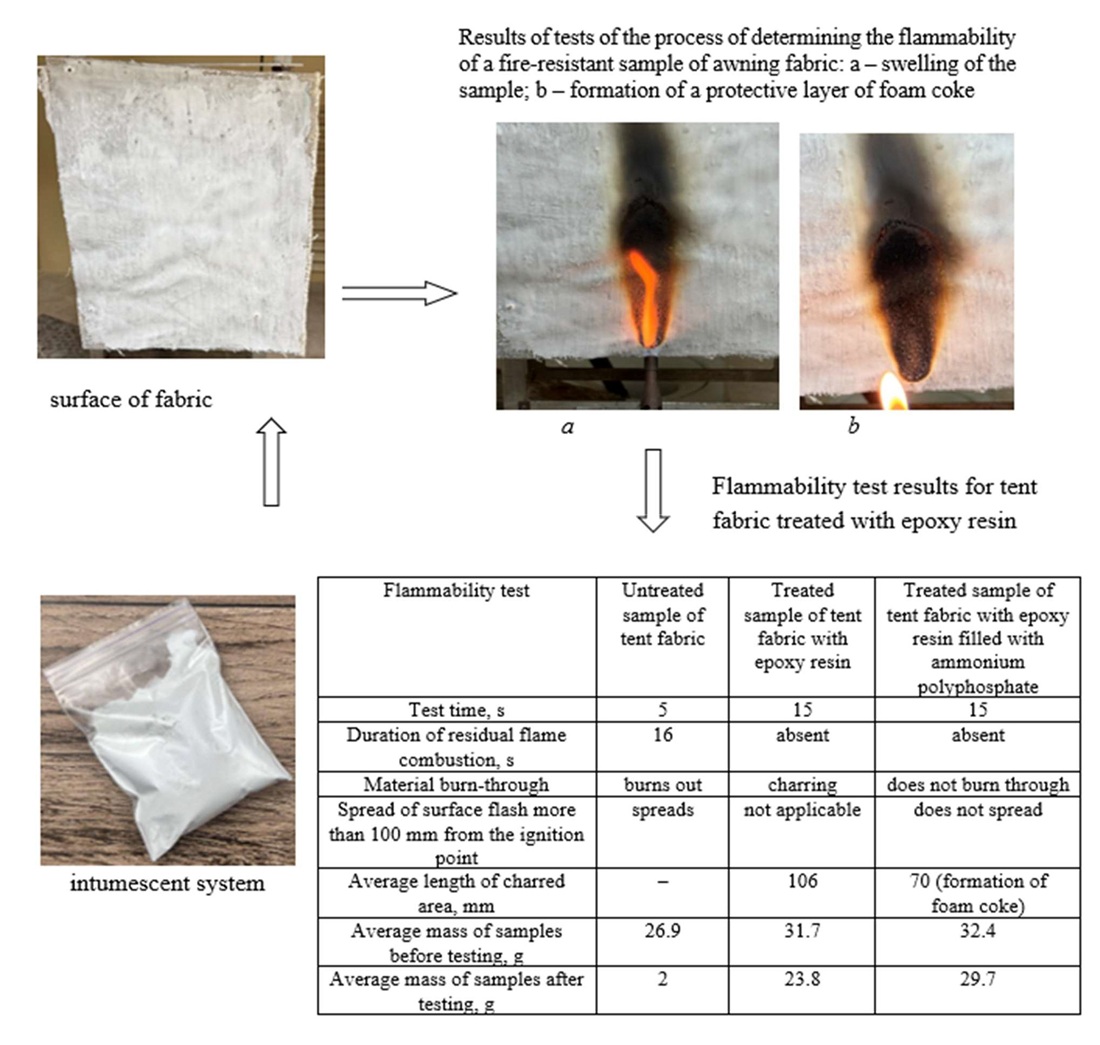
The study has shown that a sample of tent fabric caught fire when exposed to a burner flame for 5 s and continued to burn for 16 s when the ignition source was removed. The treatment of tent fabric with epoxy resin with flame retardant led to the formation of charring on the sample with a length of more than 70 mm, and the height of the swelling in the flame zone was about 3 ÷ 5 mm. When testing tent fabric samples for the flame spread index, it was found that the sample treated with epoxy resin caught fire in 524 s, the flame spread throughout the sample for 14 s, the burning length of the sample was 300 mm, and the flammability index was 36.3. However, for samples treated with epoxy resin filled with a mixture of ammonium polyphosphate and aluminum hydroxide, the flammability indices decreased by more than 30 times. The optimal concentration of components in the coating containing 34 ÷ 35% (wt.) of ammonium polyphosphate and 9 ÷ 10% (wt.) of aluminum hydroxide has been determined.
Thus, there are grounds for the possibility of designing fire-resistant coatings for construction
References
- Bi, W., Tao, Z., Li, F., Nahar, Y., Jiang, C. (2025). Development of waterborne transparent intumescent coatings for timber buildings: Influence of phosphoric acid ratio. Construction and Building Materials, 493, 143225. https://doi.org/10.1016/j.conbuildmat.2025.143225
- Riyazuddin, R., Bano, S., Husain, F. M., Khan, R. A., Alsalme, A., Siddique, J. A. (2020). Influence of Antimony Oxide on Epoxy Based Intumescent Flame Retardation Coating System. Polymers, 12 (11), 2721. https://doi.org/10.3390/polym12112721
- Zeng, L., Yang, L., Ai, L., Ye, Z., Liu, P. (2022). Synergistic Flame Retardant Effect of Ammonium Polyphosphate and Aluminum Hydroxide on Polyurethane. Journal of Wuhan University of Technology-Mater. Sci. Ed., 37 (3), 533–539. https://doi.org/10.1007/s11595-022-2562-7
- Shuklin, S. G., Makarova, L., Eremina, M. (2022). Epoxy Compositions Modified with Ammonium Polyphosphate and Boric Acid. Key Engineering Materials, 909, 21–27. https://doi.org/10.4028/p-n42c64
- Price, E. J., Covello, J., Tuchler, A., Wnek, G. E. (2020). Intumescent, Epoxy-Based Flame-Retardant Coatings Based on Poly(acrylic acid) Compositions. ACS Applied Materials & Interfaces, 12 (16), 18997–19005. https://doi.org/10.1021/acsami.0c00567
- Doanh, T. C., Thi, N. H., Nguyen, H. T., Oanh, H. T., Doan, T. D., Tuyen, N. D. et al. (2025). Preparation and synergistic effect of aluminum hydroxide nanoplates on the fire resistance and thermal stability of the intumescent flame retardant epoxy composite. RSC Advances, 15 (21), 16814–16825. https://doi.org/10.1039/d5ra00231a
- Liu, Y., Yu, Z., Li, R., Wang, X., Qiao, Y. (2026). Ammonium polyphosphate modified epoxy–polyurethane system for high-performance bamboo composites with improved fire safety. Materials Today Communications, 51, 114726. https://doi.org/10.1016/j.mtcomm.2026.114726
- Liu, Y., He, J., Yang, R. (2015). The effects of aluminum hydroxide and ammonium polyphosphate on the flame retardancy and mechanical property of polyisocyanurate–polyurethane foams. Journal of Fire Sciences, 33 (6), 459–472. https://doi.org/10.1177/0734904115609362
- Inprasit, T., Niyomdacha, D., Promchantuek, C., Thangtong, T., Vanichvattanadecha, C., Pisitsak, P. (2026). Sustainable Intumescent Flame-Retardant Coating with Sericin, Phosphorus, and Silicon for Polyester Fabrics. Polymers, 18 (6), 682. https://doi.org/10.3390/polym18060682
- Wang, Y., Hu, Q., Ye, M., Huang, X., Chen, Q., Hu, C. (2026). Synergistic Flame Retardancy of Epoxy Resin with Aminated Multi-Walled Carbon Nanotubes and Ammonium Polyphosphate. Polymers, 18 (10), 1158. https://doi.org/10.3390/polym18101158
- Vakhitova, L., Kalafat, K., Vakhitov, R., Drizhd, V. (2024). Fire-Retardant Epoxy Composition Modified with Nano-Clays. American Journal of Engineering Research (AJER), 13 (8), 41–46. Available at: https://www.ajer.org/papers/Vol-13-issue-8/13084146.pdf
- Ramadan, N., Taha, M., La Rosa, A. D., Elsabbagh, A. (2021). Towards Selection Charts for Epoxy Resin, Unsaturated Polyester Resin and Their Fibre-Fabric Composites with Flame Retardants. Materials, 14 (5), 1181. https://doi.org/10.3390/ma14051181
- Tsapko, Y., Tsapko, A., Zhartovskyi, S., Likhnyovskyi, R., Kravchenko, M., Lialina, N. et al. (2024). Establishing fire protection patterns in wood using impregnation compositions from inorganic salts. Eastern-European Journal of Enterprise Technologies, 5 (10 (131)), 62–70. https://doi.org/10.15587/1729-4061.2024.313423
- Rekiel, E., Zdziennicka, A., Jańczuk, B. (2021). Mutual influence of ethanol and surfactin on their wetting and adhesion properties. Colloids and Surfaces A: Physicochemical and Engineering Aspects, 627, 127161. https://doi.org/10.1016/j.colsurfa.2021.127161
- ASTM D5035-11. Standard Test Method for Breaking Force and Elongation of Textile Fabrics (Strip Method). https://www.mecmesin.com/standard/astm-d5035-11
- Tsapko, Y., Tsapko, Аleksii, Bondarenko, O., Chudovska, V. (2021). Thermophysical characteristics of the formed layer of foam coke when protecting fabric from fire by a formulation based on modified phosphorus-ammonium compounds. Eastern-European Journal of Enterprise Technologies, 3 (10 (111)), 34–41. https://doi.org/10.15587/1729-4061.2021.233479
- Tsapko, Y., Tsapko, Аleksii, Bondarenko, O. (2019). Effect of a flameretardant coating on the burning parameters of wood samples. Eastern-European Journal of Enterprise Technologies, 2 (10 (98)), 49–54. https://doi.org/10.15587/1729-4061.2019.163591
- Tsapko, Y., Tsapko, А. (2018). Establishment of fire protective effectiveness of reed treated with an impregnating solution and coatings. Eastern-European Journal of Enterprise Technologies, 4 (10 (94)), 62–68. https://doi.org/10.15587/1729-4061.2018.141030
- Tsapko, Y., Tsapko, А., Buiskykh, N., Horbachova, O., Mazurchuk, S., Matviichuk, A., Sarapin, Y. (2022). Establishing regularities of temperature conductivity reduction when protecting fabric against fire by intumescent coating. Eastern-European Journal of Enterprise Technologies, 2 (10 (116)), 74–80. https://doi.org/10.15587/1729-4061.2022.254546
- Tsapko, Y., Tsapko, А., Bondarenko, O. (2021). Defining patterns of heat transfer through the fire-protected fabric to wood. Eastern-European Journal of Enterprise Technologies, 6 (10 (114)), 49–56. https://doi.org/10.15587/1729-4061.2021.245713
Downloads
Published
How to Cite
Issue
Section
License
Copyright (c) 2026 Yuriy Tsapko, Oksana Berdnyk, Аleksii Tsapko, Ruslan Likhnyovskyi, Tetiana Nehrii, Oksana Kasianova, Yurii Feshchuk, Vasyl Lomaha, Olga Bedratiuk, Kseniia Bielikova

This work is licensed under a Creative Commons Attribution 4.0 International License.
The consolidation and conditions for the transfer of copyright (identification of authorship) is carried out in the License Agreement. In particular, the authors reserve the right to the authorship of their manuscript and transfer the first publication of this work to the journal under the terms of the Creative Commons CC BY license. At the same time, they have the right to conclude on their own additional agreements concerning the non-exclusive distribution of the work in the form in which it was published by this journal, but provided that the link to the first publication of the article in this journal is preserved.
A license agreement is a document in which the author warrants that he/she owns all copyright for the work (manuscript, article, etc.).
The authors, signing the License Agreement with TECHNOLOGY CENTER PC, have all rights to the further use of their work, provided that they link to our edition in which the work was published.
According to the terms of the License Agreement, the Publisher TECHNOLOGY CENTER PC does not take away your copyrights and receives permission from the authors to use and dissemination of the publication through the world's scientific resources (own electronic resources, scientometric databases, repositories, libraries, etc.).
In the absence of a signed License Agreement or in the absence of this agreement of identifiers allowing to identify the identity of the author, the editors have no right to work with the manuscript.
It is important to remember that there is another type of agreement between authors and publishers – when copyright is transferred from the authors to the publisher. In this case, the authors lose ownership of their work and may not use it in any way.








