Identification of response surface patterns in ultrasound-assisted transesterification of castor oil using CaO-MgO catalysts derived from blood cockle shell and limestone
DOI:
https://doi.org/10.15587/1729-4061.2026.364663Keywords:
heterogeneous catalysis, sonication, blood cockle shell, calcined limestone, response surface methodology, calorimetric calibrationAbstract
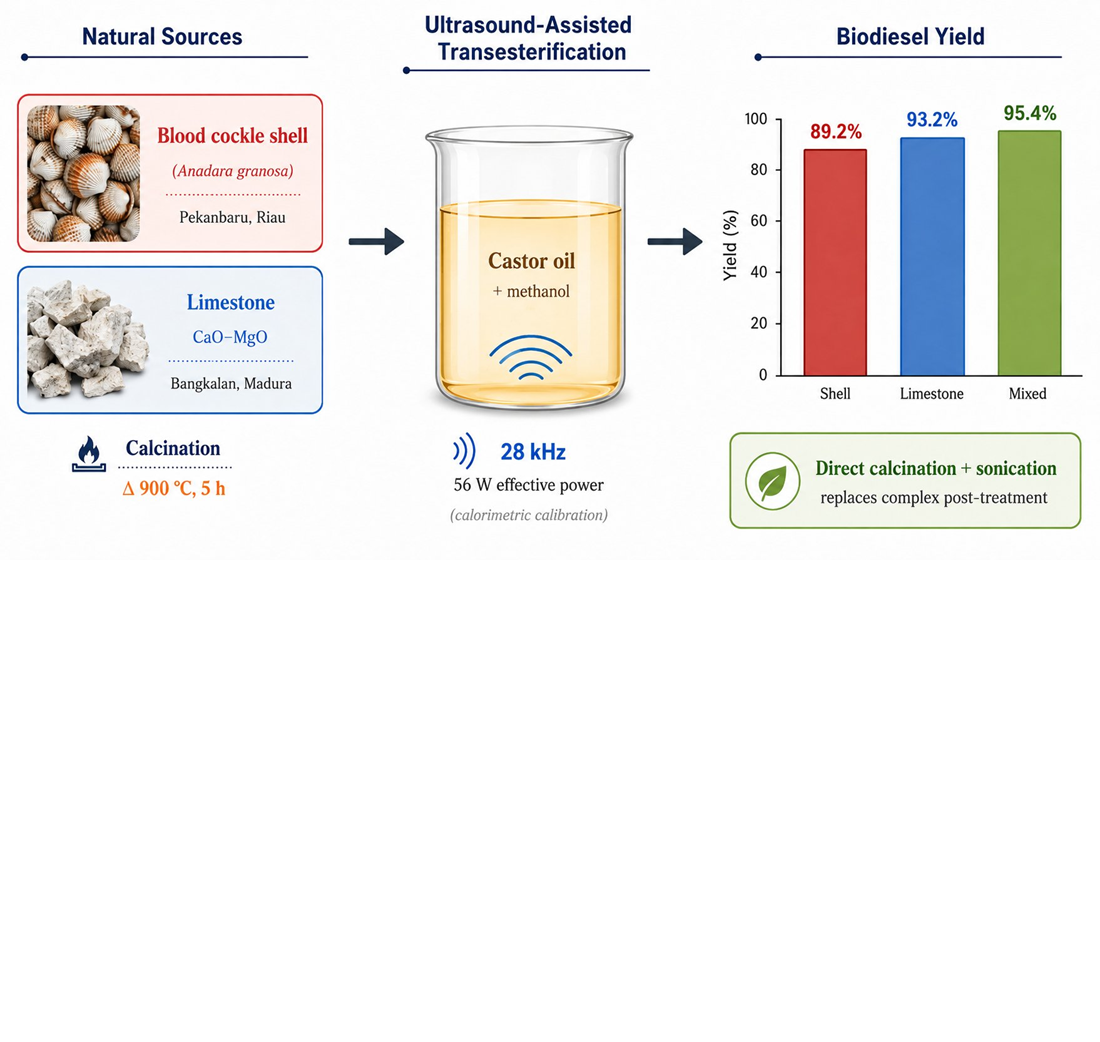
The object of this study is the ultrasound-assisted transesterification of castor oil (Ricinus communis) into biodiesel using heterogeneous catalysts derived from natural sources: blood cockle shells (Anadara granosa) from Pekanbaru and limestone from Bangkalan, Indonesia. The problem addressed is that directly calcined limestone produces low biodiesel yield without complex post-treatment, and whether ultrasonic irradiation can compensate for this has not been tested. Three catalysts (shell-derived CaO, limestone-derived CaO-MgO, and their 1:1 physical mixture) were calcined at 900°C, 5 h, characterized by X-ray diffraction, Scanning electron microscopy with energy-dispersive X-ray spectroscopy, and Fourier-transform infrared spectroscopy, and tested under ultrasonic irradiation at 28 kHz with 56.0 W effective power (calorimetric calibration, 100 W nominal). A central composite design (reaction time, catalyst loading) was employed for each catalyst. Mean yields were 95.4% (mixed), 93.2% (limestone), and 89.2% (shell). Response surface analysis revealed a maximum for limestone (97.9% at 93.9 min, 4.24 wt%), a saddle point for shell, and an inverted surface for the mixture. These distinct geometries arise from phase composition and active-site differences. Unlike prior work requiring calcination-hydration-dehydration and NiO impregnation, the limestone catalyst here achieved 93.2% yield by direct calcination and sonication alone, far exceeding the 16.45% reported without sonication. These findings apply to biodiesel production where shell and limestone are abundant, replacing complex catalyst post-treatment with direct calcination and sonication
References
- Farouk, S. M., Tayeb, A. M., Abdel-Hamid, S. M. S., Osman, R. M. (2024). Recent advances in transesterification for sustainable biodiesel production, challenges, and prospects: a comprehensive review. Environmental Science and Pollution Research, 31 (9), 12722–12747. https://doi.org/10.1007/s11356-024-32027-4
- Atabani, A. E., Silitonga, A. S., Badruddin, I. A., Mahlia, T. M. I., Masjuki, H. H., Mekhilef, S. (2012). A comprehensive review on biodiesel as an alternative energy resource and its characteristics. Renewable and Sustainable Energy Reviews, 16 (4), 2070–2093. https://doi.org/10.1016/j.rser.2012.01.003
- Banković-Ilić, I. B., Stamenković, O. S., Veljković, V. B. (2012). Biodiesel production from non-edible plant oils. Renewable and Sustainable Energy Reviews, 16 (6), 3621–3647. https://doi.org/10.1016/j.rser.2012.03.002
- Osorio-González, C. S., Gómez-Falcon, N., Sandoval-Salas, F., Saini, R., Brar, S. K., Ramírez, A. A. (2020). Production of Biodiesel from Castor Oil: A Review. Energies, 13 (10), 2467. https://doi.org/10.3390/en13102467
- Chidambaranathan, B., Gopinath, S., Aravindraj, R., Devaraj, A., Gokula Krishnan, S., Jeevaananthan, J. K. S. (2020). The production of biodiesel from castor oil as a potential feedstock and its usage in compression ignition Engine: A comprehensive review. Materials Today: Proceedings, 33, 84–92. https://doi.org/10.1016/j.matpr.2020.03.205
- Lee, H. V., Juan, J. C., Taufiq-Yap, Y. H., Kong, P. S., Rahman, N. A. (2015). Advancement in heterogeneous base catalyzed technology: An efficient production of biodiesel fuels. Journal of Renewable and Sustainable Energy, 7 (3). https://doi.org/10.1063/1.4919082
- Ponnappan, V. S., Munuswamy, D. b., Nagappan, B., Devarajan, Y. (2021). Investigation on the effect of ultrasound irradiation on biodiesel properties and transesterification parameters. Environmental Science and Pollution Research, 28 (45), 64769–64777. https://doi.org/10.1007/s11356-021-15568-w
- Yan, S., DiMaggio, C., Mohan, S., Kim, M., Salley, S. O., Ng, K. Y. S. (2010). Advancements in Heterogeneous Catalysis for Biodiesel Synthesis. Topics in Catalysis, 53 (11-12), 721–736. https://doi.org/10.1007/s11244-010-9460-5
- Tahvildari, K., Anaraki, Y. N., Fazaeli, R., Mirpanji, S., Delrish, E. (2015). The study of CaO and MgO heterogenic nano-catalyst coupling on transesterification reaction efficacy in the production of biodiesel from recycled cooking oil. Journal of Environmental Health Science and Engineering, 13 (1). https://doi.org/10.1186/s40201-015-0226-7
- Ismail, S., Ahmed, A. S., Anr, R., Hamdan, S. (2016). Biodiesel Production from Castor Oil by Using Calcium Oxide Derived from Mud Clam Shell. Journal of Renewable Energy, 2016, 1–8. https://doi.org/10.1155/2016/5274917
- Aqliliriana, C. M., Ernee, N. M., Irmawati, R. (2015). Preparation and characterization of modified calcium oxide from natural sources and their application in the transesterification of palm oil. International Journal of Scientific and Technology Research, 4 (11), 168–175.
- Widiarti, N., Bahruji, H., Holilah, H., Ni’mah, Y. L., Ediati, R., Santoso, E. et al. (2021). Upgrading catalytic activity of NiO/CaO/MgO from natural limestone as catalysts for transesterification of coconut oil to biodiesel. Biomass Conversion and Biorefinery, 13 (4), 3001–3015. https://doi.org/10.1007/s13399-021-01373-5
- Encinar, J. M., González, J. F., Pardal, A. (2012). Transesterification of castor oil under ultrasonic irradiation conditions. Preliminary results. Fuel Processing Technology, 103, 9–15. https://doi.org/10.1016/j.fuproc.2011.12.033
- Abukhadra, M. R., Mohamed, A. S., El-Sherbeeny, A. M., Soliman, A. T. A., Abd Elgawad, A. E. E. (2020). Sonication induced transesterification of castor oil into biodiesel in the presence of MgO/CaO nanorods as a novel basic catalyst: Characterization and optimization. Chemical Engineering and Processing - Process Intensification, 154, 108024. https://doi.org/10.1016/j.cep.2020.108024
- Gandhi, S. S., Gogate, P. R. (2021). Intensified transesterification of castor oil using ultrasonic horn: response surface methodology (RSM) based optimization. International Journal of Green Energy, 18 (14), 1523–1535. https://doi.org/10.1080/15435075.2021.1911808
- Sabzimaleki, M., Ghobadian, B., Mazloom Farsibaf, M., Najafi, G., Dehghani Soufi, M., Mohammad Safieddin Ardebili, S. (2015). Optimization of Biodiesel Ultrasound-Assisted Synthesis from Castor Oil Using Response Surface Methodology (RSM). Chemical Product and Process Modeling, 10 (2), 123–133. https://doi.org/10.1515/cppm-2014-0013
- Buasri, A., Chaiyut, N., Loryuenyong, V., Worawanitchaphong, P., Trongyong, S. (2013). Calcium Oxide Derived from Waste Shells of Mussel, Cockle, and Scallop as the Heterogeneous Catalyst for Biodiesel Production. The Scientific World Journal, 2013 (1). https://doi.org/10.1155/2013/460923
Downloads
Published
How to Cite
Issue
Section
License
Copyright (c) 2026 Abdullah Faizal, Slamet Wahyudi, Winarto Winarto, Ishardita Pambudi Tama

This work is licensed under a Creative Commons Attribution 4.0 International License.
The consolidation and conditions for the transfer of copyright (identification of authorship) is carried out in the License Agreement. In particular, the authors reserve the right to the authorship of their manuscript and transfer the first publication of this work to the journal under the terms of the Creative Commons CC BY license. At the same time, they have the right to conclude on their own additional agreements concerning the non-exclusive distribution of the work in the form in which it was published by this journal, but provided that the link to the first publication of the article in this journal is preserved.
A license agreement is a document in which the author warrants that he/she owns all copyright for the work (manuscript, article, etc.).
The authors, signing the License Agreement with TECHNOLOGY CENTER PC, have all rights to the further use of their work, provided that they link to our edition in which the work was published.
According to the terms of the License Agreement, the Publisher TECHNOLOGY CENTER PC does not take away your copyrights and receives permission from the authors to use and dissemination of the publication through the world's scientific resources (own electronic resources, scientometric databases, repositories, libraries, etc.).
In the absence of a signed License Agreement or in the absence of this agreement of identifiers allowing to identify the identity of the author, the editors have no right to work with the manuscript.
It is important to remember that there is another type of agreement between authors and publishers – when copyright is transferred from the authors to the publisher. In this case, the authors lose ownership of their work and may not use it in any way.








