Determining basic technological parameters for the process of electrochemical regeneration of hydrochloride-acid concentrated process solutions
DOI:
https://doi.org/10.15587/1729-4061.2026.364886Keywords:
electrochemical regeneration, copper-containing hydrochloric acid etching solutions, technological, redox parametersAbstract
This work investigates model chloride solutions, copper-containing chloride acid (peroxide and ammonia) spent technological solutions for etching printed circuit boards, in order to design unified technologies and equipment.
This paper reports results of research on determining basic technological parameters for electrochemical regeneration that provide energetically favorable conditions for the process. It was established that when maintaining Eh in the cathode chamber from 400 mV to 450 mV, the specific current consumption for the regeneration process (38–40% copper extraction degree) is from 46 · 103 C/mol to 48 · 103 C/mol (current consumption from 15 · 103 C/l to 36 · 103 C/l), which is 4 times less compared to electrolysis without Eh correction.
The study has made it possible to carry out regeneration in a diaphragm electrolyzer under energy-efficient conditions and increase the maximum degree of copper extraction from 43% to 98% by adjusting Eh. In this case, the specific current consumption is 4 times lower than that without adjusting Eh.
Maintaining Eh in the cathode chamber at about 450 mV allows for more complete extraction of copper. Adjustment of the composition and redox properties of the regenerated solutions is carried out by mixing in a certain ratio of SPS with catholyte and anolyte. It is recommended to send the mixture of catholyte and anolyte after electrolysis to a centralized wastewater treatment system.
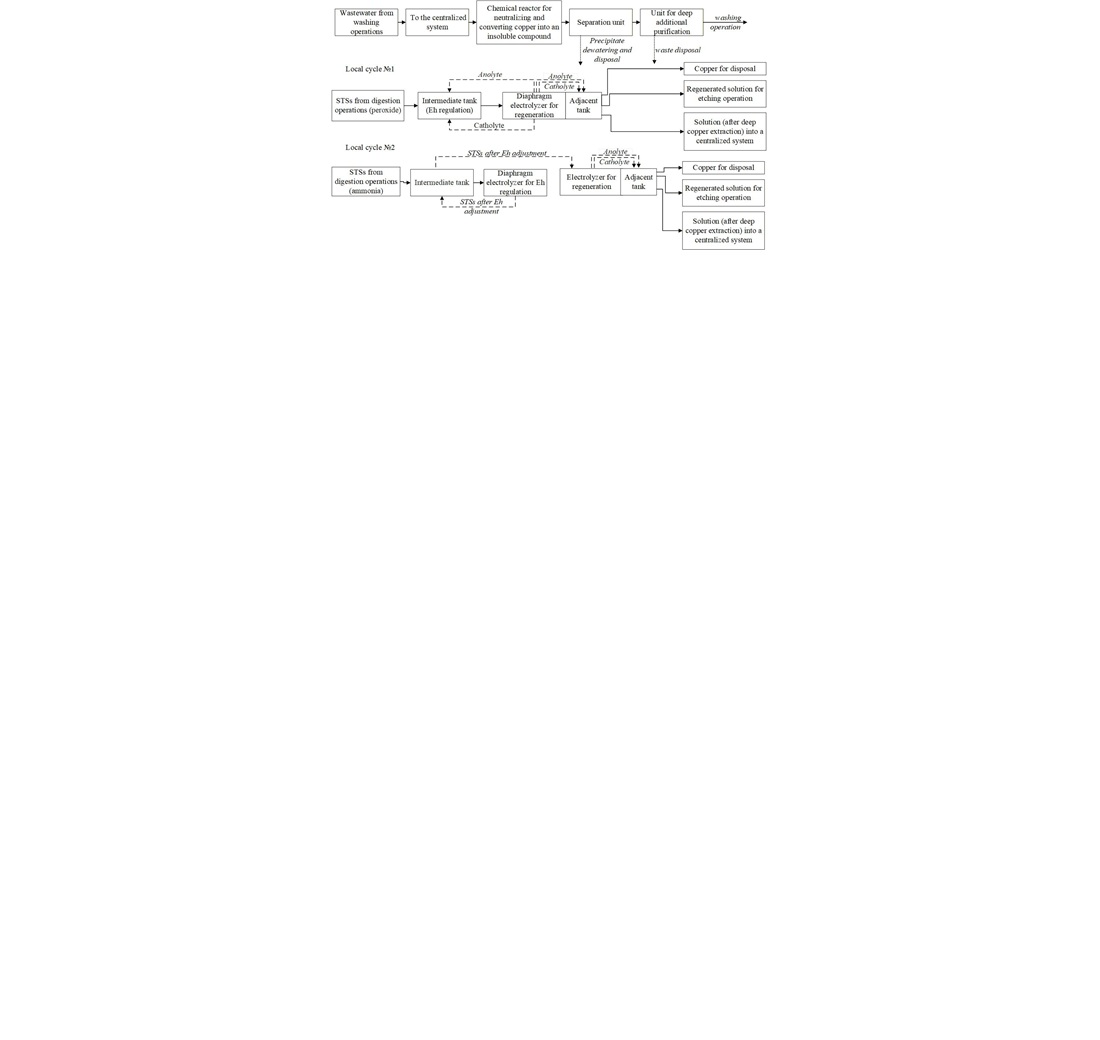
Experimental and industrial studies of the basic elements in the schemes of electrochemical regeneration in a diaphragm electrolyzer given in this work have been carried out. These schemes are supplemented with additional elements for pre-treatment: an intermediate tank, a diaphragm-free electrolyzer (for adjusting Eh); and a chamber adjacent to the anode (for adjusting the composition of the solution after regeneration)
References
- Kyryliuk, S. V. (2017). Ochyshchennia kontsentrovanykh stichnykh vod halvanichnoho vyrobnytstva u kombinovanii systemi. Rivne: NUVHP, 206. Available at: https://ela.kpi.ua/bitstream/123456789/20852/1/diss_Kyryliuk.pdf
- Nester, А., Yakovyshyna, T., Salamon, I., Sheludchenko, L., Liubynskyi, O., Romanishina, O., Dzhumelia, E. (2024). Regenerating Etching Solutions for Circuit Boards while Extracting Copper. Journal of Ecological Engineering, 25 (5), 257–267. https://doi.org/10.12911/22998993/186504
- Astrelyn, Y., Ratnavyra, Kh. (Eds.) (2015). Fyzyko-khymycheskye Metody Ochystky Vody. Upravlenye Vodnymy Resursamy. Proekt «Water Harmony». Available at: https://www.scribd.com/document/904560143/
- Yang, Z., Huang, C., Ji, X., Wang, Y. (2013). A New Electrolytic Method for On-Site Regeneration of Acidic Copper (II) Chloride Etchant in Printed Circuit Board Production. International Journal of Electrochemical Science, 8 (5), 6258–6268. https://doi.org/10.1016/s1452-3981(23)14759-6
- Nester, A., Petruk, R., Kalda, G., Pashechko, M., Yakovyshyna, T., Drobot, O., Kirchuk, R. (2025). Investigating electrodes for the extraction and utilization of copper from spent etching solutions. Advances in Science and Technology Research Journal, 19 (5), 366–374. https://doi.org/10.12913/22998624/202364
- Qasem, N. A. A., Mohammed, R. H., Lawal, D. U. (2021). Removal of heavy metal ions from wastewater: a comprehensive and critical review. Npj Clean Water, 4 (1). https://doi.org/10.1038/s41545-021-00127-0
- Rimal, V., Srivastava, P. K. (2024). Sustainable electrochemical wastewater treatment techniques. Water, the Environment, and the Sustainable Development Goals, 281–303. https://doi.org/10.1016/b978-0-443-15354-9.00001-3
- Wang, X., Wu, Y., Chen, N., Piao, H., Sun, D., Ratnaweera, H. at al. (2022). Characterization of Oxidation-Reduction Potential Variations in Biological Wastewater Treatment Processes: A Study from Mechanism to Application. Processes, 10 (12), 2607. https://doi.org/10.3390/pr10122607
- Nester, A. A. (2021). Naukovi osnovy pidvyshchennia rivnia ekolohichnoi bezpeky halvanichnoho vyrobnytstva. Khmelnytskyi: KhNU, 342. Available at: https://uacademic.info/ua/document/0521U100186#!
- Ru, C. (2022). Research on the regeneration technology of etching waste solution. E3S Web of Conferences, 338, 1051. https://doi.org/10.1051/e3sconf/202233801051
- Merentsov, N. A., Bokhan, S. A., Lebedev, V. N., Persidskiy, A. V., Balashov, V. A. (2018). System for Centralised Collection, Recycling and Removal of Waste Pickling and Galvanic Solutions and Sludge. Materials Science Forum, 927, 183–189. https://doi.org/10.4028/www.scientific.net/msf.927.183
- Fylypchuk, L. V. (2025). Synthesis of local control systems of reagents consumption in reduction of toxic impurities at wastewater in a periodical action reactor. Bulletin National University of Water and Environmental Engineering. Technical sciences series, 1 (109), 43–54. https://doi.org/10.31713/vt120254
- Wittstock, G. (2023). Lehrbuch der Elektrochemie: Grundlagen, Methoden, Materialien, Anwendungen. Wiley.
- Yatskov, M., Korchyk, N., Budenkova, N., Mysina, O., Kovalchuk, S. (2025). Determining basic technological parameters for the process of electrochemical extraction of copper from acid sulfate concentrated technological solutions. Eastern-European Journal of Enterprise Technologies, 5 (10 (137)), 41–51. https://doi.org/10.15587/1729-4061.2025.341531
- Kopyto, D., Baranek, W., Myczkowski, Z., Leszczyńska-Sejda, K., Drzazga, M., Matusewicz, M. et al. (2017). Environmentally friendly method for regeneration of copper chloride acidic solutions used in etching of printed circuits. E3S Web of Conferences, 18, 1021. https://doi.org/10.1051/e3sconf/20171801021
- Korchyk, N. M., Nester, A. A., Romanishyna, O. V. (2005). Vidnovlennia vodnykh khlorydnykh travylnykh rozchyniv. Visnyk Khmelnytskoho natsionalnoho universytetu, 1 (65), 178–182.
- Wang, R., Souilamas, M., Esfandiar, A., Fabregas, R., Benaglia, S., Nevison-Andrews, H. et al. (2025). In-plane dielectric constant and conductivity of confined water. Nature, 646 (8085), 606–610. https://doi.org/10.1038/s41586-025-09558-y
- Zapolsky, A. K., Pershina, K. D., Gerasymchuk, A. I., Kazdobin, K. A. (2013). Modern representations on the structure and conductivity of water. Naukovo-tekhnichni visti, 3, 24–40. Available at: http://nbuv.gov.ua/UJRN/Vvt_2013_3_4
- Li, S., Wang, Z. L., Wei, D. (2026). Chemical Reactions at Electrified Interfaces. Accounts of Chemical Research, 59 (2), 285–297. https://doi.org/10.1021/acs.accounts.5c00735
- Pershyna, K. D., Kokhanenko, Ye. V., Kokhanenko, V. V., Kliashtorna, O. S., Kazdobin, K. O., Herasymchuk, A. I., Masliuk, L. N. (2010). Redoks-reaktsiyi na hidratovanykh mizhfaznykh mezhakh. Visnyk NTU KhPI, 47, 75–81. Available at: https://scholar.google.com.ua/scholar?oi=bibs&cluster=15521158940409816928&btnI=1&hl=uk
- KND 211.1.4.035-95. Metodyka ekstraktsiyno-fotometrychnoho vyznachennia midi za dietylditiokarbamatom svyntsiu u poverkhnevykh i stichnykh vodakh.
- Newman, J., Balsara, N. P. (2021). Electrochemical Systems. John Wiley & Sons, 608. Available at: https://books.google.com.ua/books/about/Electrochemical_Systems.html?id=JlYMEAAAQBAJ&redir_esc=y
- Yusupova, M., Mamadjonova, M., Abdikamalova, A., Iskandarova, M., Isomiddinova, M. (2025). Study of processes of electrochemical activation of water. “INTERNATIONAL CONFERENCE ON PHYSICAL RESEARCH & ENGINEERING TECHNOLOGY PROBLEMS”: (PRETP 2024), 3304, 40045. https://doi.org/10.1063/5.0270089
- Yatskov, M. V., Korchyk, N. M., Prorok, O. A. (2016). Vyluchennia midi iz vysokokontsentrovanykh metalovmisnykh vidkhodiv iz podalshym yii vykorystanniam. Visnyk NUVHP, 3 (75). 222–229. Available at: http://ep3.nuwm.edu.ua/id/eprint/6447
- Jackowska, K., Krysiński, P. (2020). Applied Electrochemistry. De Gruyter Brill. https://doi.org/10.1515/9783110600834
Downloads
Published
How to Cite
Issue
Section
License
Copyright (c) 2026 Mykola Yatskov, Natalia Korchyk, Nadia Budenkova, Oksana Mysina, Svitlana Kyryliuk

This work is licensed under a Creative Commons Attribution 4.0 International License.
The consolidation and conditions for the transfer of copyright (identification of authorship) is carried out in the License Agreement. In particular, the authors reserve the right to the authorship of their manuscript and transfer the first publication of this work to the journal under the terms of the Creative Commons CC BY license. At the same time, they have the right to conclude on their own additional agreements concerning the non-exclusive distribution of the work in the form in which it was published by this journal, but provided that the link to the first publication of the article in this journal is preserved.
A license agreement is a document in which the author warrants that he/she owns all copyright for the work (manuscript, article, etc.).
The authors, signing the License Agreement with TECHNOLOGY CENTER PC, have all rights to the further use of their work, provided that they link to our edition in which the work was published.
According to the terms of the License Agreement, the Publisher TECHNOLOGY CENTER PC does not take away your copyrights and receives permission from the authors to use and dissemination of the publication through the world's scientific resources (own electronic resources, scientometric databases, repositories, libraries, etc.).
In the absence of a signed License Agreement or in the absence of this agreement of identifiers allowing to identify the identity of the author, the editors have no right to work with the manuscript.
It is important to remember that there is another type of agreement between authors and publishers – when copyright is transferred from the authors to the publisher. In this case, the authors lose ownership of their work and may not use it in any way.








