Improvement of a sectional cassette-capacitive apparatus for implementing preliminary thermal processing of plant raw materials
DOI:
https://doi.org/10.15587/1729-4061.2026.364887Keywords:
plant raw materials, polycomponent mixture, preliminary heat treatment, film electric heater of radiant typeAbstract
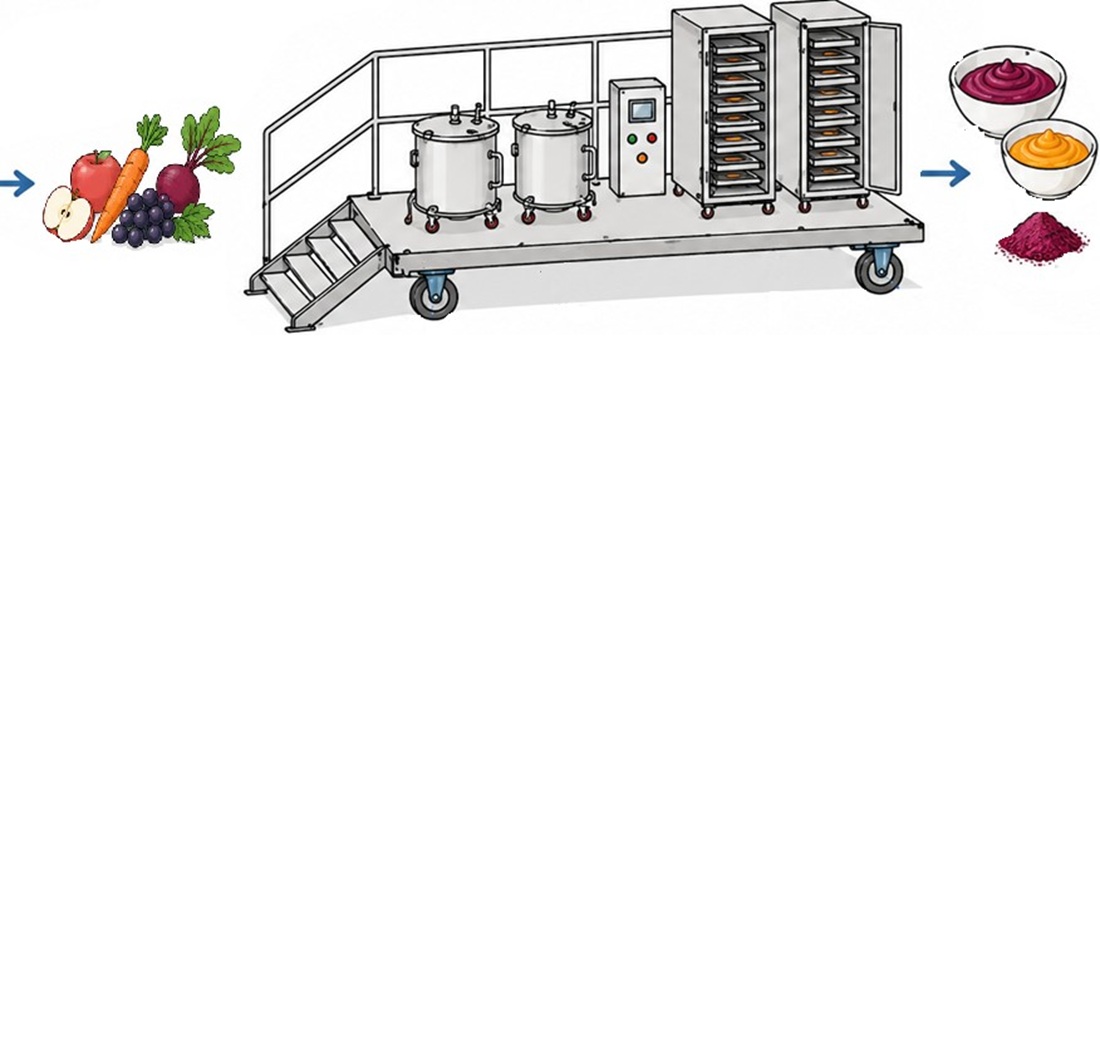
This study investigates processes of preliminary heat treatment of plant raw materials, using the example of heating a fruit and vegetable semi-finished product based on apples, carrots, beets, and elderberries, as well as partial drying of apple slices in an improved apparatus. The task addressed is to improve resource efficiency in implementing preliminary heat treatment of raw materials by improving a sectional cassette-capacitive apparatus.
A feature of the improved apparatus is the combination of capacitive and cassette stations on a truck platform, generation of a local heat supply from a film electric heater of the radiant type to eliminate the intermediate heat carrier, networks. The usable heat exchange surface of capacitive stations was increased from 0.98 m2 to 1.47 m2 through engineering by using mixing devices equipped with a heating surface. The multifunctionality of the device is formed by using a capacitive station equipped with a hemispherical perforated bubbler and hermetic covers with Peltier elements.
The capacitive station was tested on the kinetics of heating a semi-finished product (40% apple, 25% carrot, 25% beetroot, and 10% elderberry). It was established that the duration of reaching a gentle stationary mode within 55°C was reduced by 240 s (prototype – 360 s). The cassette station was tested on performing a preliminary thermal operation to dry apple slices to a content of 30…35% dry matter. The process is implemented in an improved device for 45…55 min, while convective drying – 70…85 min. Comparison of technical and technological parameters of the improved design with a steamer and a convective dryer shows a decrease in the specific metal capacity from 387 kg/m2 to 330 kg/m2. Total heat consumption for heating 75 kg of polycomponent puree-like plant mass reduced from 21353 kJ to 11309 kJ
References
- Konfo, T. R. C., Djouhou, F. M. C., Hounhouigan, M. H., Dahouenon-Ahoussi, E., Avlessi, F., Sohounhloue, C. K. D. (2023). Recent advances in the use of digital technologies in agri-food processing: A short review. Applied Food Research, 3 (2), 100329. https://doi.org/10.1016/j.afres.2023.100329
- Nazarova, L. V. (2014). Stan kharchovoi promyslovosti Ukrainy ta perspektyvy pidpryiemstv haluzi na zovnishnikh rynkakh. Available at: http://globalnational.in.ua
- Sashnova, M., Zahorulko, A., Savchenko, T., Gakhovich, S., Parkhomenko, I., Pankov, D. (2020). Improving the quality of the technological process of packaging shape formation based on the information structure of an automated system. Eastern-European Journal of Enterprise Technologies, 3 (2 (105)), 28–36. https://doi.org/10.15587/1729-4061.2020.205226
- Klymenko, N., Voronenko, I., Nehrey, M., Rogoza, K., Rogoza, N. (2023). Risk assessment of shock periods and investment attractiveness of agroholdings of Ukraine. Agricultural and Resource Economics: International Scientific E-Journal, 9 (2). https://doi.org/10.51599/are.2023.09.02.07
- Salifou, A., Konfo, C. T. R., Bokossa, A., Chabi, N. W., Tchobo, F. P., Soumanou, M. M. (2023). Innovative approaches in food processing: enhancing quality, preservation, and safety through advanced technologies: A review. World Journal of Advanced Research and Reviews, 20 (2), 637–648. https://doi.org/10.30574/wjarr.2023.20.2.2297
- Khojasteh, S. K., Elmizadeh, A., Sarraf, M., Dodange, S. (2025). Non-thermal innovations in solid food processing: Eco-friendly alternatives to thermal methods. Applied Food Research, 5 (2), 101256. https://doi.org/10.1016/j.afres.2025.101256
- Zahorulko, A., Zagorulko, A., Chuiko, L., Solomon, A., Sushko, L., Tesliuk, Y. et al. (2023). Improving the reactor for thickening organic plant-based polycomponent semi-finished products with high degree of readiness. Eastern-European Journal of Enterprise Technologies, 6 (11 (126)), 103–111. https://doi.org/10.15587/1729-4061.2023.294119
- König, L. M., Renner, B. (2019). Boosting healthy food choices by meal colour variety: results from two experiments and a just-in-time Ecological Momentary Intervention. BMC Public Health, 19 (1). https://doi.org/10.1186/s12889-019-7306-z
- Habanova, M., Saraiva, J. A., Holovicova, M., Moreira, S. A., Fidalgo, L. G., Haban, M. et al. (2019). Effect of berries/apple mixed juice consumption on the positive modulation of human lipid profile. Journal of Functional Foods, 60, 103417. https://doi.org/10.1016/j.jff.2019.103417
- Pylypenko, O. (2017). Development of Ukrainian food industry. Scientific Works of NUFT 2017, 23 (3), 15–25. Available at: http://www.irbis-nbuv.gov.ua/cgi-bin/irbis_nbuv/cgiirbis_64.exe?I21DBN=LINK&P21DBN=UJRN&Z21ID=&S21REF=10&S21CNR=20&S21STN=1&S21FMT=ASP_meta&C21COM=S&2_S21P03=FILA=&2_S21STR=Npnukht_2017_23_3_4
- Ruiz Rodríguez, L. G., Zamora Gasga, V. M., Pescuma, M., Van Nieuwenhove, C., Mozzi, F., Sánchez Burgos, J. A. (2021). Fruits and fruit by-products as sources of bioactive compounds. Benefits and trends of lactic acid fermentation in the development of novel fruit-based functional beverages. Food Research International, 140, 109854. https://doi.org/10.1016/j.foodres.2020.109854
- Zahorulko, A., Zagorulko, A., Mykhailov, V., Ibaiev, E. (2021). Improved rotary film evaporator for concentrating organic fruit and berry puree. Eastern-European Journal of Enterprise Technologies, 4 (11 (112)), 92–98. https://doi.org/10.15587/1729-4061.2021.237948
- Marković, M. S., Radosavljević, D. B., Pavićević, V. P., Ristić, M. S., Milojević, S. Ž., Bošković-Vragolović, N. M., Veljković, V. B. (2018). Influence of common juniper berries pretreatment on the essential oil yield, chemical composition and extraction kinetics of classical and microwave-assisted hydrodistillation. Industrial Crops and Products, 122, 402–413. https://doi.org/10.1016/j.indcrop.2018.06.018
- Telezhenko, L. N., Bezusov, A. T. (2004). Biologicheski aktivnye veshestva fruktov i ovoshey i ih sohranenie pri pererabotke. Odessa: Optimum, 268.
- Fellows, P. J. (2022). Properties of foods and principles of processing. Food Processing Technology, 3–95. https://doi.org/10.1016/b978-0-323-85737-6.00007-8
- Sruthy, G. N., Sandhya, K. R., Kumkum, C. R., Mythri, R., Sharma, M. (2022). Thermal processing technologies for food. Current Developments in Biotechnology and Bioengineering, 263–300. https://doi.org/10.1016/b978-0-323-91158-0.00014-4
- Zahorulko, A., Zagorulko, A., Cherevko, O., Dromenko, O., Solomon, A., Yakobchuk, R. et al. (2021). Determination of the heat transfer coefficient of a rotary film evaporator with a heating film-forming element. Eastern-European Journal of Enterprise Technologies, 6 (8 (114)), 41–47. https://doi.org/10.15587/1729-4061.2021.247283
- Dolores Alvarez, M., Canet, W. (2013). Time-independent and time-dependent rheological characterization of vegetable-based infant purees. Journal of Food Engineering, 114 (4), 449–464. https://doi.org/10.1016/j.jfoodeng.2012.08.034
- Reay, D. (2008). Heat recovery in the food industry. Handbook of Water and Energy Management in Food Processing, 544–569. https://doi.org/10.1533/9781845694678.4.544
- Ai, S., Wang, B., Li, X., Shi, W. (2016). Analysis of a heat recovery system of the spray-drying process in a soy protein powder plant. Applied Thermal Engineering, 103, 1022–1030. https://doi.org/10.1016/j.applthermaleng.2016.04.108
- de Chiara, M. L. V., Castagnini, J. M., Capozzi, V. (2024). Cutting-edge physical techniques in postharvest for fruits and vegetables: Unveiling their power, inclusion in ‘hurdle’ approach, and latest applications. Trends in Food Science & Technology, 151, 104619. https://doi.org/10.1016/j.tifs.2024.104619
- AlZohbi, G., Asfand, F., Shaik, F., Khan, M. I. (2026). Energy-efficient food drying for sustainable preservation: A review of technologies and performance. Renewable and Sustainable Energy Reviews, 235, 116918. https://doi.org/10.1016/j.rser.2026.116918
- Zahorulko, A. M., Zahorulko, O. Ye. (2021). Pat. No. 149981 UA. Plivkopodibnyi rezystyvnyi elektronahrivach vyprominiuiuchoho typu. No. u202102839; declareted: 28.05.2021; published: 23.12.2021.
- R-P-150m (MZ-2S-316) - Reaktor vakuum vyparnoy. Available at: https://www.oborud.info/product/jump.php?6109&c=619
- Cherevko, A., Mayak, O., Kostenko, S., Sardarov, A. (2019). Experimental and simulation modeling of the heat exchanche process while boiling vegetable juice. Prohresyvni tekhnika ta tekhnolohiyi kharchovykh vyrobnytstv restorannoho hospodarstva i torhivli, 1 (29), 75–85. Available at: http://nbuv.gov.ua/UJRN/Pt_2019_1_9
Downloads
Published
How to Cite
Issue
Section
License
Copyright (c) 2026 Andrii Zahorulko, Iryna Voronenko, Iryna Bozhydai, Hennadii Tesliuk, Olesya Lebedenko, Ruslan Zakharchenko, Oleksandr Kletskov, Eldar Ibaiev

This work is licensed under a Creative Commons Attribution 4.0 International License.
The consolidation and conditions for the transfer of copyright (identification of authorship) is carried out in the License Agreement. In particular, the authors reserve the right to the authorship of their manuscript and transfer the first publication of this work to the journal under the terms of the Creative Commons CC BY license. At the same time, they have the right to conclude on their own additional agreements concerning the non-exclusive distribution of the work in the form in which it was published by this journal, but provided that the link to the first publication of the article in this journal is preserved.
A license agreement is a document in which the author warrants that he/she owns all copyright for the work (manuscript, article, etc.).
The authors, signing the License Agreement with TECHNOLOGY CENTER PC, have all rights to the further use of their work, provided that they link to our edition in which the work was published.
According to the terms of the License Agreement, the Publisher TECHNOLOGY CENTER PC does not take away your copyrights and receives permission from the authors to use and dissemination of the publication through the world's scientific resources (own electronic resources, scientometric databases, repositories, libraries, etc.).
In the absence of a signed License Agreement or in the absence of this agreement of identifiers allowing to identify the identity of the author, the editors have no right to work with the manuscript.
It is important to remember that there is another type of agreement between authors and publishers – when copyright is transferred from the authors to the publisher. In this case, the authors lose ownership of their work and may not use it in any way.








