Development of an approach to the normalized functional for deviation in efficiency indicator
DOI:
https://doi.org/10.15587/1729-4061.2026.365105Keywords:
cybernetic control, efficiency criterion, ELF, normalized deviation index, mode selectionAbstract
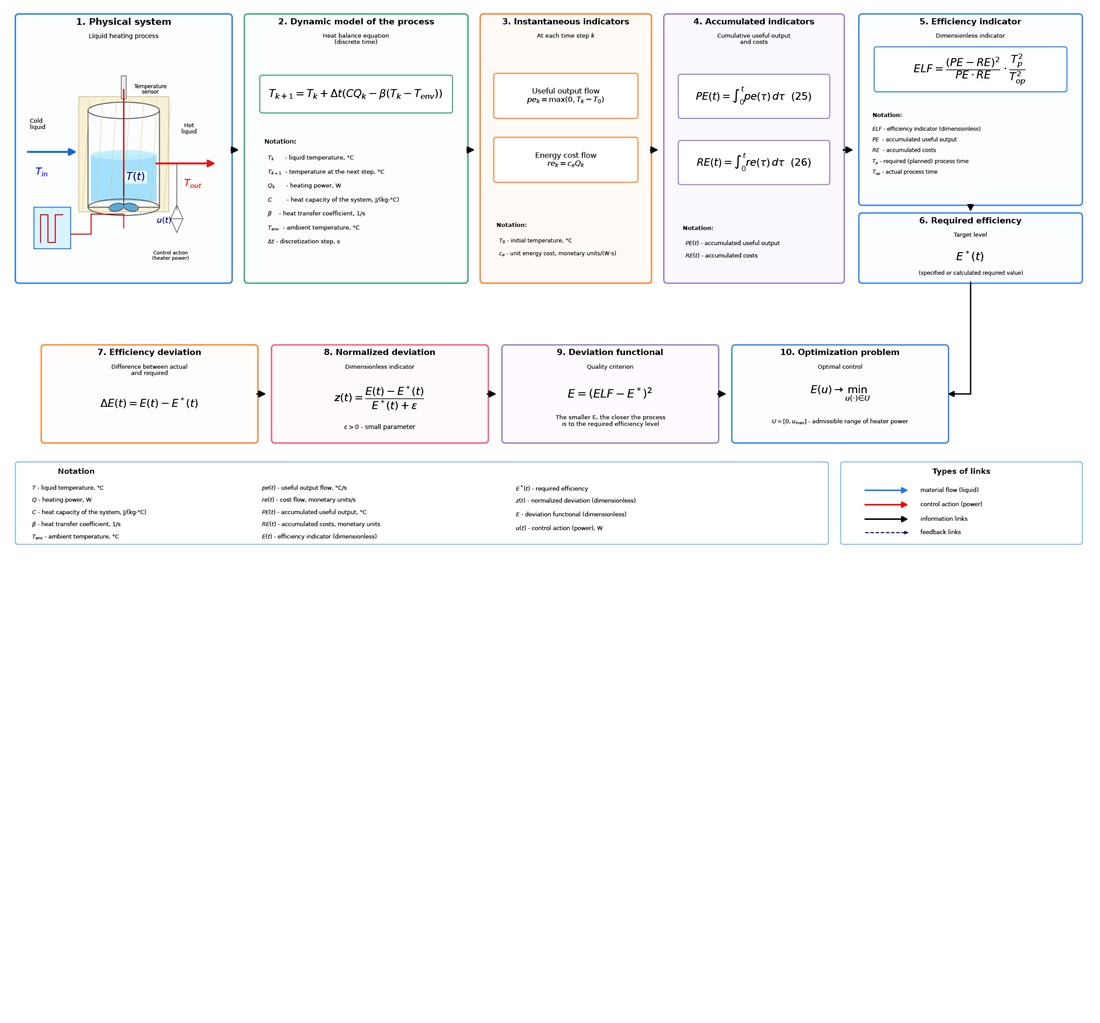
This study examines controlled technological process of heating liquid, which is considered as a cybernetic system for transforming resources into a usable technological product. The work investigates the possibility of constructing a normalized functional of deviation in the efficiency indicator in dynamic models of technological processes, used to synthesize optimal control effects. They provide a quantitative assessment of deviation of the actual efficiency from the required level and allow the application of optimal control methods.
The task addressed is to find a standardized indicator of efficiency deviation E, which would ensure the dimensionlessness of this indicator and its large-scale independence. It is a dimensionless quadratic measure of difference between the total useful result and the total costs. It has been shown that the parameter E has the properties of computational constancy and could be used for analysis, normalization, and comparison of various control modes.
The ELF (Normalized Efficiency Criterion) computing block has been designed, which makes it possible to convert input parameters into cost form, accumulate total costs and useful effect, form indicators of additional benefit and resource intensity, as well as calculate a normalized efficiency criterion. It is shown that ELF is an integrated indicator of efficiency as a ratio of additional benefit to the resource intensity of the permissible mode; the indicator E represents its normalized metric form.
The results make it possible to assess the effectiveness of the process in a quantitative way. And the functional E shows a deviation from the required mode, which gives the opportunity to conduct an analysis and make the right decisions in the management of a technological process.
The research findings could be used in any technological processes
References
- Ellis, M., Liu, J., Christofides, P. D. (2017). Economic Model Predictive Control. Springer International Publishing. https://doi.org/10.1007/978-3-319-41108-8
- Angeli, D., Amrit, R., Rawlings, J. B. (2012). On Average Performance and Stability of Economic Model Predictive Control. IEEE Transactions on Automatic Control, 57 (7), 1615–1626. https://doi.org/10.1109/tac.2011.2179349
- Hu, C., Chen, S., Wu, Z. (2023). Economic Model Predictive Control of Nonlinear Systems Using Online Learning of Neural Networks. Processes, 11 (2), 342. https://doi.org/10.3390/pr11020342
- Simkoff, J. M., Lejarza, F., Kelley, M. T., Tsay, C., Baldea, M. (2020). Process Control and Energy Efficiency. Annual Review of Chemical and Biomolecular Engineering, 11 (1), 423–445. https://doi.org/10.1146/annurev-chembioeng-092319-083227
- Orzan, A., Precup, R. (2023). Dinkelbach Type Approximation Algorithms for Nonlinear Fractional Optimization Problems. Numerical Functional Analysis and Optimization, 44 (9), 954–969. https://doi.org/10.1080/01630563.2023.2217893
- Bertsekas, D. P. (2005). Dynamic Programming and Optimal Control. Athena Scientific. Available at: https://web.mit.edu/dimitrib/www/DP1_Short_View.pdf
- Bryson, A. E., Ho, Y.-C. (2018). Applied Optimal Control. Routledge. https://doi.org/10.1201/9781315137667
- Goodwin, G. C., Graebe, S. F., Salgado, M. E. (2001). Control System Design. Prentice Hall.
- Santander, O., Betts, C. L., Archer, E. E., Baldea, M. (2020). On the interaction and integration of production planning and (advanced) process control. Computers & Chemical Engineering, 133, 106627. https://doi.org/10.1016/j.compchemeng.2019.106627
- Dorf, R. C., Bishop, R. H. (2016). Modern Control Systems. Pearson. Available at: http://pdf.lib.vntu.edu.ua/books/2021/Dorf_Modern_control_systems_2017_1106.pdf
- Åström, K. J., Murray, R. M. (2020). Feedback Systems: An Introduction for Scientists and Engineers. Princeton University Press. Available at: https://www.cds.caltech.edu/~murray/books/AM08/pdf/fbs-public_24Jul2020.pdf
- Rawlings, J. B., Mayne, D. Q., Diehl, M. (2017). Model Predictive Control: Theory, Computation, and Design. Nob Hill Publishing. Available at: https://sites.engineering.ucsb.edu/~jbraw/mpc/MPC-book-2nd-edition-1st-printing.pdf
- Li, H., Pangborn, H. C., Kovalenko, I. (2023). A System-Level Energy-Efficient Digital Twin Framework for Runtime Control of Batch Manufacturing Processes. 2023 IEEE 19th International Conference on Automation Science and Engineering (CASE), 1–6. https://doi.org/10.1109/case56687.2023.10260642
- Bertsekas, D. P. (2019). Reinforcement Learning and Optimal Control. Athena Scientific. Available at: https://faculty.engineering.asu.edu/bertsekas/wp-content/uploads/sites/129/2019/10/RL_Frontmatter-SHORT-INTERNET-POSTED.pdf
- Lutsenko, I. (2026). Development of a universal integral criterion for cybernetic control. Eastern-European Journal of Enterprise Technologies, 2 (4 (140)), 6–15. https://doi.org/10.15587/1729-4061.2026.356114
- Lutsenko, I. (2015). Identification of target system operations. development of global efficiency criterion of target operations. Eastern-European Journal of Enterprise Technologies, 2 (2 (74)), 35–40. https://doi.org/10.15587/1729-4061.2015.38963
Downloads
Published
How to Cite
Issue
Section
License
Copyright (c) 2026 Igor Lutsenko, Iryna Oksanych, Maksim Drachko, Evgeniia Burdilna

This work is licensed under a Creative Commons Attribution 4.0 International License.
The consolidation and conditions for the transfer of copyright (identification of authorship) is carried out in the License Agreement. In particular, the authors reserve the right to the authorship of their manuscript and transfer the first publication of this work to the journal under the terms of the Creative Commons CC BY license. At the same time, they have the right to conclude on their own additional agreements concerning the non-exclusive distribution of the work in the form in which it was published by this journal, but provided that the link to the first publication of the article in this journal is preserved.
A license agreement is a document in which the author warrants that he/she owns all copyright for the work (manuscript, article, etc.).
The authors, signing the License Agreement with TECHNOLOGY CENTER PC, have all rights to the further use of their work, provided that they link to our edition in which the work was published.
According to the terms of the License Agreement, the Publisher TECHNOLOGY CENTER PC does not take away your copyrights and receives permission from the authors to use and dissemination of the publication through the world's scientific resources (own electronic resources, scientometric databases, repositories, libraries, etc.).
In the absence of a signed License Agreement or in the absence of this agreement of identifiers allowing to identify the identity of the author, the editors have no right to work with the manuscript.
It is important to remember that there is another type of agreement between authors and publishers – when copyright is transferred from the authors to the publisher. In this case, the authors lose ownership of their work and may not use it in any way.








