Development of technology for the production of corn malt using plasmochemically activated aqueous solutions
DOI:
https://doi.org/10.15587/1729-4061.2026.365166Keywords:
corn malt, plasma chemical activation, hydrogen peroxide, germination enhancer, sprouted cornAbstract
The object of the study is the production of corn malt. The problem of developing an innovative technology for the production of high-quality and universal corn malt is being solved.
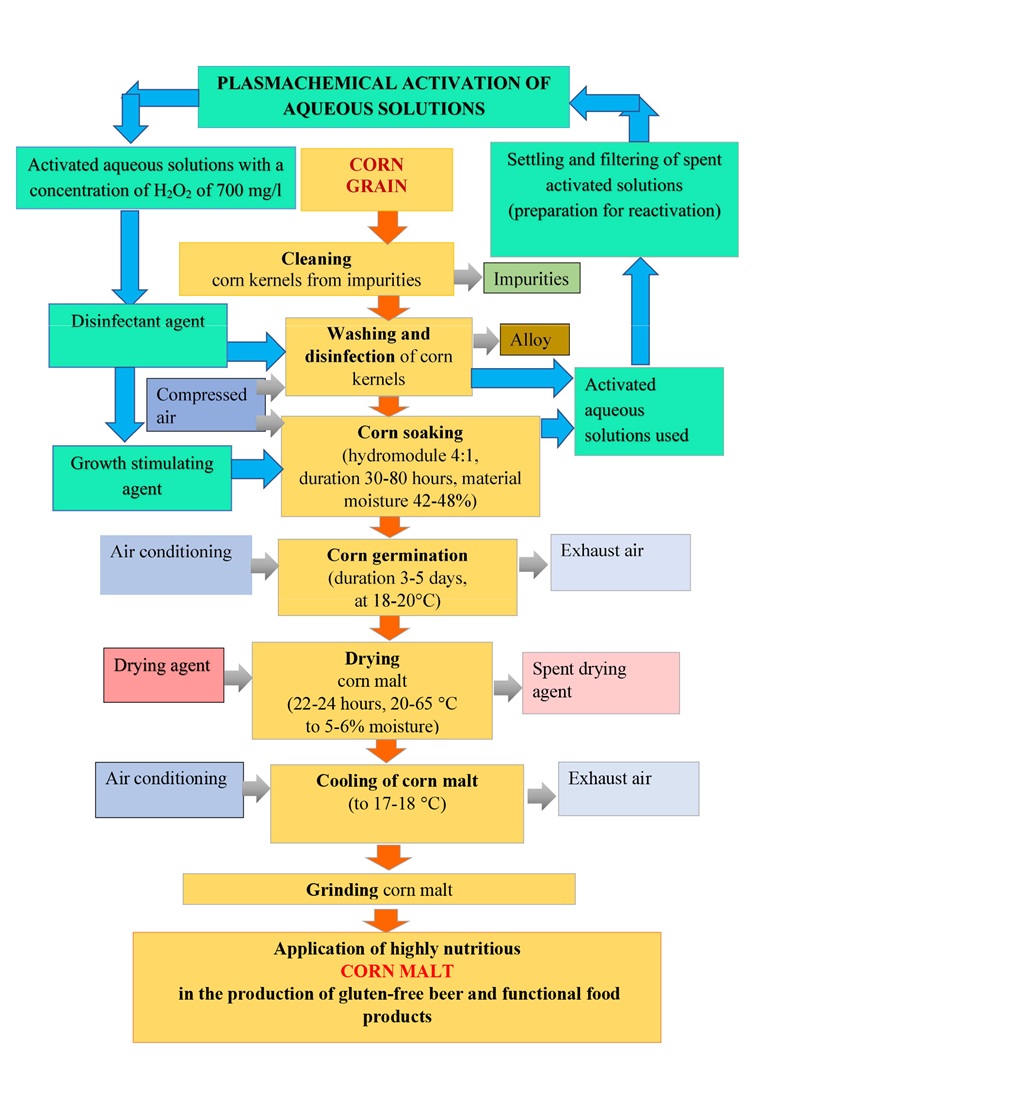
The rationality of using plasma-chemically activated solutions as an intensifier of corn grain malting, as well as a disinfectant agent in the implementation of the technological process and obtaining corn malt, has been experimentally proven. It has been established that the use of plasma-chemically activated aqueous solutions allows stimulating the process of soaking and germination of corn. The germination energy increased by 2–12%, the germination capacity by 2–9%. The moisture content of corn grain reached 42% 2.5 times faster. Monitoring of enzymatic activity showed a dynamic increase in the number of amylolytic enzymes by 2.8–3.4 times. The number of proteolytic enzymes increased from 19 units/g on the first day of germination and reached a maximum of 256 units/g on the fifth day. The total number of amino acids increased by 9.5%. An increase in the content of vitamins A, D, E, B1, C was observed, the number of which increased by 14–25%. Technological characteristics of malt showed an increase in extractability by 5.7%, saccharification time decreased to 15 minutes, acidity decreased by 0.3 units, and the content of amine nitrogen increased by 52.7 mg/100 g. Stable disinfectant properties of solutions in relation to corn malt were noted. The results indicate the production of high-quality corn malt.
The presented technology can be used in the production of high-quality gluten-free corn malts. In addition, germinated corn has functional properties and can become a valuable component in the production of dietary gluten-free products.
The result of the study is the development of a technology for the production of corn malt using plasma-chemically activated aqueous solutions
References
- Ai, Y., Jane, J.-l. (2016). Macronutrients in Corn and Human Nutrition. Comprehensive Reviews in Food Science and Food Safety, 15 (3), 581–598. https://doi.org/10.1111/1541-4337.12192
- Piazza, S., Bani, C., Colombo, F., Mercogliano, F., Pozzoli, C., Martinelli, G. et al. (2024). Pigmented corn as a gluten-free source of polyphenols with anti-inflammatory and antioxidant properties in CaCo-2 cells. Food Research International, 191, 114640. https://doi.org/10.1016/j.foodres.2024.114640
- Bandeira, C. M., Evangelista, W. P., Gloria, M. B. A. (2012). Bioactive amines in fresh, canned and dried sweet corn, embryo and endosperm and germinated corn. Food Chemistry, 131 (4), 1355–1359. https://doi.org/10.1016/j.foodchem.2011.09.135
- Flores-Calderón, A. M. D., Luna, H., Escalona-Buendía, H. B., Verde-Calvo, J. R. (2017). Chemical characterization and antioxidant capacity in blue corn (Zea maysL.) malt beers. Journal of the Institute of Brewing, 123 (4), 506–518. https://doi.org/10.1002/jib.444
- Romano, G., Tufariello, M., Calabriso, N., Del Coco, L., Fanizzi, F. P., Blanco, A. et al. (2023). Pigmented cereals and legume grains as healthier alternatives for brewing beers. Food Bioscience, 52, 102463. https://doi.org/10.1016/j.fbio.2023.102463
- Ledley, A. J., Elias, R. J., Hopfer, H., Cockburn, D. W. (2021). A Modified Brewing Procedure Informed by the Enzymatic Profiles of Gluten-Free Malts Significantly Improves Fermentable Sugar Generation in Gluten-Free Brewing. Beverages, 7 (3), 53. https://doi.org/10.3390/beverages7030053
- Dabija, A., Ciocan, M. E., Chetrariu, A., Codină, G. G. (2021). Maize and Sorghum as Raw Materials for Brewing, a Review. Applied Sciences, 11 (7), 3139. https://doi.org/10.3390/app11073139
- Cadenas, R., Caballero, I., Nimubona, D., Blanco, C. A. (2021). Brewing with Starchy Adjuncts: Its Influence on the Sensory and Nutritional Properties of Beer. Foods, 10 (8), 1726. https://doi.org/10.3390/foods10081726
- Sokrab, A. M., Mohamed Ahmed, I. A., Babiker, E. E. (2012). Effect of germination on antinutritional factors, total, and extractable minerals of high and low phytate corn (Zea mays L.) genotypes. Journal of the Saudi Society of Agricultural Sciences, 11 (2), 123–128. https://doi.org/10.1016/j.jssas.2012.02.002
- Gong, K., Chen, L., Li, X., Sun, L., Liu, K. (2018). Effects of germination combined with extrusion on the nutritional composition, functional properties and polyphenol profile and related in vitro hypoglycemic effect of whole grain corn. Journal of Cereal Science, 83, 1–8. https://doi.org/10.1016/j.jcs.2018.07.002
- Partichelli, C. P., Silveira, V. C. C., Manfroi, V., Rodrigues, R. C. (2024). Exogenous enzymes for gluten-free beer production: A review of the industrial practice and its implications for scientific research. Innovative Food Science & Emerging Technologies, 95, 103709. https://doi.org/10.1016/j.ifset.2024.103709
- Ledley, A. J., Elias, R. J., Cockburn, D. W. (2024). The role of starch digestion in the brewing of gluten-free beers. Food Bioscience, 61, 104949. https://doi.org/10.1016/j.fbio.2024.104949
- Hager, A.-S., Taylor, J. P., Waters, D. M., Arendt, E. K. (2014). Gluten free beer – A review. Trends in Food Science & Technology, 36 (1), 44–54. https://doi.org/10.1016/j.tifs.2014.01.001
- Cela, N., Galgano, F., Perretti, G., Di Cairano, M., Tolve, R., Condelli, N. (2022). Assessment of brewing attitude of unmalted cereals and pseudocereals for gluten free beer production. Food Chemistry, 384, 132621. https://doi.org/10.1016/j.foodchem.2022.132621
- Kerpes, R., Fischer, S., Becker, T. (2017). The production of gluten-free beer: Degradation of hordeins during malting and brewing and the application of modern process technology focusing on endogenous malt peptidases. Trends in Food Science & Technology, 67, 129–138. https://doi.org/10.1016/j.tifs.2017.07.004
- Canelo-Álvarez, F., Figueroa-Cárdenas, J. d. D., Martínez-Cruz, E., Pérez-Robles, J. F., Arámbula Villa, G., Mariscal-Moreno, R. M., Véles Medina, J. J. (2023). Effect of nixtamalization on gluten-free whole corn, dough viscoelasticity, and the bread-making quality of leavened corn bread. International Journal of Gastronomy and Food Science, 31, 100648. https://doi.org/10.1016/j.ijgfs.2022.100648
- Olaimat, A. N., Al-Rousan, W. M., Al-Marazeeq, K. M., Osaili, T. M., Ajo, R. Y., Angor, M., Holley, R. A. (2023). Physicochemical and sensory characteristics of gluten-free corn-based biscuit supplemented with walnut and peanut for celiac patients. Journal of the Saudi Society of Agricultural Sciences, 22 (7), 413–419. https://doi.org/10.1016/j.jssas.2023.03.007
- Bresciani, A., Giordano, D., Vanara, F., Blandino, M., Marti, A. (2021). High-amylose corn in gluten-free pasta: Strategies to deliver nutritional benefits ensuring the overall quality. Food Chemistry, 353, 129489. https://doi.org/10.1016/j.foodchem.2021.129489
- Francisco, Á. R., José, d. l. R. M., Igor, H. (2021). Development of a no added sugar kombucha beverage based on germinated corn. International Journal of Gastronomy and Food Science, 24, 100355. https://doi.org/10.1016/j.ijgfs.2021.100355
- Kumar, S., Paramasivan, K., Mutturi, S. (2025). Microbiology and health benefits of beer. Microbiology and Health Benefits of Traditional Alcoholic Beverages, 65–90. https://doi.org/10.1016/b978-0-443-13322-0.00010-1
- Tovar, G. I., Briceño, S., Suarez, J., Flores, S., González, G. (2020). Biogenic synthesis of iron oxide nanoparticles using Moringa oleifera and chitosan and its evaluation on corn germination. Environmental Nanotechnology, Monitoring & Management, 14, 100350. https://doi.org/10.1016/j.enmm.2020.100350
- He, W., Wang, Y., Dai, Z., Liu, C., Xiao, Y., Wei, Q. et al. (2019). Effect of UV-B radiation and a supplement of CaCl2 on carotenoid biosynthesis in germinated corn kernels. Food Chemistry, 278, 509–514. https://doi.org/10.1016/j.foodchem.2018.11.089
- Paucar-Menacho, L. M., Martínez-Villaluenga, C., Dueñas, M., Frias, J., Peñas, E. (2017). Optimization of germination time and temperature to maximize the content of bioactive compounds and the antioxidant activity of purple corn (Zea mays L.) by response surface methodology. LWT - Food Science and Technology, 76, 236–244. https://doi.org/10.1016/j.lwt.2016.07.064
- Kovaliova, O., Pivovarov, O., Kalyna, V., Tchoursinov, Y., Kunitsia, E., Chernukha, A. et al. (2020). Implementation of the plasmochemical activation of technological solutions in the process of ecologization of malt production. Eastern-European Journal of Enterprise Technologies, 5 (10 (107)), 26–35. https://doi.org/10.15587/1729-4061.2020.215160
- Pivovarov, O., Kovaliova, O., Koshulko, V. (2020). Effect of plasmochemically activated aqueous solution on process of food sprouts production. Ukrainian Food Journal, 9 (3), 576–587. https://doi.org/10.24263/2304-974x-2020-9-3-7
- Kovalova, O., Vasylieva, N., Haliasnyi, I., Gavrish, T., Dikhtyar, A., Andrieieva, S. et al. (2023). Development of buckwheat groats production technology using plasma-chemically activated aqueous solutions. Eastern-European Journal of Enterprise Technologies, 6 (11 (126)), 59–72. https://doi.org/10.15587/1729-4061.2023.290584
- Kovalova, O., Vasylieva, N., Stankevych, S., Zabrodina, I., Haliasnyi, I., Gontar, T. et al. (2023). Determining the effect of plasmochemically activated aqueous solutions on the bioactivation process of sea buckthorn seeds. Eastern-European Journal of Enterprise Technologies, 2 (11 (122)), 99–111. https://doi.org/10.15587/1729-4061.2023.275548
- Kovalova, O., Vasylieva, N., Haliasnyi, I., Gavrish, T., Dikhtyar, A., Andrieieva, S. et al. (2024). Development of technology for the production of all-purpose buckwheat malt using plasmochemically activated aqueous solutions. Eastern-European Journal of Enterprise Technologies, 1 (11 (127)), 38–51. https://doi.org/10.15587/1729-4061.2024.298797
- Kovalova, O., Vasylieva, N., Dikhtyar, A., Andrieieva, S., Omelchenko, S., Kotliar, O. et al. (2024). Development of oat malt production technology using plasma-chemically activated aqueous solutions. Eastern-European Journal of Enterprise Technologies, 5 (11 (131)), 80–91. https://doi.org/10.15587/1729-4061.2024.311477
- Kovaliova, O., Vasylieva, N., Stankevych, S., Zabrodina, I., Mandych, O., Hontar, T. et al. (2023). Development of a technology for the production of germinated flaxseed using plasma-chemically activated aqueous solutions. Eastern-European Journal of Enterprise Technologies, 4 (11 (124)), 6–19. https://doi.org/10.15587/1729-4061.2023.284810
- Kovalova, O., Vasylieva, N., Zhulinska, O., Balandina, I., Zhukova, L., Bezpal’ko, V. et al. (2024). Development of lentil malt production technology using plasma-chemically activated aqueous solutions. Eastern-European Journal of Enterprise Technologies, 4 (11 (130)), 76–86. https://doi.org/10.15587/1729-4061.2024.308298
- Cetinkaya-Rundel, R., Hardin, J. (2021). Introduction to Modern Statistics. OpenIntro, 549.
- Greene, W. (2017). Econometric Analysis. London: Pearson Learning Solutions, 1176.
- Vasylieva, N., Pugach, A. (2017). Economic assessment of technical maintenance in grain production of Ukrainian agriculture. Bulgarian Journal of Agricultural Science, 23 (2), 198–203. Available at: https://www.agrojournal.org/23/02-04.pdf
- Chaves-López, C., Rossi, C., Maggio, F., Paparella, A., Serio, A. (2020). Changes Occurring in Spontaneous Maize Fermentation: An Overview. Fermentation, 6 (1), 36. https://doi.org/10.3390/fermentation6010036
- Geißinger, C., Gastl, M., Becker, T. (2021). Enzymes from Cereal and Fusarium Metabolism Involved in the Malting Process – A Review. Journal of the American Society of Brewing Chemists, 80 (1), 1–16. https://doi.org/10.1080/03610470.2021.1911272
Downloads
Published
How to Cite
Issue
Section
License
Copyright (c) 2026 Olena Kovalova, Natalia Vasylieva, Tatiana Gontar, Yana Svishchova, Oleg Kolontaievskyi, Anna Sokolenko, Inna Zabrodina, Serhii Stankevych, Tetiana Novozhylova, Maryna Ponomarova

This work is licensed under a Creative Commons Attribution 4.0 International License.
The consolidation and conditions for the transfer of copyright (identification of authorship) is carried out in the License Agreement. In particular, the authors reserve the right to the authorship of their manuscript and transfer the first publication of this work to the journal under the terms of the Creative Commons CC BY license. At the same time, they have the right to conclude on their own additional agreements concerning the non-exclusive distribution of the work in the form in which it was published by this journal, but provided that the link to the first publication of the article in this journal is preserved.
A license agreement is a document in which the author warrants that he/she owns all copyright for the work (manuscript, article, etc.).
The authors, signing the License Agreement with TECHNOLOGY CENTER PC, have all rights to the further use of their work, provided that they link to our edition in which the work was published.
According to the terms of the License Agreement, the Publisher TECHNOLOGY CENTER PC does not take away your copyrights and receives permission from the authors to use and dissemination of the publication through the world's scientific resources (own electronic resources, scientometric databases, repositories, libraries, etc.).
In the absence of a signed License Agreement or in the absence of this agreement of identifiers allowing to identify the identity of the author, the editors have no right to work with the manuscript.
It is important to remember that there is another type of agreement between authors and publishers – when copyright is transferred from the authors to the publisher. In this case, the authors lose ownership of their work and may not use it in any way.








