Identification the impact of carbon addition on phase formation and electrochemical performance of LiFePO4/C synthesized from ferronickel-derived FePO4
DOI:
https://doi.org/10.15587/1729-4061.2026.365363Keywords:
LiFePO4, ferronickel-derived FePO4, carbon addition, phase formation, cathode materialsAbstract
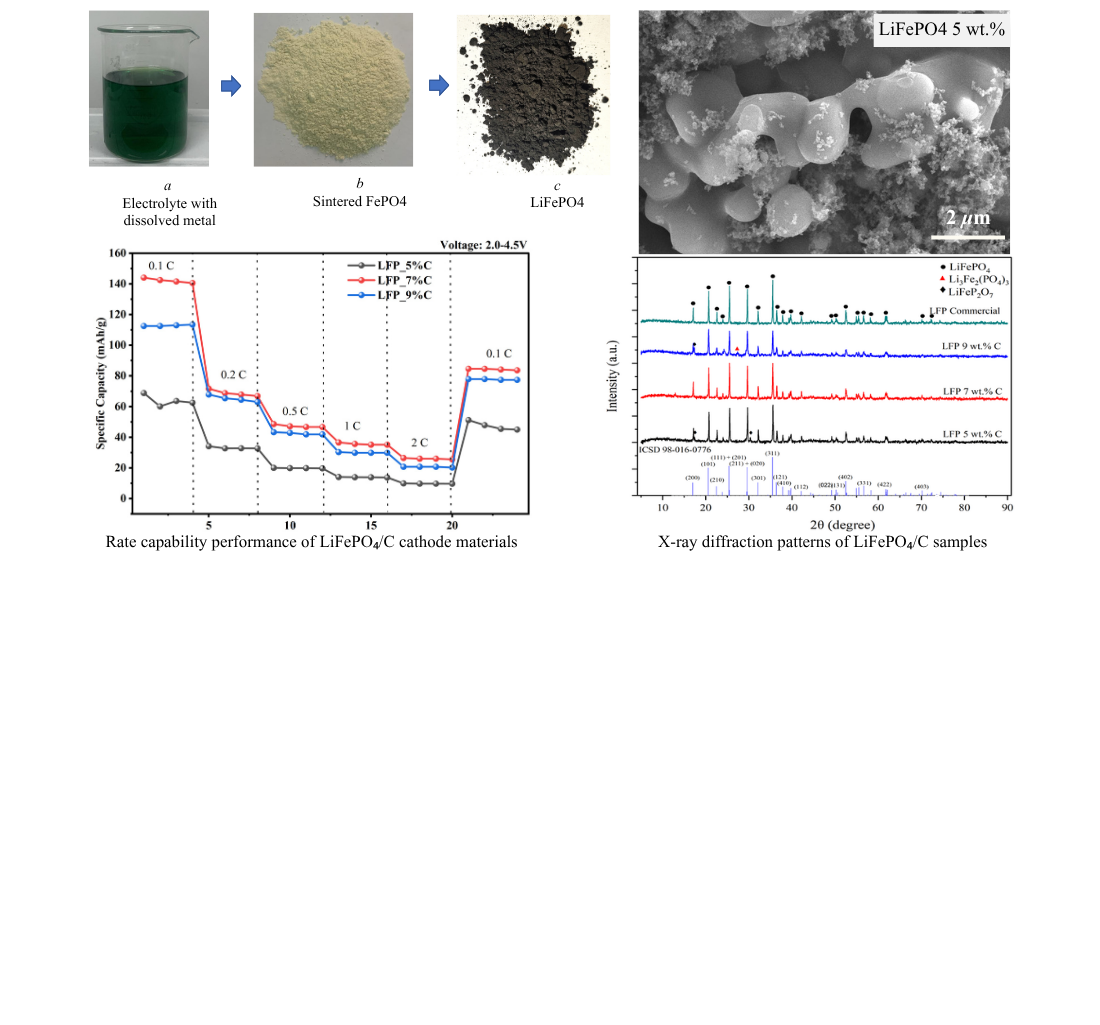
The object of this study was LiFePO4/C cathode material synthesized using a ferronickel-derived FePO4 precursor, with the main focus is the effect of carbon addition on phase formation and electrochemical performance. The problem was how carbon addition affects olivine LiFePO4 phase formation, impurity suppression, microstructure, and electrochemical performance when a non-commercial ferronickel-derived iron precursor is used. The precursor was mixed with LiOH as a lithium source and varying amounts of carbon from Super P: 5 wt.%, 7 wt.%, and 9 wt.%. Carbon addition influenced the formation of olivine LiFePO4. At 7 wt.% LFP/C, the diffraction pattern was dominated by the LiFePO4 phase, around 99.60% based on Rietveld refinement. The absence of detectable Ni by EDX suggests that Ni carryover from the ferronickel-derived precursor was minimized. The results suggest that ferronickel-derived FePO4 can be used as a precursor for LiFePO4/C synthesis, and carbon addition promotes phase development with 7 wt.% as the optimum composition. The results can be practically used as a basis for developing value-added LiFePO4/C cathode materials from ferronickel-derived iron resources under controlled synthesis conditions, particularly when the FePO4 precursor purity is maintained, Super P carbon is used in the range of 5–9 wt.%, and the material is processed by ball milling, preheating at 300°C, and calcination at 650°C under an argon atmosphere. The 7 wt.% LFP/C sample had a specific capacity of 140 mAh g⁻1 at 0.1 C, but electrochemical performance still requires optimization due to particle interconnection and agglomeration. EIS data show that 7 wt.% carbon is the most favorable composition in terms of charge-transfer resistance (34.91 Ω) and conductivity (2.79 × 10⁻4 S/cm), while 9 wt.% carbon provided the best lithium-ion diffusion characteristics (1.96 × 10⁻13 cm2 s⁻1). These results indicate that ferronickel-derived iron resources have strong potential to be converted into value-added battery cathode materials
References
- Mohamed, N., Allam, N. K. (2020). Recent advances in the design of cathode materials for Li-ion batteries. RSC Advances, 10 (37), 21662–21685. https://doi.org/10.1039/d0ra03314f
- Seher, J., Fröba, M. (2021). Shape Matters: The Effect of Particle Morphology on the Fast-Charging Performance of LiFePO4/C Nanoparticle Composite Electrodes. ACS Omega, 6 (37), 24062–24069. https://doi.org/10.1021/acsomega.1c03432
- Lara, C., Maril, M., Tobosque, P., Núñez, J., Pizarro, L., Carrasco, C. (2025). Comprehensive analysis of improved LiFePO4 kinetics: Understanding barriers to fast charging. Journal of Power Sources, 640, 236747. https://doi.org/10.1016/j.jpowsour.2025.236747
- Kaur, G., Gates, B. D. (2022). Review – Surface Coatings for Cathodes in Lithium Ion Batteries: From Crystal Structures to Electrochemical Performance. Journal of the Electrochemical Society, 169 (4), 43504. https://doi.org/10.1149/1945-7111/ac60f3
- Chen, S.-P., Lv, D., Chen, J., Zhang, Y.-H., Shi, F.-N. (2022). Review on Defects and Modification Methods of LiFePO4 Cathode Material for Lithium-Ion Batteries. Energy & Fuels, 36 (3), 1232–1251. https://doi.org/10.1021/acs.energyfuels.1c03757
- Kang, H., Wang, G., Guo, H., Chen, M., Luo, C., Yan, K. (2012). Facile Synthesis and Electrochemical Performance of LiFePO4/C Composites Using Fe–P Waste Slag. Industrial & Engineering Chemistry Research, 51 (23), 7923–7931. https://doi.org/10.1021/ie300088p
- Kumar, K., Kumar, S., Sen, A., Mediboyana, H., Bag, S. S., Kundu, R. (2024). Utilizing Cold Rolling Mill Iron Oxide To Synthesize Lithium Iron Phosphate for Li-Ion Batteries. ACS Sustainable Resource Management, 1 (6), 1185–1194. https://doi.org/10.1021/acssusresmgt.4c00065
- Khalil, S. B., Broughel, A. (2025). Stainless success, battery lag: Evaluation of Indonesia’s resource nationalism in nickel. The Extractive Industries and Society, 23, 101677. https://doi.org/10.1016/j.exis.2025.101677
- Jeong, T., Mohanty, S. K., Kwon, W. J., Reddy, S. C., Pati, A. R., Ryu, J. H., Yoo, H. D. (2025). Tailoring iron phosphate precursors via microcrystallization for high-performance lithium iron phosphate cathodes in lithium-ion batteries. Journal of Materials Chemistry A, 13 (22), 16694–16703. https://doi.org/10.1039/d5ta00679a
- Yuan, Y., Hu, J., Wang, L., Li, Y., Yao, Y. (2024). Structural properties and electrochemical performance of different polymorphs of FePO4 as raw materials for lithium ion electrodes. Journal of Materials Chemistry C, 12 (18), 6511–6518. https://doi.org/10.1039/d4tc00957f
- Song, Y., Fu, Z. (2024). Mini-Review on the Preparation of Iron Phosphate for Batteries. Energy & Fuels, 38 (19), 18194–18207. https://doi.org/10.1021/acs.energyfuels.4c02533
- Shen, Z.-Z., Wang, R.-X., Yuan, H.-Y., Guo, Y., Xiao, D., Meng, Y. (2025). Waste to treasure: A sustainable technic to prepare high-performance lithium iron phosphate from laterite nickel tailings. Separation and Purification Technology, 353, 128489. https://doi.org/10.1016/j.seppur.2024.128489
- Chang, L., Wei, A., Luo, S., Bi, X., Yang, W., Yang, R., Liu, J. (2023). Preparation of LiFePO4/C cathode material by extracting Fe2O3 from laterite nickel ore by ammonium jarosite method. Journal of Alloys and Compounds, 936, 168078. https://doi.org/10.1016/j.jallcom.2022.168078
- Ishtiaq, S., Majid, A., Qadeer, A., Alkhedher, M., Bulut, N. (2025). Recent progress in carbon coating and surface modification of LiFePO4 cathodes. RSC Advances, 15 (50), 42331–42346. https://doi.org/10.1039/d5ra05833c
- Yuan, Y., Zhou, W., Dai, X., Wu, F., Chen, H., Mai, Y. et al. (2025). Regulation of nano FePO4 precursors and exploration of influencing mechanisms in LiFePO4/C cathode. New Journal of Chemistry, 49 (5), 1802–1813. https://doi.org/10.1039/d4nj04412f
- Zhi, X., Liang, G., Wang, L., Ou, X., Gao, L., Jie, X. (2010). Optimization of carbon coatings on LiFePO4: Carbonization temperature and carbon content. Journal of Alloys and Compounds, 503 (2), 370–374. https://doi.org/10.1016/j.jallcom.2010.02.173
- Ma, G., Luo, X., Cheng, M., Ju, D. (2025). Effect of impurities in FePO4 raw materials on the performance of LiFePO4 cathode materials. Scientific Reports, 15 (1). https://doi.org/10.1038/s41598-025-99729-8
- Syahrial, A. Z., Astini, V., M.S, J. W. (2025). Electrolysis and precipitation-based purification of ferronickel for high-purity nickel production. Eastern-European Journal of Enterprise Technologies, 3 (6 (135)), 46–53. https://doi.org/10.15587/1729-4061.2025.324608
- Astini, V., Meirawati, S., Nengsih, S., -, A., -, H., Soedarsono, J. W. M., Zulfia, A. (2024). Influence of Electrolyte Molarity and Applied Voltage on the Purification of Ferronickel by Electrolysis Method. Metalurgi, 39 (1), 7. https://doi.org/10.55981/metalurgi.2024.742
- Kashi, R., Khosravi, M., Mollazadeh, M. (2018). Effect of carbon precursor on electrochemical performance of LiFePO4-C nano composite synthesized by ultrasonic spray pyrolysis as cathode active material for Li ion battery. Materials Chemistry and Physics, 203, 319–332. https://doi.org/10.1016/j.matchemphys.2017.10.021
- Li, B., Xiao, J., Zhu, X., Wu, Z., Zhang, X., Han, Y. et al. (2024). Enabling high-performance lithium iron phosphate cathodes through an interconnected carbon network for practical and high-energy lithium-ion batteries. Journal of Colloid and Interface Science, 653, 942–948. https://doi.org/10.1016/j.jcis.2023.09.133
- Zhang, T., Lin, S., Yu, J. (2022). Influence Mechanism of Precursor Crystallinity on Electrochemical Performance of LiFePO4/C Cathode Material. Industrial & Engineering Chemistry Research, 61 (15), 5181–5190. https://doi.org/10.1021/acs.iecr.1c04784
- Zhang, S. M., Zhang, J. X., Xu, S. J., Yuan, X. J., Tian, T. (2013). Synthesis of Nano-Sized FePO4 Cathode Material via a Microemulsion Technique. Applied Mechanics and Materials, 320, 675–682. https://doi.org/10.4028/www.scientific.net/amm.320.675
- Hsieh, C.-T., Pai, C.-T., Chen, Y.-F., Chen, I.-L., Chen, W.-Y. (2014). Preparation of lithium iron phosphate cathode materials with different carbon contents using glucose additive for Li-ion batteries. Journal of the Taiwan Institute of Chemical Engineers, 45 (4), 1501–1508. https://doi.org/10.1016/j.jtice.2013.12.017
- Rajoba, S. J., Jadhav, L. D., Kalubarme, R. S., Yadav, S. N. (2019). Influence of synthesis parameters on the physicochemical and electrochemical properties of LiFePO4 for Li-ion battery. Journal of Alloys and Compounds, 774, 841–847. https://doi.org/10.1016/j.jallcom.2018.09.325
- Ravet, N., Gauthier, M., Zaghib, K., Goodenough, Mauger, A., Gendron, F. (2007). Mechanism of the Fe3+ Reduction at Low Temperature for LiFePO4 Synthesis from a Polymeric Additive. Chemistry of Materials, 19 (10), 2595–2602. https://doi.org/10.1021/cm070485r
- Feng, H., Milev, A. S., Kannangara, G. S. K. (2014). Novel Co-Precipitation Method for Synthesis of Carbon-Free LiFePO4. ECS Meeting Abstracts, MA2014-01 (2), 250. https://doi.org/10.1149/ma2014-01/2/250
- Zhang, S. S., Allen, J. L., Xu, K., Jow, T. R. (2005). Optimization of reaction condition for solid-state synthesis of LiFePO4-C composite cathodes. Journal of Power Sources, 147 (1-2), 234–240. https://doi.org/10.1016/j.jpowsour.2005.01.004
- Scaccia, S., Carewska, M., Wisniewski, P., Prosini, P. P. (2003). Morphological investigation of sub-micron FePO4 and LiFePO4 particles for rechargeable lithium batteries. Materials Research Bulletin, 38 (7), 1155–1163. https://doi.org/10.1016/s0025-5408(03)00110-7
- Dadwal, K., Fábián, M., Tolnai, I., Sharma, S., Kaur, R., Gracheva, M. et al. (2025). Neutron, X-ray diffraction, DSC, Raman, Mössbauer and leaching studies of iron phosphate glasses and crystalline phases. RSC Advances, 15 (7), 5286–5304. https://doi.org/10.1039/d5ra00295h
Downloads
Published
How to Cite
Issue
Section
License
Copyright (c) 2026 Vita Astini, Anne Zulfia Syahrial, Achmad Subhan, Johny Wahyuadi Mudaryoto Soedarsono

This work is licensed under a Creative Commons Attribution 4.0 International License.
The consolidation and conditions for the transfer of copyright (identification of authorship) is carried out in the License Agreement. In particular, the authors reserve the right to the authorship of their manuscript and transfer the first publication of this work to the journal under the terms of the Creative Commons CC BY license. At the same time, they have the right to conclude on their own additional agreements concerning the non-exclusive distribution of the work in the form in which it was published by this journal, but provided that the link to the first publication of the article in this journal is preserved.
A license agreement is a document in which the author warrants that he/she owns all copyright for the work (manuscript, article, etc.).
The authors, signing the License Agreement with TECHNOLOGY CENTER PC, have all rights to the further use of their work, provided that they link to our edition in which the work was published.
According to the terms of the License Agreement, the Publisher TECHNOLOGY CENTER PC does not take away your copyrights and receives permission from the authors to use and dissemination of the publication through the world's scientific resources (own electronic resources, scientometric databases, repositories, libraries, etc.).
In the absence of a signed License Agreement or in the absence of this agreement of identifiers allowing to identify the identity of the author, the editors have no right to work with the manuscript.
It is important to remember that there is another type of agreement between authors and publishers – when copyright is transferred from the authors to the publisher. In this case, the authors lose ownership of their work and may not use it in any way.








